
California Prevailing Wage: Complete Legal Guide
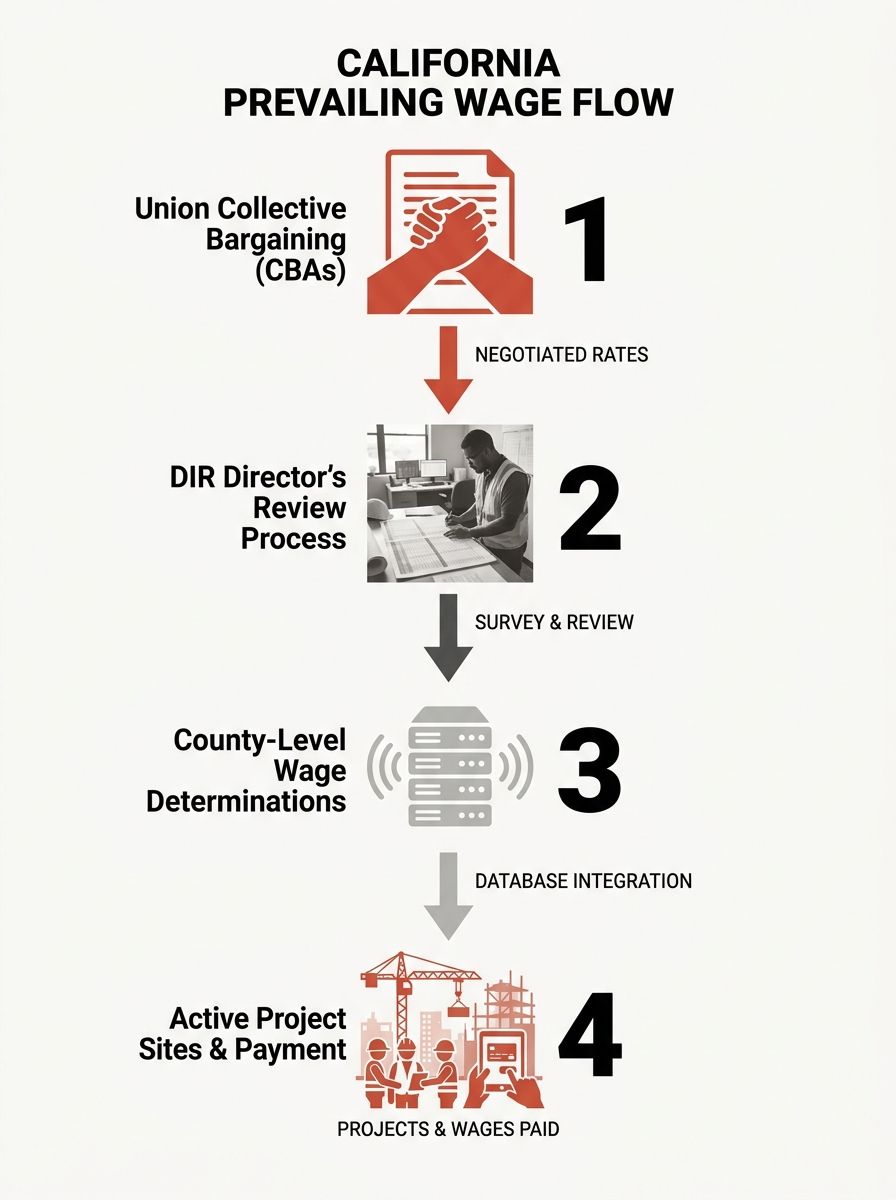
California's Director of Industrial Relations sets prevailing wage rates for every county and trade classification in the state, drawing primarily from collectively bargained union agreements.

California Prevailing Wage: Complete Legal Guide
California's Director of Industrial Relations sets prevailing wage rates for every county and trade classification in the state, drawing primarily from collectively bargained union agreements. These rates are the legal minimum for all public works projects exceeding $1,000 in total cost and include both hourly pay and fringe benefits such as health insurance, pension contributions, and training fund payments.
Understanding what is the prevailing wage in California requires grasping a system that is more decentralized and more union-connected than most workers realize. The prevailing wage is not a single number posted on a website. It is a matrix of thousands of rates, each specific to a geographic area, a trade classification, and a project type, all flowing from a process that directly incorporates the standards that organized labor has already won at the bargaining table. The California Department of Industrial Relations maintains a searchable database of prevailing wage determinations organized by county and occupation, and the rates shift as new collective bargaining agreements are ratified across the state. This architecture means that strong union contracts in a county pull prevailing wage floors upward for every worker on public projects in that area, whether they carry a union card or not.
That structural link between collective bargaining and prevailing wage is the reason California's system is often called the state's "Little Davis-Bacon" law, referencing the federal Davis-Bacon Act that governs wages on federally funded projects. But California's version, codified in Labor Code sections 1720 through 1861, reaches further. It covers state and local public works including school construction, highway projects, water infrastructure, publicly subsidized housing, and projects receiving indirect public support such as fee waivers or land conveyances. The scope is broad by design, and understanding it matters for every construction worker whose paycheck depends on whether their employer classifies a project correctly.
The Rate-Setting Mechanism and Its Union Roots
The Director of the Department of Industrial Relations determines prevailing wage rates by examining the wages and benefits being paid to workers in the same trade or occupation in the locality where a public works project will be performed, as described in DIR's prevailing wage guidance. In practice, the rates are usually based on rates specified in collective bargaining agreements, because unionized construction in California sets the benchmark that the DIR surveys and adopts. An electrician in Los Angeles County and an electrician in Humboldt County will have different prevailing wage rates, reflecting different local market conditions and different collectively bargained standards. The system is deliberately regional, not statewide, to prevent a race to the bottom where contractors from low-wage areas undercut local labor standards.
This design carries a direct consequence that workers and organizers should understand. When a building trades local negotiates a strong collective bargaining agreement, that contract doesn't only raise wages for union members on private jobs. It raises the prevailing wage floor for every worker on every public project in that jurisdiction. The reverse is also true: when union density declines in a county and fewer collectively bargained rates exist for the DIR to survey, the prevailing wage drifts downward, weakening protections for all construction workers in the area. The connection between organizing strength and prevailing wage levels is arithmetic, not abstract, and it's one of the strongest arguments for union density in the building trades that exists in American labor law.
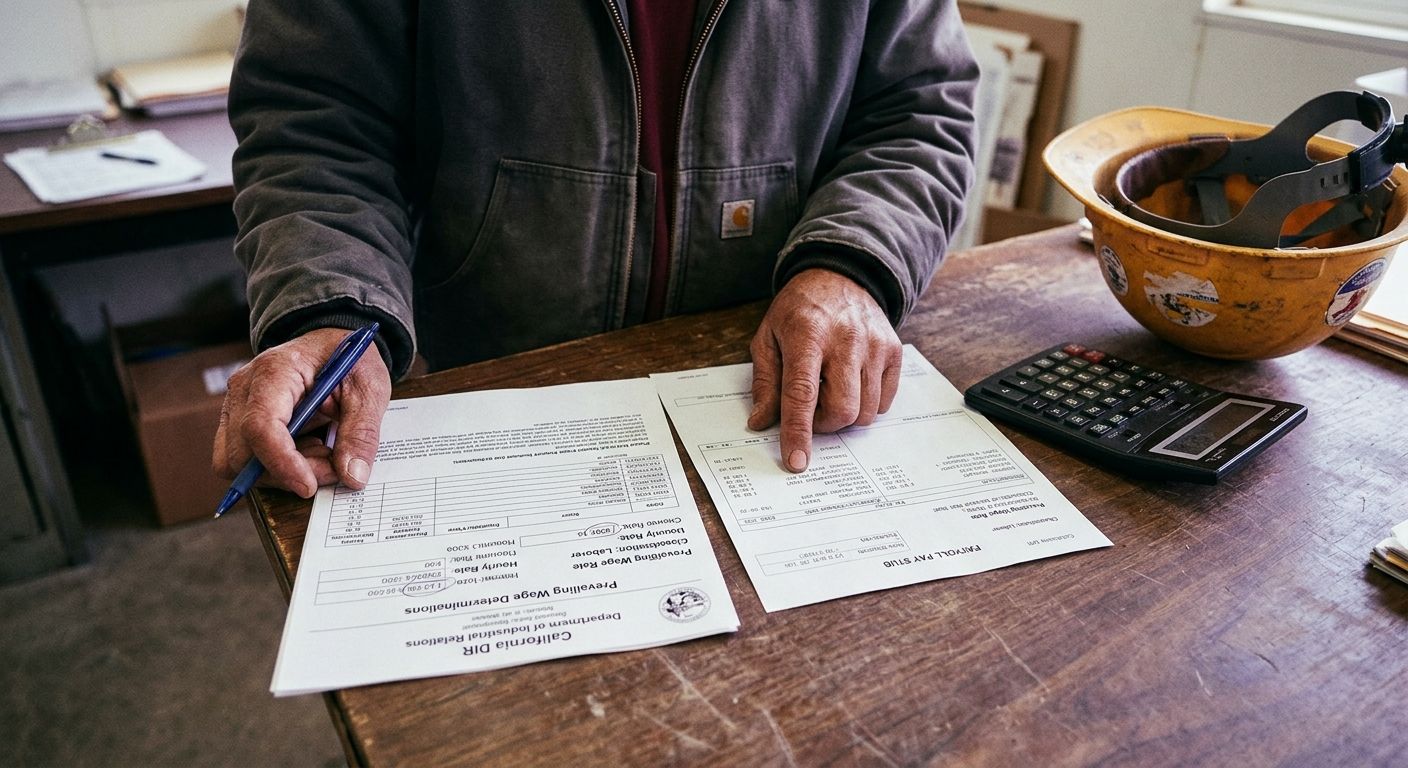
The rate itself encompasses far more than base hourly pay. What is prevailing wage California covers employer payments for health and welfare benefits, pension contributions, vacation, travel and subsistence pay, and apprenticeship or training fund contributions. A worker who receives the correct base hourly rate but whose employer skimps on fringe benefit contributions is being underpaid under the law, even if the number on their paycheck looks right. This distinction between base pay and total compensation is where a large share of prevailing wage violations occur, and it's the specific problem that AB 889 was designed to address.
Where the Law Applies and Where Contractors Exploit the Gaps
The triggering threshold for California's prevailing wage requirement is low: $1,000 in total project cost. Any public works project above that amount obligates the contractor to pay prevailing rates. There are narrow exemptions, though they are more nuanced than many contractors acknowledge. If an awarding body has an approved labor compliance program, prevailing wages are not required for construction projects of $25,000 or less, or for alteration, demolition, and repair projects of $15,000 or less. These thresholds are intentionally modest, reflecting the legislative intent to cover the vast majority of publicly funded construction work in the state.
But the definition of "public works" is where enforcement gets complicated and where noncompliant contractors try to escape coverage. California law defines public works to include construction, alteration, demolition, installation, or repair work done under contract and paid for in whole or in part out of public funds. The "in part" language is critical. Projects that receive public subsidies, tax credits, fee waivers, or publicly conveyed land can trigger prevailing wage obligations even when the primary funding source is private. We've seen this become an increasingly contentious area as public-private partnerships multiply in affordable housing and infrastructure development. A contractor who believes they're building a "private" project can discover that a local government's contribution of land or waiver of development fees has converted the entire job into prevailing wage work.
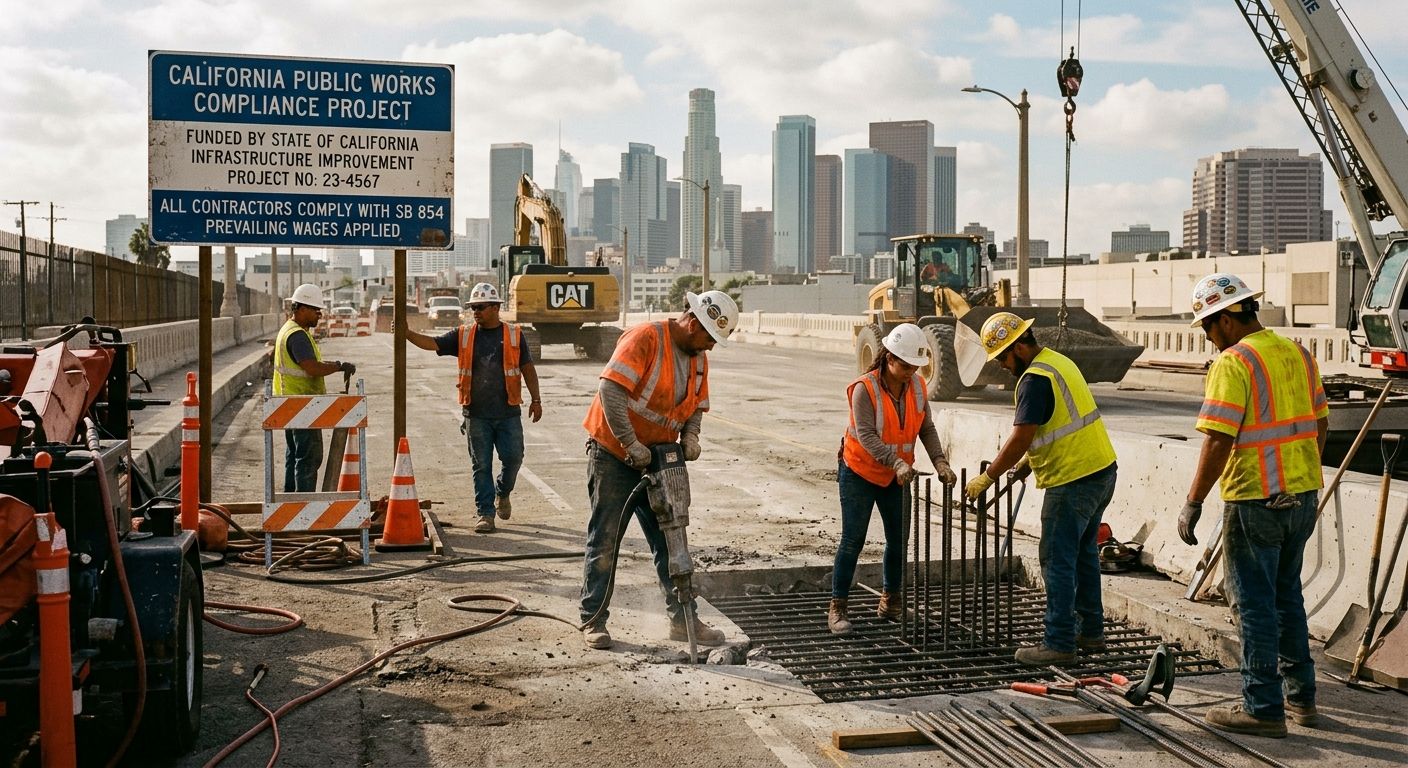
Misclassification of workers and projects represents the most common form of prevailing wage theft in California. Employers reclassify skilled tradespeople into lower-paid classifications, label public works projects as private, or structure contracts to fall below exemption thresholds by splitting larger jobs into smaller ones. For workers trying to understand how prevailing wage enforcement actually functions, the gap between the law's stated reach and its on-the-ground application is where wages get stolen. The law's architecture is sound. Its enforcement has always been the pressure point, and AB 889 represents the legislature's most direct attempt to close that gap.
AB 889, Penalties, and the New Enforcement Landscape
AB 889, effective January 1, 2026, revised Labor Code section 1773.1 to mandate the annualization of all fringe benefits credited toward the prevailing wage, calculated over a consistent 12-month period that accounts for both public and private hours worked for the same employer. Before this change, some contractors engaged in a practice called "frontloading," where they concentrated benefit contributions onto public project hours to meet prevailing wage requirements while paying minimal benefits during private work. The new law eliminates that practice and retroactively revoked prior exemptions that had allowed the DIR Director to waive annualization requirements in certain circumstances.
The compliance burden has increased substantially. Employers must now maintain inspection-ready records of total annual hours, benefit contribution schedules, and employee-specific annualization calculations, all of which must be produced to the Division of Labor Standards Enforcement upon request. Failure to comply with these documentation standards or to properly annualize benefits results in denial of fringe benefit credits, civil wage and penalty assessments, and potential debarment from public works contracts. For workers, this means the paper trail that proves prevailing wage violations has become far more detailed and far harder for employers to obscure.
Penalties for prevailing wage violations in California already carried serious weight before AB 889. Contractors who fail to pay the prevailing rate face back-pay obligations plus interest, and the law imposes penalties of $200 per day, per worker paid less than the required rate. To put that in concrete terms: a project with 15 underpaid workers over a 60-day period generates $180,000 in penalties alone, before back wages and interest enter the calculation. Repeat offenders face debarment from all public works contracts, a sanction that can permanently end a contractor's ability to operate in the public construction sector. The broader framework of prevailing wage law at the federal level mirrors some of these enforcement tools, but California's penalties are among the steepest in the country.
Workers who suspect prevailing wage violations have several channels for reporting. The DLSE investigates complaints and conducts audits, and workers are protected from retaliation for filing complaints under California Labor Code section 1102.5. The DIR's searchable database allows workers to look up the exact prevailing wage for their trade and county, creating a transparent benchmark against which they can measure their own pay. But transparency only works when workers know the system exists, and too many construction workers in California have never been told what prevailing wage they're owed or that they have a legal right to demand it.
The enforcement ecosystem connects to the longer arc of American labor's fight for fair compensation on public projects, where the pattern has been remarkably consistent: strong laws on paper, inadequate enforcement on the ground, and workers left to fill the gap through collective action and complaint-filing. California's prevailing wage framework is better resourced than what exists in most states, but the enforcement apparatus still depends heavily on workers knowing their rights and being willing to exercise them, often at personal risk.
The Tension This Framework Still Carries
California's prevailing wage system is genuinely unusual in American labor law because it creates a direct, measurable transmission mechanism from union bargaining power to legal wage standards for all workers in a trade and geography. When building trades unions negotiate strong contracts, every construction worker in that county benefits through higher prevailing wage determinations, regardless of their own union membership status. This is an elegant piece of legal architecture, and it deserves recognition as one of the more durable victories that organized labor has secured in state-level policy.
But the system carries a tension that AB 889's reforms did not resolve and that no single legislative fix is likely to address on its own. The prevailing wage protects workers on projects that are correctly identified and classified as public works. An entire shadow economy of misclassified projects, workers labeled as independent contractors, and contracts structured to avoid prevailing wage triggers operates alongside the compliant sector. The DIR's enforcement capacity, while real, cannot reach every jobsite in a state with the fifth-largest economy on earth. And the workers most vulnerable to prevailing wage theft — immigrants, non-English speakers, workers without union representation — are the least likely to file complaints or navigate the enforcement bureaucracy successfully.
The law is strong where it reaches. The persistent question, and the one that organized labor in California's construction trades continues to grapple with, is how to extend that reach into the corners where violations flourish unchallenged. Stronger penalties help. Better documentation requirements help. AB 889's annualization mandate closes a genuine loophole that cost workers real money. But the consistent lesson from decades of prevailing wage enforcement is that the law works best where unions are present to monitor compliance, file complaints, and ensure that every worker on a public project knows the rate they're owed. What is prevailing wage in California is a legal question with a clear answer. Whether every worker actually receives it remains an organizing question, and the answer depends on the density and commitment of the workforce itself.
The Union Edge Staff
Related Articles
Prevailing Wage for California: Complete Guide
Prevailing wage for California is the legally mandated minimum hourly compensation, base pay plus fringe benefits, that every worker on a qualifying public works project must receive, as determined by the Director of the Department of Industrial Relations (DIR).

What Is Prevailing Wage? Legal Definition & Requirements
A prevailing wage is the minimum hourly rate, including fringe benefits, that contractors and subcontractors must pay workers on government-funded projects, as determined by the U.S. Department of Labor or a state equivalent.

How Prevailing Wage Laws Actually Work — and Why Enforcement Determines Whether They Mean Anything
The Davis-Bacon Act requires contractors on federal construction projects to pay locally determined wage rates. It has done so since 1931.
Also in the paper