
Prevailing Wage for California: Complete Guide
Prevailing wage for California is the legally mandated minimum hourly compensation, base pay plus fringe benefits, that every worker on a qualifying public works project must receive, as determined by the Director of the Department of Industrial Relations (DIR).
Prevailing Wage for California: Complete Guide to How the System Actually Works
Prevailing wage for California is the legally mandated minimum hourly compensation, base pay plus fringe benefits, that every worker on a qualifying public works project must receive, as determined by the Director of the Department of Industrial Relations (DIR). The rate isn't pulled from industry surveys or employer self-reports. It's derived from collective bargaining agreements negotiated by unions, which means organized labor sets the wage floor for publicly funded construction across the state.
What California Law Defines as Prevailing Wage
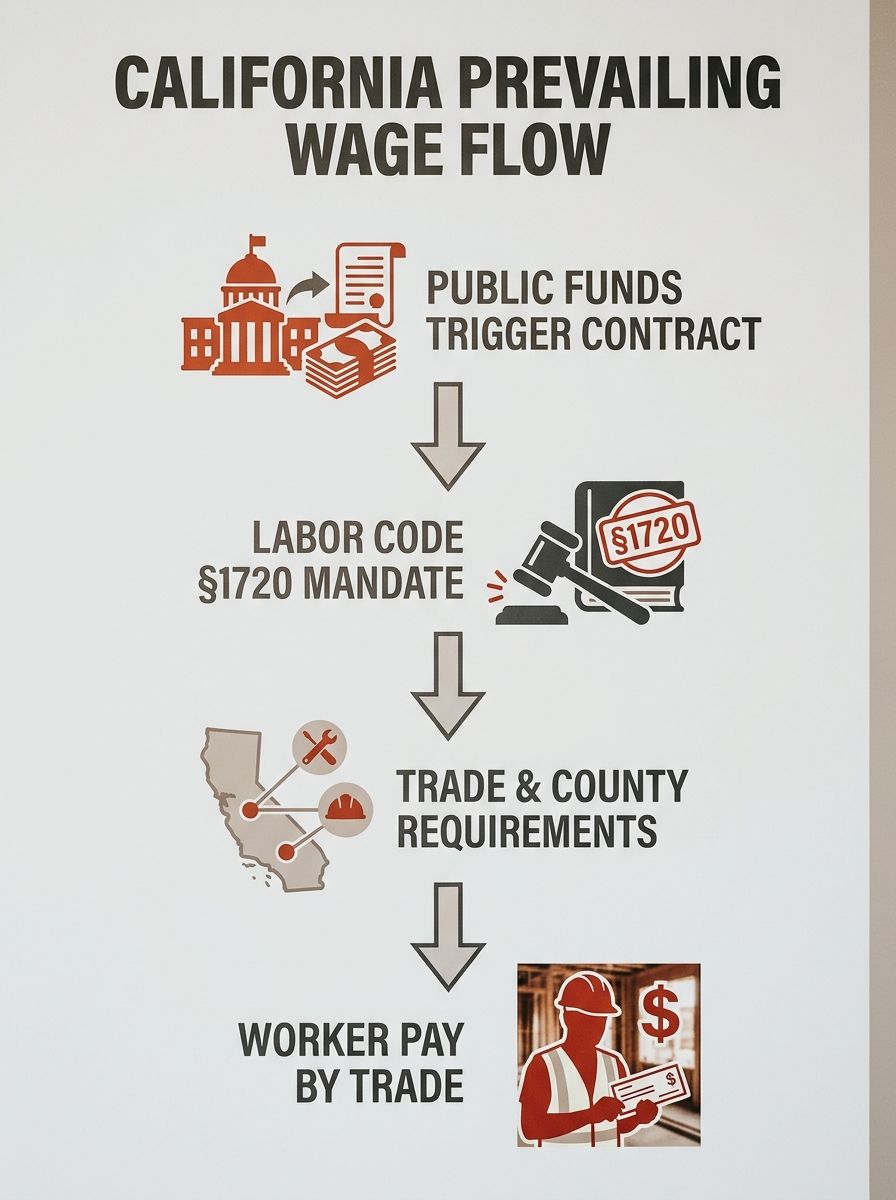
California Labor Code §1771 requires that workers on public works projects receive "not less than the general prevailing rate of per diem wages for work of a similar character in the locality." The definition of "public works" under §1720 is broad: construction, alteration, demolition, installation, or repair work performed under contract and paid in whole or in part out of public funds, as the Husch Blackwell state summary details. This includes preconstruction and post-construction activities related to a public works project.
For workers building, retrofitting, or renovating publicly funded hospitals, clinics, veterans' care facilities, and public health labs, prevailing wage in California guarantees that the rate they earn reflects what their trade commands in that county, not what a low-bid contractor wants to pay. The threshold is low: any public works contract exceeding $1,000 triggers the requirement. Higher thresholds of $25,000 for new construction or $15,000 for maintenance work apply only when the awarding body operates an approved Labor Compliance Program.
The law has been on the books since 1931, making it one of the oldest prevailing wage statutes in the country. It predates the federal Davis-Bacon Act's widespread enforcement apparatus and covers a wider range of projects than federal law does.
How DIR Sets the Rates Using Collective Bargaining Data
The Director of DIR determines prevailing wage rates by examining collective bargaining agreements and rates predetermined for federal public works within each locality and nearest labor market area, under California Labor Code §1773. The process works in three steps.
First, DIR's Office of Policy, Research and Legislation collects active collective bargaining agreements from building trades unions across all 58 counties. Second, staff analysts match each agreement to specific craft classifications. Third, the Director publishes general prevailing wage determinations that list hourly base rates and fringe benefit requirements for each trade, by county. These determinations are revised twice per year, according to the Los Angeles Bureau of Contract Administration, and posted on the DIR's online determination system.
The consequence of this structure is significant: because union-negotiated rates form the basis of prevailing wage, every dollar unions win at the bargaining table lifts the wage floor for all workers on public projects, union and non-union alike. A carpenter working for a non-union contractor on a county hospital seismic retrofit receives the same rate that the local carpenters' union negotiated. The mechanism converts collective bargaining power into a regional standard.
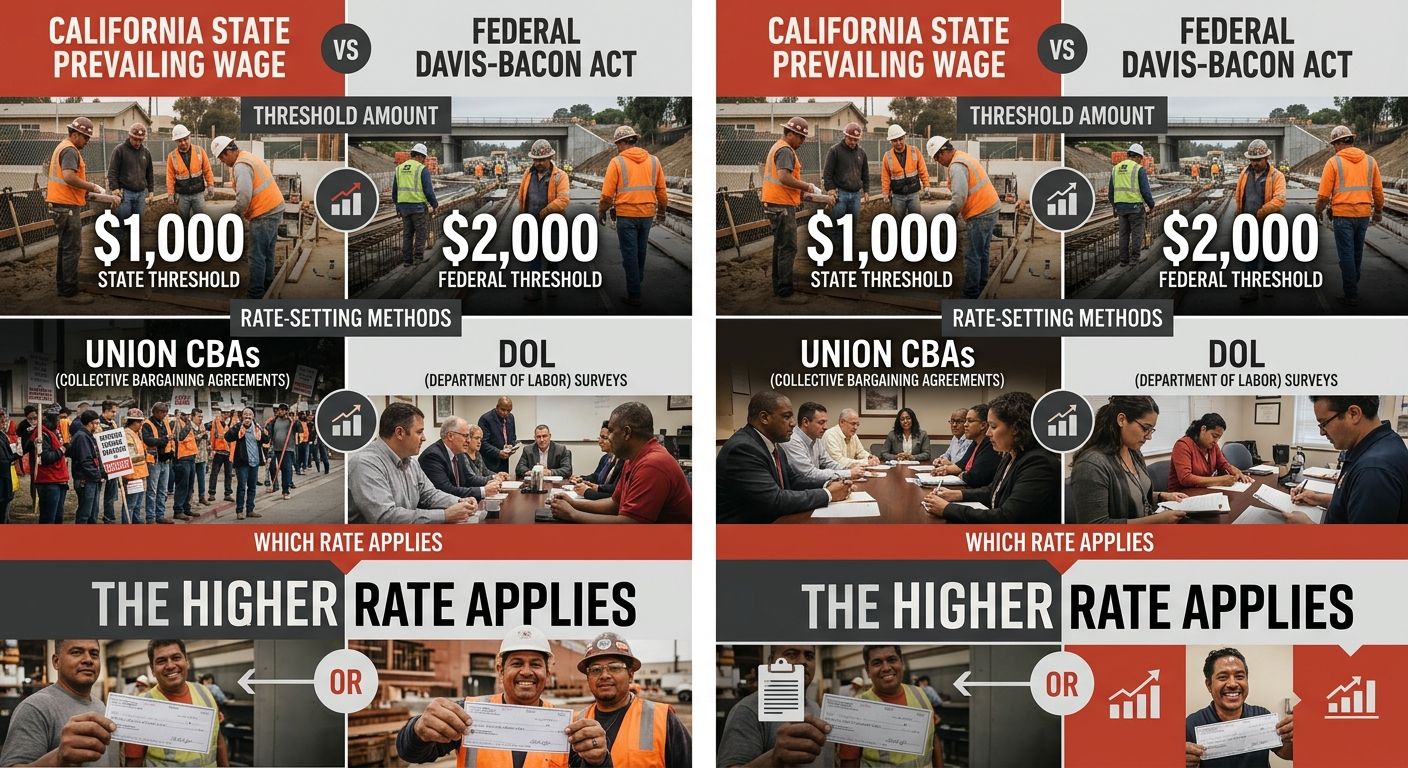
The federal layer adds another dimension. The U.S. Department of Labor maintains 28 active Davis-Bacon wage determinations covering 58 California counties, with the latest revision dated September 17, 2026. On projects receiving federal funding, such as Caltrans highway work or federally funded healthcare facilities, both state prevailing wage and federal Davis-Bacon requirements apply. The Davis-Bacon Act covers federal contracts exceeding $2,000. When both laws apply, workers receive whichever rate is higher for their classification.
Which Projects Trigger Prevailing Wage Requirements
The scope of covered projects is wider than many contractors realize. Any work meeting two conditions triggers prevailing wage in California: the work must qualify as "public works" under §1720, and it must be paid in whole or in part with public funds. That second condition is where disputes frequently arise.
Public funds include direct appropriations from state, county, or city budgets, but also bond proceeds, tax increment financing, and certain grant funds. A hospital expansion financed partly through a municipal bond issue, a community health center built with state grant money, or a veterans' care facility renovation using federal pass-through funding all qualify. Preconstruction surveys, post-construction cleanup, and off-site fabrication of materials specifically required for the project can also trigger coverage.
The types of work covered fall into broad categories:
Construction: new buildings, structures, infrastructure
Alteration: modifications to existing structures
Demolition: tearing down structures
Installation: placing equipment, systems, or fixtures
Repair: maintenance and restoration work
California's definition explicitly extends to hauling and delivery of materials to or from a public works site when performed by workers employed by a contractor or subcontractor on the project. Even landscape maintenance on publicly owned property can trigger prevailing wage if performed under contract.
For anyone working in healthcare construction specifically, the practical impact is enormous. California's ongoing hospital seismic compliance mandate, which requires facilities to meet updated structural standards, has generated billions of dollars in publicly funded or publicly bonded renovation work. Every electrician, plumber, ironworker, and laborer on those projects is entitled to prevailing wage rates.
The Fringe Benefit Calculation After AB 889
AB 889, which took effect January 1, 2026, rewrote how California handles fringe benefits under prevailing wage. The law mandates the annualization of fringe benefits and prohibits the frontloading of benefit costs onto public project hours alone.
Before AB 889, some contractors would calculate fringe benefit credits by dividing total annual benefit costs by only the hours worked on public projects, inflating the per-hour credit and reducing the cash wage owed. That practice is now illegal. Under the new rule, employers must divide total annual fringe benefit contributions by total annual hours worked across all projects, public and private. The result is an accurate per-hour fringe benefit credit.
This change requires contractors to maintain inspection-ready records documenting each worker's total annual hours across every project type. The recordkeeping burden falls squarely on the employer. DIR aligned this standard with federal Davis-Bacon enforcement practices, creating more consistency between state and federal compliance requirements.
The fringe benefit component of prevailing wage typically includes health insurance contributions, pension fund payments, vacation pay, training fund contributions, and other benefits specified in the applicable collective bargaining agreement. On many California trades, fringe benefits add $15 to $40 or more per hour on top of the base hourly rate. For healthcare construction workers, these fringe benefits often include the very health insurance coverage that connects their labor to the healthcare system they're physically building.
Enforcement, Penalties, and Worker Remedies
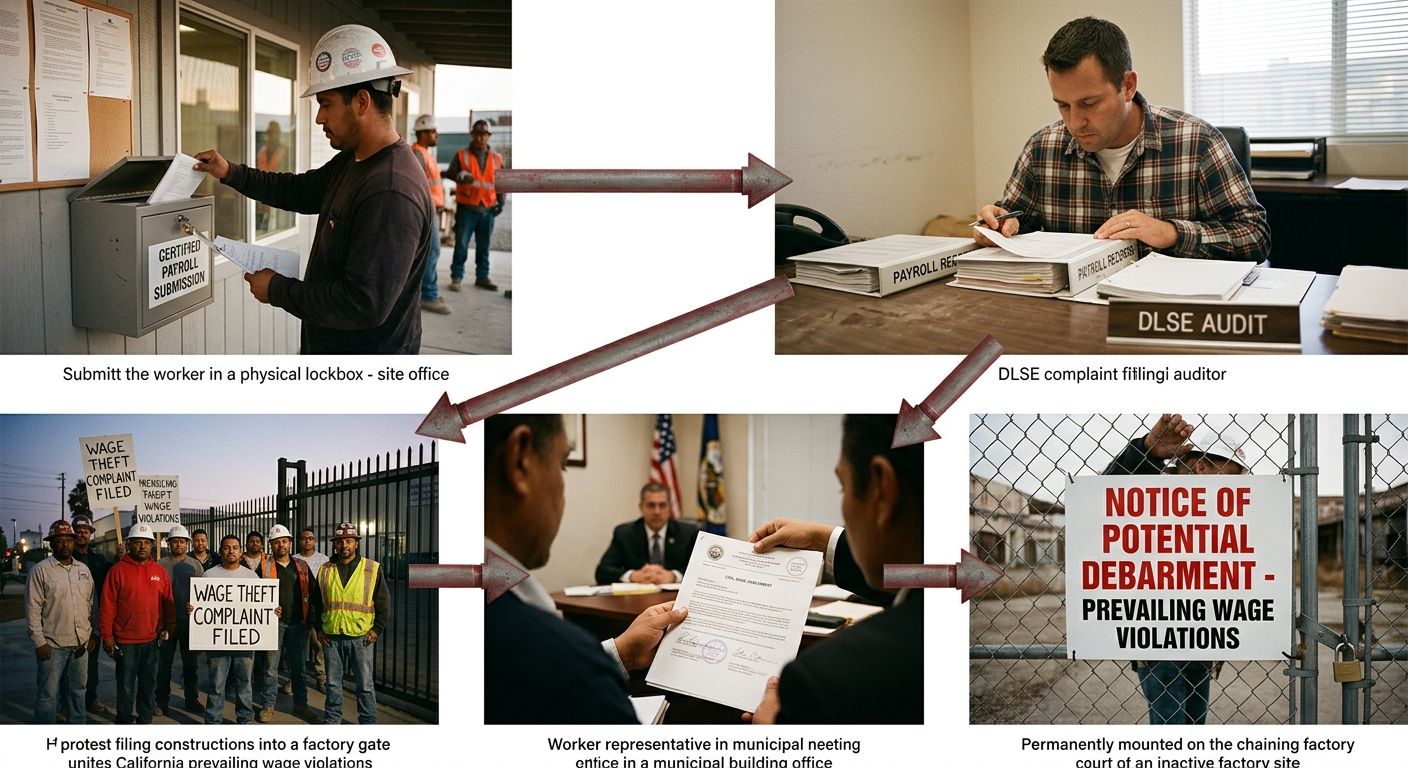
DIR's Division of Labor Standards Enforcement (DLSE) and awarding bodies share responsibility for monitoring prevailing wage compliance. Contractors on public works must submit weekly certified payroll records through DIR's electronic Certified Payroll Reporting (eCPR) system. Every subcontractor must be registered with DIR's public works contractor registration program before performing any work on a covered project.
When violations are found, consequences escalate quickly. The penalties include:
Civil wage and penalty assessments: DIR can issue these within 18 months of project completion, covering the full amount of unpaid wages plus penalties
Contract fund withholding: Awarding bodies can withhold payments from the prime contractor to satisfy wage claims
Debarment: Contractors found in violation can be barred from bidding on or working on any public works project in California for a period determined by DIR
Criminal penalties: Willful violations can trigger criminal prosecution under Labor Code §1777.1
Workers who believe they've been underpaid can file complaints directly with DLSE. They can also contact the Labor Compliance Section at (213) 847-2662 if they're working on City of Los Angeles projects. Understanding California's minimum wage structure provides useful context, but prevailing wage rates for skilled trades typically run $40 to $100+ per hour depending on classification and county, far above the state minimum.
For workers in Los Angeles specifically, the combination of city wage ordinances and prevailing wage requirements on public projects creates one of the strongest wage floors in the country for construction trades.
The Rate-Record-Report Compliance Framework
Contractors and workers benefit from understanding prevailing wage compliance as three interlocking obligations: Rate, Record, and Report.
Rate means identifying the correct prevailing wage determination for each worker on the project. This requires matching the worker's actual duties to the correct craft classification, then looking up the county-specific rate published by DIR. Misclassification is one of the most common violations. A worker performing journeyman electrician duties must be paid the electrician's prevailing rate, regardless of what the contractor calls the position.
Record means maintaining the detailed payroll and benefits records that AB 889 now demands. This includes each worker's name, address, Social Security number, craft classification, hourly rate, daily and weekly hours worked, deductions, and net wages paid. After AB 889, it also includes total annual hours across all project types for fringe benefit annualization calculations.
Report means submitting accurate weekly certified payroll through the eCPR system and ensuring every subcontractor on the project is DIR-registered. The prime contractor bears ultimate responsibility for subcontractor compliance.
Organizations like the Workers Rights Consortium have documented how rigorous monitoring systems translate directly into better wage outcomes for workers. The same principle applies here: the enforcement architecture works when the paperwork is accurate and when workers know their rights.
Where the Prevailing Wage Model Breaks Down
The mechanism has real limitations. Prevailing wage in California assumes that collective bargaining agreements exist for every trade in every locality. In counties with low union density or specialized trades without active CBAs, DIR must extrapolate from neighboring labor markets. Those extrapolations can produce rates that don't reflect actual local conditions.
Misclassification remains the system's biggest vulnerability. Contractors who label skilled workers as general laborers, or who split journeyman-level work across lower-paid classifications, can pay rates that technically match a published determination while shortchanging workers by thousands of dollars per month. AB 889's annualization requirement added another layer of complexity that honest contractors must navigate while bad actors look for workarounds.
The complaint-driven enforcement model also creates gaps. Workers on temporary visas, workers employed through layers of subcontracting, and workers without documentation often lack the practical ability to file complaints, even though prevailing wage protections apply to them regardless of immigration status. As our coverage of worker retaliation cases has shown, the threat of job loss silences many legitimate claims.
And the twice-annual rate revision cycle means published rates can lag behind actual CBA increases by months. A union that ratifies a new agreement in February may not see the corresponding prevailing wage increase until the next determination cycle.
Common Questions
Does prevailing wage apply to private projects in California?
No. Prevailing wage under Labor Code §§1720–1784 applies only to public works projects paid in whole or in part with public funds. Private construction projects, even large ones, are not covered unless they receive public subsidies, tax increment financing, or other public fund sources that trigger the definition.
How do I find the prevailing wage rate for my specific trade and county?
DIR publishes all current general prevailing wage determinations on its online lookup system. Search by county, craft classification, and project type. Rates include both the base hourly wage and the fringe benefit requirement. Free lookup tools at sites like WageFinder also organize the data by county for all 59 California counties.
What's the difference between California prevailing wage and federal Davis-Bacon rates?
California's prevailing wage law covers state-funded public works contracts over $1,000. The federal Davis-Bacon Act covers federally funded contracts over $2,000. California's rates derive primarily from local union CBAs, while Davis-Bacon rates come from U.S. Department of Labor surveys. When both apply to the same project, workers receive whichever rate is higher. As of September 2026, the DOL maintains 28 active Davis-Bacon determinations across 58 California counties.
Can a contractor be banned from public works for prevailing wage violations?
Yes. DIR can debar contractors found in violation of prevailing wage requirements, barring them from bidding on or performing work on any California public works project. Debarment periods vary based on the severity and pattern of violations. Civil wage and penalty assessments can also be issued within 18 months of project completion.
Do apprentices receive prevailing wage?
Apprentices registered in approved apprenticeship programs receive a percentage of the journeyman prevailing wage rate according to their apprenticeship level. Contractors must adhere to apprenticeship utilization ratios, generally one apprentice hour for every five journeyman hours. Unregistered apprentices or workers performing apprentice-level work without enrollment in an approved program must be paid full journeyman rates.
The Union Edge Staff
Frequently Asked Questions
- What is the minimum contract amount that triggers prevailing wage requirements in California?
- Any public works contract exceeding $1,000 triggers prevailing wage requirements in California. Higher thresholds of $25,000 for new construction or $15,000 for maintenance work apply only when the awarding body operates an approved Labor Compliance Program.
- How are California prevailing wage rates determined?
- The Director of the Department of Industrial Relations determines prevailing wage rates by examining collective bargaining agreements negotiated by building trades unions across all 58 counties. These rates are published twice per year and list hourly base rates and fringe benefit requirements for each trade by county.
- What types of construction work are covered by California prevailing wage?
- Prevailing wage covers construction, alteration, demolition, installation, and repair work on public works projects paid in whole or in part with public funds. It also includes preconstruction and post-construction activities related to public works projects, as well as hauling and delivery of materials to or from a covered project site.
- What changed with prevailing wage fringe benefits under AB 889?
- Effective January 1, 2026, AB 889 requires annualization of fringe benefits by dividing total annual benefit contributions by total annual hours worked across all projects. This prevents contractors from inflating per-hour fringe benefit credits by calculating benefits only against public project hours.
- What are the penalties for prevailing wage violations in California?
- Penalties include civil wage and penalty assessments for unpaid wages, contract fund withholding from the prime contractor, debarment from future public works projects, and criminal prosecution for willful violations. DIR can issue assessments within 18 months of project completion.
- Do apprentices have to be paid prevailing wage in California?
- Apprentices registered in approved apprenticeship programs receive a percentage of the journeyman prevailing wage rate according to their apprenticeship level. Unregistered apprentices or workers performing apprentice-level work without enrollment in an approved program must be paid full journeyman rates.
- How do California prevailing wage and federal Davis-Bacon rates compare?
- California's prevailing wage applies to state-funded contracts over $1,000 and is based on local union collective bargaining agreements, while the federal Davis-Bacon Act covers federally funded contracts over $2,000 and is based on DOL surveys. When both laws apply to the same project, workers receive whichever rate is higher.
- What must contractors submit to comply with prevailing wage requirements?
- Contractors must submit weekly certified payroll records through DIR's electronic Certified Payroll Reporting (eCPR) system. Every subcontractor must also be registered with DIR's public works contractor registration program before performing work on a covered project.
Related Articles

California Prevailing Wage: Complete Legal Guide
California's Director of Industrial Relations sets prevailing wage rates for every county and trade classification in the state, drawing primarily from collectively bargained union agreements.

What Is Prevailing Wage? Legal Definition & Requirements
A prevailing wage is the minimum hourly rate, including fringe benefits, that contractors and subcontractors must pay workers on government-funded projects, as determined by the U.S. Department of Labor or a state equivalent.

How Prevailing Wage Laws Actually Work — and Why Enforcement Determines Whether They Mean Anything
The Davis-Bacon Act requires contractors on federal construction projects to pay locally determined wage rates. It has done so since 1931.
Also in the paper