
How Starbucks Workers United Turned Social Media Into a Bargaining Pressure Tool — and What Other Unions Can Learn
Starbucks Workers United's social media campaign didn't succeed because it generated public sympathy.

How Starbucks Workers United Turned Social Media Into a Bargaining Pressure Tool
Starbucks Workers United's social media campaign didn't succeed because it generated public sympathy. It succeeded because baristas posting TikToks about illegal firings and walkouts made the cost of fighting the union higher than the cost of bargaining, producing a February 2024 framework agreement covering more than 12,000 workers across 500-plus stores.
The conventional wisdom in labor circles treats social media as a broadcasting channel: post updates about negotiations, share strike photos, ask supporters to sign petitions. SBWU broke that mold. It turned every barista's phone into a pressure point aimed directly at Starbucks' consumer brand. That distinction explains why a campaign by part-time coffee workers organized more than 600 individual store locations when decades of traditional retail organizing at comparable chains had stalled.
Brand Equity Was the Actual Target
Why did Starbucks agree to a framework agreement in February 2024 after spending years on aggressive anti-union tactics that generated more than 100 NLRB complaints? Because the social media campaign created a specific kind of pain that courtroom fights couldn't: it made Starbucks look hypocritical in front of its core customers.
Eric Blanc, a labor relations scholar who has studied the SBWU campaign extensively, observed that workers were able to "damage [Starbucks'] image enough to make them scared they'd lose a whole generation of Gen Z customers." The fear was rational. Starbucks' brand identity depends on projecting progressive values, ethical sourcing, and employee "partnership." When baristas posted videos showing themselves fired for organizing, or documented understaffing that left single workers covering entire shifts, those posts contradicted a brand story the company spent billions of dollars a year maintaining.
The holiday gift card boycott illustrates this dynamic with precision. SBWU urged customers to withhold gift card purchases until Starbucks signed a first contract. The campaign didn't need to slash gift card revenue by 50% to work. It needed to generate enough visible consumer resistance that executives calculated the reputational cost of continued union-busting exceeded the cost of sitting down at a bargaining table. According to research from Barnes & Thornburg, unions increasingly use social media "to mount public pressure on employers to pay higher wages and benefits," and the Starbucks campaign is the clearest case of that tactic producing a concrete bargaining result.
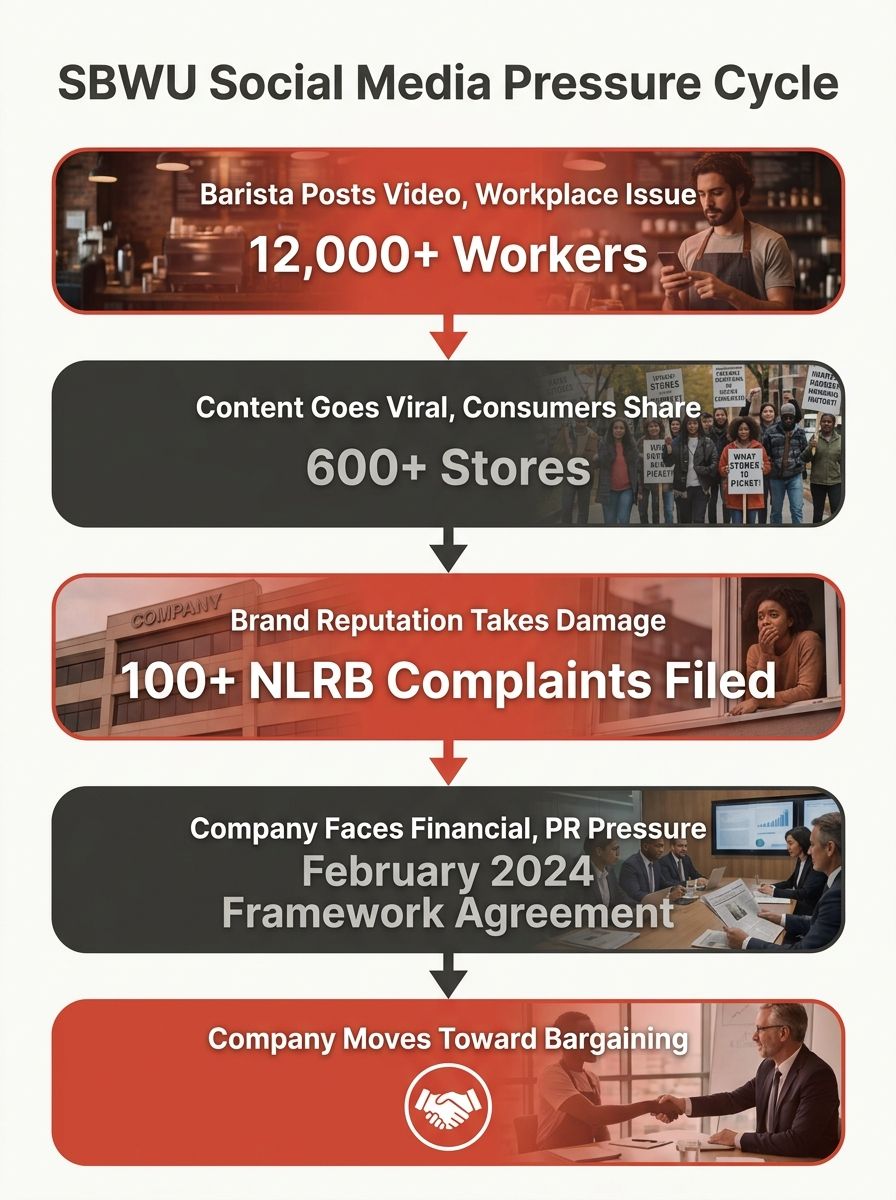
This worked at Starbucks because the company sells an identity to consumers who care about that identity. A union organizing warehouse workers for a logistics subcontractor that consumers have never heard of can't generate the same kind of public pressure through social media, regardless of how compelling the content is. The lesson for other unions building a digital organizing strategy: match the tactic to the employer's vulnerability. For consumer-facing brands, that vulnerability is reputation. The spending patterns we've tracked across U.S. employers show companies will pour extraordinary sums into fighting unions through legal channels, but social media campaigns that threaten brand equity can alter that math overnight.
Workers Controlled the Narrative Because They Were the Narrative
Traditional union communication flows through professional staff. Communications directors draft press releases. Media coordinators schedule interviews. Lawyers review statements before anything goes public. SBWU reversed this pipeline entirely. Worker-led communications became the campaign's signature, and the authenticity of rank-and-file voices proved more effective than polished institutional messaging.
Casey Moore, SBWU's former communications lead, explained that "social media is a way to engage directly with the broader public in a way that most unions haven't been doing very well." The operative word is "directly." When a barista in Memphis posted a video about being terminated the day after a union election, that content reached tens of thousands of viewers without passing through any institutional filter. No press release. No waiting 72 hours for a reporter to pick up the story.
This directness solved a problem that has dogged union campaigns for decades. As the Emergency Workplace Organizing Committee has documented, employers routinely characterize unions as outside agitators interfering with the employer-employee relationship. When workers themselves are creating and posting content, that framing collapses. A 22-year-old barista talking about her own working conditions on her own Instagram account can't credibly be dismissed as an outside organizer.
The data supports this approach. Research on how unions use digital communications found that "workers are able to begin organizing on their own," and that this self-directed organizing "seriously undermines" the employer's outsider argument. SBWU organizer Billie Adeosun captured the cultural shift bluntly: "I love that we've made unionizing sexy." The SBWU campaign attracted younger workers, many in their early 20s, precisely because it spoke in their native format: short-form video, personal storytelling, direct address to camera. ProjectHR research on digital organizing campaigns found that these shorter video formats, focused on workplace issues like hours, benefits, and training, consistently outperform traditional text-heavy union communications in engagement metrics.
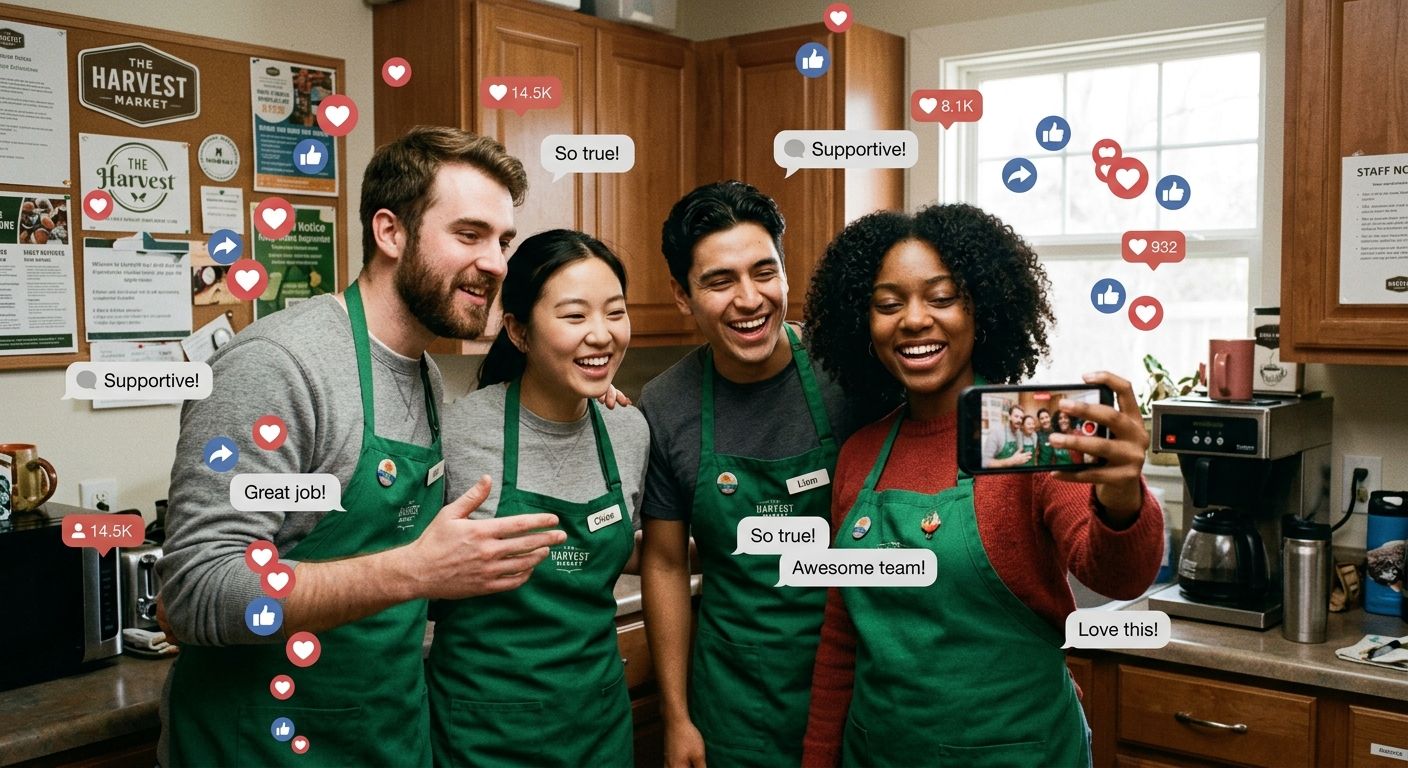
Unions that still rely primarily on institutional communications should study this carefully. The captive audience meeting playbook works because employers control the room and the message. A social media union campaign flips that dynamic by giving workers an unfiltered channel to the public. But the channel only works when workers, not paid staffers, are the ones speaking. Polished union graphics with stock photography don't go viral. A barista tearfully explaining she was written up for wearing a union pin does.
Digital Tools Scaled the Campaign Without Scaling the Payroll
Organizing more than 600 Starbucks locations across the country would have been financially impossible using the traditional model of deploying 1 or 2 paid organizers to each worksite. At a typical cost of $60,000 to $80,000 per organizer annually, covering 600 stores would require a budget of $36 million to $48 million per year in staff alone. SBWU used Zoom, social media, and a centralized website to train and coordinate rank-and-file organizers remotely, cutting that cost by orders of magnitude.
The centralized website served as what Jacobin described as "a central point of contact to which inspired workers around the country can reach out." This architecture mattered enormously. When a barista in Phoenix saw a TikTok from a barista in Chicago celebrating their union election win, they could visit the SBWU website, express interest, and connect to organizing resources within hours. The pipeline from inspiration to action was short, digital, and almost entirely free.
This mirrors what Gateway Journalism Review found about unions using social media to boost labor actions: social media has "peeled back the curtain a bit" when it comes to labor negotiations, enabling a transparency that traditional media coverage never provided. But SBWU went further than transparency. It built a self-replicating organizing infrastructure where each successful store election generated the content that inspired the next wave of organizing. Since the February 2024 framework agreement, 200-plus additional stores have voted to unionize, feeding the same digital flywheel.
The contrast with older digital organizing efforts is instructive. Research from Workology found that earlier union social media efforts relied on static tools: Facebook Fan Pages, Google Groups that restricted member posting. The Jimmy John Workers' Union ran a Google Group with 361 members where none could post comments or discuss. These tools broadcast information in one direction. They didn't build organizing capacity or create public pressure bargaining opportunities.
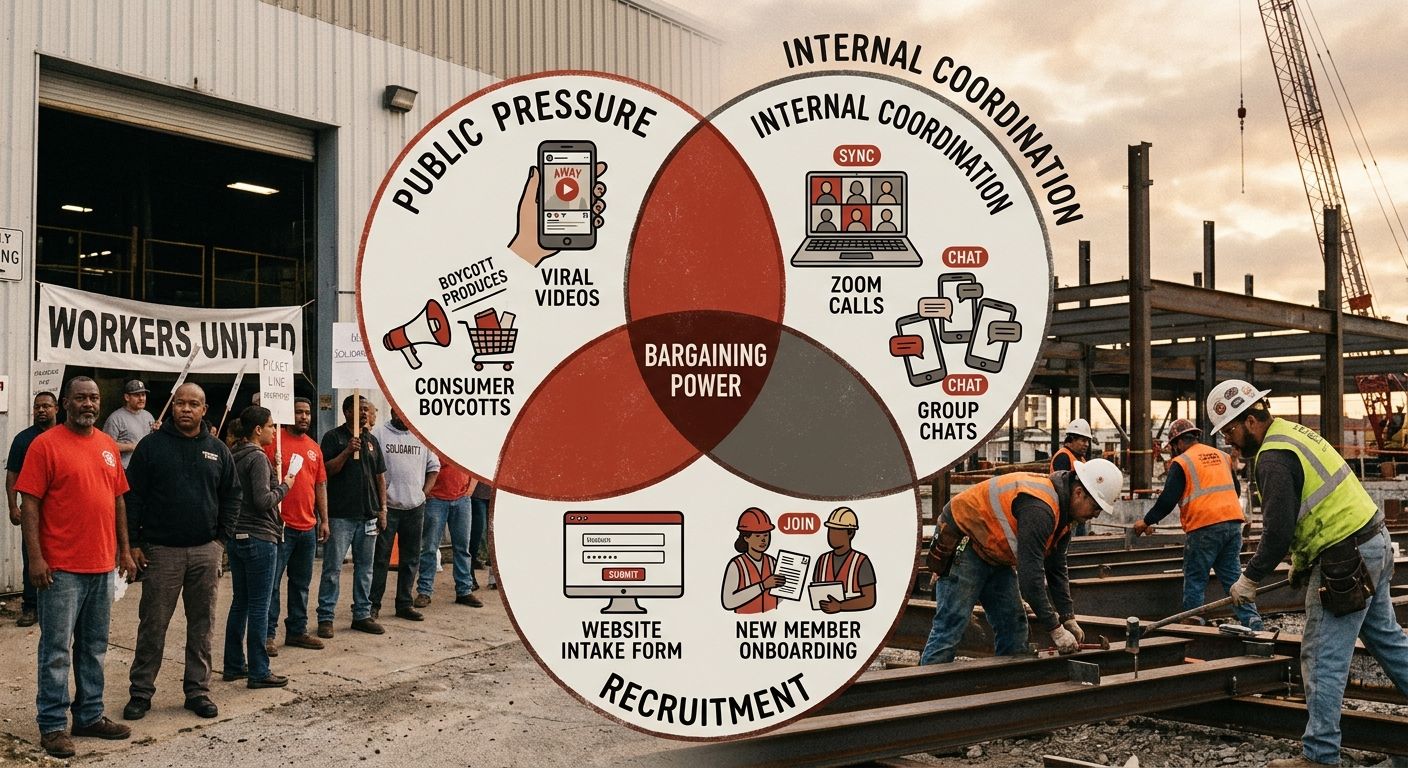
SBWU's model used social media for three distinct functions simultaneously: public pressure (viral content targeting consumers), internal coordination (Zoom trainings, group chats for 12,000-plus members), and recruitment (the centralized website converting viewers into organizers). That triple function is what other unions should replicate. With 71% of Americans expressing approval of unions according to Gallup, the public appetite for pro-union content exists at a generational high. The gap is in execution, in building digital infrastructure that converts passive sympathy into organized workplaces and real contract wins.
Unions that want to build similar systems need to think about digital security from day one. Employers monitor social media during organizing campaigns, and workers who post publicly become targets for retaliation. SBWU's experience included documented cases of baristas being terminated after their social media activity identified them as organizers. The visibility that powered the campaign also exposed individual workers to risk, a tension every union adopting this model will face.
Where This Leaves Every Other Union's Social Media Account
The contrarian claim holds up under scrutiny. SBWU's social media success was a function of economic pressure applied through consumer-facing content that made union-busting more expensive than bargaining. Awareness and sympathy were byproducts of a strategy aimed at the corporate balance sheet.
But the model has real limits that unions should acknowledge honestly before trying to copy it. It works best against consumer-facing companies with brand identities anchored in progressive values. Starbucks, Trader Joe's, REI: these are employers where the gap between brand image and worker treatment creates viral content almost automatically. A union organizing security guards for a subcontractor that consumers will never interact with can't generate the same kind of public pressure through TikTok, no matter how skilled the content creators.
The transferable elements are structural. Train rank-and-file workers to create their own content rather than routing everything through communications staff. Build a centralized digital intake system so that workers inspired by a social media post can connect to organizing resources the same day. Pair every piece of viral content with a specific demand or action, whether that's a first contract demand, a boycott target, or a public petition with a clear ask. And recognize that social media divorced from shop-floor organizing is noise. Every successful SBWU viral moment was backed by a real workplace action: a walkout, an election filing, an unfair labor practice charge.
The 12,000-plus workers who belong to Starbucks Workers United today didn't get there through clever content strategy alone. They got there because worker-led communications, digital infrastructure, and old-fashioned workplace organizing reinforced each other in a cycle that Starbucks couldn't break with Littler Mendelson attorneys or mandatory meetings. The social media piece was the visible surface of a deeper organizing architecture. Unions that treat it as a standalone tactic, as a way to look current rather than a way to build power, will keep posting into the void.
The Union Edge Staff
Related Articles

From Salting to Sustained Campaigns: How Unions Plant Organizers and Build Lasting Workplace Power
Salting, the practice of trained union organizers taking jobs at non-union workplaces to build support from the inside, drove the first successful Starbucks organizing campaign in decades.

From First Contact to First Contract: The Hidden Gaps in Union Organizing Timelines and How to Navigate Them
Winning a union election takes weeks. Reaching a first contract takes 465 days on average, according to Bloomberg Law's analysis of federal labor databases.

The Organizing Committee Trap: Why Worker Committees Fail and How to Build Leadership Density That Actually Wins
Organizing committees at VW Chattanooga failed twice before the plant's 2024 election finally succeeded. The difference was structural: the winning campaign built trained leadership at a ratio of one worker-leader for every twenty-five employees, covering 90 percent of the plant by election day.
Also in the paper