
Teamsters-Backed First Contract Bill Passes House With Bipartisan Support, Heads to Senate
The U.S. House of Representatives passed the Faster Labor Contracts Act on June 9, 2026, with bipartisan support, advancing Teamsters-led legislation that would require employers to begin bargaining with newly organized workers within 10 days of a union vote, according to the International Brotherho

Teamsters-Backed First Contract Bill Passes House With Bipartisan Support, Heads to Senate
The U.S. House of Representatives passed the Faster Labor Contracts Act on June 9, 2026, with bipartisan support, advancing Teamsters-led legislation that would require employers to begin bargaining with newly organized workers within 10 days of a union vote, according to the International Brotherhood of Teamsters.
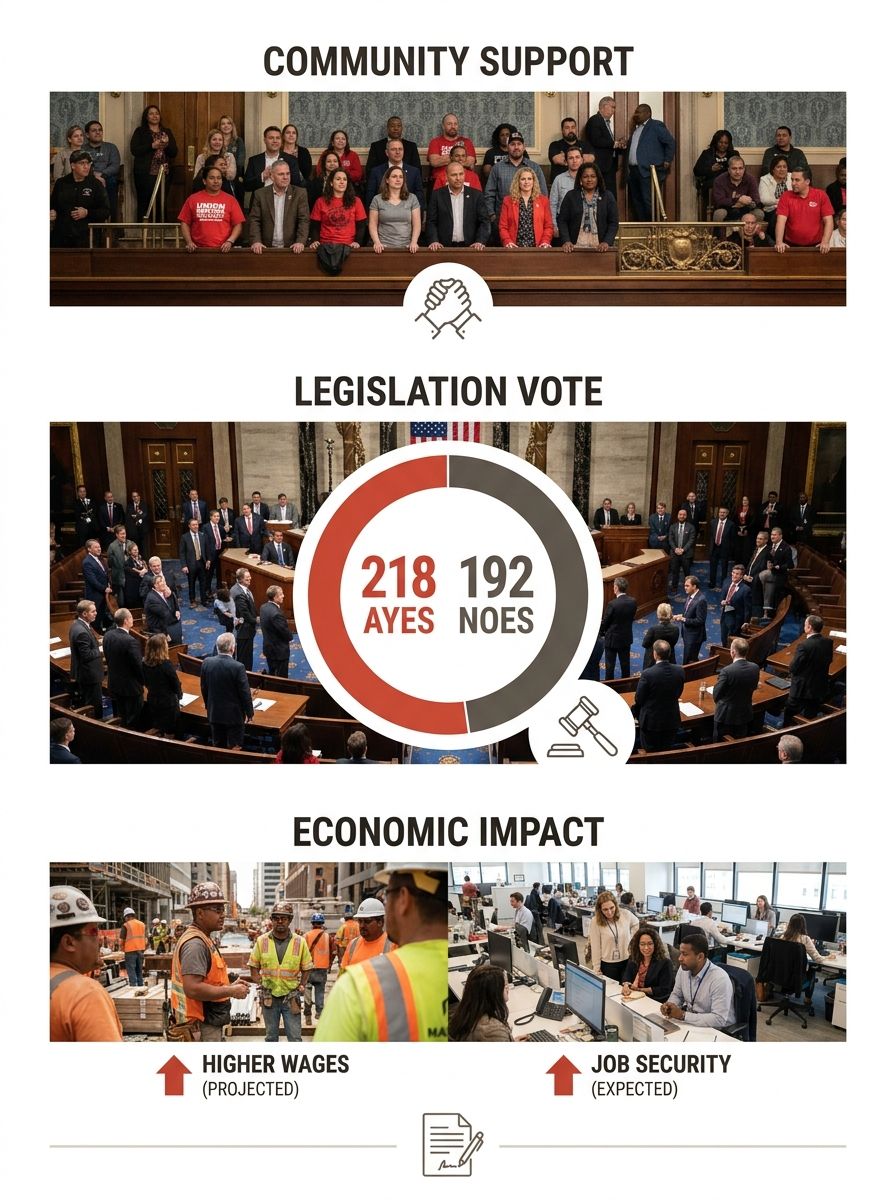
The bill reached the House floor through a discharge petition filed by Congressman Donald Norcross (D-NJ) that collected 218 signatures three weeks before passage, forcing a vote on legislation House leadership had not scheduled. The Senate version, introduced by Senator Josh Hawley (R-MO) and Senator Cory Booker (D-NJ), continues to gain support in the upper chamber.
What the Legislation Changes
The Faster Labor Contracts Act would amend the National Labor Relations Act to establish binding timelines for first-contract negotiations. Employers would face a 10-day deadline to begin bargaining after workers vote to form a union. If the parties reach no agreement within 90 days, the legislation provides a path to mediation. When mediation fails to produce a contract, the bill creates a referral process to arbitration to resolve outstanding issues.
"The 1.3-million member Teamsters Union has worked tirelessly to build a coalition of Democrats, Republicans, and Independents," said Teamsters General President Sean M. O'Brien in the union's statement. The legislation targets what labor organizers describe as a widespread employer tactic: delaying first-contract negotiations until worker momentum dissipates after successful organizing campaigns.
Current National Labor Relations Act provisions require employers to bargain "in good faith" with newly certified unions but establish no deadline for reaching agreement. Workers wait 458 days on average for employers to negotiate first union contracts, according to the Teamsters statement.
Discharge Petition Forces Floor Vote
The discharge petition mechanism bypasses committee leadership and House leadership to force floor votes on bills that have not advanced through normal legislative channels. Norcross's petition required 218 signatures from House members to succeed. The petition reached that threshold three weeks before the June 9 floor vote.
House Minority Leader Hakeem Jeffries (D-NY) supported the legislation, as did unnamed House Republicans referenced in the Teamsters statement. The bipartisan coalition marks a departure from recent labor legislation battles, where party-line votes have dominated. The PRO Act passed the House in 2021 on a near party-line vote but never reached a Senate floor vote.
"Hardworking Americans are forced to wait 458 days on average for their employers to stop playing games," said Teamsters General Secretary-Treasurer Fred Zuckerman. The union frames the legislation as addressing what it calls "corporate corruption" in first-contract bargaining processes.
Why First-Contract Delays Matter for Union Organizing
Organizing campaigns that win union certification elections frequently fail to secure first contracts. Employers who delay bargaining for months or years can outlast worker committees, leading organizing drives to collapse before members see tangible benefits from unionization. First-contract bargaining mistakes destroy new unions when newly organized workers face extended negotiation timelines without enforcement mechanisms.
The 458-day average wait period cited by the Teamsters extends beyond the typical timeframe for maintaining worker engagement after organizing victories. Workers who voted for union representation while employed at a facility may leave before a contract materializes. Turnover erodes bargaining committees and reduces member participation in ratification votes.
The legislation would compress that timeline by establishing concrete deadlines. The 10-day requirement to begin bargaining and 90-day mediation trigger create enforcement mechanisms that the National Labor Relations Act currently lacks for first-contract negotiations.
O'Brien connected the legislation to organizing campaigns at major employers. "Millions of workers at Amazon and other major companies who are fed up with being overworked, underpaid, and undervalued are organizing their unions today," he said in the statement. Amazon workers have won union elections at multiple facilities but have not secured first contracts at certified locations.
Senate Timeline and Legislative Path
The Senate version of the Faster Labor Contracts Act must clear committee markup and reach a floor vote to advance to the President's desk. Senator Hawley, a Missouri Republican, co-sponsored the Senate bill with Senator Booker, a New Jersey Democrat. The bipartisan Senate sponsorship mirrors the House passage coalition.
No Senate vote date has been scheduled. The Teamsters statement calls for the Senate to "schedule its own markup and pass the FLCA as soon as possible." Legislative calendars before the August recess period show limited floor time for bills that lack committee approval.
Labor law amendments typically face procedural obstacles in the Senate, where 60-vote thresholds for cloture can block legislation from reaching final passage. The bill's bipartisan House passage may indicate sufficient Senate support to overcome procedural hurdles, but the Senate's composition makes passage less certain than in the House.
Reading Between the Lines
The Faster Labor Contracts Act's bipartisan House passage represents the first significant labor law amendment to advance this far since the National Labor Relations Act's 1947 Taft-Hartley revisions. The discharge petition mechanism reveals the legislation had broader support than House leadership structures typically accommodate for labor bills.
The 458-day average wait statistic frames first-contract delays as a systemic barrier rather than isolated employer behavior. Workers who wait over a year for a first contract after winning union elections face attrition that makes contract enforcement nearly impossible. The legislation's arbitration provision removes employer incentive to delay indefinitely, since mandatory arbitration would eventually resolve outstanding issues.
The Senate timeline determines whether the bill becomes law or joins previous labor legislation that passed one chamber but died in the other. Hawley's Republican co-sponsorship suggests the bill can attract crossover votes, but Senate floor arithmetic remains unclear. If the legislation clears the Senate, it would represent the most significant expansion of organized labor's legal protections in decades, not through new organizing rights, but through enforcement mechanisms for existing certification victories.
The Union Edge Staff
Related Articles

House Passes Binding Arbitration Bill for First Union Contracts as NLRB Moves Toward Republican Majority
The House of Representatives passed H.R. 5408 on June 9, 2026, legislation that would impose 10-day bargaining deadlines and binding arbitration for initial union contracts, while Republican NLRB nominee James Macy advanced toward confirmation in a June 10 hearing that could shift the Board's majori
House Passes Union Contract Bill as Worker Income Share Hits 79-Year Low
The U.S. House of Representatives passed the Faster Labor Contracts Act on September 15, legislation designed to expedite union contract negotiations for newly organized workplaces, according to an analysis published in the Las Vegas Sun.

Federal Workers Bargaining Rights Bill Explained
The Protect America's Workforce Act (H.R. 2550) passed the U.S. House on December 11, 2025, by a 231-195 bipartisan vote.
Also in the paper