
New Deal NLRB: History & Modern Impact
Every major rollback of American labor rights has exploited the same structural weakness that Senator Robert Wagner left in his 1935 statute.

The NLRB Was Built to Be Gutted, and That Design Flaw Still Hasn't Been Fixed
Every major rollback of American labor rights has exploited the same structural weakness that Senator Robert Wagner left in his 1935 statute. The New Deal NLRB gave workers broad rights to organize and bargain collectively but gave the agency almost no punitive enforcement power against employers who violated the law. Union membership surged from 13% in 1935 to one in three workers by the early 1950s, then collapsed to 6% in the private sector.
Senator Wagner's Fix for a Broken Promise
Why did the NLRB need to exist at all? Because the federal government had already tried to protect collective bargaining once and failed catastrophically. The National Industrial Recovery Act of 1933 provided for collective bargaining under Section 7(a), but it created no independent enforcement body. Employers ignored it. Company-dominated unions flourished. Workers who tried to organize faced firings, blacklisting, and violence with no federal recourse.
Senator Wagner studied that failure closely. In the fall of 1934, he began revising his labor disputes bill, drawing on the experience of the two earlier NIRA boards and their inability to compel compliance. By February 1935, Wagner introduced the National Labor Relations Act in the Senate. FDR signed it into law on July 5, 1935, and the new deal NLRB was born.
The Wagner Act did several things that the NIRA couldn't. It outlawed company unions, the employer-created organizations that management had used to simulate collective bargaining without actually permitting it. It prohibited discriminatory firings, blacklisting, and strike-breaking as unfair labor practices. It established that employee union elections would be certified by the NLRB based on majority rule and exclusive representation, giving unions a clear legal pathway to recognition.
And the results were staggering. Union membership rose from 13% of the workforce in 1935 to 20% by 1939. The National Archives notes that the act "contributed to a dramatic surge in union membership and made labor a force to be reckoned with both politically and economically." By the early 1950s, roughly one in three American workers carried a union card.
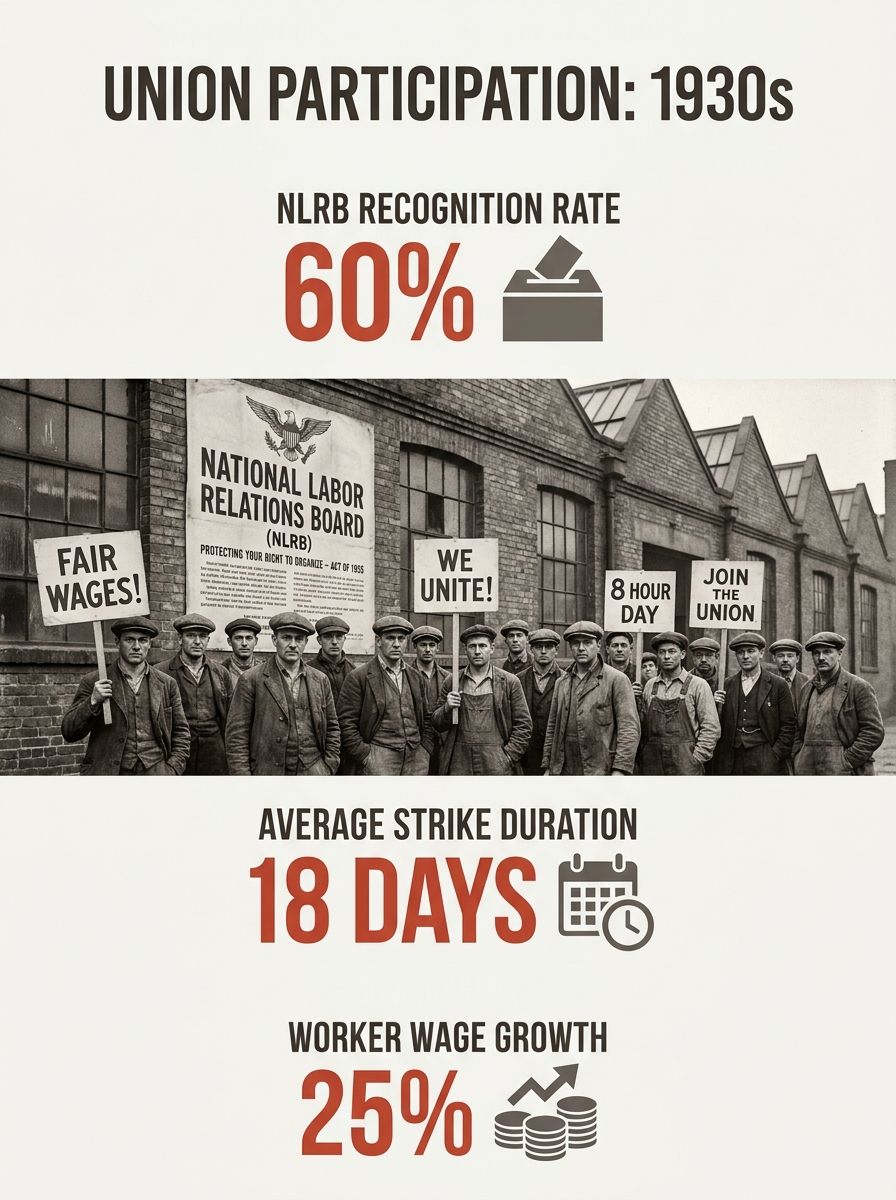
But here's what Wagner didn't build: meaningful penalties. The NLRB could order an employer to reinstate a fired worker and pay back wages. It could order an employer to cease and desist from unfair labor practices. What it couldn't do was fine employers, impose punitive damages, or send anyone to jail. For a small business, an NLRB order carried weight. For a major corporation, the cost of violating the law was, and remains, a rounding error compared to the cost of a unionized workforce. Today, when organizers file unfair labor practice charges, they're working within the same remedial framework Wagner established 91 years ago.
This was the design flaw. The rights were expansive. The enforcement was advisory. And the moment political winds shifted, the architecture crumbled.
Taft-Hartley: The Template for Every Rollback Since
The Supreme Court upheld the NLRA's constitutionality in NLRB v. Jones & Laughlin Steel Corp. on April 12, 1937, a 5-4 decision that legitimized federal regulation of labor relations under the Commerce Clause. For a decade, the Wagner Act operated more or less as written. Then employers and their congressional allies found the vulnerability.
The 1947 Taft-Hartley Act amended the NLRA in ways that precisely inverted several of Wagner's original protections. It established a new category of unfair labor practices for unions, creating legal symmetry where Wagner had deliberately placed the burden on employers. It banned secondary boycotts and closed shops. It required union officers to sign affidavits swearing they were not members of the Communist Party. And it granted states the power to pass right-to-work laws, fracturing the national framework of exclusive representation that Wagner had considered essential.
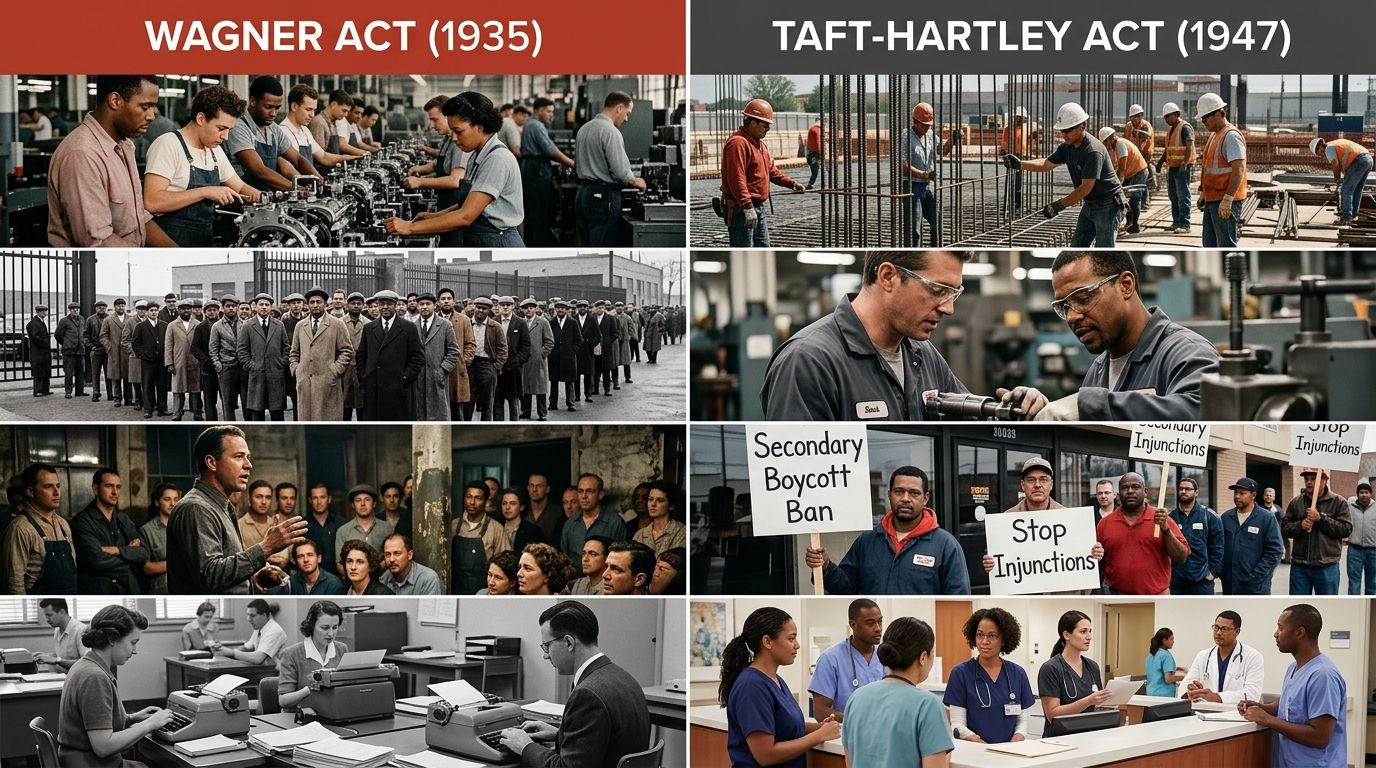
The Taft-Hartley amendments also stripped protections from specific categories of workers. Non-profit hospital employees, who had been covered under the original Wagner Act, lost their NLRB protections in 1947. It took until 1974 for Congress to amend the NLRA again and bring those healthcare workers back under the board's jurisdiction, a 27-year gap during which hospital employers faced no federal obligation to recognize unions. The pattern of covering workers, then uncovering them through amendment, has repeated for groups ranging from agricultural laborers (excluded from the start) to supervisors (excluded by Taft-Hartley).
The racial dimension deserves direct acknowledgment. The NLRA of 1935 included no protections for the rights of racial minorities in the workplace. Unions like the American Federation of Labor refused membership to Black workers. Others, like the CIO, practiced internal discrimination, steering white members toward better jobs and seniority. Wagner's statute didn't cause this discrimination, but it didn't prevent it either, and the enforcement gap made it easier for both employers and unions to maintain racial hierarchies.
What Taft-Hartley demonstrated was a principle that has governed every subsequent attack on the NLRB: the agency's power depends entirely on what Congress chooses to leave in place. Wagner had created broad rights enforced by a weak body. Any hostile legislature could restrict the rights while leaving the weak body intact, producing an agency that looked functional but couldn't accomplish its original mission.
Understanding this pattern changes how organizers should think about collective bargaining agreements and the legal framework that's supposed to protect them. The contract is only as strong as the agency backing it, and the agency has always been one congressional vote away from losing its teeth.
The Same Architecture Under a Newer Kind of Attack
The Taft-Hartley playbook required an act of Congress. The current assault on the NLRB has found a way around that step entirely.
Private-sector union membership has fallen to 6%, the lowest level since 1900. Overall union density sits at 10%. These numbers reflect decades of employer opposition operating within the weak-enforcement framework that Wagner originally built and Taft-Hartley widened. But the recent attacks go further than anything the 1947 Congress attempted.
Legal scholars and labor advocates have warned that anti-union employers are now trying to relitigate the New Deal itself by challenging the NLRB's constitutional structure in federal courts. The argument runs that the board's administrative adjudication process violates the Seventh Amendment right to a jury trial, or that its structure violates separation-of-powers principles. These challenges echo the pre-1937 constitutional arguments that the Supreme Court rejected in Jones & Laughlin, but they're finding a warmer reception in the current judicial environment.
The administrative attack has been even more direct. Board member Gwynne Wilcox was fired in what labor organizations have called an unlawful removal, stripping the board of its quorum and preventing it from issuing decisions on pending cases. Without a functioning board, employers facing unfair labor practice complaints face no adjudicator. The cases stack up. Workers wait. And the agency designed to protect organizing rights becomes a procedural void.
This matters for anyone navigating the NLRB election process right now. An election certification means little if the board lacks the members to rule on challenged ballots or adjudicate employer interference. The structural weakness Wagner built in 1935 has been exploited from a new angle: instead of amending the statute, opponents are disabling the institution itself.
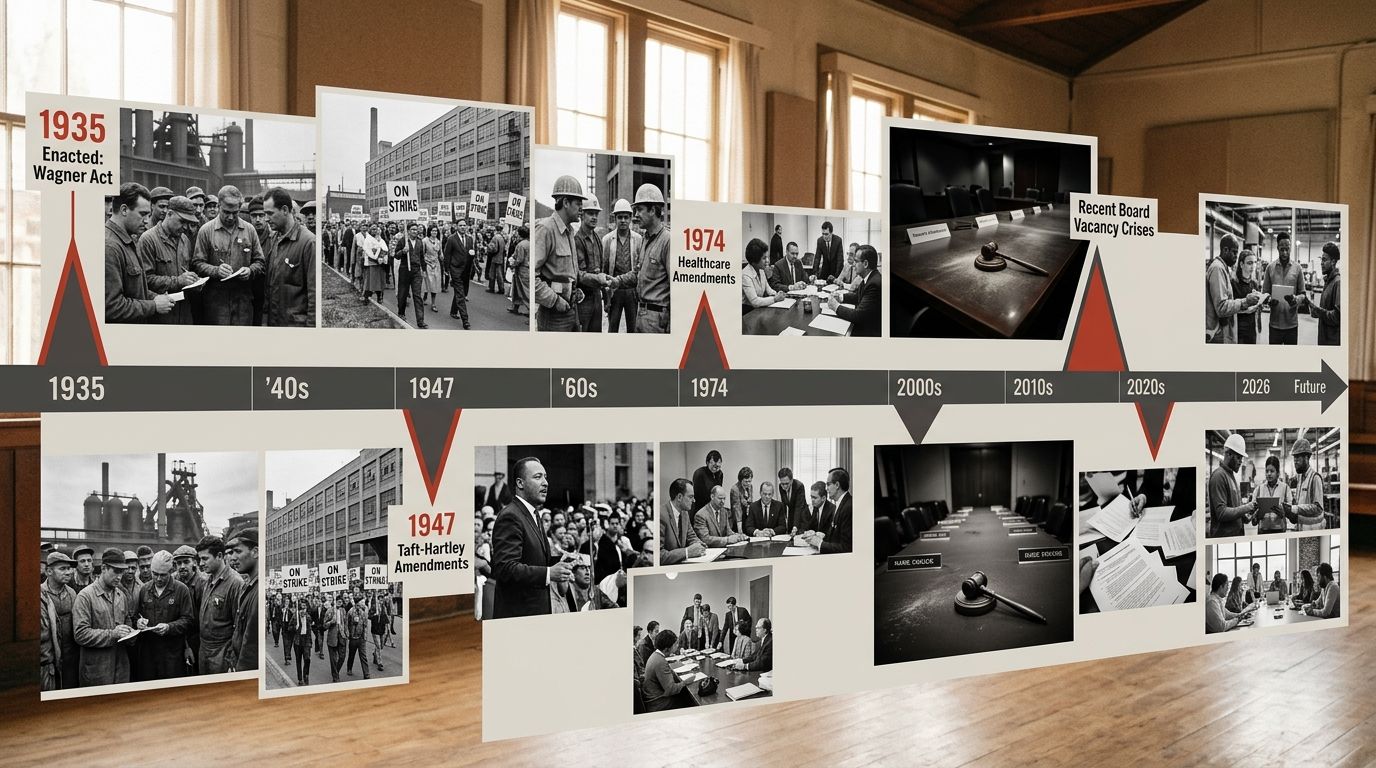
The legislative response has been stalled. The PRO Act, which would have added financial penalties for employer violations, required first-contract arbitration provisions, and banned captive audience meetings, has failed repeatedly to pass the Senate. Each failure reinforces the original design flaw: the NLRB's power can be expanded only through affirmative legislative action, but it can be diminished through amendment, defunding, court challenge, or simple vacancy.
The Vulnerability, Ninety-One Years On
The thesis here is simple and supported by every decade of evidence since 1935: the New Deal NLRB was designed with enforcement power insufficient to survive political opposition. Wagner built the agency to protect organizing rights during a moment of extraordinary pro-labor political alignment. The statute assumed that future Congresses, future administrations, and future courts would continue supporting those rights, or at least refrain from actively dismantling them. That assumption failed within 12 years and has continued failing at regular intervals since.
This doesn't mean the Wagner Act was worthless. Union density reached 33% under its framework, wages rose across the economy, and the principle that workers have a federally protected right to organize became embedded in American law in a way that hasn't been fully reversed even now. The NLRB, even in its weakened form, remains the primary venue for workers to assert organizing rights and challenge employer retaliation.
But the 91-year-old pattern holds. Broad statutory rights, weak enforcement architecture, and dependence on political goodwill for institutional survival add up to a system that delivers dramatic gains when conditions align and gives them back when conditions shift. Organizers who build campaigns assuming the NLRB will function as designed are planning for the best case. Organizers who build parallel power through strong contracts, strike funds, community coalitions, and state-level protections are planning for every case. The Wagner Act gave American workers something real. Protecting what it promised has always required more than the law itself provides.
The Union Edge Staff
Related Articles
NLRB Wagner Act: What You Need to Know
The National Labor Relations Act of 1935, commonly called the Wagner Act, is the federal statute that guarantees private-sector employees the right to organize unions, bargain collectively, and strike.

NLRB: What Employers and Employees Need to Know
The National Labor Relations Board is the independent federal agency that decides whether your employer broke the law when it fired you for talking about wages, interrogated you about a union meeting, or refused to bargain after workers voted to organize.

The PRO Act Is Dead Again — and Labor's Legislative Strategy Needs a Hard Reset
The Richard L. Trumka Protecting the Right to Organize Act has been introduced in four consecutive Congresses. It passed the House once, never reached a Senate floor vote, and changed zero lines of federal labor law.
Also in the paper