
The American Labor Movement: A Complete Historical Overview
The anthracite coal strike of 1902 ran 163 days, according to the U.S. Department of Labor, and became the first major dispute where a president mediated instead of sending troops. That pattern (federal action only after economic crisis) defines the entire arc of the American labor movement.

The American Labor Movement: From Conspiracy Trials to Collective Power, a 235-Year Fight
The anthracite coal strike of 1902 ran 163 days, according to the U.S. Department of Labor, and became the first major dispute where a president mediated instead of sending troops. That pattern (federal action only after economic crisis) defines the entire arc of the American labor movement.
Before There Were Unions, There Were Criminal Conspiracies
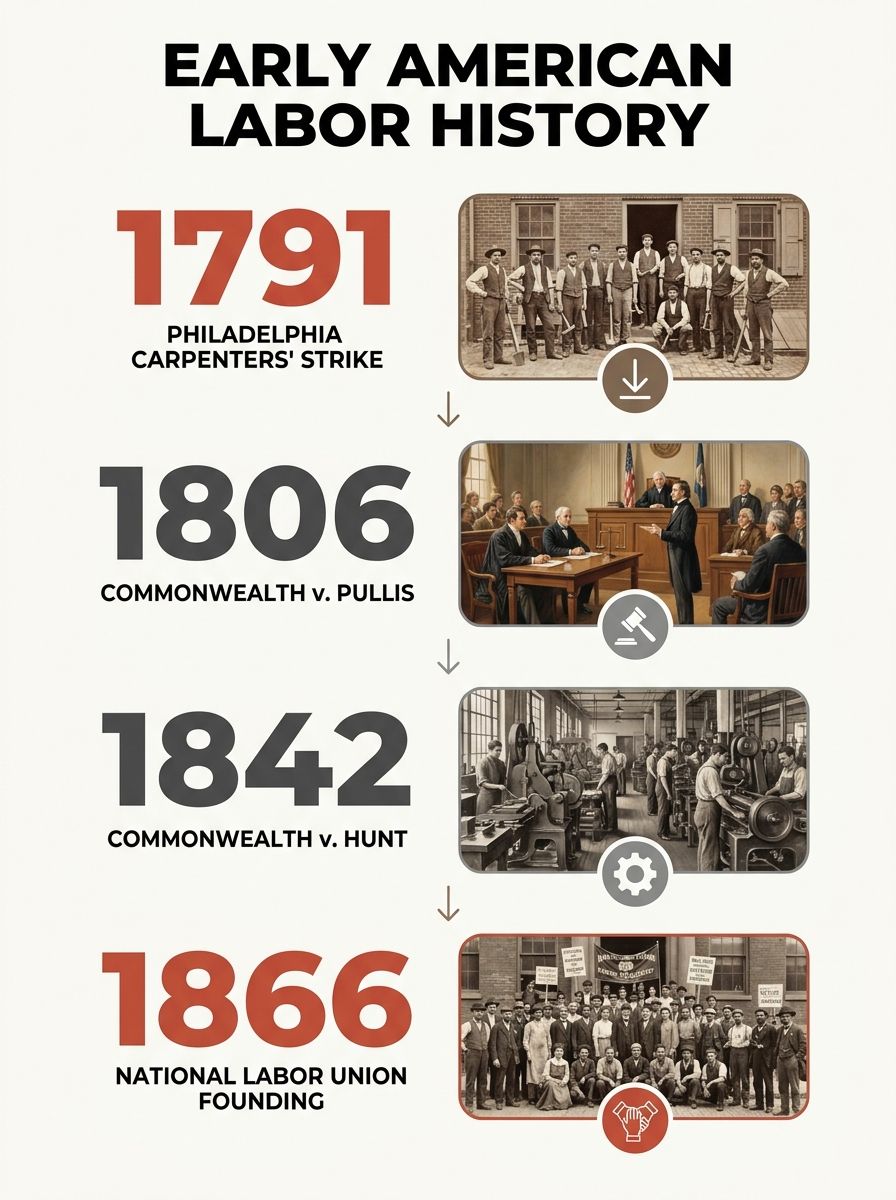
The earliest organized labor actions in the United States predate the Constitution itself. Philadelphia carpenters walked off the job in 1791 demanding a 10-hour workday, and shoemakers in the same city formed the Federal Society of Journeymen Cordwainers in 1794. These weren't called unions. Courts treated them as criminal conspiracies.
The 1806 Commonwealth v. Pullis trial convicted those Philadelphia cordwainers of criminal conspiracy for organizing to raise wages. For the next three decades, American courts routinely applied conspiracy doctrine to any group of workers who collectively refused to work below a certain rate. The legal framework was straightforward: individual workers could negotiate, but collective action constituted an illegal restraint of trade.
This changed with the Massachusetts Supreme Court's 1842 ruling in Commonwealth v. Hunt, which established that labor unions were legal organizations and that strikes for a closed shop did not constitute criminal conspiracy. The decision didn't end employer hostility. It removed one legal weapon from the arsenal.
Between 1842 and the Civil War, local trade unions multiplied across northeastern cities, but they remained fragmented by craft, by city, and by the recurring economic panics of 1837 and 1857 that wiped out membership rolls. No national coordination existed. Workers who wanted to organize had legal permission but almost no institutional infrastructure.
The Gilded Age Built the Movement's Skeleton
The first national federation of unions, the National Labor Union, was created after workers demanded an eight-hour workday, according to the Journal of Political Inquiry at NYU. The NLU persuaded Congress to pass an eight-hour law for federal employees in 1868, though enforcement was almost nonexistent. The organization collapsed by the mid-1870s, but the eight-hour demand survived as the central rallying cry of American labor for the next 70 years.
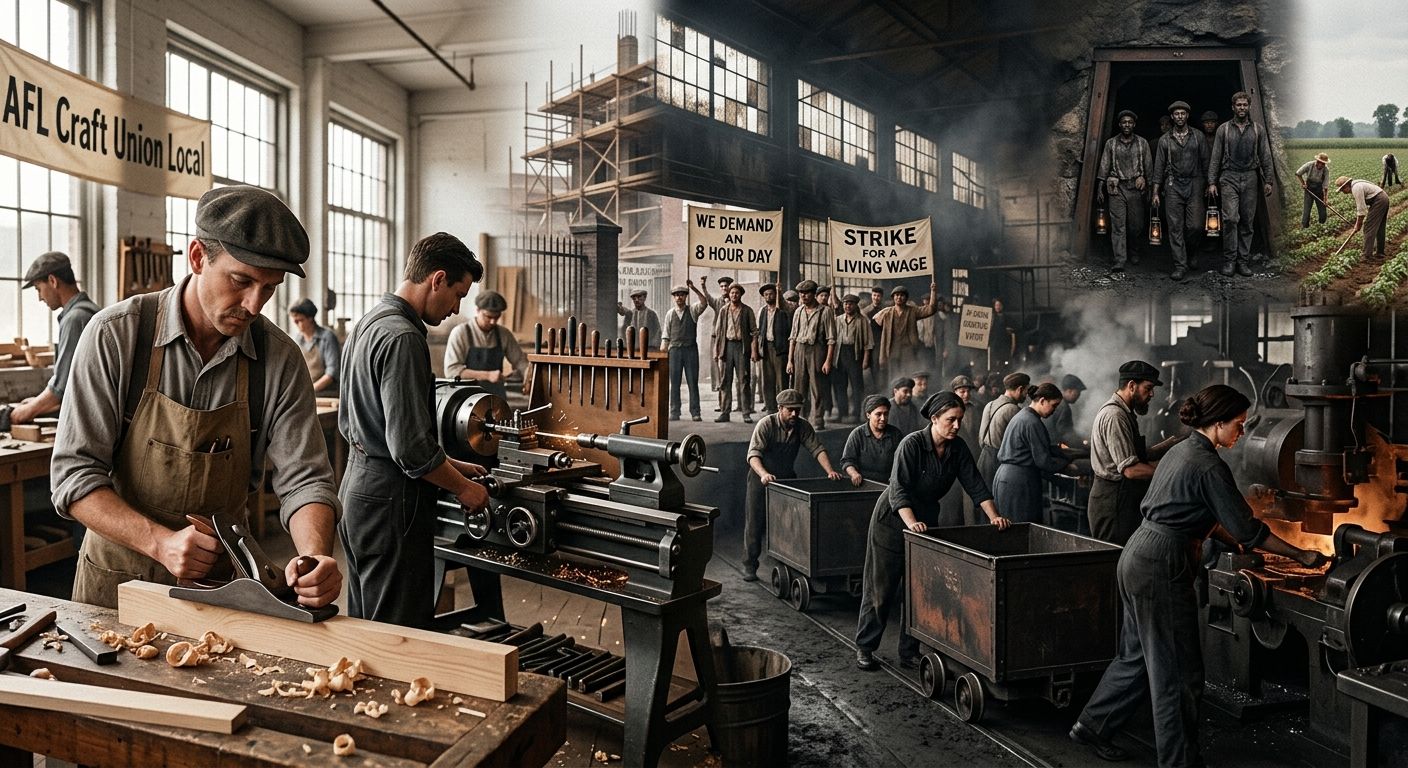
What replaced the NLU was both larger and more contradictory. The Knights of Labor, founded in 1869, grew to roughly 700,000 members by 1886 and accepted unskilled workers, women, and Black workers into its ranks. The American Federation of Labor, founded that same year under Samuel Gompers, took the opposite approach. Gompers, who joined his first labor union, the United Cigar Makers, in 1864, built the AFL around exclusive craft unionism.
The AFL's composition reflected deliberate exclusion. As documented in the labor history record on Wikipedia, "the unions of the AFL were composed primarily of skilled men. Unskilled workers, African-Americans, Hispanics and women were generally excluded. The AFL saw women as threatening the jobs of men, since they often worked for lower wages."
That exclusion shaped the movement's trajectory for decades. The AFL survived where the Knights did not, in part because its narrow membership base was easier to defend during economic downturns. But the cost was enormous. Millions of workers in the most dangerous, lowest-paid industries had no union willing to represent them.
The Western Federation of Miners, created in 1893, represented one response to the AFL's limitations. The WFM organized hard-rock miners in western states and repeatedly clashed with both mine operators and the AFL itself. By 1905, the WFM had helped found the Industrial Workers of the World, which rejected craft distinctions entirely and organized along industrial lines.
When the Federal Government Finally Picked a Side
Why did it take until 1902 for a president to treat strikers as something other than a threat to public order? Because every previous intervention had been a military one. The Smithsonian documented this clearly: "No president had ever shown much sympathy to workers on strike. Rutherford Hayes sent federal troops to quell a national railroad strike in 1877. Grover Cleveland sent troops to break the Pullman strike in 1894."
The great anthracite coal strike of 1902 broke that pattern. Restless miners demanded more pay and shorter hours. The mine operators, according to the Department of Labor's account, "complained that profits were low, and that the union destroyed discipline." Theodore Roosevelt appointed a commission instead of deploying soldiers. The strike ended on October 23, 1902, after 163 days. Miners won a 10% pay increase and a reduction to 9-hour days, though the union did not win formal recognition.
The significance wasn't the settlement terms. The significance was the precedent. A president had acknowledged that workers had legitimate grievances deserving mediation rather than suppression. That precedent would take another 33 years to become statute.
The intervening decades saw a volatile mix of state-level reforms and federal inaction. The Triangle Shirtwaist Factory fire of 1911, which killed 146 garment workers in New York City, accelerated state-level workplace safety legislation. The Clayton Antitrust Act of 1914 attempted to exempt unions from antitrust prosecution, though courts interpreted it so narrowly that the exemption barely functioned. World War I brought temporary gains as the federal government needed labor cooperation for wartime production, but those gains evaporated in the Red Scare crackdowns of 1919-1920.
The New Deal Rewrote the Rules of the Game
The Great Depression changed the math. By 1933, unemployment reached approximately 25%. Wages had collapsed. Strikes were erupting in industries from textiles to trucking to longshoremen. The political cost of inaction exceeded the political cost of siding with workers.
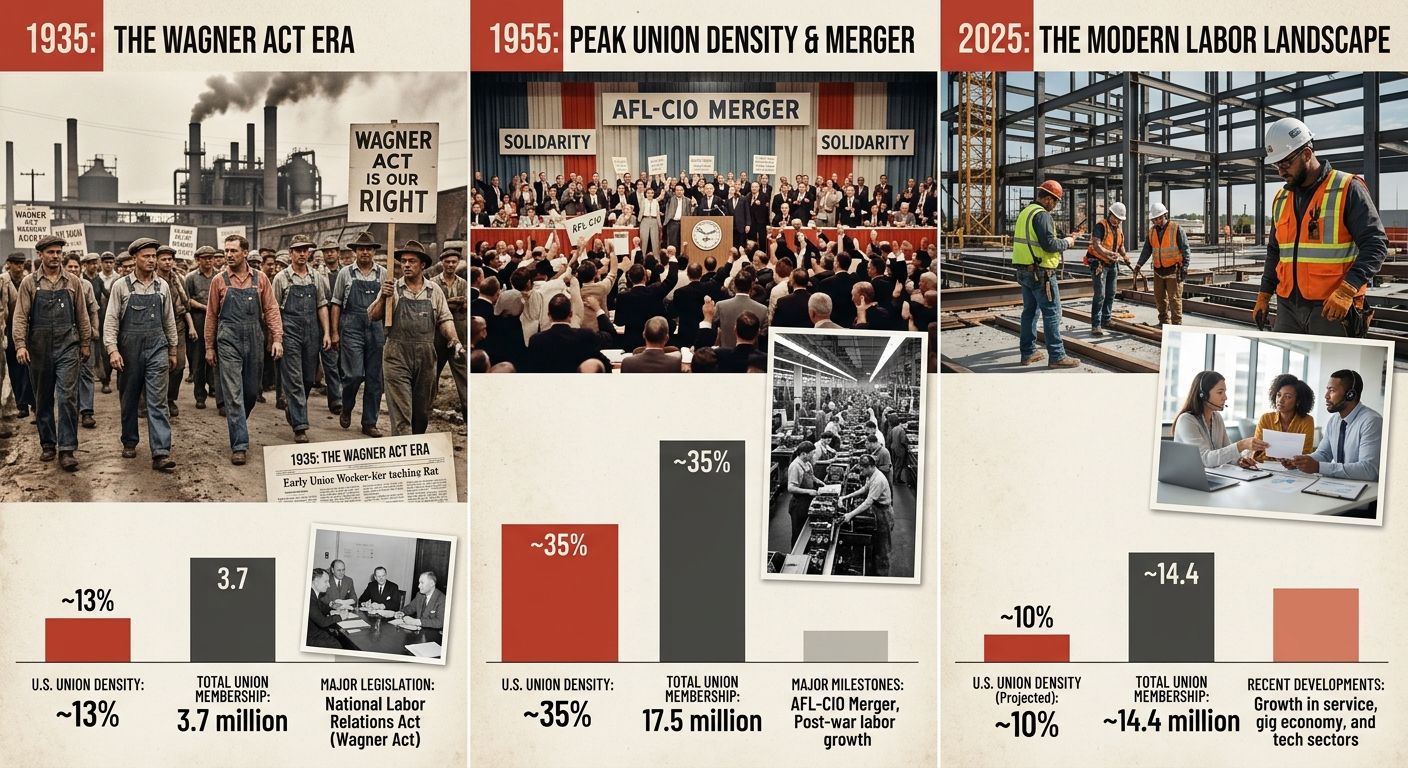
The National Labor Relations Act of 1935 (the Wagner Act) gave workers the federally protected right to organize, form unions, and bargain collectively. It created the National Labor Relations Board to enforce those rights, established unfair labor practice categories for employers, and mandated employer recognition of unions that won majority support. The history and ongoing impact of the NLRB traces directly to this statute.
Three years later, the Fair Labor Standards Act of 1938 established minimum wage, overtime pay, recordkeeping, and youth employment standards affecting employees in the private sector and in federal, state, and local governments. The initial minimum wage was $0.25 per hour. The FLSA also set the maximum standard workweek at 44 hours (later reduced to 40). Understanding how prevailing wage requirements function in government contracts builds on this same legislative foundation.
The AFL-CIO describes Eugene Victor Debs as the "Apostle of industrial unionism" and Arthur Joseph Goldberg as the "legal strategist for the union movement." Goldberg helped architect the AFL-CIO merger of 1955 that combined the federation's 15.5 million members under a single organizational roof, ending two decades of bitter rivalry between craft and industrial unionists.
Union membership peaked at roughly 35% of the non-agricultural workforce in the mid-1950s. The structure of collective bargaining agreements that unions negotiated during this era set wage and benefit standards that influenced entire industries, unionized or not.
Taft-Hartley and the Long Erosion
The Labor Management Relations Act of 1947 (Taft-Hartley) passed over President Truman's veto and immediately restricted the tools unions had used to build power. It banned secondary boycotts, allowed states to pass right-to-work laws prohibiting union security agreements, required union officers to sign anti-communist affidavits, and authorized the president to seek 80-day injunctions against strikes deemed threats to national health or safety.
The effects were structural and compounding. Right-to-work laws spread across southern and western states, creating a geographic split in union density that persists today. By 1960, 19 states had enacted right-to-work statutes. By 2026, 27 states have them on the books. Each law weakened the financial base of unions in those states by allowing workers to benefit from collective bargaining without paying dues.
The FLSA itself contained carve-outs that persist. The Department of Labor notes that the act "exempts agricultural workers from overtime premium pay, but requires the payment of the minimum wage to workers employed on larger farms" employing more than approximately seven full-time workers. Agricultural workers, domestic workers, and tipped employees were deliberately excluded from full coverage in 1938, and while some protections have been extended since, the exclusions shaped which workers could build power through legal channels and which could not.
Between 1955 and 1980, union density fell from roughly 35% to around 23%. The decline accelerated after 1981, when President Reagan fired 11,345 striking air traffic controllers and decertified their union, PATCO. The signal to private-sector employers was unambiguous: the federal government would tolerate aggressive anti-union tactics.
By 2000, private-sector union membership had dropped below 10%. Public-sector unions, which had grown rapidly after President Kennedy's 1962 Executive Order 10988 granted federal employees limited bargaining rights, maintained higher density rates but faced their own legislative attacks in states like Wisconsin, where Act 10 in 2011 stripped most public-sector workers of collective bargaining rights.
The Modern Movement and Its Unfinished Business
The period since 2020 has produced a surge in organizing activity that the membership numbers haven't yet captured. Starbucks Workers United filed petitions at over 400 stores. Amazon warehouse workers in Staten Island won an election in 2022. The International Brotherhood of Teamsters secured a contract at UPS in 2023 covering 340,000 workers after a credible strike threat backed by substantial strike fund preparation. And the ILO adopted its first international treaty on gig worker protections in 2026, acknowledging that the workforce has changed in ways domestic law hasn't kept pace with.
The legislative picture remains stuck. The PRO Act, which would have banned captive-audience meetings, overridden state right-to-work laws, and imposed meaningful penalties for employer violations, has failed to pass multiple times. NLRB unfair labor practice penalties remain capped at back pay and reinstatement, amounts so low that many employers treat them as a cost of doing business. An employer who illegally fires a union supporter during an organizing campaign faces, at worst, an order to rehire the worker and pay lost wages, often years after the campaign is over.
The BLS reported union membership at 10% of wage and salary workers in 2024, though public approval of unions reached 67% in Gallup polling that same year. That 57-percentage-point gap between approval and membership is itself a data point worth studying. Workers want unions. The legal and economic infrastructure makes getting one extraordinarily difficult.
Questions the Numbers Still Can't Answer
Union density tells you how many workers have a union. It doesn't tell you how many tried and failed, how many were fired during campaigns, or how many never started because the legal risks were too high. The NLRB tracks election petitions and outcomes, but it doesn't track the campaigns that died before a petition was ever filed.
The American labor movement's 235-year history shows that legal frameworks matter enormously, but they follow organizing rather than leading it. The Wagner Act passed because millions of workers were already striking. The FLSA passed because political pressure from organized workers made inaction untenable. Taft-Hartley passed because employer lobbies organized just as effectively in the opposite direction.
The numbers we do have (163 days in the coal fields, 35% peak density, 10% current membership, $0.25 as the first minimum wage, 27 right-to-work states) sketch a trajectory. They don't tell us where it ends. What the data can't measure is the thing that has powered every phase of this movement: the moment a group of workers in a specific workplace decide collectively that conditions are unacceptable and that they're willing to take risks to change them. That decision has never been quantifiable. It has always been the variable that mattered most.
The Union Edge Staff
Related Articles
NLRB Wagner Act: What You Need to Know
The National Labor Relations Act of 1935, commonly called the Wagner Act, is the federal statute that guarantees private-sector employees the right to organize unions, bargain collectively, and strike.

New Deal NLRB: History & Modern Impact
Every major rollback of American labor rights has exploited the same structural weakness that Senator Robert Wagner left in his 1935 statute.

Taft-Hartley's Ban on Solidarity Strikes Marks 79th Anniversary as Labor Researchers Examine Continuing Impact on Union Use
The Taft-Hartley Act's prohibition on solidarity strikes, enacted June 23, 1947, continues to restrict union use nearly 79 years later, according to analysis published this week by labor researcher Hayley Brown examining how the ban prevents cross-employer collective action that proved effective in
Also in the paper