
Organizing Migrant Workers Across Borders: Why Traditional Union Strategies Fall Short and What Actually Works
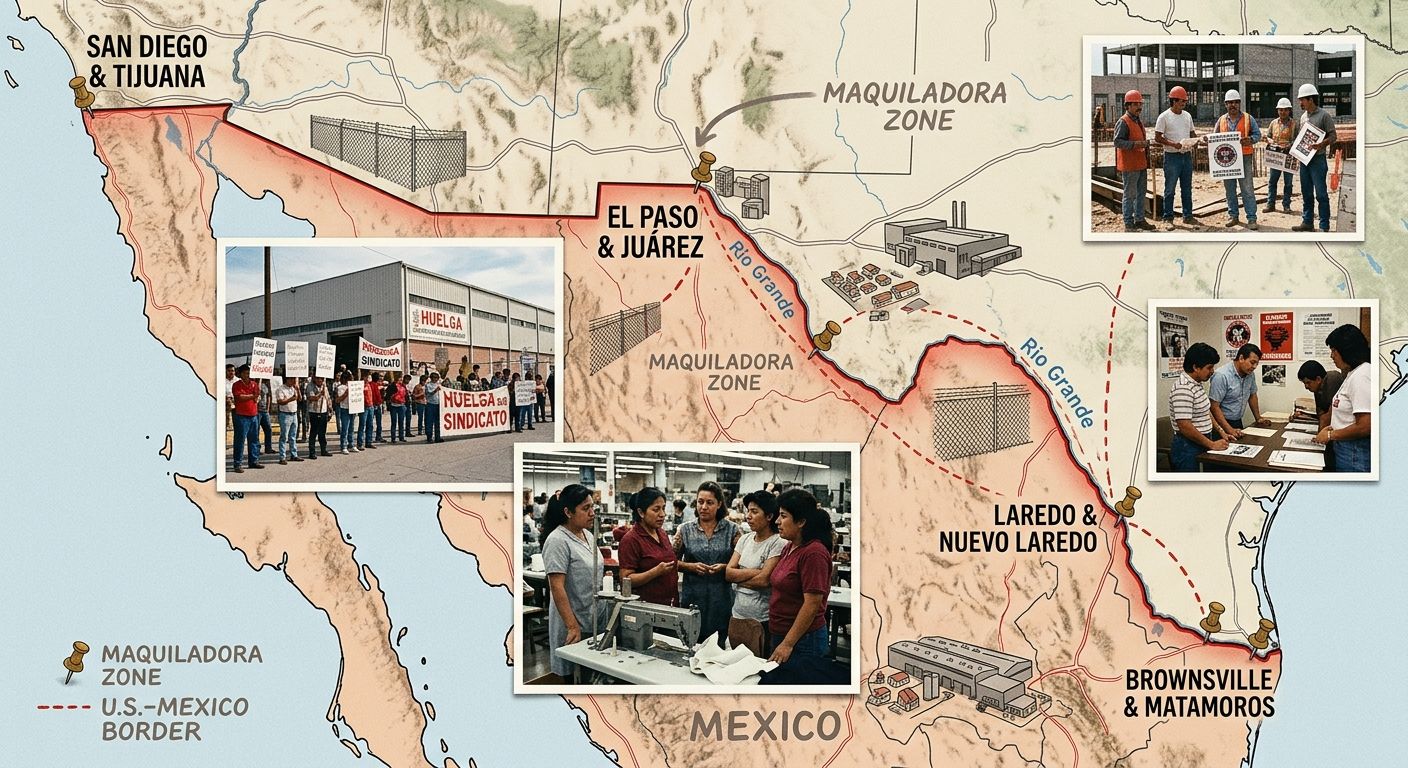
Cross-border groups like the Coalition for Justice in the Maquiladoras helped workers organize independent unions at Sony, Alcoa, Custom Trim, and Sara Lee plants along the Mexico-U.S.

Organizing Migrant Workers Across Borders: Why Traditional Union Strategies Fall Short and What Actually Works
Cross-border groups like the Coalition for Justice in the Maquiladoras helped workers organize independent unions at Sony, Alcoa, Custom Trim, and Sara Lee plants along the Mexico-U.S. border, proving that migrant worker organizing works when campaigns follow workers across national boundaries rather than waiting for them to settle into a single shop.
Those campaigns, documented by the Reimagine! project, didn't follow the standard union playbook. They couldn't. The workers moved. The employers exploited that movement. And the legal frameworks governing labor rights stopped at border crossings where the workers themselves did not. The history of cross-border labor solidarity is a history of standard organizing models breaking down and forcing unions to rebuild their strategies from the ground up. What follows is the sequence of how that rebuilding happened, where it stalled, and which approaches have produced durable results.
The Firm-Based Trap
For decades, European and North American unions built their power within individual firms. A Council of Europe report on migrant-union relations acknowledged the core problem plainly: "For many years European trade unionism has concentrated on improving the economic and social rights of workers in firms, but it has not been possible to resolve the problems encountered by migrants solely within that context."
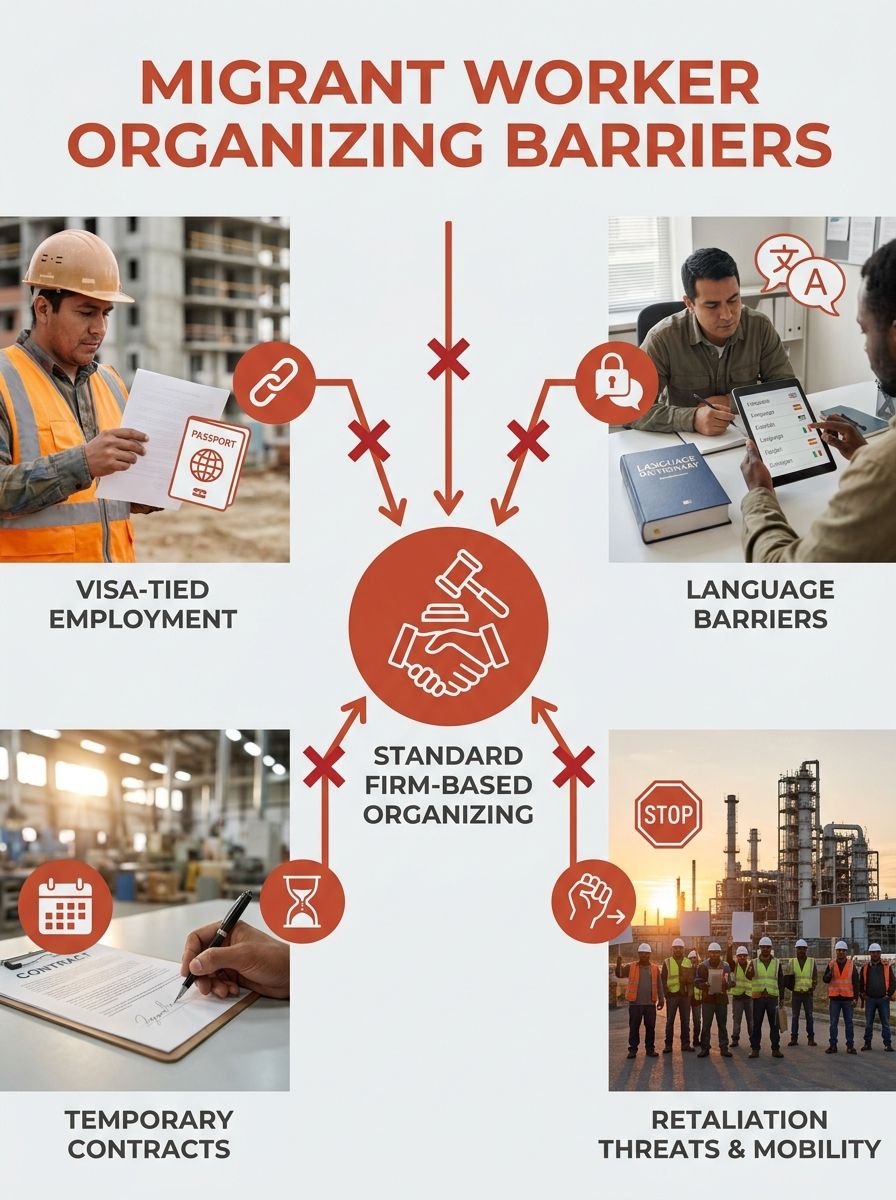
That firm-based model assumed workers stayed put. They had fixed contracts, predictable schedules, and a single employer who could be pressured through collective bargaining. Migrant workers violated every one of those assumptions. They rotated through employers on temporary contracts. Their legal right to remain in a country was often tied directly to a specific job. And the industries that depended on them most heavily, including agriculture, meatpacking, logistics, construction, and hospitality, were structured around seasonal demand and high turnover.
Academic research has confirmed that unions sometimes actively supported exclusionary policies rather than organizing migrant workers. Boräng, Kalm, and Lindvall's 2020 study in the Journal of European Social Policy found that unions have historically "neglected migrant rights, or even supported exclusionary policies." The authors identified an alternative they called the "equalization strategy," in which unions push for equal rights between native and foreign workers to fight exploitation and unfair competition. But adoption of that strategy has been slow and uneven.
Cornell University's Precarious Workforce Initiative documents the structural conditions underlying this failure. The initiative focuses on workers who "receive little or no benefits and have largely no institutional or legal protection." Migrant workers sit squarely in that category. Agency work, where employees work for a staffing firm rather than the company that actually directs their labor, strips several dollars per hour from wages and makes the employer relationship murky enough to frustrate traditional organizing drives.
The dangers of precarious work in migrant-heavy industries are well documented. Construction sites relying on subcontracted migrant labor have produced fatal results, as we've covered in reporting on criminal charges following a worker's electrocution death at a Bengaluru metro construction site. The pattern repeats globally: layers of subcontracting obscure who bears legal responsibility, and migrant workers bear the physical risk.
Cross-Border Campaigns Along the Mexico-U.S. Corridor
The first sustained attempt to build cross-border labor solidarity at scale came from the Mexico-U.S. border region in the 1990s. Mexico's Congreso de Trabajo formally denounced Proposition 187 before the United Nations and the International Labour Organization, calling it a violation of human and union rights against 5 million Mexicans working in the United States. The denunciation marked a shift. Mexican labor federations were acknowledging that their members didn't stop being workers when they crossed the border.
Francisco Hernández Juárez, a prominent Mexican labor leader, went further and proposed creating an International Union for Migrant Workers. The proposal recognized something the firm-based model couldn't accommodate: workers whose labor market spanned two countries needed representation that did the same.
On the ground, the Coalition for Justice in the Maquiladoras and allied organizations were already building that kind of representation. CJM provided direct support to border workers organizing independent unions at Sony, Alcoa, Custom Trim, Sara Lee, Han Young, and other plants in Mexico's northern maquiladora zone. Migrant Rights International estimated that over 170 million people lived outside their country of origin. The border region became a laboratory for intersectional union strategy because the workers there faced overlapping vulnerabilities: immigration status, language, race, gender, and the raw economic desperation that drove them to accept precarious work in the first place.
These campaigns worked differently from standard National Labor Relations Board elections. There was no stable bargaining unit to petition for. Workers might be employed at a plant for months before cycling to another facility or crossing back to Mexico. Organizers had to build relationships that survived job transitions and geographic moves, which meant building leadership density among workers themselves rather than relying on union staff to run campaigns from the outside.
Southeast Asia's Long Road to Recognition
The ILO launched a dedicated project on migrant worker organizing spanning countries of origin (Myanmar, Indonesia, and Nepal) and destination (Malaysia and Thailand). The project's design reflected a lesson learned from the Americas: effective organizing had to happen on both ends of the migration pipeline. Training workers about their rights before they left home turned out to be as important as supporting them after they arrived.
The obstacles in Southeast Asia dwarfed those in North America. Malaysia's Malaysian Trades Union Congress reported that achieving government recognition for a new union could take five to seven years. For migrant workers on two-year contracts, that timeline made conventional union certification impossible. By the time a union won recognition, the workers who organized it would have already been sent home.
The ILO project responded by waiving membership fees for migrant workers and providing targeted legal guidance on issues specific to their situation: contract disputes with recruitment agencies, wage theft by labor brokers, and retaliation by employers who could trigger deportation with a single phone call. The approach treated union inclusion as a service delivery problem, not a mobilization problem. Workers didn't need to be convinced that organizing mattered. They needed practical help that arrived faster than their contracts expired.
Spain Wrote a Different Playbook
Spain's two major union confederations, CCOO (Comisiones Obreras) and UGT (Unión General de Trabajadores), built dedicated immigration service offices called CITEs (Centros de Información para Trabajadores Extranjeros). These offices handle over 27,200 legal cases annually, focusing on work permit renewals, residence permits, and asylum applications.
The model inverted the traditional union value proposition. Instead of asking migrant workers to join a union that would then negotiate better wages, Spanish unions offered concrete immigration services first. Workers walked in needing help with a visa renewal and walked out as union members. The CITE offices created a point of contact that survived job changes, employer retaliation, and the seasonal employment cycles that define precarious work in Spain's agricultural and hospitality sectors.
This legal integration approach produced measurable results. Union density among migrant workers in Spain grew at a pace that outstripped density gains in countries relying on workplace-only organizing. The model demonstrated that collective bargaining agreements covering migrant workers become enforceable when the union already has an established relationship with the worker through non-workplace services.
Spain's success contrasted sharply with the failures described by a migrant worker and union rep writing in Bella Caledonia, who reported working in "precarious hospitality, manufacturing, and logistics settings" across Bradford and Glasgow since 2014, "constantly trying to help set up structures that catered to the needs of migrant workers. Our attempts were commendable, yet they always failed or fell apart in the long run." The difference between the Spanish and British experiences came down to institutional commitment: Spain embedded immigration services into the union's permanent infrastructure, while UK efforts depended on individual reps doing extra work within structures that weren't designed for mobile, multilingual workforces.
California Redesigns the Election Clock
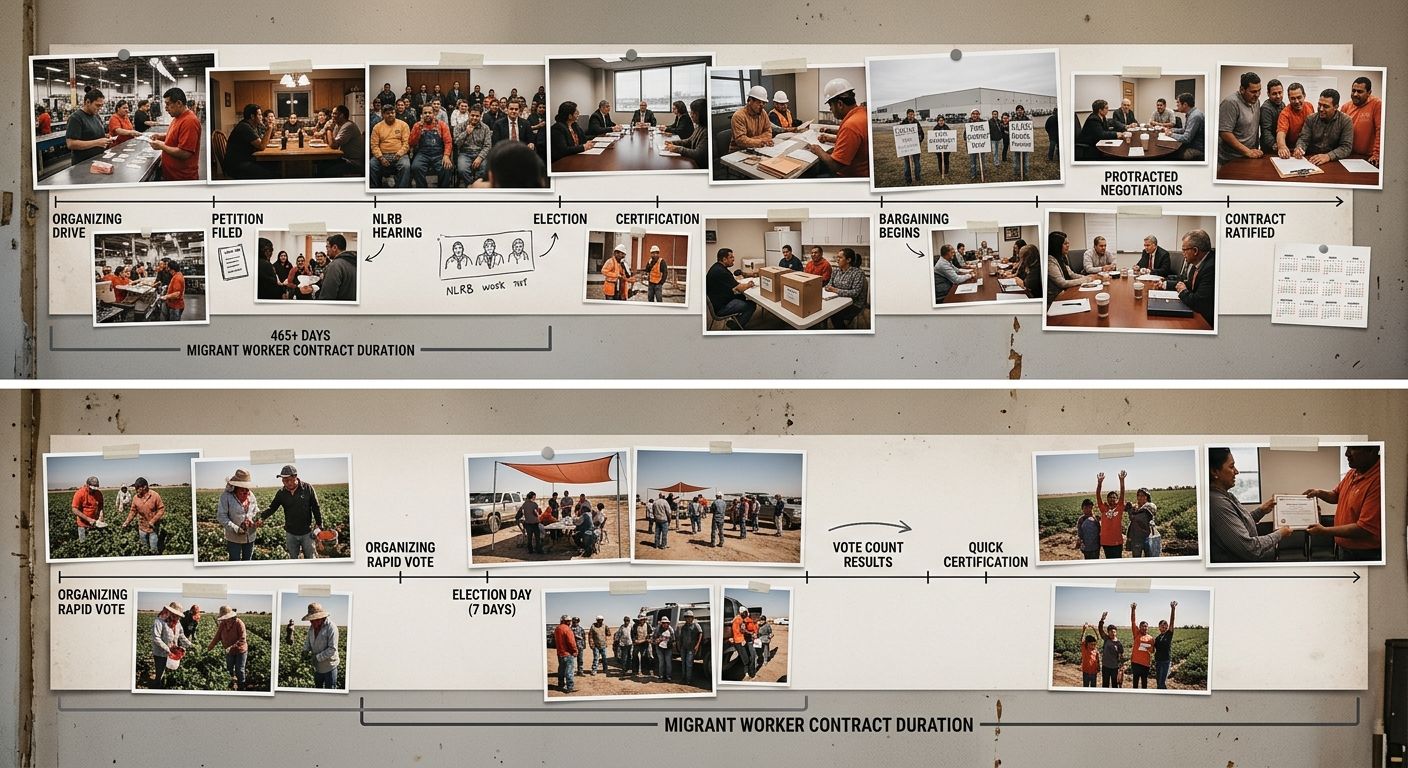
California's Agricultural Labor Relations Act introduced a mechanism that directly addressed the timing problem. The ALRA mandates union elections within seven days of a petition filing. During active strikes, that window shrinks to two days. The law was designed specifically for agricultural migrant workers whose employment at any given farm might last only weeks.
Compare that to the standard NLRB timeline. As we've documented in our reporting on the hidden gaps in union organizing timelines, reaching a first contract takes an average of 465 days according to Bloomberg Law's analysis. For migrant workers on seasonal visas, 465 days means the workers who organized the campaign will never see the contract. California's rapid-election model acknowledged this reality and compressed the timeline to match the actual duration of migrant employment.
The ALRA also illustrates a broader principle: the legal architecture surrounding labor elections was built for permanent workers in stable industries. Adapting it for migrant worker organizing requires changing the law itself, not just the organizing tactics. Unions advocating for binding arbitration for first contracts are pursuing a parallel reform, recognizing that employers can simply stall negotiations until migrant workers' contracts expire and a new, unorganized workforce replaces them.
The Intersectional Framework Takes Hold
The Solidarity Center, the AFL-CIO's international arm, formally adopted an organizing philosophy described as "equality, radical inclusion and intersectionality that is explicitly feminist, anti-racist, pro-equality, pro-worker, pro-migrant and class-conscious," according to organizational documentation archived before the second Trump administration took office. That language signaled a shift in how U.S.-affiliated labor institutions understood migrant worker organizing: as a problem that couldn't be separated from race, gender, nationality, and immigration status.
In Europe, the EU-funded INFALA project (Intersectional Faces of Labor Organization) launched under the Horizon research program to systematically examine solidarity, agency, and labor organization among workers from the Middle East and North Africa who had entered Europe's logistics sector. The project's design reflected accumulated evidence that migrant workers in logistics, warehousing, and delivery face a specific combination of pressures: algorithmic scheduling, piece-rate pay structures, and employer strategies that exploit immigration-related fears to suppress organizing.
France's CGT union evolved its approach in the late 2000s by establishing national-specific support structures and weekly advice sessions for undocumented workers. The CGT recognized that extreme precariousness and geographic mobility meant that undocumented migrants couldn't be integrated into traditional company-based union chapters. Instead, the union created territorial structures organized around neighborhoods and migrant communities rather than individual employers.
Durham University researchers studying precarious economies have identified two regulatory models that countries use to address these conditions. Korea adopted an equality approach, legislating protections for fixed-term, part-time, and agency workers against discrimination. India pursued specific regulation targeting particular categories of vulnerable work. Both models produced measurable improvements, but neither fully resolved the problem of workers whose precariousness stems from immigration status rather than contract type alone.
The State of Play
The campaigns and reforms described above share a common thread: they all abandoned the assumption that migrant workers can be organized the way permanent, domestic workers are. Every successful model replaced at least one element of the traditional playbook. Spain replaced the workplace as the primary point of contact. California replaced the election timeline. The CJM replaced the national boundary as the limit of union jurisdiction. France's CGT replaced the employer-based chapter with territorial organization.
The unsolved problem is scale. Spain's 27,200 annual legal cases serve a fraction of the migrant workforce. California's rapid elections apply to agriculture but haven't been replicated in construction, meatpacking, or hospitality. The ILO's Southeast Asian project reached workers in five countries but couldn't overcome Malaysia's five-to-seven-year recognition timeline through organizing alone.
Wage theft enforcement remains unevenly applied. The recent Dutch prosecution seizing €3.3 million from a meat-sector agency owner showed that legal action against exploitative labor brokers can produce results, but individual prosecutions don't change the structural incentives that make migrant labor exploitation profitable.
What the evidence points toward is a model with three components working simultaneously: legal services that address immigration status directly (the Spanish CITE approach), election and bargaining timelines compressed to match actual migrant employment durations (the California ALRA model), and organizing structures that follow workers across borders and between employers rather than anchoring to a single workplace (the CJM and CGT territorial approaches). Unions that have adopted all three elements, or at least two of them, have built durable membership among migrant workers. Unions that tried to run standard campaigns with translated leaflets and multilingual staff but no structural changes have consistently watched their gains evaporate when workers' contracts ended or their immigration status shifted.
The labor movement's record on migrant worker organizing is, honestly, one of its most glaring institutional failures. Decades of evidence show what works. The question is whether unions will invest in permanent infrastructure to support migrant members or continue treating cross-border labor solidarity as a side project that gets attention only during political crises.
The Union Edge Staff
Related Articles

The Migrant Worker Organizing Blind Spot: Why Standard Union Strategies Fail Vulnerable Workforces
In Malaysia, achieving official government recognition for a new trade union representing migrant workers takes between five and seven years, according to research from the Malaysian Trades Union Congress. The average guest worker visa in that country lasts two to three years.

Beyond the Union Office: Why Organizers Fail When They Wait for Workers to Come to Them
Campaigns that file for an NLRB election with 60–70% worker support win 78% of the time. Campaigns built primarily on walk-in interest at a union hall rarely come close to that success rate.

When Workers Speak Multiple Languages: 6 Organizing Communication Failures and How to Fix Them
Language barriers cause an estimated 25% of workplace accidents in industries with concentrated immigrant workforces, and they sabotage union campaigns at comparable rates.
Also in the paper