
UK Has No Maximum Workplace Temperature Despite 38C Heatwave Forecast and Health Agency Warnings
The United Kingdom has no legal maximum workplace temperature despite forecasts predicting heat could reach 38C this week, forcing workers to rely on general health and safety protections as the UK Health Security Agency warns of significant impacts across health services and a rise in deaths among

UK Has No Maximum Workplace Temperature Despite 38C Heatwave Forecast and Health Agency Warnings
The United Kingdom has no legal maximum workplace temperature despite forecasts predicting heat could reach 38C this week, forcing workers to rely on general health and safety protections as the UK Health Security Agency warns of significant impacts across health services and a rise in deaths among vulnerable populations, according to the Oxford Mail.
The forecast temperatures could exceed the June record of 35.6C set in 1976, the report states. UKHSA issued health alerts warning of expected increases in mortality, particularly among people aged 65 and over or those with existing health conditions.
Current Legal Framework
The Health and Safety at Work Act 1974 requires employers to provide a safe working environment, which includes protection from weather-related hazards including excessive heat, the report notes. However, UK law establishes no specific temperature threshold above which work must stop.
Workers cannot leave their jobs solely because of high temperatures, according to the report. The absence of a maximum temperature standard contrasts with minimum workplace temperature regulations, which set 16C as the threshold for offices and 13C for physical work environments.
John Johnston, head of e-commerce at Workwear Express, told the publication that health and safety laws require employers to take reasonable steps to protect employees during extreme weather periods, especially for outdoor work.
Employer Obligations Under Existing Law
Employers must provide personal protective equipment designed for high temperatures, conduct thorough risk assessments, and ensure workers receive training to identify symptoms of heat exhaustion and heat-related conditions, Johnston stated in the report.
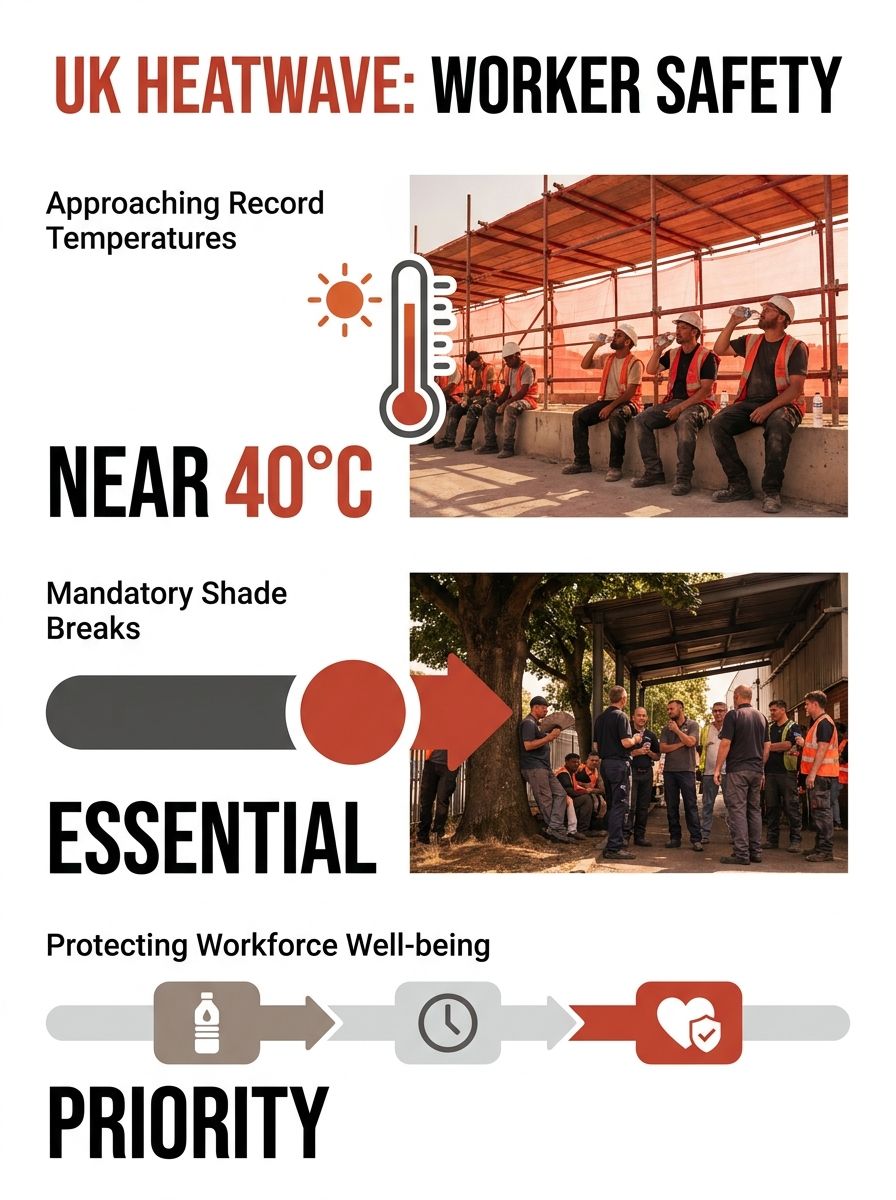
Organizations should offer sheltered areas for breaks to help staff cool down and recover from prolonged sun exposure, according to the guidance cited. The report notes that workplace accident risk increases in high temperatures due to sunburn, dehydration, and heatstroke.
Employers must provide first aid resources and ensure a trained first aider is present on site, the report states. The requirements apply across sectors but carry particular weight for construction, agriculture, warehousing, and other outdoor or poorly ventilated work environments. Organizations conducting workplace safety moments before shifts should incorporate heat-specific protocols during extreme weather periods.
Workers' Right to Refuse Unsafe Conditions
Workers have the right to refuse work if they believe working conditions are unsafe or pose a serious risk to their health and safety under the Employment Rights Act 1996, the report states. This protection exists despite the absence of a maximum temperature threshold.
Trade union members are encouraged to contact their unions for advice and support if they feel unsafe at work during extreme heat, according to the guidance. The right to refuse unsafe work applies regardless of union membership status, though organized workers typically have clearer grievance procedures and collective bargaining protections.
The report does not specify whether any employers have faced enforcement actions for heat-related safety violations, nor whether workers have successfully invoked the right to refuse work during previous heatwaves.
Context and Outlook
The UK's regulatory approach to workplace heat differs from jurisdictions that have adopted specific temperature thresholds or mandatory cooling requirements. As climate patterns shift and extreme heat events become more frequent, the absence of a maximum workplace temperature standard leaves enforcement dependent on general health and safety assessments rather than bright-line rules.
Workers in sectors without strong union representation or clear safety protocols face particular vulnerability during extreme heat events. The current framework places the burden on individual workers to assess risk and invoke their right to refuse unsafe conditions, a determination that can carry employment consequences without clear regulatory backing.
The forecast 38C temperatures would mark the highest June readings in 50 years if realized, testing whether existing employer obligations and worker protections prove sufficient without explicit temperature limits. Union advisories typically recommend documenting heat-related safety concerns in writing and raising issues through shop stewards before individual workers refuse assignments.
The Union Edge Staff
Related Articles

Workplace Safety Failures Kill 30 Workers Across Three Countries in Four-Day Span
At least 30 workers died in workplace accidents across Greece, China, and the United States between July 9 and July 12, 2026, prompting regulators to impose safety penalties exceeding half a million dollars and order operational shutdowns at facilities in three countries, according to enforcement fi

Essential Workplace Safety: 10 Topics Every Business Needs
Fall protection has topped OSHA's most-cited violations list for over a decade, and the same ten health and safety topics in the workplace appear in the agency's enforcement data year after year, accounting for the bulk of preventable worker injuries and deaths across American industries.

Supreme Court Rules Home Office Must Specify Grounds for Right-to-Work Penalties
The UK Supreme Court ruled on Monday that the Home Office must explicitly state which legal provision an employer violated when issuing civil penalties for right-to-work breaches, overturning a £15,000 fine against Akbar's Restaurants after justices found the penalty notice invalid.
Also in the paper