
Labor Market Policy: Shaping Opportunities
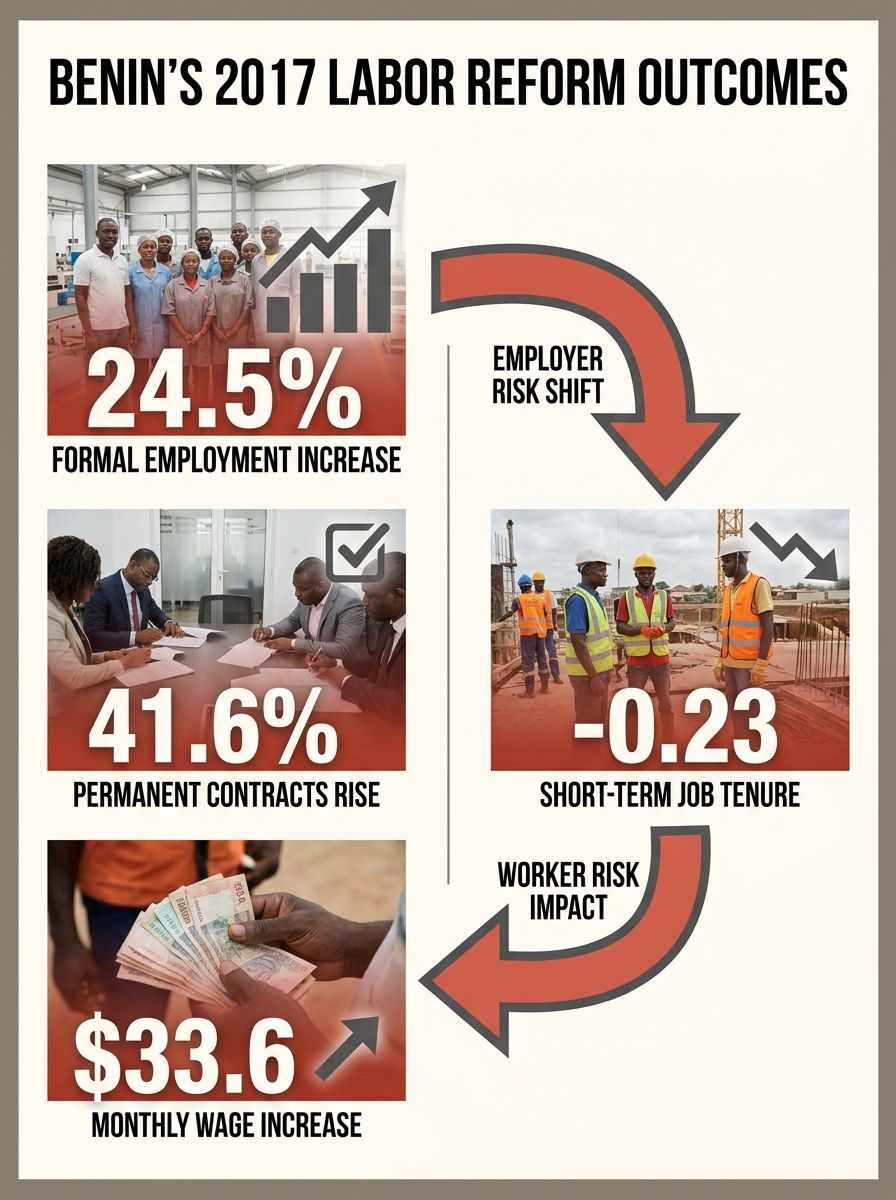
Benin's 2017 labor code overhaul cut employer firing costs, legalized indefinite short-term contracts, and produced a 24.5% surge in formal sector employment, while simultaneously reducing job tenure for short-term workers by 0.23 months and shifting economic risk from employers to the workforce.

How Benin's Labor Market Reform Created Jobs and Gutted Worker Security
Benin's 2017 labor code overhaul cut employer firing costs, legalized indefinite short-term contracts, and produced a 24.5% surge in formal sector employment, while simultaneously reducing job tenure for short-term workers by 0.23 months and shifting economic risk from employers to the workforce.
The Code Rewrite
Why does a West African nation's labor law matter to workers in Detroit or Dallas? Because the same policy framework has been the template for labor market policy debates worldwide for decades: reduce employer costs, increase "flexibility," promise that jobs will follow. Benin's reform gave policymakers exactly what they asked for, a controlled experiment in what happens when you strip worker protections to juice formal employment numbers.
Before 2017, Benin's labor code imposed significant dismissal costs on employers. Firing a worker meant severance payments, administrative procedures, and legal exposure. Short-term contracts had duration limits. The reform flipped these constraints: employers gained the ability to hire on indefinite short-term contracts, dismissal costs dropped, and the formal labor market opened wide.
The results looked spectacular on paper. Formal sector employment climbed 24.5%. Permanent contracts for retained workers rose 41.6%. Average formal wages increased by $33.6 per month. International development institutions pointed to these figures as proof that labor market flexibility works.
But the workers inside those numbers tell a different story.
The Workers Behind the Percentages
Short-term contract workers, the largest group of new hires under the reformed code, saw their average job tenure decrease by 0.23 months. That number sounds small until you understand what it means in practice: faster turnover, less time building skills or seniority, and a constant churn that makes collective organizing nearly impossible.
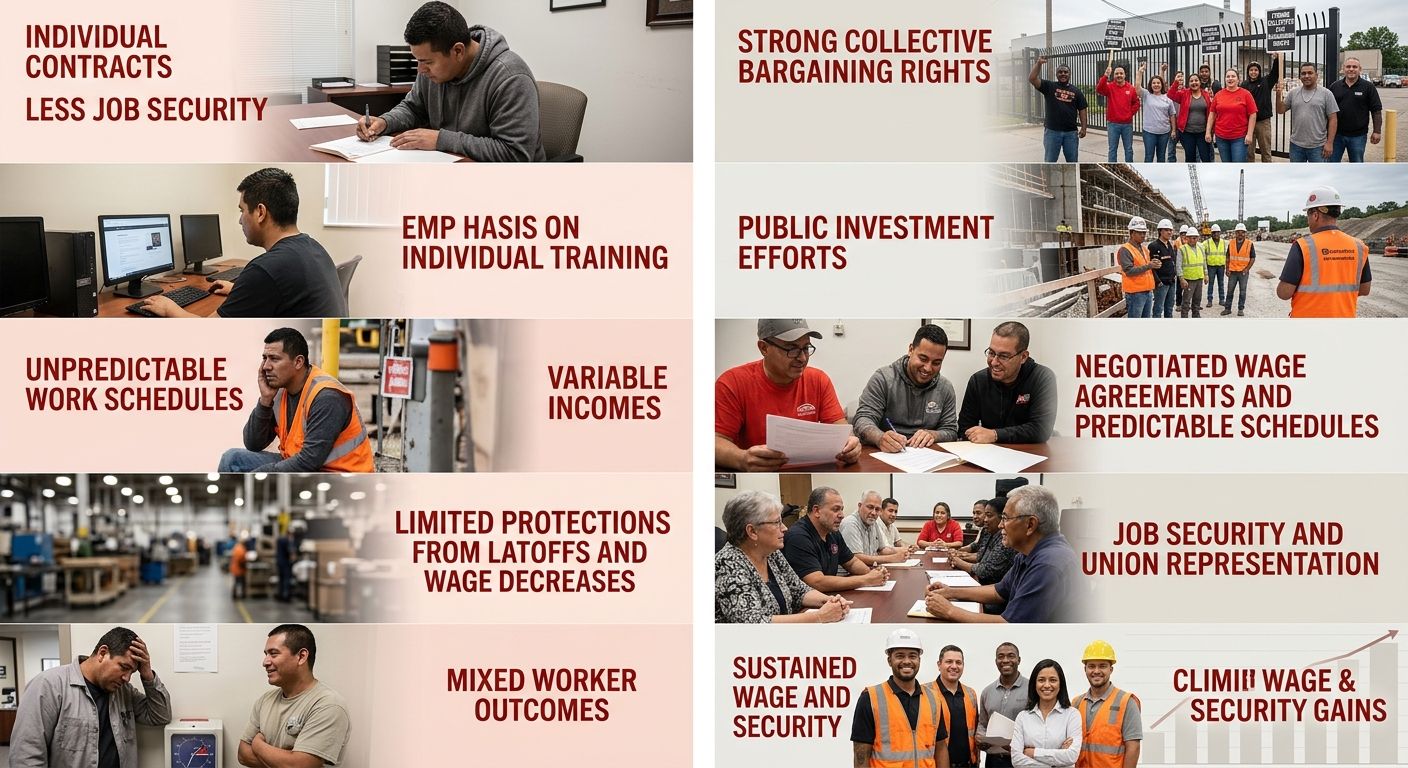
This is a structural pattern that labor researchers have documented across dozens of countries. When governments reduce firing costs without building compensating protections (unemployment insurance, retraining programs, portable benefits), the result is a two-tier workforce. A smaller core of permanent employees gains stability and rising wages. A larger periphery of short-term workers cycles through jobs without accumulating the bargaining power or institutional protections that make employment actually good.
Benin's reform architects acknowledged this gap. The policy included language about retraining programs and enhanced unemployment benefits. But as implementation unfolded, those complementary safety nets lagged far behind the deregulation. Employers got flexibility immediately. Workers got promises.
The pattern echoes across borders. South Africa's ongoing debate about reducing dismissal costs to address its staggering unemployment rate runs into the same wall: without simultaneous investment in worker protections, formal sector growth risks becoming a pipeline from unemployment into precarious employment. The job exists on paper, but the worker's actual economic security barely changes.

What 199 Program Evaluations Actually Found
The question Benin's case raises (do active labor market policies deliver for workers or for employment statistics?) has been studied extensively. A meta-analysis by David Card, Jochen Kluve, and Andrea Weber examined 199 program impacts drawn from 97 studies conducted between 1995 and 2007, producing the most rigorous large-scale evaluation of active labor market policies in the research literature.
Their findings are blunt. "Job search assistance programmes yield relatively favourable programme impacts, whereas public sector employment programmes are less effective," the study concluded. Training programs landed somewhere between: associated with positive medium- to long-term outcomes, but showing weak or negligible effects in the short term.
This creates an uncomfortable reality for policymakers. The cheapest interventions, job search assistance, resume workshops, and interview coaching, produce the most immediately measurable results. But they do so by accelerating placement into existing jobs, many of which are low-wage, precarious, or unsafe. Training programs that actually build durable skills take longer to show results and cost more per participant. Public employment programs, which unions have historically championed because they create jobs with built-in labor standards, showed the weakest measured impacts in these individual-level evaluations.
The weakness of public employment programs in these evaluations deserves scrutiny, though. The studies measured individual-level outcomes. Did this specific participant get a job? They didn't capture community-level effects. India's MGNREGS public works program, for example, raised private sector casual wages by 4.7% and increased female labor force participation across entire regions. Those effects don't show up when you're tracking whether participant #4,237 found employment six months later.
The Inter-American Development Bank's analysis of public employment services reinforces the point: public providers in France decreased unemployment duration by approximately 7% compared to private providers who prioritized enrollment volume over placement quality. The metric matters enormously. If you measure success by how many people cycle through your intake process, you optimize for throughput. If you measure success by whether workers end up in jobs with living wages, benefits, and the right to organize, you build different programs entirely.
The American Version of the Same Tradeoff
U.S. labor market policy operates on the same tension, with different vocabulary. The Department of Labor's Employment and Training Administration funds job training programs for adults, youth, and dislocated workers. The Department of Commerce's $1 billion Build Back Better Regional Challenge targets regional industry cluster development. The Workforce Innovation and Opportunity Act (WIOA) structures how federal workforce dollars flow to state and local programs.
These programs share a design assumption: if you train individual workers and match them to employer needs, labor market outcomes improve. The American Enterprise Institute, not typically aligned with organized labor's priorities, has acknowledged the limitation. "If we want better returns from public investments in workforce development, we will need a period of innovation and evaluation to design, test, and verify new models of workforce program delivery," AEI researchers wrote. The current model, they argued, shouldn't be "designed and imposed centrally on our sprawling and diverse country only to see them swamped by local contingencies."
That criticism from the right converges with a different critique from workers and unions: training programs designed around employer wish lists produce employer-shaped outcomes. When companies define the "skills gap," they're describing the distance between what they want to pay and what a properly trained and fairly compensated workforce costs. The Brookings Institution's research series on the skills gap documented this dynamic, finding that employer experiences with workforce shortages consistently point back to compensation and working conditions rather than worker deficiencies.
And then there's the competition problem. The U.S. Treasury's report on labor market competition described how monopsony power emerges "when a single firm can restrain its hiring to lower wages and boost profits." The report committed the Department of Justice and Federal Trade Commission to "vigorously enforce antitrust laws in labor markets." The Joint Economic Committee reinforced this, calling for prohibiting non-compete agreements for low-wage workers and shifting the legal burden to employers who adopt practices that risk reducing labor market competition.
The connections to current fights are direct. When Apple closed its first unionized retail location, the decision operated within a labor market where employer concentration gives companies asymmetric power over workers. Federal policy that addresses monopsony without strengthening workers' ability to bargain collectively treats a symptom while ignoring the structural disease. Efforts to protect federal workers' bargaining rights and the broader fight over the PRO Act's repeated legislative failures are labor market policy questions, even if they rarely carry that label.
Benin's Unfinished Equation, and Ours
Benin's reform produced a 24.5% increase in formal employment. By any macroeconomic measure, that's a dramatic success. But the reform simultaneously created a larger class of workers with shorter tenure, weaker ties to any single employer, and fewer pathways to the kind of stable employment that allows people to build lives, send kids to school, and organize for better conditions.
Global spending on labor market programs averages less than 0.3% of GDP. That figure alone explains why the complementary protections, the retraining, the unemployment insurance, the portable benefits, always arrive late or not at all. Governments spend enough to deregulate hiring and declare victory, but not enough to build the infrastructure that would make flexible labor markets actually work for the people inside them.
Denmark's "flexicurity" model is frequently cited as proof that flexibility and security can coexist. But Denmark invests heavily in both: generous unemployment benefits, mandatory upskilling for jobless workers, and active labor market spending that dwarfs what Benin, South Africa, or the United States commit. The model works because workers hold genuine power through unions, through social insurance, through a political system that treats labor protections as infrastructure rather than overhead.
The history of American labor organizing shows what happens when policy leans on flexibility without building the counterweight. Every era of deregulation has produced job growth measured in quantity and degradation measured in quality. And every era of worker power, through unions, through legislation, through collective action like the recent C&H Sugar walkout, has forced the policy conversation back toward the question that Benin's reform sidestepped: jobs for whom, on whose terms, and with what protections?
Labor market policy shapes opportunities. But workers shape labor market policy, when they have the organization and the solidarity to demand it.
The Union Edge Staff
Related Articles

The PRO Act Is Dead Again — and Labor's Legislative Strategy Needs a Hard Reset
The Richard L. Trumka Protecting the Right to Organize Act has been introduced in four consecutive Congresses. It passed the House once, never reached a Senate floor vote, and changed zero lines of federal labor law.

Beyond the Union Office: Why Organizers Fail When They Wait for Workers to Come to Them
Campaigns that file for an NLRB election with 60–70% worker support win 78% of the time. Campaigns built primarily on walk-in interest at a union hall rarely come close to that success rate.
House Passes Union Contract Bill as Worker Income Share Hits 79-Year Low
The U.S. House of Representatives passed the Faster Labor Contracts Act on September 15, legislation designed to expedite union contract negotiations for newly organized workplaces, according to an analysis published in the Las Vegas Sun.
Also in the paper