
The Salting Strategy: How Unions Place Workers Inside Non-Union Shops to Build Power from Within
"I got hired at Starbucks because a friend got fired and nobody did anything about it. That's when I realized: you can't organize a workplace from the outside. You have to be in it.

The Salting Strategy: How Unions Place Workers Inside Non-Union Shops to Build Power from Within
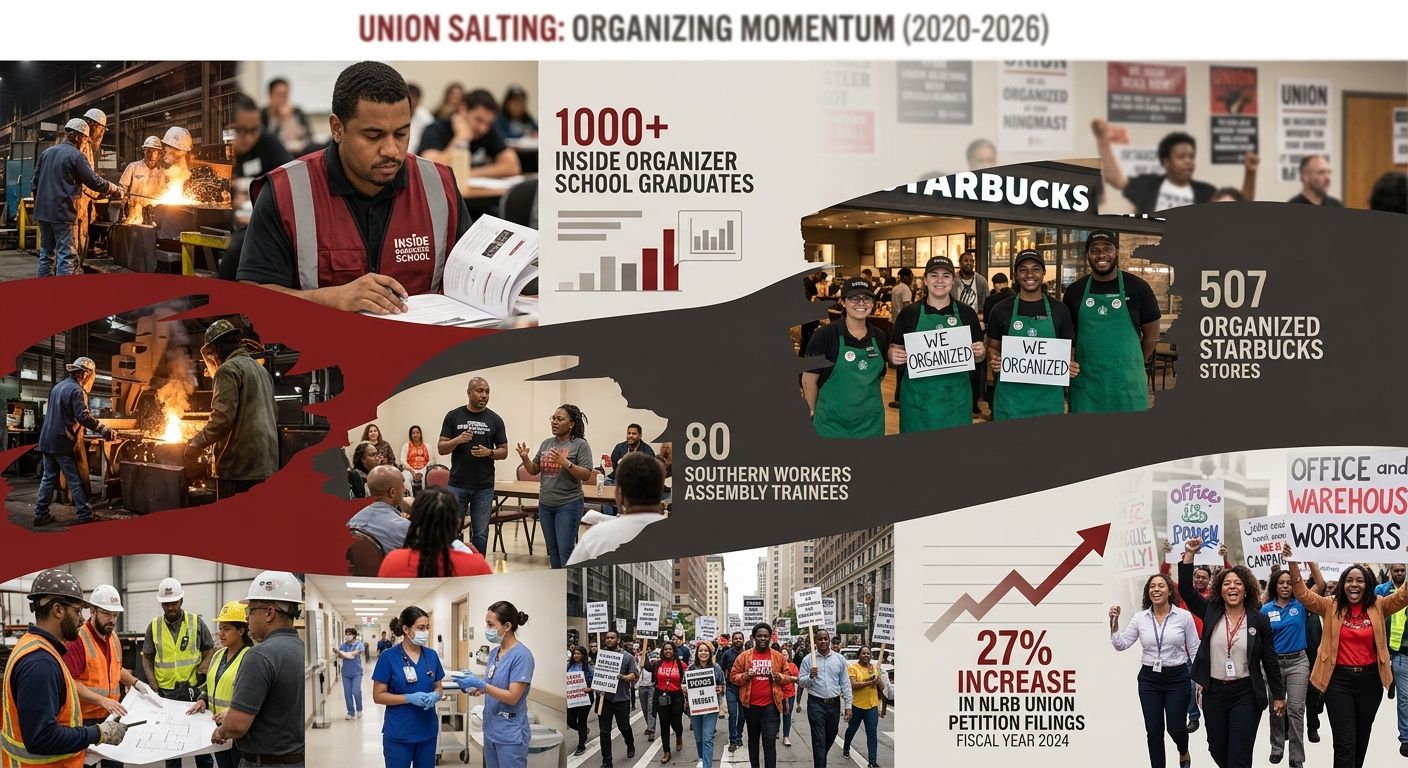
"I got hired at Starbucks because a friend got fired and nobody did anything about it. That's when I realized: you can't organize a workplace from the outside. You have to be in it." That's how Jaz Brisack, one of the most effective union organizers of the past five years, describes the decision that helped launch Starbucks Workers United. Brisack didn't sneak in. Didn't lie on an application. They applied for a barista job, made drinks, cleaned floors, and talked to coworkers about what a union could do for them. Within a year, a movement was born that now represents over 507 stores and more than 11,500 workers.
This is salting. It's one of the oldest and most effective union organizing methods in the American labor playbook, and right now it's experiencing a resurgence that corporate America is scrambling to contain.
What Salting Actually Is (And What It Isn't)
Salting is the act of getting a job at a specific workplace with the intent of organizing a union. A "salt" is an organizer who enters a non-union shop as a regular employee, does the work, earns the trust of coworkers, and builds support for collective bargaining from the inside out.
Let's be direct about something: anti-union employers and their lawyers love to frame this as "workplace infiltration strategy" or even espionage. That framing is dishonest. A salt is not a spy. A salt is a worker. They clock in, they do the job, they collect a paycheck, and they exercise their legal right to talk to coworkers about organizing. The National Labor Relations Act (NLRA) protects the right of employees to form or join a union, and the Supreme Court confirmed in NLRB v. Town & Country Electric (1995) that paid union organizers who also genuinely work for an employer qualify as "employees" under Section 2(3) of the NLRA.
Compare that to the actual history of workplace infiltration in this country. For decades, corporations hired labor spies to enter workplaces, identify union leaders, and destroy organizing campaigns. The Pinkerton Agency made a fortune doing exactly that. So when employers cry foul about salting, the hypocrisy runs deep.
Why Salting Works When Other Tactics Fail
Private-sector union density sits at a dismal 6%. Millions of workers want union representation but can't get it because traditional organizing models hit walls. External organizers can leaflet outside a warehouse or knock on doors in a neighborhood, but the conversations that change minds happen inside the workplace, during shifts, in break rooms, on loading docks.
That's exactly why the approach of building organizing campaigns from first conversation to first contract often requires someone on the inside who knows the terrain.
Here's what makes union salting tactics uniquely powerful:
Salts experience the same working conditions as everyone else. They're not outsiders guessing about problems. They live the understaffing, the wage theft, the unsafe equipment. That credibility can't be faked.
Daily proximity builds trust. Organizing is relationship work. A salt who covers someone's shift, helps train a new hire, or simply listens during lunch creates the kind of bonds that survive a boss's anti-union campaign.
Salts can identify organic leaders. Every workplace has someone coworkers naturally look to. A skilled salt spots those people early and brings them into the organizing committee.
Speed and surprise matter. The Starbucks campaign proved that a team of salts, working together, can build majority support before management even realizes what's happening. By the time corporate flew in union-avoidance consultants, the workers had already filed for an election.
The New Generation of Salts
This isn't your grandfather's union drive. Today's salting movement is organized, trained, and strategic in ways we haven't seen before.
The Inside Organizer School (IOS), co-led by Brisack and fellow Starbucks organizer Casey Moore, has trained over 1,000 people since its founding. The IOS deliberately uses the term "inside organizer" rather than "salt" to include both new hires entering a workplace to organize and existing employees who decide to step up. Their three-day retreats cover practical skills: how to inoculate coworkers against management retaliation, how to build an organizing committee, and how to launch a campaign with speed.
The Southern Workers Assembly launched its Rank and File Program in early 2024, placing organizers in the South's growing auto and battery plants. Around 80 people have attended training weekends. This connects directly to the UAW's $40 million investment in organizing the "Battery Belt" across Tennessee, the Carolinas, and Georgia, where over 75,000 new jobs have been created by EV manufacturing incentives.
And groups like the Emergency Workplace Organizing Committee (EWOC) are providing resources that help rank-and-file workers self-organize without waiting for an established union to show up. As EWOC explains, the goal is building foundational support for workers committed to self-reliance and mutual aid.
The rank-and-file organizing approach these programs teach is fundamentally different from the top-down model that dominated American labor for decades. When we look at how the organizing model compares to the service model, salting sits squarely on the organizing side. It puts workers at the center, builds power from below, and creates durable structures that don't collapse when a staff organizer moves on to the next campaign.
Legal Protections for Salts and the Limits Employers Face
The law here is clear but contested. Under the NLRA, workers have the right to organize, and employers cannot refuse to hire pro-union applicants because of their union sympathies. In the Aerotek case, a national employment screening service for non-union contractors failed to consider four union electricians for positions while placing many other electricians at non-union companies. That's textbook discrimination under Section 8(a)(3) of the NLRA.
But there's been a significant shift. In July 2025, the NLRB's Acting General Counsel William Cowen issued updated guidance that tightens scrutiny of salting cases. The new policy requires the General Counsel to prove that an applicant had a genuine interest in employment, not just union motives. Regions must now verify that applicants in mass campaigns actually authorized their submissions. Backpay for salts is no longer presumed.
This doesn't make salting illegal. But it does mean unions and organizers need to be more careful, more documented, and more strategic about how they execute these campaigns.
Here are the key legal protections that still stand:
Section 7 of the NLRA protects the right of employees to engage in "concerted activities" for mutual aid or protection, including talking about unions at work during non-work time.
Section 8(a)(1) makes it an unfair labor practice for employers to interfere with, restrain, or coerce employees exercising Section 7 rights.
Section 8(a)(3) prohibits discrimination in hiring or tenure based on union membership or activity.
The Department of Labor confirms that the NLRA protects the right of employees to form or join a union at a non-union workplace.
How to Run a Salting Campaign
We've seen enough campaigns succeed and fail to know what separates the two. If your union or organizing committee is considering undercover organizing through a salting approach, here's what the best campaigns get right.
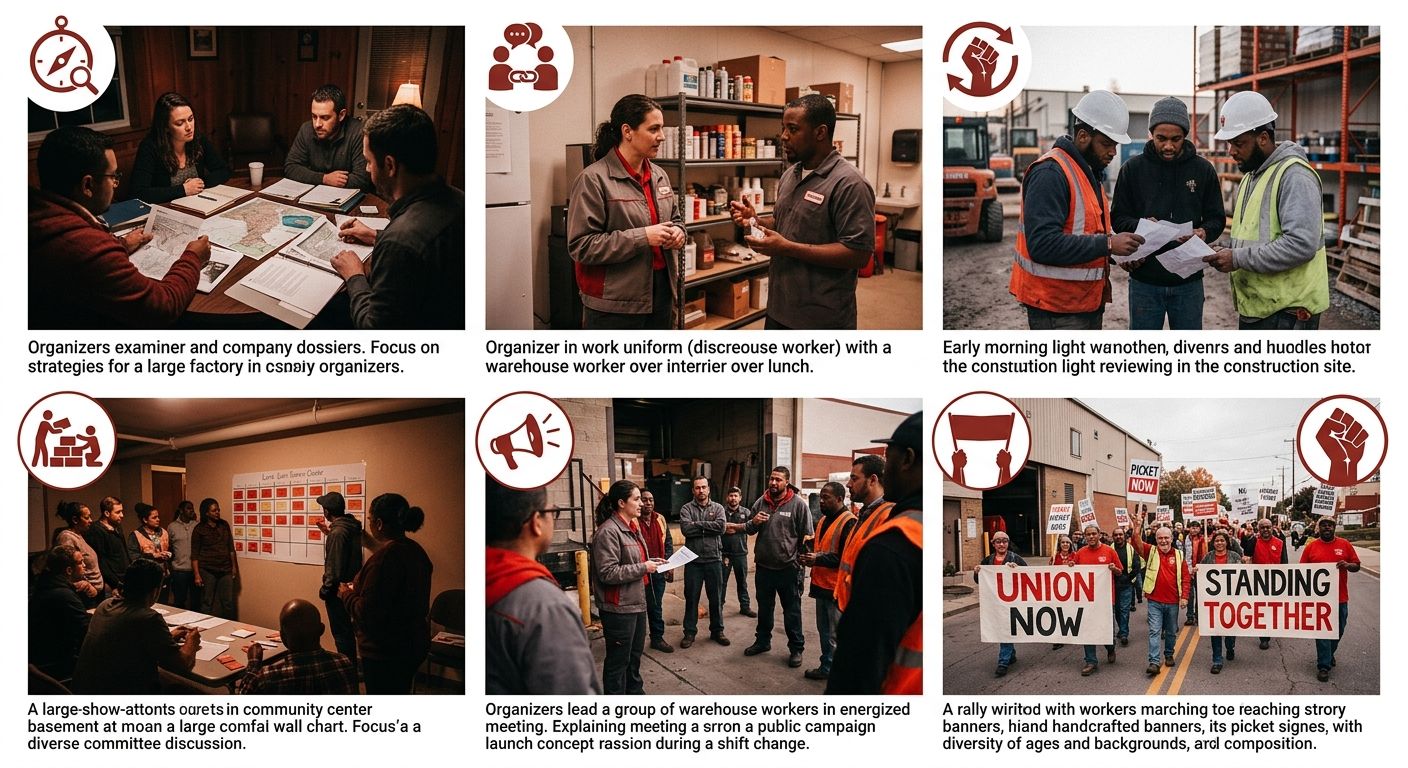
Step 1: Pick the Target Strategically
Not every non-union shop is a good salting target. Look for workplaces with high turnover (making it easy to get hired), visible worker grievances, and strategic importance to a broader industry campaign. The Starbucks effort worked partly because coffee shops hire constantly.
Step 2: Train Before You Deploy
Nobody should walk into a workplace cold. Programs like the Inside Organizer School exist for a reason. Salts need training in one-on-one organizing conversations, mapping the workplace (who works where, who influences whom), handling management intimidation, and understanding their legal rights. This is also where avoiding common mistakes with organizing tools becomes critical, because a careless text message or social media post can blow a campaign wide open before it's ready.
Step 3: Apply Honestly
This matters more than ever after the 2025 NLRB guidance change. Fill out the application completely and truthfully. Show genuine interest in the job. A salt who actually wants to do the work and does it well is both legally stronger and more effective at building coworker trust.
Step 4: Build Relationships First, Talk Union Second
The most common mistake new salts make is moving too fast. Spend your first weeks learning the workplace, identifying natural leaders, and building genuine friendships. The union conversation should grow organically from shared frustrations, not feel like a pitch from an outsider.
Step 5: Map the Workplace
Create a detailed picture of every worker: name, shift, department, attitude toward management, likely stance on unionizing. This map guides everything. You need to know where your support is strong, where it's weak, and who the swing votes are before you make any public move.
Step 6: Build the Committee, Then Go Public
A successful campaign needs an organizing committee that reflects the workforce across shifts, departments, and demographics. Get your committee solid before going public. Once management knows, the clock starts ticking and the union-busting playbook comes out.
What Employers Do to Fight Back
Be prepared. Anti-union employers spend billions on avoidance consultants. When they suspect salting, they'll tighten screening processes, monitor break room conversations, hold captive audience meetings, and sometimes fire suspected organizers on pretextual grounds.
Knowing that OSHA's updated standards protect you from retaliation for reporting safety concerns is one piece of the puzzle, but salts also need to understand that employers have legal avenues to push back. They can standardize interview processes, require detailed employment histories, and flag inconsistencies. The best defense is being an excellent worker with nothing to hide on your application.
And be aware that some employers' tactics cross legal lines. If you're disciplined or fired after management discovers your organizing activity, file an unfair labor practice charge with the NLRB immediately. Document every interaction. Save every text, email, and written warning. Your paper trail is your armor.
Why Salting Matters to the Future of American Labor
NLRB union petition filings rose 27% in fiscal year 2024 compared to 2023, more than double 2021 levels. Workers want unions. The obstacle isn't desire. It's access.
Salting bridges that gap. It brings experienced organizers into workplaces where no institutional union presence exists and creates the conditions for workers to choose representation on their own terms. As UE, one of the most rank-and-file-driven unions in the country, has demonstrated for decades, unions built by workers organizing themselves from the bottom up develop a fundamentally different character than those built from the top down. They're more democratic. More resilient. More willing to fight.
And salting connects to something larger. When organizing stays confined to workplaces that already have union history, the labor movement can't grow. Building power in non-union industries requires people willing to go where the work is, earn the trust of their coworkers, and build something together. It requires getting into communities beyond the workplace and showing people that collective action works.
Rand Wilson, a veteran labor organizer, puts it simply: "Employers are getting really good at keeping people very atomized. It's that special bond with your coworkers that is so critical to having a union."
Where to Begin If You're Ready to Organize
If you're reading this and thinking about becoming a salt, or supporting someone who is, here's where to start. Get trained by contacting the Inside Organizer School, EWOC, or your local union about organizing training programs. Know your rights by reading the NLRA and talking to a labor lawyer so you understand what's protected and what's risky under the current NLRB guidance. Connect with others, because salting works best as part of a coordinated campaign, not a solo effort — link up with experienced organizers who can support you. Be honest and be excellent, since the strongest salt is one who genuinely does the job well, files a clean application, and earns respect on the shop floor before ever mentioning the word "union." Document everything from day one: keep records of your hours, your interactions with management, any policy violations you witness, and any signs of retaliation.
The labor movement doesn't grow by waiting for workers to find us. It grows when organizers go where the workers are. Salting has been doing exactly that for generations, and today's new wave of inside organizers is proving it works. Private-sector union density won't climb from 6% on its own. Someone has to walk through the door, clock in, and start the conversation.
That someone could be you. Talk to your union. Get trained. Get hired. Get organizing.
The Union Edge Staff
Also in the paper