
How to Run a Workplace Safety Audit Before OSHA Shows Up: A Step-by-Step Union Guide
Unions that run their own workplace safety audits catch hazards months before OSHA inspectors arrive, build airtight documentation for grievances, and shift power over working conditions back to the shop floor.

How to Run a Workplace Safety Audit Before OSHA Shows Up: A Step-by-Step Union Guide
Unions that run their own workplace safety audits catch hazards months before OSHA inspectors arrive, build airtight documentation for grievances, and shift power over working conditions back to the shop floor. Three distinct approaches exist, each with different resource costs, time commitments, and levels of management involvement.
OSHA Doesn't Have Enough Inspectors — Your Union Does
OSHA inspection coverage across the United States is thin enough that most workplaces will never see a federal inspector in a given year. As we reported when covering the aftermath of a fatal chemical plant incident, six OSHA inspectors were responsible for 60,000 workplaces across West Virginia. That ratio means a single inspector covers roughly 10,000 worksites. Nationally, OSHA has about 1,850 federal and state inspectors for approximately 11 million workplaces under its jurisdiction, according to the agency's own data. At that pace, it would take the agency 165 years to inspect every covered workplace once.
OSHA's published hazard identification guidance spells this out clearly: the agency expects "input from workers, including surveys or minutes from safety and health committee meetings" as a primary source for identifying dangers. Translation: OSHA assumes workers and their representatives are doing much of the identification work already.
Your union has something federal inspectors don't: people on the floor every shift, every day, who know where the broken guardrails are, which ventilation systems stopped working in January, and which supervisors routinely skip lockout/tagout procedures. The question is how to organize that knowledge into a union safety audit that produces real results.
Three methods dominate. Each works. Each carries tradeoffs.
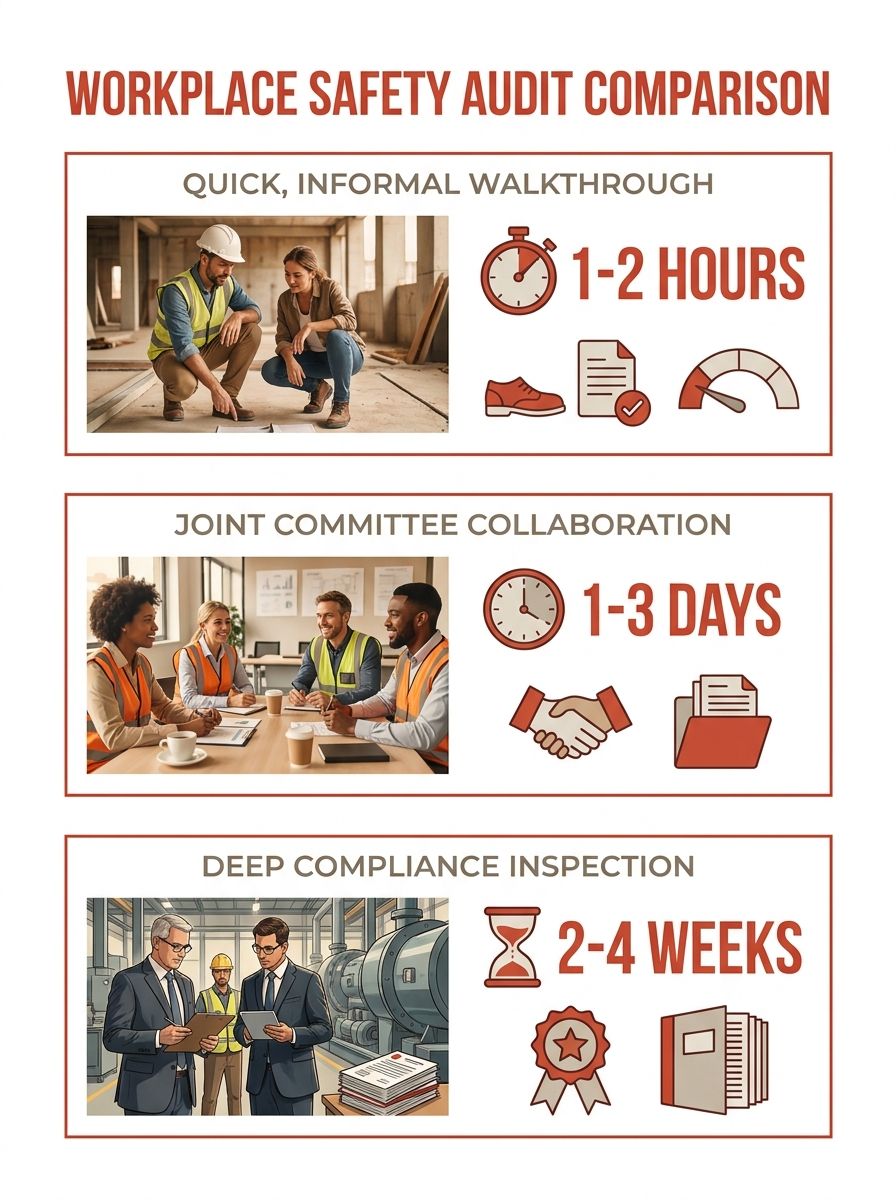
Feature | Steward Walkthrough | Joint Safety Committee Audit | Full-Scale Compliance Audit |
|---|---|---|---|
Time per cycle | 1–2 hours weekly | 4–8 hours monthly | 20–40 hours quarterly |
People needed | 1–2 stewards per area | 3–5 labor + management reps | 5–10 auditors, possibly external |
Management involvement | Minimal or none | Equal participation required | High, including document access |
Documentation produced | Informal logs, photos | Meeting minutes, formal reports | Full compliance binder |
Legal weight | Supports grievances | Creates joint record | Mirrors OSHA's own process |
Best for | Ongoing hazard tracking | Contract enforcement | OSHA inspection preparation |
Cost to the union | Steward time only | Committee training, meeting time | Significant time and possible consultant fees |
Steward Walkthroughs on the Shop Floor
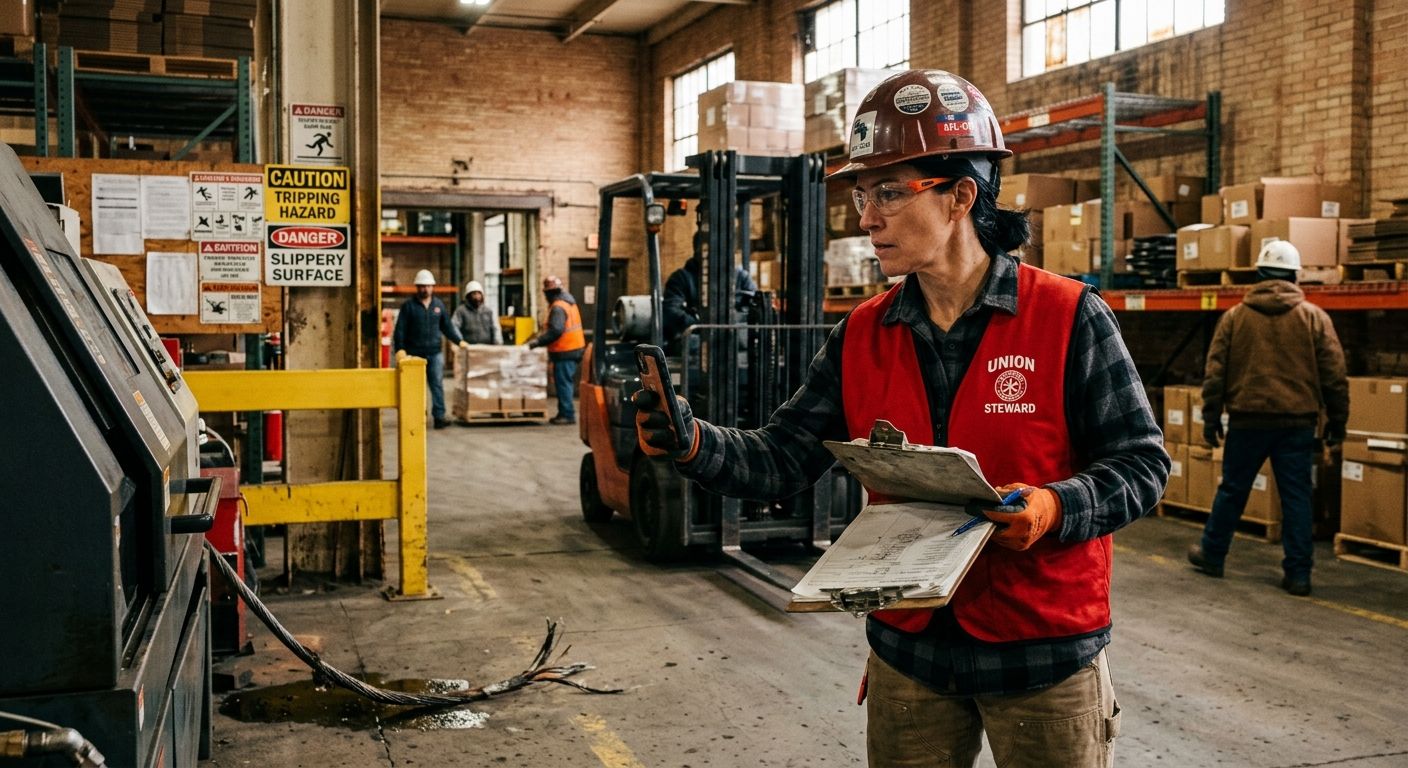
A steward walkthrough is the fastest, cheapest, and most repeatable form of union safety audit. One or two trained stewards walk a defined area of the workplace on a regular schedule, typically weekly, and document every hazard they find. No management cooperation is required. No committee structure needs to exist. The steward carries a checklist, a phone camera, and a notebook.
The OSHA Safety and Health Program Audit Tool, published in December 2017, uses a 4-tier scoring system: Not Implemented, Partially Implemented, Implemented with Minor Deficiencies, and Fully Implemented. Stewards can adapt this same framework when rating conditions in their area. Did management install the guard on the press? Not Implemented. Is the eyewash station accessible but expired? Partially Implemented. Writing it down in those terms gives your documentation the same language OSHA auditors use.
OSHA's published guidance on hazard identification lists 6 specific action items, including inspecting the workplace for safety hazards and characterizing the nature of identified hazards to prioritize them for control. Stewards doing walkthroughs are performing action items 2 and 6 directly.
What to document during each walkthrough
Every steward walkthrough should produce 5 categories of workplace hazard documentation: the specific hazard observed, its exact location, the date and time, who was exposed or at risk, and whether management was previously notified. Photographs are critical. As compliance guidance from UDS Health notes, records should include "certificates of completion, photographs of corrected hazards, or receipts for new equipment." If management claims they fixed something, the photo record from your steward walkthrough either confirms or contradicts that claim.
The tradeoff with steward walkthroughs is clear. They're informal. Management can dismiss them. They don't carry the institutional weight of a joint committee report, and they don't produce the kind of binder that makes an OSHA compliance officer nod approvingly. But they happen every week, they're entirely under union control, and they build an ongoing record that becomes powerful evidence over time. A single walkthrough log might be easy to wave off. Fifty-two weeks of documented hazards with dated photos are a different matter entirely.
Joint Safety Committee Audits
A joint safety committee audit involves both union representatives and management sitting at the same table, inspecting the same workplace, and signing off on the same findings. This is the approach with the most structural power, and it's the one that most closely aligns with what OSHA recommends.
Minnesota OSHA's Workplace Safety Consultation program offers a concrete model. According to the Minnesota Department of Labor and Industry, the state "can provide assistance to help employers develop an effective safety committee and to help maintain the effectiveness of an existing safety committee," including "interpretation of OSHA standards, training in self-inspection techniques," and help "preparing and/or presenting specific training and education programs." If your state has a similar consultation program, the union should push management to request it. It's free, and it establishes a formal framework that's hard for the employer to walk away from.
The NALC's joint labor-management safety and health committee training materials outline what an effective joint safety committee does: creates and maintains an interest in safety, promotes committee teamwork, reviews OSHA 300 logs and statistical reports, and works through case studies and group exercises. The training emphasizes that committees need equal labor and management representation, typically 3 to 5 members from each side, to function properly.
Where joint committees shine
When a joint committee documents a hazard, both sides have signed the report. That signature makes it extraordinarily difficult for management to later claim they didn't know about the problem. If OSHA does show up and finds that same hazard uncorrected, the joint committee minutes become evidence that the employer had actual knowledge and failed to act. Under OSHA's General Duty Clause, Section 5(a)(1) of the OSH Act, employers must provide a workplace "free from recognized hazards." A joint committee report is proof of recognition.
If your collective bargaining agreement includes safety committee language, this approach deserves serious attention. We've previously explored how unions win hazard control through formal joint representation, and the pattern holds: committees with contractual authority to investigate, document, and recommend corrective actions produce measurably better outcomes than informal systems.
The tradeoff is speed and independence. Joint committees require management's participation, which means scheduling meetings that work for both sides, negotiating over disputed findings, and sometimes watching management representatives water down conclusions. If your employer is hostile to union involvement in safety, getting a functioning joint committee off the ground can take months of grievances and pressure. And the committee only meets monthly in most setups, compared to a steward walkthrough's weekly rhythm.
Full-Scale Internal Compliance Audits
A full-scale compliance audit mirrors the process OSHA itself uses when conducting a planned inspection. It reviews written programs, training records, injury and illness logs, equipment maintenance schedules, and physical conditions across the entire facility. This is the most labor-intensive option, requiring 20 to 40 hours per quarterly cycle and a team of 5 to 10 people, but it produces the strongest documentation for OSHA inspection preparation.
OSHA's Safety and Health Program Audit Tool breaks this process into 4 major sections: Management Leadership, Worker Participation, Hazard Identification and Assessment, and Hazard Prevention and Control. Each section contains specific requirements scored on the 4-tier system. Section 2, Worker Participation, specifically evaluates whether the employer "rewards worker contributions to workplace safety and health." If your employer scores "Not Implemented" on that requirement, you've identified both a compliance gap and a bargaining opportunity.
Building the audit binder
The audit should produce a physical or digital binder organized by OSHA standard number. For general industry workplaces, that means reviewing compliance with 29 CFR 1910 standards covering at minimum: hazard communication (1910.1200), lockout/tagout (1910.147), personal protective equipment (1910.132–138), fire protection (1910.155–165), and walking/working surfaces (1910.21–30). For construction sites, the equivalent is 29 CFR 1926. Each section of the binder should contain the relevant written program, training records with dates, inspection logs, and any corrective action documentation.
OSHA's guidance on hazard prevention and control states that "effective controls protect workers from workplace hazards; help avoid injuries, illnesses, and incidents; minimize or eliminate safety and health risks." Your binder should map each identified hazard to the specific control measure in place, creating a direct line from problem to solution that any inspector can follow.
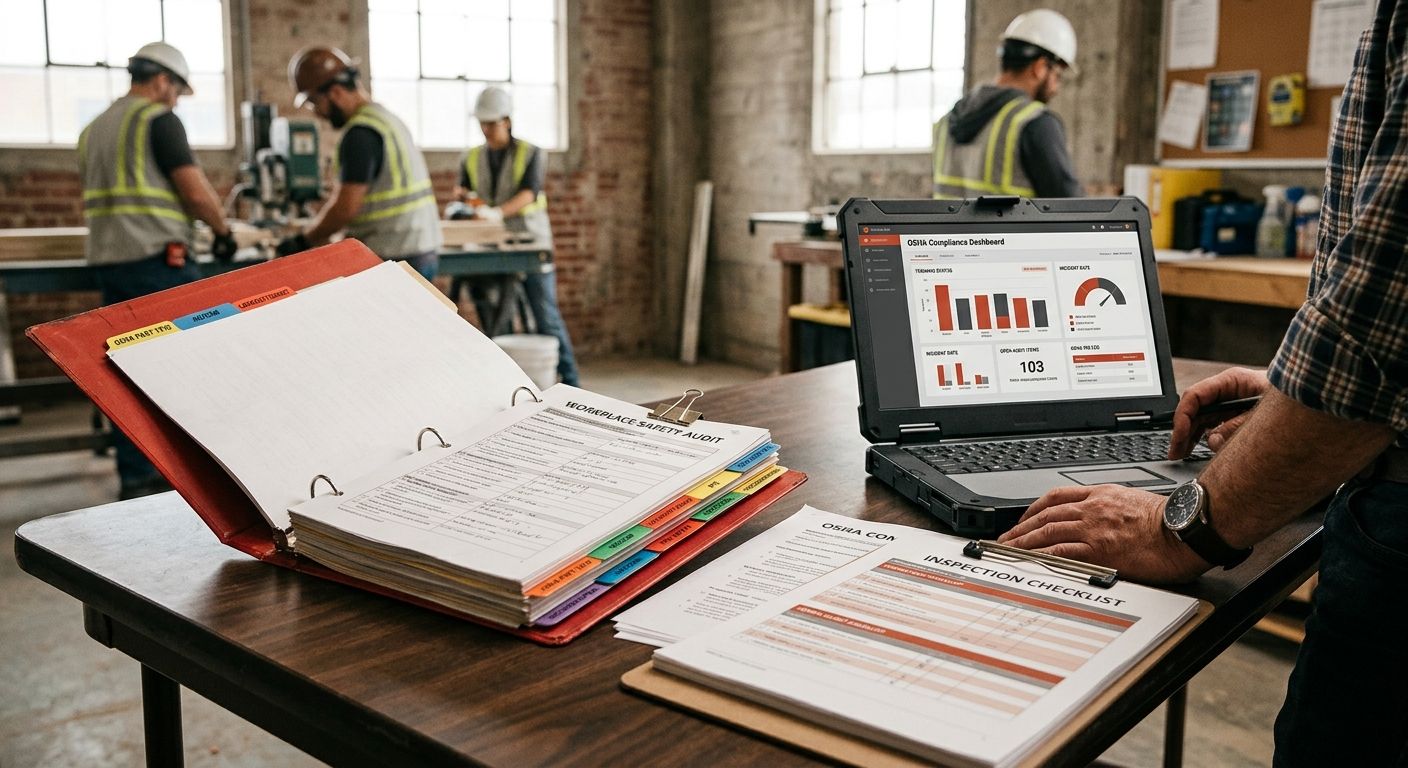
The tradeoff here is obvious: resources. A full-scale audit demands serious time from union officers and stewards who already have packed schedules. It often requires training that most locals don't have in-house. And it works best when the union has some level of cooperation from management, because accessing training records, OSHA 300 logs, and equipment maintenance files typically requires employer participation or a contractual right to information requests. If management stonewalls, the audit becomes incomplete, and an incomplete audit can create a false sense of security.
The approach also carries a political risk worth naming. If the union conducts a full-scale audit and finds serious violations, management will argue that the union was aware of the hazards too. This is why documentation discipline matters. Every finding should include a formal written notification to management with a date stamp, creating a clear record that the union identified the hazard and reported it. The union's role is to find problems and demand fixes. The employer's legal obligation is to actually fix them.
Who Should Pick Which
The right approach depends on 3 factors: what your contract says, how cooperative management is, and how urgent the safety problems are.
If you have no safety committee language in your contract and management is hostile, start with steward walkthroughs. They require zero management buy-in, cost nothing beyond steward time, and begin building the documentation trail immediately. A steward walkthrough every week for 12 weeks gives you a body of evidence strong enough to file grievances, submit OSHA complaints, or pressure management into forming a joint committee. Understanding the difference between organizing models and service models helps here, because steward walkthroughs are fundamentally an organizing tool. They get members involved in identifying their own workplace dangers.
If your contract includes joint safety committee provisions, use them aggressively. Push for monthly meetings with a rotating inspection schedule that covers every department at least once per quarter. Insist on written minutes signed by both labor and management representatives. And supplement the committee's work with steward walkthroughs between meetings, so hazards that emerge mid-month don't sit undocumented for weeks.
If you have reason to believe OSHA is coming, whether because of a complaint filing, a serious injury, or an inspection pattern in your industry, run the full-scale compliance audit. The 20 to 40 hours it takes to complete one is a fraction of the cost your members will pay if OSHA finds willful violations, which carry penalties of up to $161,323 per violation under 2024 penalty amounts. Treat the audit as an investment in your members' safety and your union's credibility.
You can also layer these approaches. Steward walkthroughs feed findings into joint committee meetings, which identify patterns that justify a full compliance audit. The three methods aren't competing strategies. They're stages of the same system, and the strongest union safety programs run all three at different intervals, building a record that protects workers whether OSHA shows up next month or never shows up at all.
The Union Edge Staff
Related Articles

Workplace Safety Moments That Save Lives
Three formats dominate how employers run workplace safety moments before shifts: management-scripted toolbox talks, worker-led peer discussions, and joint safety committee programs backed by union contracts.

The Safety Committee Power Play: How Unions Win Workplace Hazard Control Through Formal Joint Representation
Workplace safety committees without union backing don't reduce injury rates.

How One Poultry Plant's Safety Committee Won LOTO Enforcement After Three Amputations — A Case Study in Grievance-to-Policy Conversion
OSHA's lockout tagout standard, 29 CFR 1910.147, has been federal law since 1989. Poultry plants still rank among its worst violators.
Also in the paper