
The Organizing Model vs. Service Model: Why Your Union's Strategic Choice Determines Campaign Success
Thirty-one percent. That's the win rate for private-sector union elections in the United States, according to the Economic Policy Institute, after workers endure the full weight of employer anti-union campaigns. The number is grim, but it hides something important.

The Organizing Model vs. Service Model: Why Your Union's Strategic Choice Determines Campaign Success
Thirty-one percent. That's the win rate for private-sector union elections in the United States, according to the Economic Policy Institute, after workers endure the full weight of employer anti-union campaigns. The number is grim, but it hides something important. Some unions consistently outperform that average, winning elections and then winning strong first contracts. Others lose campaigns they should have won, or win the vote only to watch their bargaining power evaporate within two years. The difference between these outcomes often traces back to a single structural decision made long before any election petition gets filed: whether the union operates as a service model or an organizing model. That choice shapes everything from how dues get spent to whether rank-and-file members see themselves as consumers of a service or participants in a movement. And right now, as organizing drives surge through tech companies, healthcare systems, and logistics warehouses, the tension between these two models has become the defining internal debate of the American labor movement.
What the Service Model Promises and Where It Breaks Down
The service model is the older of the two approaches, and its appeal is easy to understand. Under this framework, union staff function much like attorneys or insurance adjusters. Members pay dues, and in return they receive professional representation: grievance handling, contract negotiation, legal counsel. The relationship mirrors a transaction. Workers bring their problems to the union hall, and paid representatives try to solve those problems on their behalf. For decades, this was simply how unions ran. It worked well enough when union density was high and employers treated collective bargaining as a normal cost of doing business.
The trouble is that the service model creates a passive membership. When workers view the union as an outside organization that services their needs, they stop thinking of it as something they own. Attendance at meetings drops. Steward positions go unfilled. Contract campaigns become the responsibility of a handful of paid staff rather than a broad mobilization of the workforce. The Massachusetts Nurses Association, which has published one of the clearest comparative frameworks between the two models, describes the service model's attitude toward employers as prioritizing a "good relationship with management" above all else. That priority often translates into cautious bargaining, where staff representatives avoid confrontation because they'll need to work with the same managers on the next grievance.
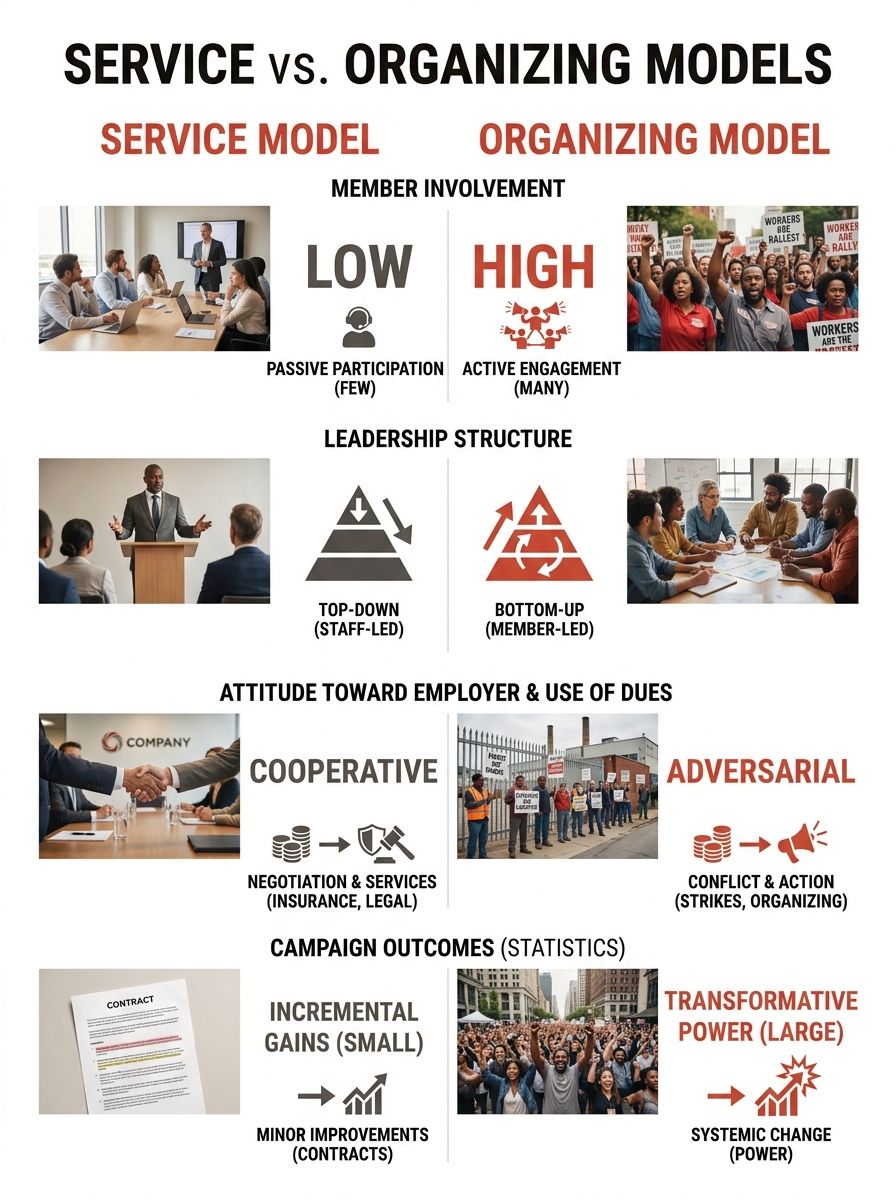
The math doesn't favor this approach. A union local with 500 members and two full-time staff reps can only process so many grievances per month. When the employer decides to push back hard during contract negotiations, those two reps can't generate the kind of workplace pressure that forces real concessions. They can file unfair labor practice charges. They can send strongly worded letters. But they can't shut down a department floor with a credible strike threat, because the membership hasn't been organized to take collective action. The service model treats the union like a law firm. Workers who've never been asked to do anything except pay dues are unlikely to walk a picket line when it matters.
How Organizing-Model Unions Build Power Differently
The organizing model starts from a fundamentally different premise: the union's power comes from the active participation of its members, and every decision about union structure should be designed to increase that participation. Dues still get collected. Grievances still get filed. Contracts still get negotiated. But the work of the union is distributed across a much larger group of trained workplace leaders rather than concentrated in a small professional staff.
In practice, this means the organizing model requires constant investment in member education and leadership development. Stewards aren't appointed to fill a bureaucratic role; they're trained to have one-on-one conversations with coworkers, identify workplace issues, and build support for collective action on the shop floor. The union doesn't wait for workers to bring complaints to the office. Instead, organizers go to where workers are, mapping the workplace, identifying natural leaders, and building the kind of relationships that turn individual frustration into group demands. We've written before about why organizers fail when they wait for workers to come to them, and the organizing model is essentially the structural answer to that problem.
The data backs up the approach. Unions with active member engagement programs report 23% higher contract satisfaction rates and 31% better grievance resolution outcomes compared to unions focused solely on contract negotiations, according to research compiled by Solidarity Tech. Those numbers make intuitive sense. When more workers are involved in identifying priorities before bargaining begins, the resulting contract is more likely to address the issues that actually matter to the workforce. And when workers have been organized around specific demands during the negotiation process, they're more likely to ratify the final agreement and enforce its terms on the job.
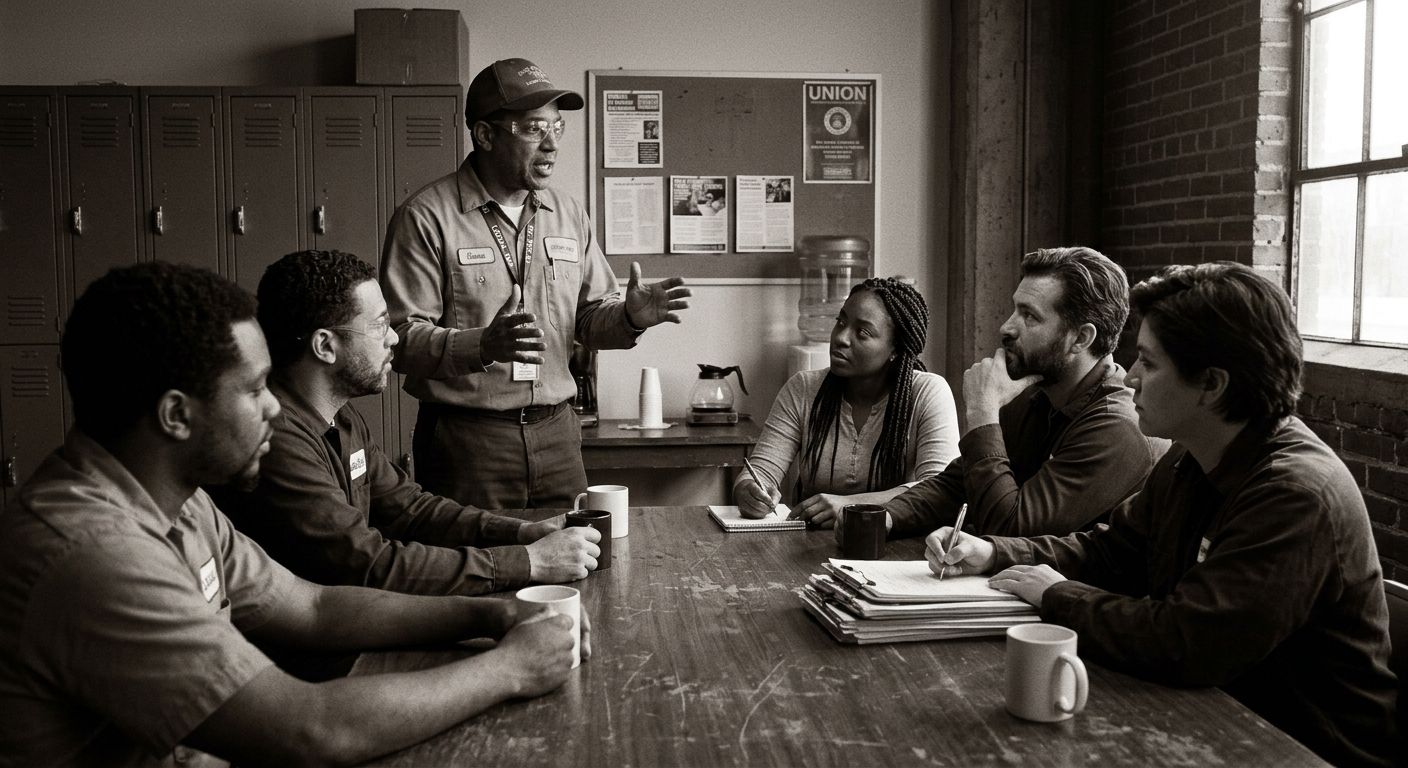
The organizing model also changes who leads the union. Service-model unions tend to develop top-heavy leadership structures where the same officers serve for decades and staff representatives accumulate institutional knowledge that members never access. Organizing-model unions push in the opposite direction, trying to make their leadership reflect the workforce's demographics and rotating responsibilities so that more members gain experience with union governance. This matters enormously for retention. A worker who has served as a steward, participated in a bargaining committee, or helped organize a new unit has a personal stake in the union that goes far beyond the transactional calculation of dues-for-services.
Collective Bargaining Under Each Model Looks Like a Different Sport
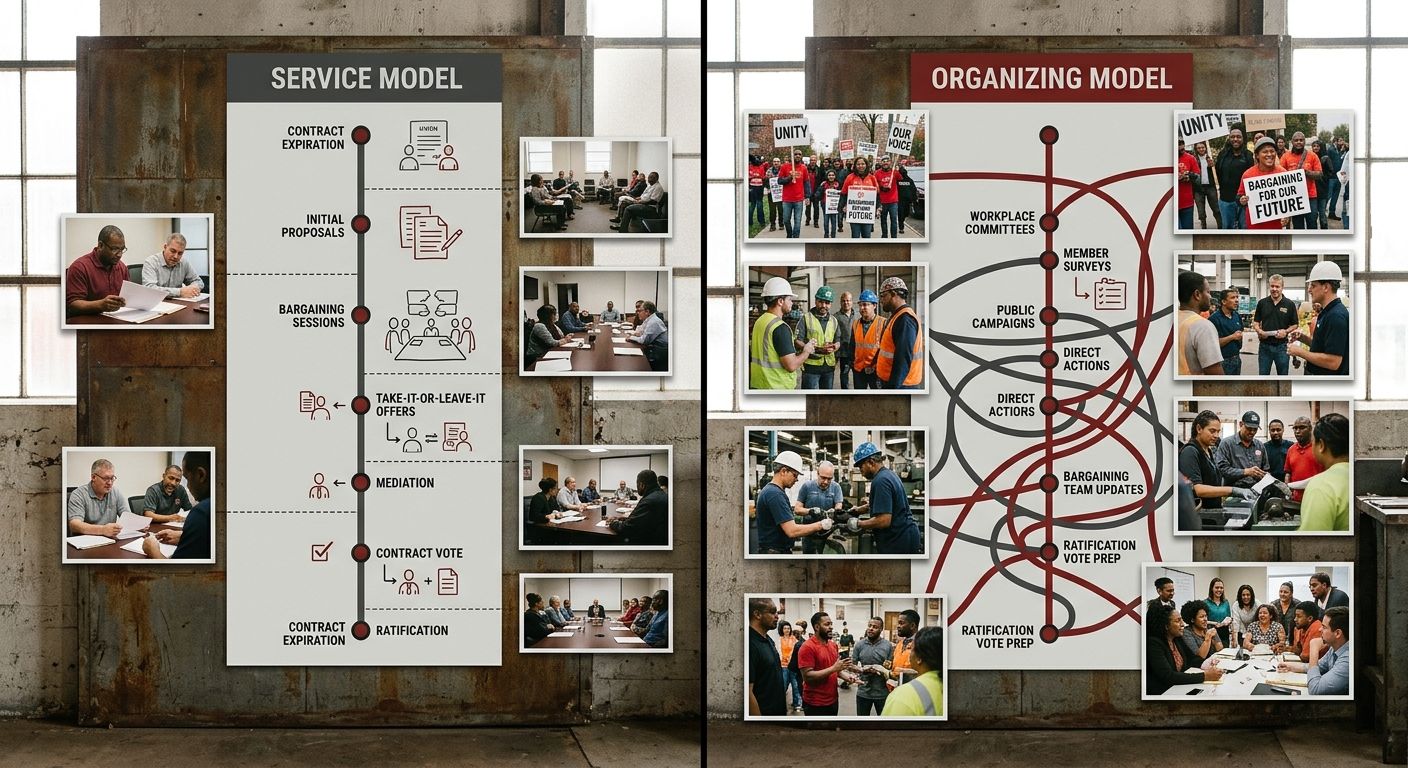
The clearest place to see the difference between the two models is at the bargaining table. Under the service model, collective bargaining tends to follow a familiar script. Management presents its proposals. The union's professional negotiators counter. Both sides trade concessions across several sessions. If the gap is small enough, a deal gets reached. If not, the union files for mediation or, in rare cases, threatens action. The membership hears about the process through occasional updates and votes to ratify whatever the negotiators bring back. As the AFL-CIO has documented, collective bargaining remains the best vehicle for raising wages and improving conditions for working people. But the process works differently depending on how much real power the union brings to the table.
Under the organizing model, bargaining is treated as a campaign. Long before the first session, stewards are gathering information from coworkers about their priorities. Bargaining surveys go out. Town halls are held. By the time the union sits down with management, the negotiating committee isn't guessing at what workers want; they have detailed data. And the workers themselves know exactly what's being asked for and why. If management stalls on a key issue, the union can escalate quickly because the groundwork for collective action has already been laid. A petition signed by 80% of the workforce. A coordinated slowdown. A public action that draws media attention. These pressure tactics require a mobilized membership, which is precisely what the organizing model is designed to produce. The recent healthcare worker mobilization at the University of California showed how credible strike threats from organized workforces can force employers back to the table with real offers.
This dynamic extends well beyond any single contract fight. Unions that follow the organizing model tend to build political capacity over time. Research from the University of Chicago found that when unions supported political candidates, those candidates saw their vote share increase by six percentage points, a result driven by the unions' ability to professionalize campaigns and provide strategic support. That kind of electoral influence doesn't come from writing checks. It comes from having thousands of engaged members who will knock on doors, make phone calls, and turn out on election day. A service-model union can endorse candidates. An organizing-model union can deliver votes.
The tension between the two models also shows up in how unions handle internal conflict. Service-model unions often struggle with contested elections, factional disputes, and member apathy because the structure doesn't give most workers a meaningful role in governance. When something goes wrong, members blame the staff reps the way a customer blames a contractor. Organizing-model unions still have internal conflicts, but the broader distribution of responsibility tends to produce members who understand the constraints their union operates under and engage with disagreements constructively rather than simply withdrawing.
Building a serious organizing committee with well-educated worker leaders is where most of this work succeeds or fails. Without that foundation, even a union that claims to follow the organizing model will drift back toward servicing habits under the pressure of daily casework.
Where the Choice Gets Harder Than the Theory
The honest version of this argument is that the organizing model is harder. It requires more time, more training, more tolerance for messy democratic processes, and a willingness to share power that many incumbent union leaders find uncomfortable. A service-model union can operate with a small, professional staff that handles everything efficiently. An organizing-model union needs dozens or hundreds of trained volunteer leaders who may not always agree with each other or with the elected officers. It demands that paid staff shift their role from problem-solver to coach, which can feel like a demotion for reps who built their careers on being the person who fixes things.
There's also a real question about resources. The organizing model requires, as Wikipedia's overview of the framework notes, a "relatively high level of membership dues" to sustain the training programs, communications infrastructure, and organizer positions that keep the model running. In right-to-work states where non-members can free-ride on union contracts without paying dues, the financial math becomes brutal. A union that can't fund organizer positions will default to servicing because that's what a skeleton staff can manage. The structural choice between models is never made in a vacuum; it's shaped by legal frameworks, employer behavior, and the economic conditions workers face.
We remain convinced, based on what we've seen across campaigns and contracts, that the organizing model produces stronger unions, better contracts, and more durable worker power. The evidence supports that conclusion. But we also recognize that many local unions are caught between the model they want to run and the model their resources allow. A local with 200 members in a hostile legal environment, facing an employer with unlimited money for anti-union consultants, may not have the luxury of building a full organizing infrastructure before its next contract expires. These unions face genuine dilemmas, and dismissing their practical constraints doesn't help anyone.
What keeps us up at night is the feedback loop. Service-model unions produce passive members, which leads to weaker contracts, which leads to lower satisfaction, which leads to declining membership, which leads to fewer resources, which makes the shift to an organizing model even harder. Breaking that cycle requires intentional choices by union leaders and active engagement from rank-and-file members who are willing to invest their own time in building something collective. The strategic choice between these models isn't abstract. It determines whether your union will be around in ten years and whether it will be worth belonging to.
The Union Edge Staff
Related Articles

From Recognition to Results: The Post-Election Bargaining Roadmap Unions Get Wrong
Forty-four percent of newly certified unions between 1999 and 2004 never reached a first contract, according to a study of more than 8,000 successful elections by sociologist John-Paul Ferguson. The election was the easy part.

Beyond the Union Office: Why Organizers Fail When They Wait for Workers to Come to Them
Campaigns that file for an NLRB election with 60–70% worker support win 78% of the time. Campaigns built primarily on walk-in interest at a union hall rarely come close to that success rate.

Leadership Density Over Card Counts: Why Union Authorization Metrics Fail and What Actually Predicts Organizing Success
Authorization cards measure interest, not resilience.
Also in the paper