
The Safety Committee Power Play: How Unions Win Workplace Hazard Control Through Formal Joint Representation
Workplace safety committees without union backing don't reduce injury rates.

The Safety Committee Power Play: How Unions Win Workplace Hazard Control Through Formal Joint Representation
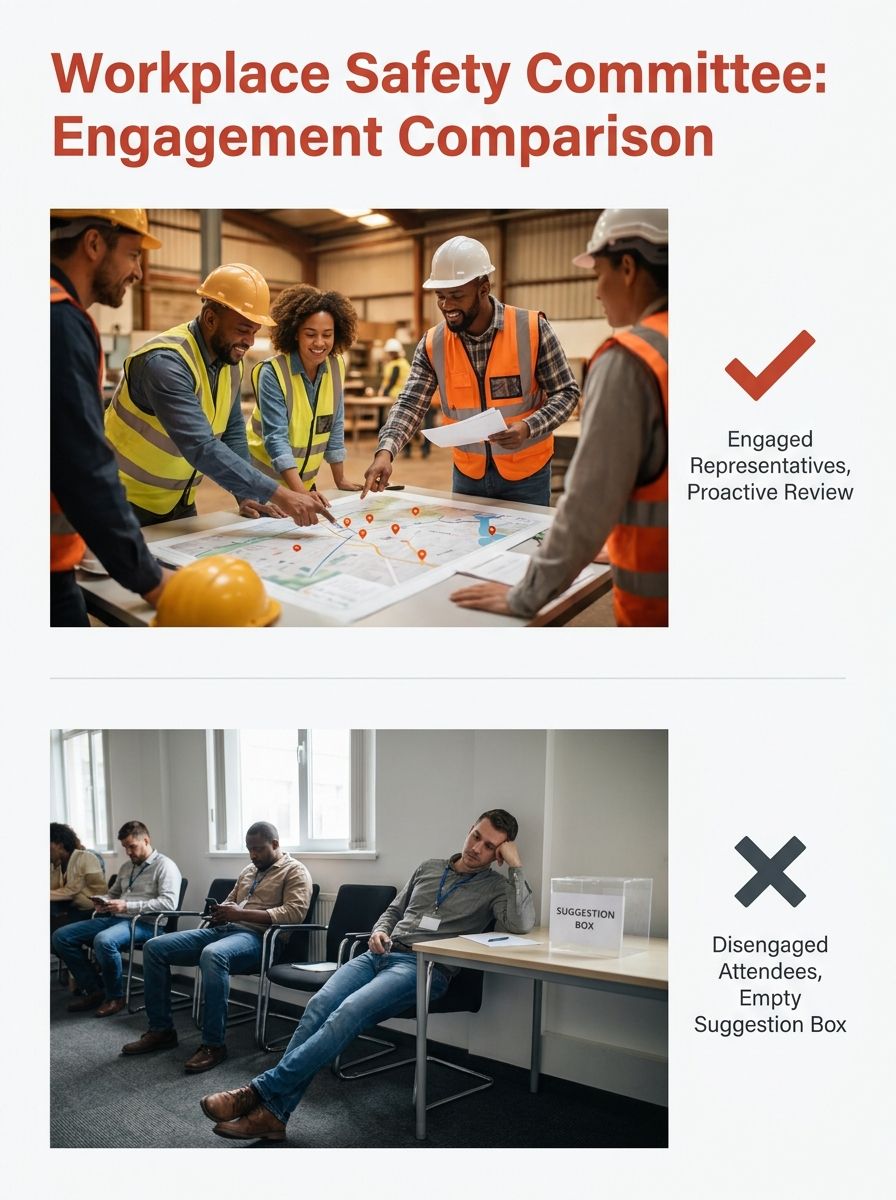
Workplace safety committees without union backing don't reduce injury rates. A systematic review conducted for the Canadian Ministries of Labour examined decades of data across provinces and industries and reached that blunt conclusion: only union-supported health and safety committees showed a significant impact in reducing injuries. The non-union versions looked identical on paper. They had the same meeting schedules, the same inspection checklists, the same employer-appointed members sitting around the same conference table. And they produced nothing measurable.
This finding upends a comfortable assumption shared by regulators, HR departments, and even some workers themselves. The assumption goes like this: if you create a formal body, give it a name, assign it responsibilities, and schedule monthly meetings, safety improves. It doesn't. The committee structure is a shell. What fills that shell determines whether anyone goes home safer. And unions fill it with three things management-only committees cannot provide: enforceable contract language, trained worker representatives who can't be fired for speaking up, and a power balance that forces employers to act on recommendations rather than file them away.
The Evidence Gap Between Union and Non-Union Committees
A realist review published in the journal Safety Science gathered experts from across Canada representing government, employers, and unions to examine what actually makes joint safety committees effective. Thirty-one studies met their inclusion criteria. The mechanisms they identified as critical for effectiveness were: adequate information, education, and training; appropriate committee composition; and sufficient authority to act.
Non-union committees consistently fell short on all three.
Here's why. When a safety committee exists only because a regulation requires one, the employer controls who sits on it, what information flows to it, and whether its recommendations get funded. Workers on these committees serve at the pleasure of management. They can be removed, reassigned, or simply ignored. The committee meets its legal obligation by existing, not by producing results.
Union-backed joint safety committees operate differently. The union selects its own representatives. Those representatives have contractual protection against retaliation. The committee's authority, meeting frequency, and access to incident data are written into the collective bargaining agreement. And when recommendations go ignored, the union has a grievance procedure to escalate the dispute.
Research from Ontario's auto industry confirms this dynamic. Hall et al., interviewing unionized health and safety representatives, found that the most effective approach was one they called active worker representation, where reps used their contractual rights to push employers beyond minimum compliance. The least effective committees were those where worker reps adopted a cooperative stance without any structural power behind it. Good intentions without enforceable rights produced the same results as no committee at all.
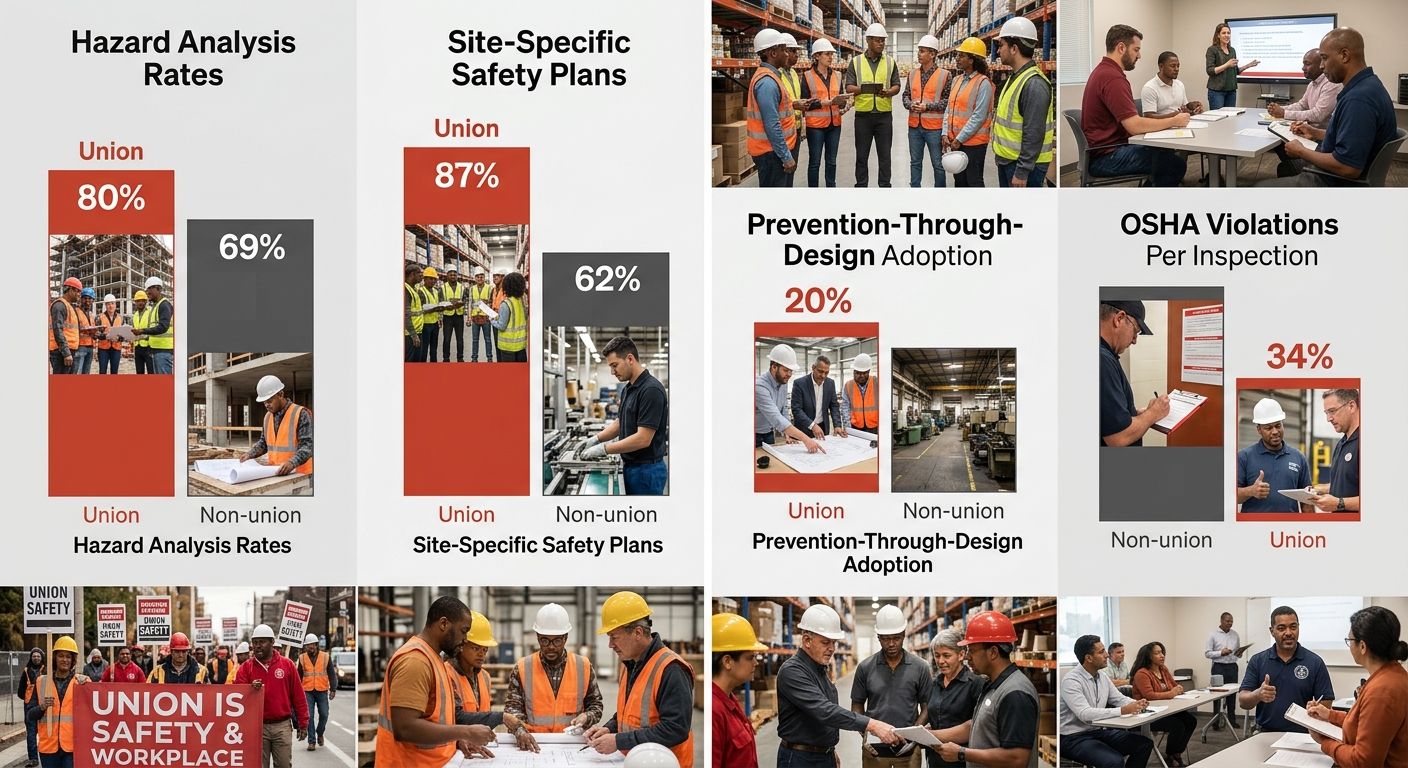
The data from CPWR surveys of 3,000 construction firms reinforces this pattern. Union contractors were 20% more likely to use prevention-through-design practices. Eighty percent conducted hazard analyses before starting projects, compared to 69% of non-union firms. And 87% implemented site-specific safety plans versus 62% on the non-union side. These gaps aren't random. They reflect the structural demands unions embed in contracts.
Contract Language Is Where Hazard Control Lives or Dies
The Teamsters put this plainly: the rights, responsibilities, and structure of the joint committee should be spelled out clearly in the contract in order to produce a focused and effective group. Vague safety language gives management room to comply on paper while changing nothing on the floor. Specific contract language pins down who sits on the committee, how often it meets, what data it can access, what timelines employers must follow when responding to recommendations, and what happens when they don't respond.
This matters more than many locals realize. The difference between a useful safety governance structure and a decorative one often comes down to a handful of clauses. Consider the hierarchy of controls. OSHA's own framework says employers should first try to eliminate a hazard, then engineer it out, then put administrative controls in place, and only then rely on personal protective equipment like gloves, masks, and harnesses. But without contract language enforcing that hierarchy, employers default to the cheapest option: handing workers PPE and calling the problem solved.
Unions can negotiate language requiring that employers will first consider engineering and administrative controls before workers are required to use PPE. That single clause changes the entire dynamic. Instead of asking workers to protect themselves from a hazard, it forces the employer to remove or reduce the hazard itself. One approach puts the burden on the worker. The other puts it on the employer, where it belongs.
UC Berkeley's Labor Occupational Health Program maintains an extensive collection of sample contract language taken from actual collective bargaining agreements covering everything from infectious disease protocols to ergonomic evaluations to climate-related hazards. These aren't theoretical suggestions. They're clauses that real unions bargained, won, and enforced. The UAW negotiated language allowing up to seven trained Ergonomic Monitors per plant, each receiving a full week of specialized training. The United Steelworkers secured the right to shut down operations presenting imminent danger in their agreement with ArcelorMittal. SEIU won requirements for the strongest feasible protections against bloodborne and airborne diseases, including engineering controls and training programs.
If your local is approaching the bargaining table with a general request for "improved safety," you're leaving the most powerful tool unused. When you're negotiating workplace-specific contracts, the specificity of your safety language determines whether management treats the committee as a partner or a formality. Spell out the committee's right to review OSHA 300 logs monthly. Spell out employer response timelines. Spell out funding for independent industrial hygiene testing. Every vague sentence is a loophole.
Training and Information Access Separate Real Committees from Theater
The Canadian realist review identified training as one of the three critical mechanisms for committee effectiveness. This makes intuitive sense. A worker representative who doesn't understand how to read an air quality report, interpret an injury trend, or identify a machine guarding deficiency can't push back effectively when management says everything is fine. Training turns committee seats into actual power.
But training doesn't happen by accident. Non-union committees rarely receive more than a brief orientation. Union-backed committees, by contrast, can bargain for employer-funded training that covers hazard recognition, industrial hygiene basics, ergonomic assessment, and workers' legal rights under OSHA. The research from the pandemic era makes this case even more clearly. A study on health and safety representatives during COVID-19 found that the agency of trained reps operated independently of formal structures. In other words, trained union reps pushed for protections even when the regulatory framework hadn't caught up to the crisis. Their knowledge gave them the standing to demand changes that untrained workers couldn't articulate.
This connects directly to how communication breakdowns create hazards in the first place. When worker representatives lack training, they can't translate floor-level knowledge into the technical language that forces management to respond. They know something feels dangerous. They can't explain why it violates a specific standard. Trained reps bridge that gap.
Information access is the other half of this equation. Joint safety committees function only when worker representatives can see the same data management sees. That means injury logs, near-miss reports, workers' compensation claims, inspection findings, and results from environmental monitoring. Unions that bargain for transparent data sharing give their committee members the evidence they need to identify patterns management might prefer to ignore. If your workplace has systems for anonymous hazard reporting, the committee should be reviewing those submissions too, looking for recurring themes that point to systemic problems rather than isolated incidents.
British Columbia's WorkSafeBC provides templates and tools for joint committee operations, including structured inspection forms, meeting agendas, and recommendation tracking sheets. These resources are useful, but they work best when the committee has contractual teeth. A well-formatted recommendation that gets filed in a drawer is still worthless.
Composition Determines Whether Worker Representation Is Real
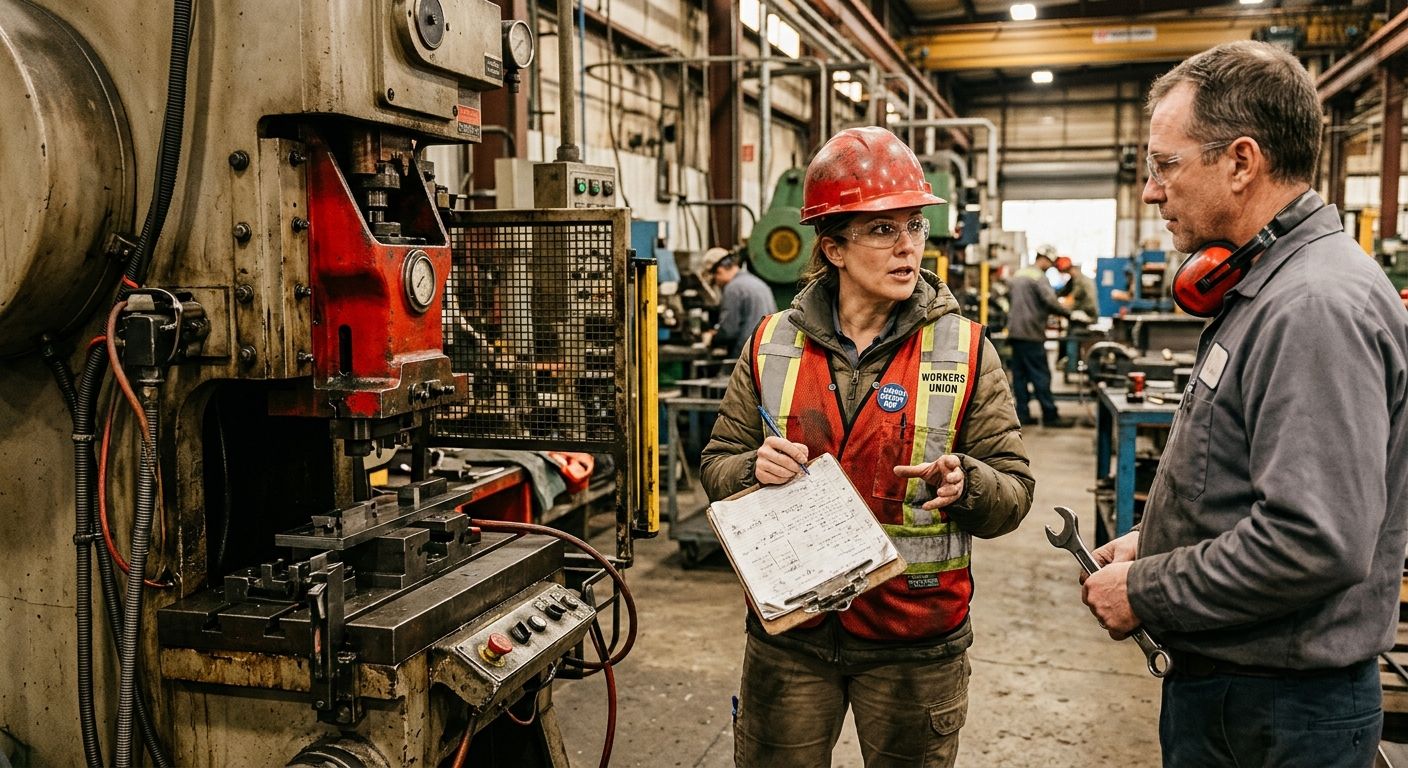
Who sits on the committee matters as much as what the committee does. The systematic review flagged appropriate committee composition as a key mechanism of effectiveness. This means equal representation between workers and management, selection of worker reps by the union rather than by management, and inclusion of members who actually work on the floor rather than office-based supervisors who rarely encounter the hazards being discussed.
This is where many non-union committees fail completely. Management appoints worker representatives who are cooperative, unlikely to raise uncomfortable issues, and dependent on management favor for their positions. The result is a committee that looks balanced on an organizational chart but operates as a management advisory panel.
Union locals should insist on several composition requirements in contract language. First, worker representatives must be selected by the union, not volunteered or appointed by the employer. Second, the committee should include representatives from each major work area or shift, so that night-shift hazards and warehouse conditions get the same attention as daytime office issues. Third, committee members need protected time to conduct inspections, attend training, and investigate incidents without losing pay or being required to make up hours. And fourth, the co-chair structure should alternate between labor and management, ensuring the agenda isn't controlled by one side.
The organizing model versus service model debate within the labor movement is directly relevant here. Locals that treat safety committees as a service provided to members miss the organizing potential. Every hazard identified and resolved through the committee demonstrates union value to the rank and file. Every management refusal to act on a recommendation becomes an organizing issue. Safety committees, run well, are a constant, visible reminder of why the union exists. Locals that train stewards and committee members to approach safety work as worker education build deeper engagement and stronger contracts in the next bargaining cycle.
Where Paper Committees Go to Die
The contrarian claim at the top of this article sounds harsh, but the research supports it from multiple angles. A committee without union power behind it lacks the three mechanisms the Canadian review identified as essential: training, composition, and authority. Strip away any one of those, and the committee becomes a compliance exercise. Strip away all three, as most non-union committees do by default, and you have a monthly meeting that generates meeting minutes and nothing else.
Union locals that want to build real hazard control through joint safety committees need to treat the committee as a bargaining priority, not an afterthought. The contract language exists. Dozens of unions have already negotiated enforceable clauses covering everything from ergonomic monitors to shutdown authority to monthly data access. The research backing this approach spans decades and jurisdictions. And the injury rate data consistently shows that unionized workplaces with active joint committees outperform their non-union counterparts by wide margins, with union worksites in construction showing 34% fewer OSHA violations per inspection.
The pattern holds whether you're looking at auto plants in Ontario, hospital wards in California, or construction sites across the country. Safety governance works when workers have structural power at the table. It doesn't work when they're invited to the table as guests. The committee is the structure. The union is the power. Separate them, and you get a binder on a shelf.
The Union Edge Staff
Related Articles

Workplace Safety Moments That Save Lives
Three formats dominate how employers run workplace safety moments before shifts: management-scripted toolbox talks, worker-led peer discussions, and joint safety committee programs backed by union contracts.

How to Run a Workplace Safety Audit Before OSHA Shows Up: A Step-by-Step Union Guide
Unions that run their own workplace safety audits catch hazards months before OSHA inspectors arrive, build airtight documentation for grievances, and shift power over working conditions back to the shop floor.

10 Essential Safety Suggestions for Modern Workplaces
Workplace safety suggestions fall into three categories: compliance-only programs that meet OSHA's legal minimum, technology-driven systems that use data and wearables to track hazards, and worker-led safety committees where employees identify and fix risks themselves.
Also in the paper