
Dutch Employers Push to Shift 2027 Bargaining Focus From Wages to Training; Union Demands 5.5% Hike
Dutch employers' associations announced Friday they will push to redirect 2027 collective bargaining negotiations away from wage increases toward investments in training and artificial intelligence, arguing that productivity gains must precede higher pay.

Dutch Employers Push to Shift 2027 Bargaining Focus From Wages to Training; Union Demands 5.5% Hike
Dutch employers' associations announced Friday they will push to redirect 2027 collective bargaining negotiations away from wage increases toward investments in training and artificial intelligence, arguing that productivity gains must precede higher pay. Trade union CNV responded the same day by setting wage increase demands between 3 and 5.5 percent, according to NL Times.
The divergence sets up a fundamental clash over how the Netherlands structures labor negotiations heading into 2027, with employers seeking to break what they call an automatic link between inflation and wage increases.
Employers Call for Training and AI Investment Over Wage Hikes
Three employers' organizations—AWVN, VNO-NCW, and MKB Nederland—jointly called for a strategic shift in how collective agreements are negotiated. Lisette van Breguel, director of AWVN, told NU.nl that bargaining rounds have become increasingly adversarial as wage demands dominate discussions.
"We all have a pie to share, and everyone gets a slice," Van Breguel said. "Instead of just dividing up the existing pie, we want to work together to make the pie bigger."
The employers' coalition argues Dutch companies face mounting competitive pressure from rising wage costs, high sickness absenteeism, and limited productivity growth. Van Breguel said some companies are already opening new facilities in Poland and Ireland rather than expanding in the Netherlands.
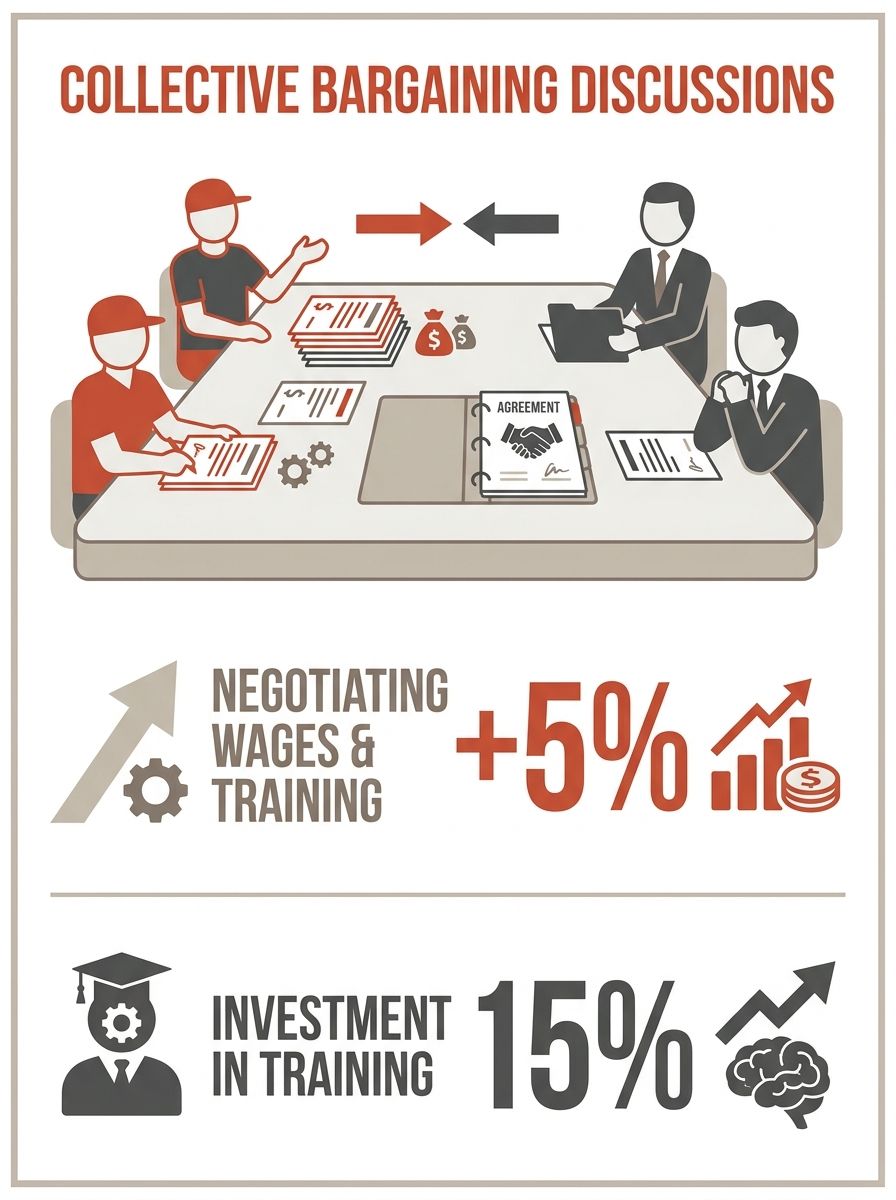
The proposed approach would allocate more collective agreement funds to training programs, particularly to help workers adapt to artificial intelligence reshaping job functions across sectors. If those investments deliver productivity gains, employers suggested a portion could return to workers through higher wages or profit-sharing arrangements rather than automatic annual increases tied to inflation.
"We want to avoid the automatic link—where one thing immediately follows the other," Van Breguel said. "Employers shouldn't have to foot the bill for everything."
Similar tensions over how to balance wage demands against technology investment have emerged in other labor markets, notably in tech sector organizing efforts as AI transforms workplace roles.
CNV Sets 3 to 5.5 Percent Wage Target for 2027
CNV chairman Hans Van den Heuvel announced the union will seek wage increases between 3 and 5.5 percent in the coming bargaining round, based on projected inflation of 2.8 percent and a 2.5 percent rise in labor productivity.
"Inflation is rising, and workloads are heavy," Van den Heuvel said. "Workers should not have to foot the bill again—especially not at a time when the government is already hitting them so hard."
The union's position directly challenges the employers' request to decouple wage growth from inflation metrics. Van den Heuvel argued that if employees contribute to productivity increases and economic growth, they must share in those benefits immediately rather than waiting for discretionary employer decisions.
CNV also plans to demand higher travel allowances across all collective agreements, citing elevated fuel prices, and will push for provisions addressing work-life balance. Van den Heuvel pointed to rising caregiving burdens as workers juggle responsibilities for young children and elderly parents, a factor he linked to high absenteeism rates.
"For many working people, this is becoming unsustainable," the chairman said. "A trend reflected in high absenteeism rates."
The Netherlands' largest union federation, FNV, is scheduled to announce its bargaining demands Monday, September 14.
Context and Outlook
The September 11 announcements frame what will likely be contentious negotiations across Dutch industries in 2027. Employers' emphasis on training and AI readiness reflects broader concerns about maintaining competitiveness in an economy where automation is accelerating faster than workforce skill development. Their proposed model—investing now, raising wages later based on results—asks workers to accept deferred compensation in exchange for uncertain future gains.
CNV's counter-demand for immediate wage increases between 3 and 5.5 percent maintains the traditional union position that cost-of-living adjustments and productivity shares should flow to workers without delay. The 5.5 percent upper bound combines the union's 2.8 percent inflation forecast with its 2.5 percent productivity growth estimate, plus a margin the union argues accounts for government policies it describes as economically burdensome to workers.
The outcome of these negotiations will likely influence labor strategy beyond the Netherlands, as unions and employers across Europe wrestle with similar questions about how to structure compensation and training commitments in rapidly automating workplaces. FNV's Monday announcement will clarify whether the Netherlands' two largest union federations present a united front on wage floors or pursue separate strategies.
The Union Edge Staff
Related Articles

Fair Work Commission Grants 4.75% Minimum Wage Increase to 2.7 Million Australian Workers
Australia's Fair Work Commission ruled June 2 that 2.7 million workers on award wages will receive a 4.75% pay increase effective July 2026, with an additional 100,000 lowest-paid employees receiving a 6% structural adjustment, according to The Guardian. The decision affects roughly one in five Aust

Dutch Prosecutors Seize €3.3 Million from Meat-Sector Agency Owner in Wage Theft Case
Dutch prosecutors seized €3.3 million in assets from the shareholder of a meat-industry temp agency suspected of embezzling foreign workers' wages, according to DutchNews.nl. The Dutch labour inspectorate's criminal investigation service, acting under the public prosecution department, froze bank ac

Labor Market Policy: Shaping Opportunities
Benin's 2017 labor code overhaul cut employer firing costs, legalized indefinite short-term contracts, and produced a 24.5% surge in formal sector employment, while simultaneously reducing job tenure for short-term workers by 0.23 months and shifting economic risk from employers to the workforce.
Also in the paper