
Tech Workers Gain Momentum in Union Organizing as AI Reshapes Industry
Tech industry workers are increasingly turning to union organizing after decades of resistance from employers, driven by mounting job losses, workplace discontent, and artificial intelligence implementation that threatens employment stability, according to an analysis published by the San Francisco

Tech Workers Gain Momentum in Union Organizing as AI Reshapes Industry
Tech industry workers are increasingly turning to union organizing after decades of resistance from employers, driven by mounting job losses, workplace discontent, and artificial intelligence implementation that threatens employment stability, according to an analysis published by the San Francisco Examiner on September 6, 2026. The shift marks a significant departure from Silicon Valley's historically anti-union culture and creates new opportunities for labor organizers in a sector that has long resisted collective bargaining.
Factors Driving Tech Sector Organizing
Three converging pressures are reshaping attitudes toward unionization among technology workers, the Examiner's Troy Wolverton reported. Job losses across the industry have eroded the employment security that once made tech workers reluctant to organize. Employee discontent with working conditions, compensation structures, and corporate decision-making has intensified as companies implement cost-cutting measures. The rapid deployment of artificial intelligence systems creates new uncertainty about job stability and the future scope of technical work.
The technology industry has actively opposed union organizing for decades, maintaining that collaborative workplace cultures and competitive compensation packages eliminated the need for collective bargaining. That resistance created one of the least unionized sectors in the American economy, even as employment in technology companies expanded rapidly through the 2010s and early 2020s.
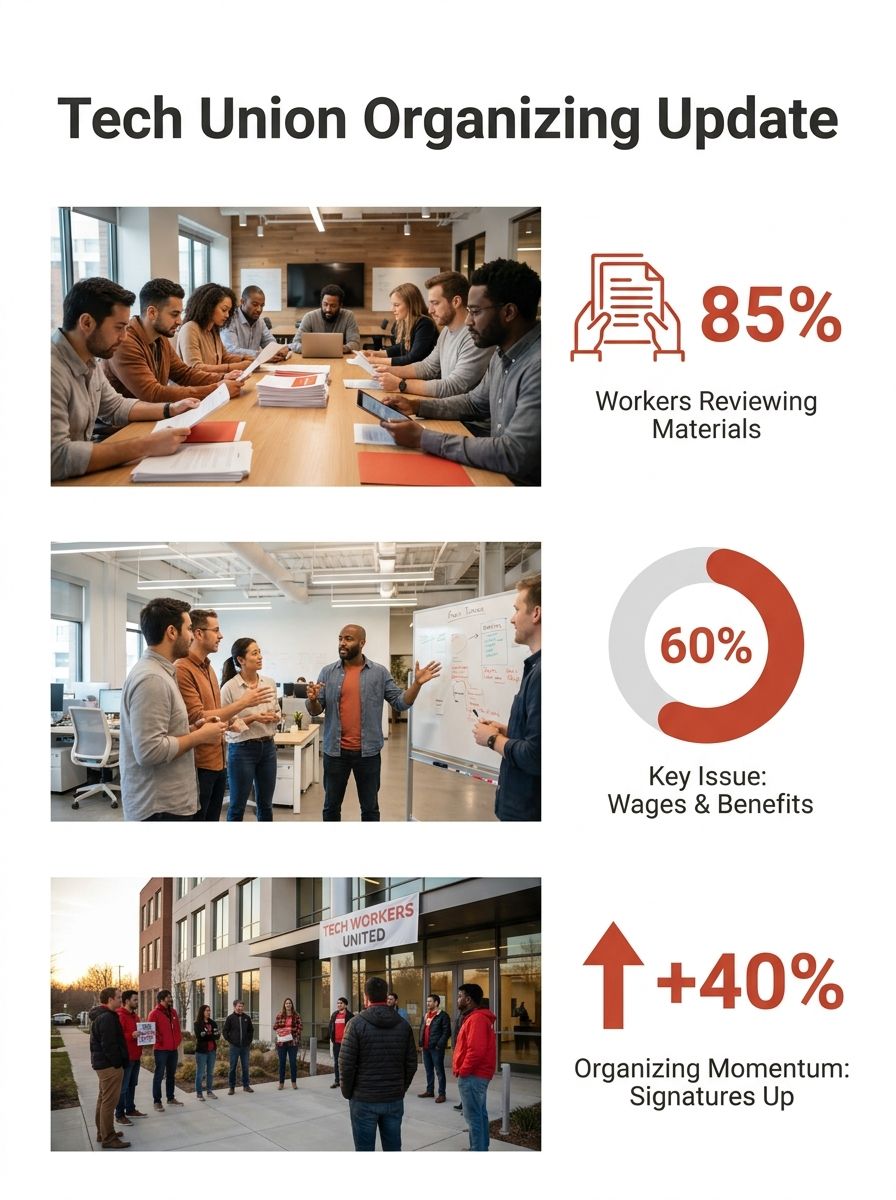
Recent economic pressures and technological disruption have weakened those anti-union arguments. Mass layoffs at major technology companies through 2025 and into 2026 demonstrated that even highly skilled workers face employment volatility. AI implementation raised questions about which technical roles remain viable and what protections workers might need as automation expands.
Traditional Obstacles to Tech Organizing
Technology companies have historically deployed multiple strategies to prevent union formation. High starting salaries and equity compensation created financial incentives that discouraged collective action. Corporate cultures emphasizing individual merit and rapid career advancement framed unions as incompatible with innovation. At-will employment arrangements and non-compete clauses limited workers' ability to organize without risking termination or future employment prospects.
The sector's geographic concentration in regions with weak labor organizing infrastructure, particularly Silicon Valley and Seattle, further isolated tech workers from established union networks. Many technology employees identified more strongly with their companies' missions or their professional identities as engineers and designers than with the broader working class, reducing interest in traditional labor organizing.
Those barriers remain significant, but labor organizers report new receptiveness among tech workers who have experienced layoffs, witnessed colleagues lose jobs despite strong performance reviews, or faced demands to train AI systems that may eventually replace human workers.
AI as Organizing Catalyst
The expansion of artificial intelligence capabilities into areas previously considered secure for highly skilled workers has become a particular focus for organizing conversations. Workers in software development, content creation, customer support, and data analysis face increasing competition from AI systems that companies present as more efficient and cost-effective alternatives to human employees.
Labor advocates argue that collective bargaining agreements could establish protections around AI implementation, including requirements that companies provide retraining opportunities, limit AI-driven job eliminations, or ensure human oversight of automated systems. Those arguments resonate with workers who previously dismissed unions as unnecessary but now see collective action as the primary tool for negotiating terms around technological change.
The pattern mirrors historical organizing waves triggered by automation, from industrial robotics in manufacturing to computerization in clerical work. Technology sector workers, long insulated from those dynamics, now confront similar pressures as their own tools threaten employment security.
Organizing Landscape and Challenges
Despite growing interest, tech sector union organizing faces substantial obstacles. The industry's project-based employment model, with frequent contractor and freelance arrangements, complicates efforts to build stable organizing committees. High employee turnover rates in many tech companies disrupt organizing momentum. Legal challenges around classification of workers as employees versus independent contractors create uncertainty about who can legally organize.
Technology companies retain significant resources to oppose organizing campaigns, including access to labor consultants, attorneys specializing in union avoidance, and communication platforms that allow management to reach workers directly. The sector's political influence provides access to policymakers who might intervene in labor disputes or regulatory proceedings.
Recent organizing successes in adjacent industries, including cannabis workers winning union contracts and service workers organizing at entertainment venues, provide models that tech organizers study for applicable strategies. Those campaigns demonstrate that even in traditionally non-union sectors, sustained organizing combined with employer pressure points can produce results.

Context and Outlook
The technology sector's emerging openness to unionization represents a fundamental shift in American labor dynamics. For decades, technology companies successfully marketed themselves as different from traditional industries—more collaborative, more innovative, more aligned with employee interests—making collective bargaining seem unnecessary. That narrative collapsed under the weight of mass layoffs, stagnant wages despite record corporate profits, and now AI-driven job insecurity that even high-skilled workers cannot individually negotiate around.
The convergence of economic vulnerability and technological disruption creates conditions that have historically favored organizing. Whether tech workers translate current receptiveness into actual union formation remains uncertain, but organizers report more successful conversations in 2026 than in any previous year. The sector's influence on the broader economy means organizing victories in technology could shift labor relations well beyond Silicon Valley, potentially affecting how American workers across industries respond to automation and AI.
For union organizers and workers' rights advocates, the tech sector represents both opportunity and challenge—a massive workforce historically resistant to organizing but now facing conditions that make collective action appealing. The benefits of collective bargaining agreements may finally resonate with workers who once dismissed them as incompatible with innovation. How companies and workers navigate this inflection point will likely shape labor relations for the next generation.
The Union Edge Staff
Related Articles

Tech Workers Push Union Recognition at Google and Meta as AI Reshapes Job Security
The Alphabet Workers Union delivered a 4,500-signature job security petition to Google executives last week, capping a year in which union actions at Alphabet doubled from 2024 levels, according to The Guardian.

When AI Safety Tools Become Union-Busting Weapons: What Workers Need to Know About Algorithmic Surveillance
AI-powered surveillance systems sold to employers as workplace safety monitoring tools are being repurposed to track union sympathizers, suppress organizing conversations, and algorithmically discipline workers who exercise their legal right to collective action.

AFL-CIO Endorses Sectoral Bargaining for First Time as States Lead New Wave of Worker Organizing
The AFL-CIO passed a resolution at its July 2026 conference endorsing sectoral bargaining for the first time in the federation's history, according to a Time article published Wednesday.
Also in the paper