
State of Missouri Minimum Wage: 2024 Guide
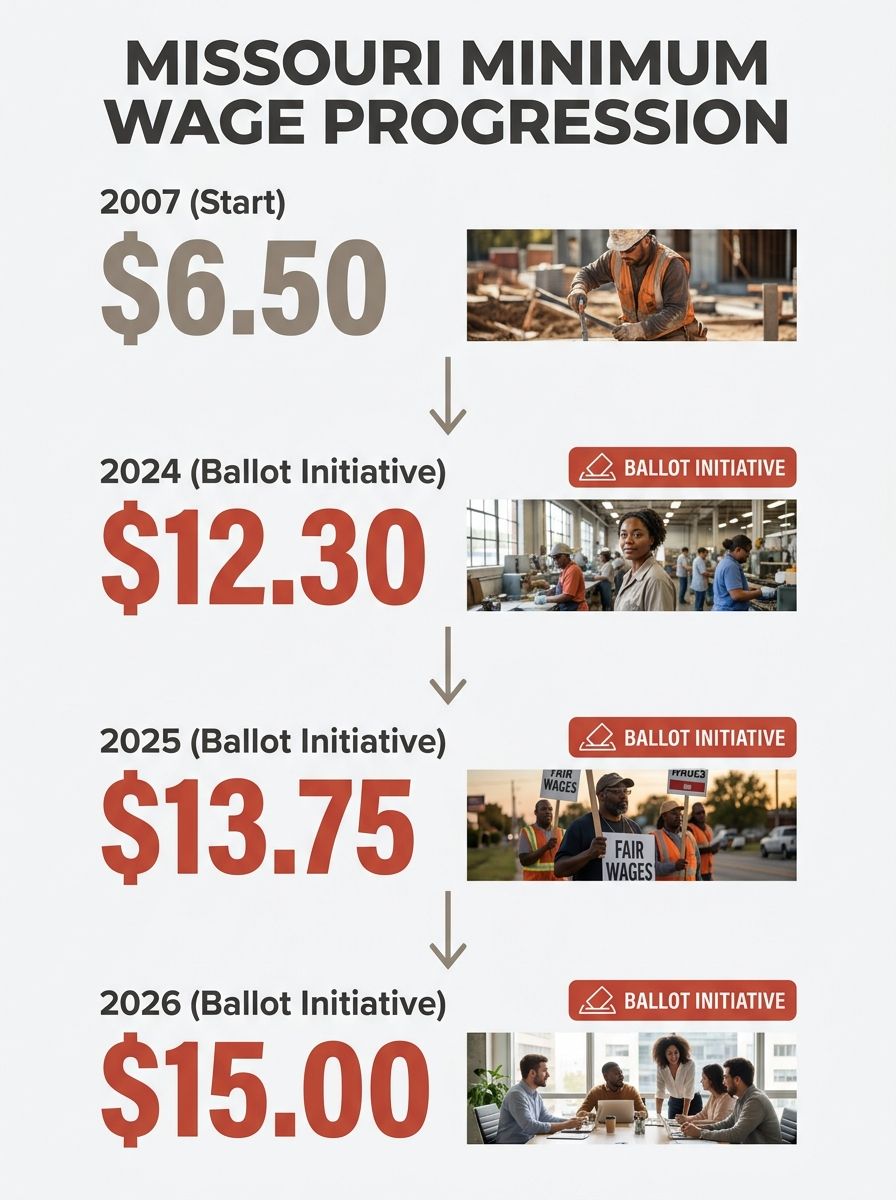
The state of Missouri minimum wage is set through voter-approved ballot initiatives rather than ordinary legislation, a mechanism that carried the rate to $12.30 per hour in 2024 and will push it to $15.00 by January 2026.

State of Missouri Minimum Wage: How the Voter-Driven Rate Mechanism Works
The state of Missouri minimum wage is set through voter-approved ballot initiatives rather than ordinary legislation, a mechanism that carried the rate to $12.30 per hour in 2024 and will push it to $15.00 by January 2026. This direct-democracy pipeline gives workers unusual power over wage floors, but it also invites a predictable backlash: elected lawmakers have repeatedly attempted to override what voters decided.
What RSMo § 290.502 Actually Establishes
The minimum wage state of Missouri workers receive is defined by Revised Statutes of Missouri, Section 290.502. The statute requires all private employers with annual gross revenue of $500,000 or more to pay at least the state-mandated hourly rate. The Missouri Department of Labor and Industrial Relations administers enforcement, and employers covered by both state law and the federal Fair Labor Standards Act must follow whichever standard is higher, according to the Department's compliance guidance.
For 2024, the Missouri Department of Labor confirmed the rate at $12.30 per hour, effective January 1. Tipped employees receive a minimum of $6.15 per hour, exactly 50% of the full rate, with employers required to make up any shortfall if tips don't bring total hourly compensation to $12.30. Overtime is calculated at 1.5 times the minimum wage, producing an overtime floor of $18.45 per hour in 2024.
This structure differs sharply from states like North Carolina, where the rate sits frozen at the federal $7.25 floor. Missouri's ballot-initiative process has produced real, measurable increases that outpace both the federal minimum and many neighboring states' rates.
The Ballot Initiative Timeline: 2006, 2018, 2024
Missouri's wage floor has been shaped by three major ballot measures, each one driven by worker advocacy and coalition organizing rather than statehouse negotiations.
Proposition B, 2006: Missouri voters approved a minimum wage increase and embedded an annual cost-of-living adjustment mechanism tied to the Consumer Price Index for Urban Wage Earners and Clerical Workers (CPI-W). This was the structural foundation. It meant the rate could move each year without returning to the ballot or requiring legislative approval.
Proposition B, 2018: Voters approved a phased increase from $7.85 to $12.00 per hour by 2023, overriding years of legislative inaction. The initiative passed with roughly 62% support, a significant margin in a state that skews conservative in statewide races. From 2024 onward, the rate was to continue adjusting annually based on CPI-W data measured each September 30.
Proposition A, November 5, 2024: The most recent ballot measure amended RSMo § 290.502 again, setting the 2025 rate at $13.75 and the 2026 rate at $15.00. The Missouri Department of Labor announced the $13.75 rate for January 1, 2025. Proposition A also included a paid sick leave mandate, which became a flashpoint for legislative conflict almost immediately after passage. A coalition of labor and advocacy groups has since mobilized $1 million to challenge lawmakers who voted to repeal the sick leave provision.
The pattern is consistent: Missouri workers have gone around their legislature to set wage policy at the ballot box three times in eighteen years, winning each time by wide margins.
How the CPI Adjustment Formula Worked
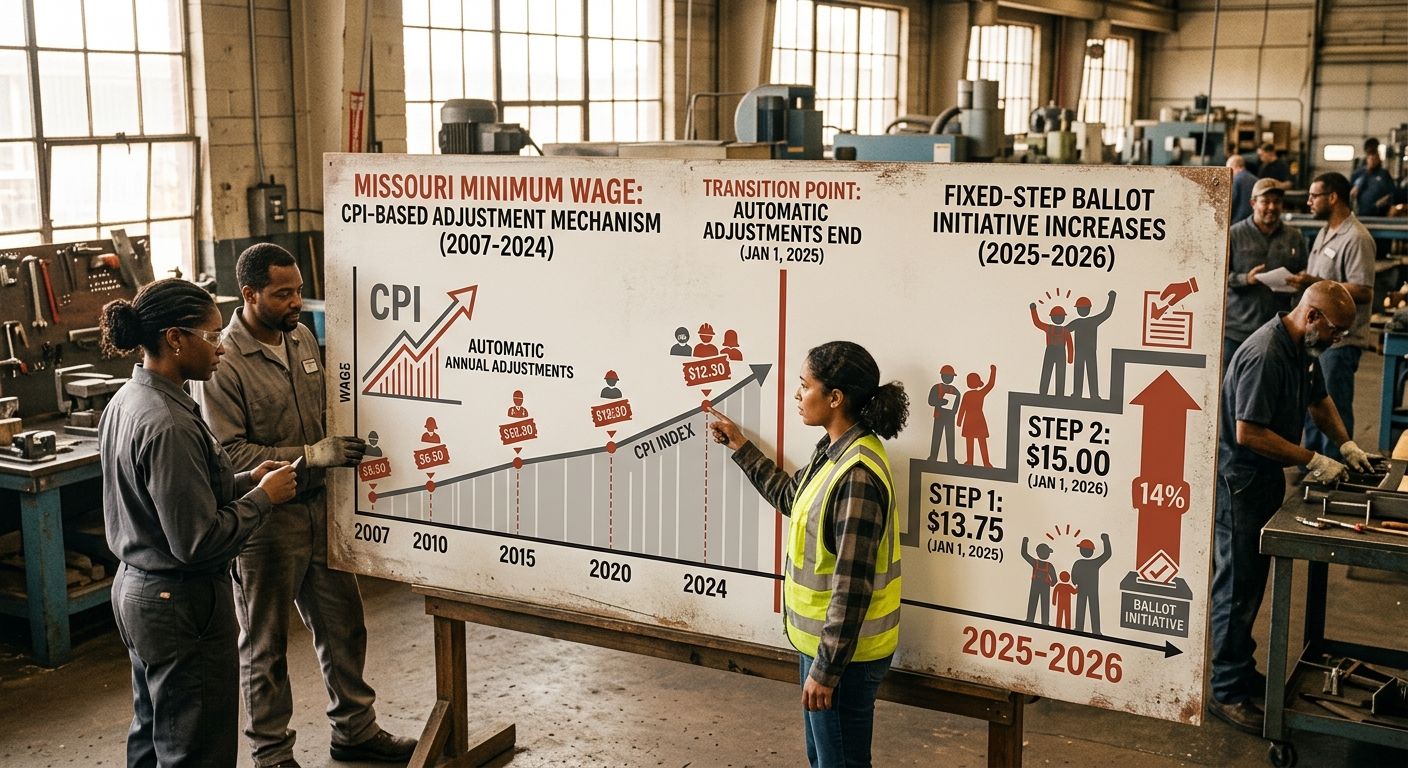
Between 2007 and December 31, 2024, Missouri's minimum wage adjusted automatically each year based on the CPI-W. The mechanism worked through a specific calendar:
The Director of the Department of Labor measured the percentage change in the CPI-W as of the preceding July compared to the prior year.
If the index rose, the minimum wage increased by the same percentage, rounded to the nearest five cents.
If the index fell, the wage could decrease, though it could never drop below the rate set by the most recent ballot initiative.
The new rate was announced each September 30 and took effect the following January 1.
This formula is what carried the rate from $12.00 (the 2023 endpoint of Proposition B 2018) to $12.30 in 2024. The Department of Labor stated explicitly that "the minimum wage may increase or decrease each year depending on cost-of-living changes reflected in the Consumer Price Index for Urban Wage Earners and Clerical Workers."
The CPI mechanism expired at the end of 2024, replaced by the fixed-step increases in Proposition A. After the $15.00 rate takes effect in January 2026, no automatic adjustment mechanism exists unless voters or lawmakers create one. The Federal Reserve Bank of St. Louis tracks the full historical series of Missouri's minimum wage from 1991 through 2026, providing a clear picture of how the rate has moved over three decades.
Exemptions That Shrink Coverage
The state of Missouri minimum wage applies broadly, but several carve-outs reduce the number of workers actually covered.
The most significant exemption targets small businesses. Missouri exempts employers with annual gross revenue under $500,000 from the state minimum wage rate, according to reporting by KRCU. These businesses may pay as low as the federal minimum of $7.25, nearly $5.00 less than the 2024 state rate. Given that 96% of Missouri's 231,753 private businesses had fewer than 50 workers in the first quarter of 2024 (per Bureau of Labor Statistics data cited by the Missouri Independent), the exemption has real reach, even though the revenue threshold, not employee count, is the legal trigger.
Additional exemptions under state and federal law cover:
Workers under 20 years old during their first 90 days of employment (a federal training wage provision)
Certain agricultural employees
Workers employed by immediate family members
Some seasonal amusement or recreational establishment workers
For healthcare workers specifically, these exemptions matter. Home health aides, certified nursing assistants, and medical office staff employed by small clinics or home care agencies that fall below the $500,000 revenue line can legally be paid the federal minimum instead of the state rate. In a state where low-wage healthcare jobs make up a growing share of the labor market, the gap between $7.25 and $12.30 (or $13.75, or $15.00) is the difference between poverty wages and something closer to subsistence. Understanding how federal and state wage floors interact is essential for any worker trying to determine what they're owed.
Tipped Wages and the 50% Rule
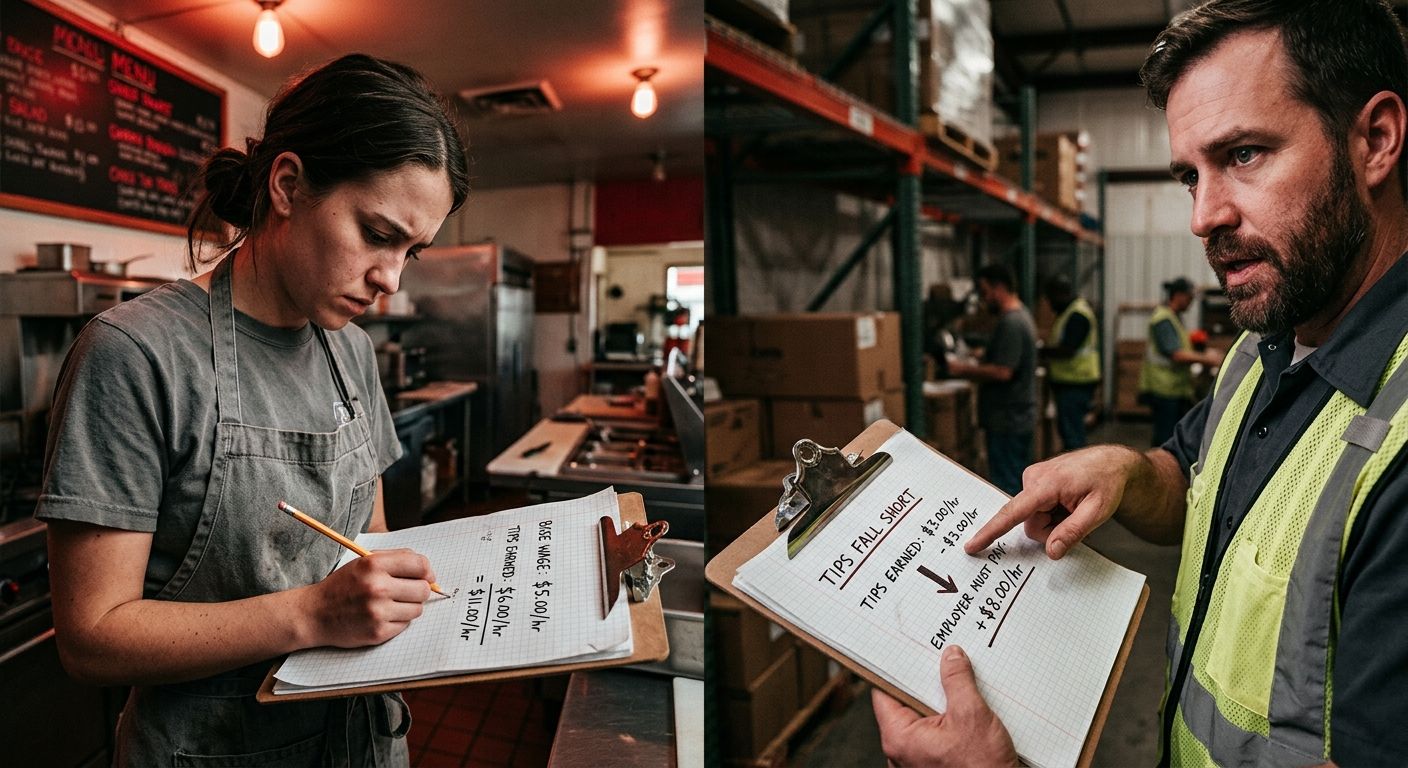
Missouri law sets the tipped minimum wage at exactly 50% of the standard minimum wage. For 2024, that means $6.15 per hour. For 2025, it rises to $6.88. In 2026, it will reach $7.50.
The tip credit mechanism requires employers to verify, per pay period, that each tipped employee's combined earnings (base wage plus tips) meet or exceed the full minimum wage. If a server or bartender's tips fall short during any pay period, the employer must cover the difference out of pocket. Overtime for tipped employees is calculated at 1.5 times the full minimum wage ($18.45 in 2024), with the tip credit applied against that figure.
This structure differs from states like Arizona, where the tipped wage calculations follow a different formula. It also differs from the federal tipped minimum of $2.13 per hour, which remains one of the lowest employer-paid base rates in any developed economy. Missouri's 50% floor provides significantly more protection than the FLSA baseline, though enforcement gaps remain a persistent issue. Wage theft complaints involving tip credit violations are among the most common labor grievances filed with the Missouri Department of Labor.
Year | Standard Minimum Wage | Tipped Minimum Wage (50%) | Overtime Floor (1.5x) |
|---|---|---|---|
2024 | $12.30 | $6.15 | $18.45 |
2025 | $13.75 | $6.88 | $20.63 |
2026 | $15.00 | $7.50 | $22.50 |
Where the Model Breaks
Missouri's ballot-initiative model for setting minimum wages has real strengths: it bypasses legislative gridlock, produces clear mandates, and has delivered consistent increases. But the model has structural weaknesses that became painfully visible after the November 2024 vote.
The most glaring failure point is legislative override. Proposition A passed with voter approval, but the Missouri legislature moved quickly to strip one of its core provisions. HB 567, signed by Governor Kehoe, repealed the paid sick leave mandate that voters had approved as part of the same ballot measure. The automatic CPI adjustment mechanism, which had provided annual inflation protection since 2007, also expired. As one state legislator told the Missouri Independent, "I just think the market should dictate it," capturing the philosophical opposition that persists even after voters speak.
The second weakness is the small-business exemption. With 46% of Missouri's private-sector workforce employed by businesses with fewer than 50 workers, and many of those businesses falling below the $500,000 revenue threshold, a substantial portion of the labor force may never benefit from the state minimum wage at all. The exemption disproportionately affects healthcare workers in small home care operations, independent medical practices, and rural clinics.
The third vulnerability is the absence of any future escalator. Once Missouri reaches $15.00 in January 2026, no mechanism exists to adjust the rate for inflation. Without another ballot initiative or legislative action, the real value of the wage floor will erode year by year, repeating the same pattern that necessitated Proposition B in 2018. Workers and unions will need to organize another ballot campaign to prevent stagnation, a process that takes years and millions of dollars.
This dynamic echoes what's happening nationally. Union membership grew by 411,000 workers in 2025, with much of that growth concentrated in states where collective bargaining protections remain strong. Missouri's ballot-box approach has delivered wage gains, but sustaining those gains requires continuous organizing pressure that most state labor movements struggle to maintain election cycle after election cycle.
Common Questions
Does Missouri's minimum wage apply to all employers?
No. Businesses with annual gross revenue below $500,000 are exempt from the state minimum wage under Missouri law. These employers must still comply with the federal minimum of $7.25 per hour under the FLSA. The revenue threshold, not the number of employees, determines which rate applies.
What happens to the minimum wage after 2026?
After the $15.00 rate takes effect on January 1, 2026, no automatic adjustment mechanism exists. The CPI-W escalator that operated from 2007 through 2024 has expired. Any future increase will require either a new voter-approved ballot initiative or legislative action, neither of which is currently scheduled.
Can Missouri's minimum wage decrease?
Under the CPI adjustment formula that operated through 2024, the rate could technically decrease if the CPI-W fell, but it could never drop below the most recently voter-approved floor. Since the fixed-step increases in Proposition A replaced the CPI formula, the rate moves only upward on the schedule voters approved. After 2026, it will remain at $15.00 unless changed by law.
How does Missouri's rate compare to the federal minimum?
Missouri's 2024 rate of $12.30 per hour is $5.05 above the federal minimum wage of $7.25, which has not increased since July 2009. By 2026, Missouri's rate will be more than double the federal floor. Workers covered by both state and federal law receive whichever rate is higher.
Are healthcare workers covered by Missouri's minimum wage?
Healthcare workers employed by businesses meeting the $500,000 annual revenue threshold are fully covered. But home health aides, nursing assistants, and clinic staff at smaller operations may fall under the exemption and receive only the $7.25 federal rate. Given that healthcare is one of Missouri's largest low-wage employment sectors, this gap affects tens of thousands of workers who provide direct patient care.
The Union Edge Staff
Frequently Asked Questions
- What is Missouri's minimum wage in 2024 and 2025?
- Missouri's minimum wage is $12.30 per hour for 2024 and $13.75 per hour for 2025, with a scheduled increase to $15.00 in January 2026. These rates are set through voter-approved ballot initiatives rather than legislation.
- Which employers are exempt from Missouri's minimum wage?
- Employers with annual gross revenue below $500,000 are exempt from Missouri's state minimum wage and may pay the federal minimum of $7.25 per hour instead. This exemption affects approximately 96% of Missouri's private businesses.
- What is the tipped minimum wage in Missouri?
- Missouri's tipped minimum wage is set at exactly 50% of the standard minimum wage: $6.15 in 2024, $6.88 in 2025, and $7.50 in 2026. Employers must make up any shortfall if tips don't bring total hourly compensation to the full minimum wage.
- How much will Missouri's minimum wage increase after 2026?
- After January 1, 2026, when the rate reaches $15.00, no automatic adjustment mechanism exists. Any future increase will require either a new voter-approved ballot initiative or legislative action.
- How has Missouri set its minimum wage differently from other states?
- Missouri uses voter-approved ballot initiatives to set its minimum wage rather than ordinary legislation, giving workers direct control over wage policy. This mechanism has produced three major wage increases since 2006, most recently Proposition A in November 2024.
- What is Missouri's overtime rate for 2024?
- Missouri's overtime rate is calculated at 1.5 times the minimum wage, producing an overtime floor of $18.45 per hour in 2024. This applies to both standard and tipped employees, with the tip credit applied against the overtime figure.
- How much higher is Missouri's minimum wage compared to the federal minimum?
- Missouri's 2024 minimum wage of $12.30 is $5.05 higher than the federal minimum of $7.25, which has remained unchanged since 2009. By 2026, Missouri's rate will be more than double the federal floor.
Related Articles

Minimum Wage Missouri: Current Rates & Updates
Proposition A won 58% of the vote in November 2024, directing Missouri's minimum wage to climb to $15.00 per hour by January 2026 and then adjust annually for inflation. Seven months later, Governor Mike Kehoe signed House Bill 567, which kept the $15.

Minimum Wage Ohio: 2024 Rates & Legal Guide
Article II, Section 34a of the Ohio Constitution contains the formula that sets Ohio's minimum wage every January 1, removing the state legislature from the process entirely. The rate adjusts automatically based on the Consumer Price Index, which pushed the minimum wage in Ohio from $10.

State of Colorado Minimum Wage 2024: Rates & Changes
Colorado's state minimum wage rose to $14.42 per hour on January 1, 2024, set automatically by a Consumer Price Index formula that removes the state legislature from annual rate decisions entirely.
Also in the paper