
House Passes Binding Arbitration Bill for First Union Contracts as NLRB Moves Toward Republican Majority
The House of Representatives passed H.R. 5408 on June 9, 2026, legislation that would impose 10-day bargaining deadlines and binding arbitration for initial union contracts, while Republican NLRB nominee James Macy advanced toward confirmation in a June 10 hearing that could shift the Board's majori

House Passes Binding Arbitration Bill for First Union Contracts as NLRB Moves Toward Republican Majority
The House of Representatives passed H.R. 5408 on June 9, 2026, legislation that would impose 10-day bargaining deadlines and binding arbitration for initial union contracts, while Republican NLRB nominee James Macy advanced toward confirmation in a June 10 hearing that could shift the Board's majority, according to legal analysis published by Squire Patton Boggs.
The bill's passage marks a significant departure from current National Labor Relations Act requirements, which mandate only good-faith bargaining without deadlines. Many newly unionized workplaces currently take more than a year to negotiate first contracts, with no mechanism to break deadlocks beyond economic pressure.
How the Faster Labor Contracts Act Would Work
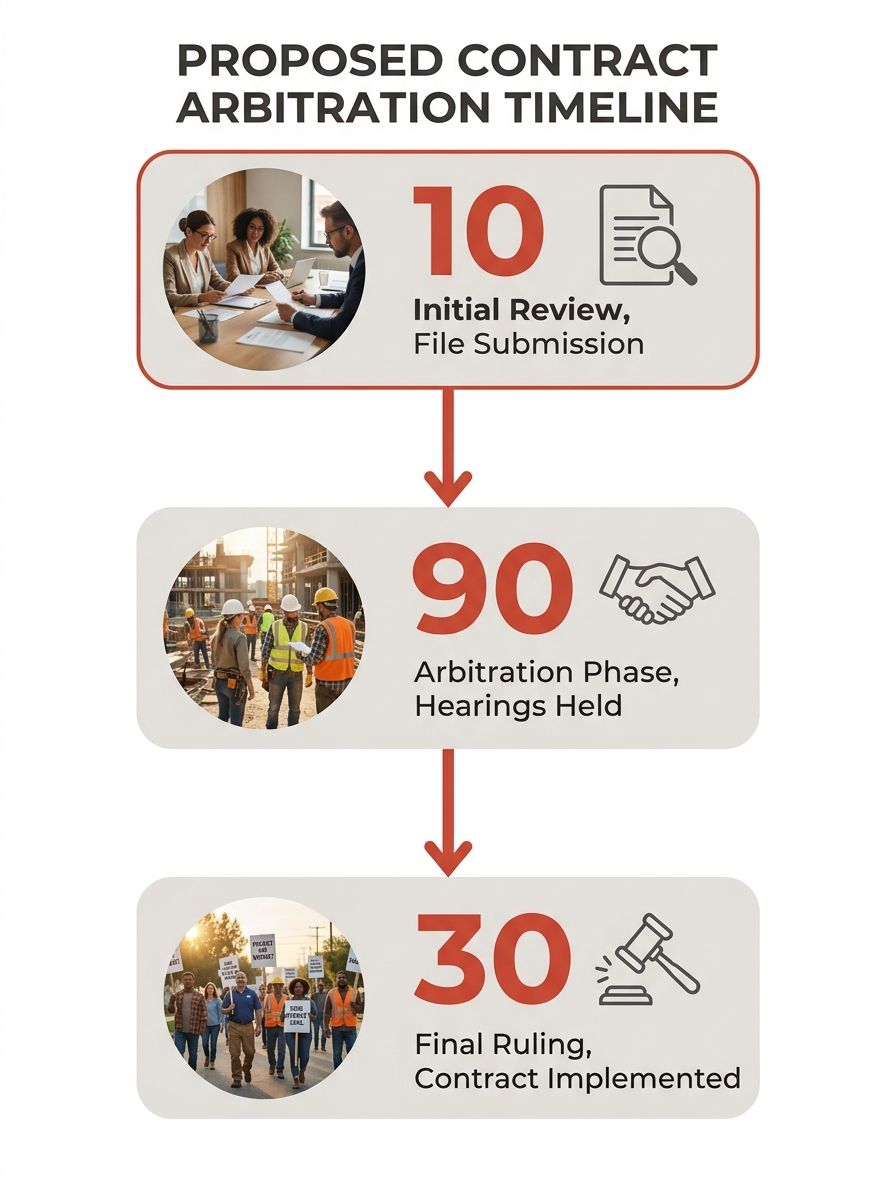
The Faster Labor Contracts Act establishes a three-stage timeline for initial collective bargaining agreements. Employers would face a 10-day deadline to meet with newly certified or recognized unions after receiving a written bargaining request. Both parties would then have 90 days to reach an agreement through direct negotiations, during which they must make "every reasonable effort" to settle.
If negotiations fail, either party could notify the Federal Mediation and Conciliation Service and request mediation. The FMCS would have 30 days to broker a settlement. Should mediation prove unsuccessful, the agency would refer the dispute to a three-person arbitration panel with authority to impose binding contract terms for two years.
The arbitration panel would consider multiple factors in setting contract terms: the employer's financial status, the size and type of operations, employees' cost of living and ability to support their families, and the wages and benefits offered by comparable employers in the same industry. This framework mirrors interest arbitration procedures currently used in some public-sector bargaining, such as federal workers' bargaining processes, but would represent a new mechanism for private-sector labor relations.
Uncertain Senate Path Despite Bipartisan House Support
The legislation received bipartisan support in the House vote, an unusual achievement for labor legislation in the current Congress. The bill now faces the Senate, where procedural hurdles and Republican skepticism could block passage. Legal observers quoted in the analysis expressed doubt the measure would survive Senate consideration, given the chamber's current composition and historic resistance to expanding union use in private-sector negotiations.
If enacted, the law would fundamentally alter the balance of power in first-contract campaigns. Unions have long sought mandatory arbitration provisions to counter what organizers describe as employer delay tactics during initial bargaining. Management attorneys argue the timelines would pressure employers into unfavorable agreements and cede control over wages and working conditions to third-party arbitrators unfamiliar with specific business operations.
The 120-day total timeline from initial request to arbitration referral would compress negotiation windows that currently stretch across multiple quarters. Employers would need to assemble bargaining teams, analyze financial data, and develop contract proposals within weeks of union certification—a pace many HR departments are not structured to maintain.
NLRB Nominee Macy Hearing Signals Potential Policy Shift
James Macy, the Republican nominee to the National Labor Relations Board, appeared before the Senate Committee on Health, Education, Labor and Pensions on June 10, 2026. His confirmation would establish a three-member Republican majority on the five-seat Board for the first time since the previous administration.
The Board regained its three-member operating quorum earlier in 2026 after functioning with only two members, but Board members typically refrain from overturning existing precedents without a three-member ideological majority. Macy's confirmation would clear the path for the Board to revisit recent decisions including Cemex Construction Materials Pacific, LLC (which set standards for when employers must recognize unions based on authorization cards), Stericycle, Inc. (which narrowed permissible workplace rules), and McLaren Macomb (which restricted confidentiality provisions in severance agreements).
The confirmation timeline carries urgency because Democratic member David Prouty's term expires August 27, 2026. If the Senate fails to confirm at least one nominee before that date, the Board would lose its three-member quorum and be unable to issue decisions in pending cases. The Senate panel must approve Macy's nomination before the full Senate votes on confirmation.
Labor organizers monitoring the nomination process have noted that Board composition historically determines policy on critical organizing issues, from union election procedures to unfair labor practice remedies. A Republican-majority Board would likely adopt more employer-friendly interpretations of the National Labor Relations Act, as examined in historical analyses of NLRB shifts.
What This Means for Union Members
The Faster Labor Contracts Act would address a longstanding union complaint: employers who drag out first-contract negotiations for years after workers vote to organize. Binding arbitration removes the indefinite waiting period that often leads to decertification campaigns when new members lose faith in the union's ability to deliver a contract.
However, arbitration also removes membership control over contract terms. A panel of three arbitrators, rather than elected bargaining committees and ratification votes, would set wages, benefits, and working conditions for two years. Locals accustomed to collective bargaining processes that allow member input would need to prepare members for a fundamentally different path to a first contract.
The simultaneous NLRB composition shift represents a different concern. A Republican-majority Board could weaken the legal framework that makes organizing campaigns viable, from limiting card-check recognition to expanding employer speech rights during union drives. Unions investing resources in organizing campaigns under current precedents may find those rules reversed midstream if Macy's confirmation proceeds before Prouty's August departure.
The Union Edge Staff
Related Articles

Teamsters-Backed First Contract Bill Passes House With Bipartisan Support, Heads to Senate
The U.S. House of Representatives passed the Faster Labor Contracts Act on June 9, 2026, with bipartisan support, advancing Teamsters-led legislation that would require employers to begin bargaining with newly organized workers within 10 days of a union vote, according to the International Brotherho

Senate Committee Schedules NLRB Nominations as Board Risks Losing Democratic Quorum Before August Recess
The Senate HELP Committee placed National Labor Relations Board nominees James Macy and David Prouty on its calendar for a June 15 hearing, setting up votes that could reshape the Board's composition before Congress's August recess, according to Labor Relations Ink.
House Passes Union Contract Bill as Worker Income Share Hits 79-Year Low
The U.S. House of Representatives passed the Faster Labor Contracts Act on September 15, legislation designed to expedite union contract negotiations for newly organized workplaces, according to an analysis published in the Las Vegas Sun.
Also in the paper