
Minimum Wage State of Illinois: 2024 Guide
The minimum wage in the state of Illinois is $15.00 per hour for workers 18 and older, the rate that took effect January 1, 2025, completing a phased schedule of six annual increases. But Illinois doesn't operate on a single number.
Minimum Wage State of Illinois: 2024 Guide
The minimum wage in the state of Illinois is $15.00 per hour for workers 18 and older, the rate that took effect January 1, 2025, completing a phased schedule of six annual increases. But Illinois doesn't operate on a single number. Chicago, Cook County, and the state each enforce separate wage floors with different rules for tipped workers, youth employees, and specific industries.
How the Illinois Minimum Wage Law Is Structured
The Illinois Minimum Wage Law, administered by the Illinois Department of Labor, sets the statewide floor that every employer must meet. Governor JB Pritzker signed the current version in 2019, creating a fixed schedule of annual $1.00 increases that moved the rate from $8.25 to $15.00 over six years. The law covers all workers 18 and older, with narrow exemptions for agricultural employees, certain summer camp staff during their first 8 weeks, and car wash employees covered under separate statutes.
This structure means Illinois workers don't rely on periodic legislative fights to get a raise. The schedule was locked in, and each January 1 brought a predictable increase. That's a significant contrast from states like Texas, where workers still earn the federal minimum of $7.25 per hour because the state defers entirely to the Fair Labor Standards Act.
For healthcare workers, home health aides, certified nursing assistants, dietary staff, hospital housekeepers, this distinction matters enormously. These workers make up one of the largest groups earning at or near minimum wage in Illinois, and the scheduled increases meant predictable income growth rather than stagnation.
The Six-Step Increase Schedule: $8.25 to $15.00
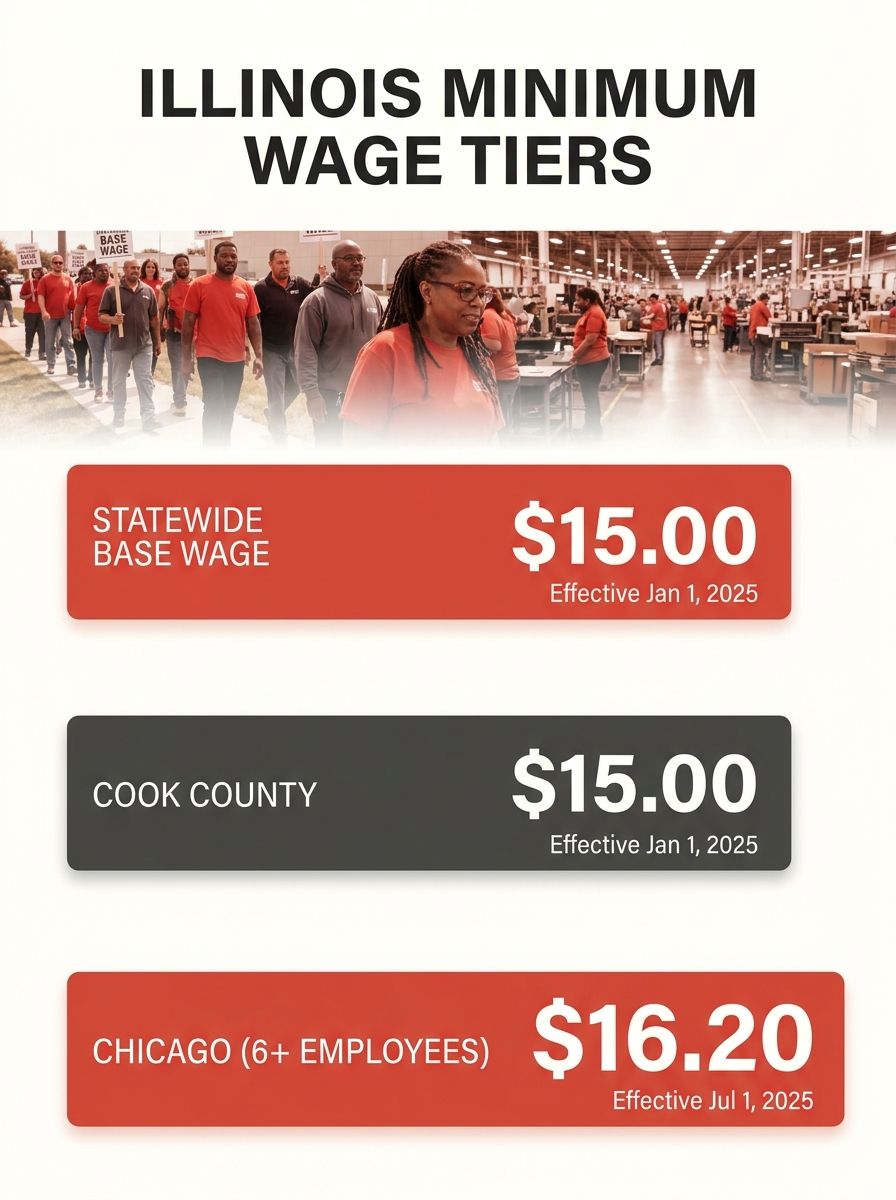
Governor Pritzker's 2019 legislation mapped out every increase in advance. According to the Illinois Governor's office press release, the January 1, 2024 increase to $14.00 was the sixth raise since the law's passage. Here's how the full schedule played out:
Effective Date | Minimum Wage Rate | Increase |
|---|---|---|
January 1, 2020 | $9.25 | +$1.00 |
July 1, 2020 | $10.00 | +$0.75 |
January 1, 2021 | $11.00 | +$1.00 |
January 1, 2022 | $12.00 | +$1.00 |
January 1, 2023 | $13.00 | +$1.00 |
January 1, 2024 | $14.00 | +$1.00 |
January 1, 2025 | $15.00 | +$1.00 |
The FRED database maintained by the St. Louis Fed tracks Illinois minimum wage data back to 1972, when the rate was $1.40 per hour. The state held that $1.40 floor for four consecutive years before raising it to $2.10 in 1976, according to the Illinois Department of Labor's historical rate table. Between 1976 and 2019, increases came irregularly and often lagged inflation. The 2019 law broke that pattern by establishing a fixed, predictable trajectory.
For context, the 2024 rate of $14.00 placed Illinois well above the federal floor of $7.25 and above neighboring states like Missouri, which had its own schedule of increases driven by a voter-approved ballot measure. Illinois also outpaced Maryland's $15.00 rate, which reached that level through different legislative mechanics.
Chicago and Cook County Enforce Higher Floors
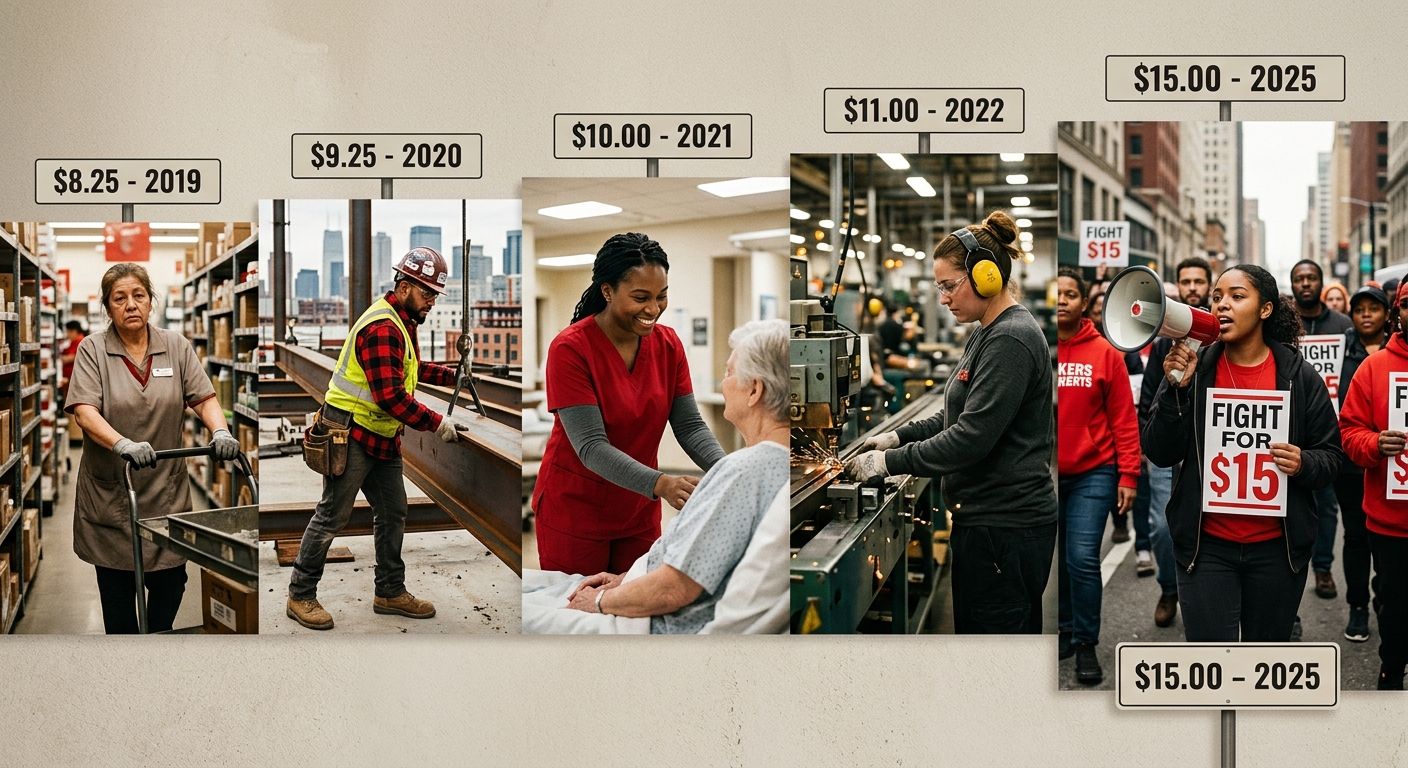
Why does an Illinois worker's paycheck depend on their ZIP code? Because Chicago and Cook County each passed their own minimum wage ordinances that supersede the state floor wherever the local rate is higher.
As of July 1, 2024, Chicago's minimum wage stood at $16.20 per hour for employers with 21 or more workers. Smaller employers with 4 to 20 workers paid $15.00. Chicago's rate is projected to reach $16.60 by July 2025, with annual adjustments tied to the Consumer Price Index. Cook County's rate aligns with the state minimum for non-tipped workers ($15.00 as of January 2025) but maintains its own enforcement mechanism.
This three-tier system creates real compliance challenges. A home care agency operating across the Chicago metropolitan area might have CNAs working in three different wage jurisdictions on the same day. An employer paying the statewide rate in DuPage County would be violating Chicago's ordinance if they sent that same worker to a client's home inside city limits. The rule is straightforward in principle: whichever rate is highest applies. In practice, especially for healthcare staffing agencies and multi-site employers, tracking which rate applies where requires constant attention.
Tipped Workers, Youth, and Sub-Minimum Wage Categories
The Illinois Minimum Wage Law allows employers to pay tipped workers a base wage equal to 60% of the standard minimum. At the 2024 statewide rate of $14.00, that translated to a tipped minimum of $8.40 per hour. When the rate hit $15.00 in January 2025, the tipped minimum rose to $9.00. The critical requirement: if a tipped worker's combined earnings (base wage plus tips) don't reach the full minimum wage in any pay period, the employer must make up the difference. That's federal law under the FLSA, and Illinois enforces it at the state level too.
Workers under 18 who work fewer than 650 hours in a calendar year are eligible for a youth minimum wage, set at $13.00 as of 2025. This provision covers a specific and narrow group: teenage workers in part-time and seasonal employment.
One of the most significant sub-minimum provisions involves workers with disabilities. Illinois currently allows employers to hold federal 14(c) certificates to pay workers with disabilities below the full minimum. The Dignity in Pay Act changes that. Effective December 31, 2029, Illinois will prohibit employers from holding those certificates, phasing out sub-minimum pay for workers with disabilities entirely. This affects workers in sheltered workshops and community rehabilitation programs across the state, many of which operate in healthcare-adjacent care settings.
The Illinois Wage Payment and Collection Act also mandates overtime at 1.5 times the regular rate for hours beyond 40 in a workweek. Employers must maintain accurate records of hours and wages for at least two years and provide detailed pay stubs. These requirements apply to every employer subject to the minimum wage law, without exception.
The $27 Proposal and What Comes After $15
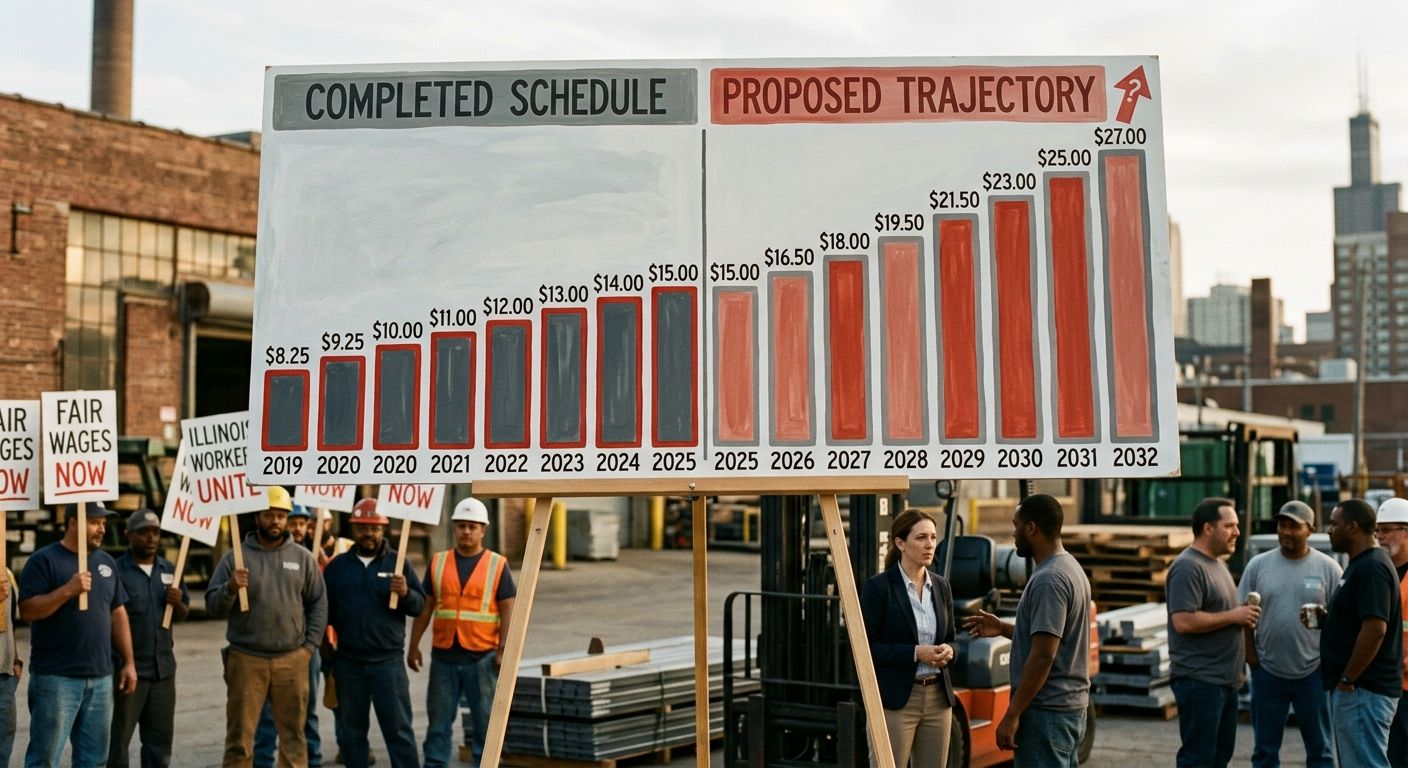
With the $15 floor now in place, the question for Illinois workers is whether the rate keeps pace with rising costs or stagnates as it did for decades before 2019. A legislative proposal currently under consideration would raise the minimum wage in the state of Illinois to $27 by 2032, with the rate set at $17 until the end of 2027 and then increasing by $2 every year until it reaches the target.
The business opposition is predictable and vocal. "Small business owners are sounding the alarm about the unintended consequences of raising the state's mandated minimum wage," said Noah Finley, NFIB Illinois State Director, in a statement opposing further increases. "Small employers are already managing a variety of rising business costs; the last thing they need is a government-imposed labor cost increase that will only result in fewer jobs and small businesses in the state."
But the data from Illinois's own experience complicates that narrative. Economic analysis of the $15 minimum wage's impact found that reaching $15 lifted approximately 200,000 Illinois workers out of poverty and boosted average incomes for 1.4 million adult workers by roughly $6,000 annually, with little measurable negative impact on overall employment levels. For healthcare workers specifically, these gains were concentrated among the lowest-paid roles: home health aides, personal care assistants, and dietary workers in long-term care facilities.
The concern around the $27 proposal centers on the speed and magnitude of the jump. A $12 increase over five years is substantially steeper than the $6.75 increase spread over six years under the current law. Whether the Illinois legislature advances this proposal will depend in large part on organizing pressure from workers and unions in the industries most affected, including healthcare, food service, and retail.
Where This System Falls Short
The three-tier structure protects workers in high-cost areas like Chicago, but it leaves gaps. Workers in downstate Illinois, Carbondale, Decatur, Springfield, earn the same $15.00 as workers in the collar counties, even though their cost of living is substantially lower. That sounds like a benefit, but the flip side is that $15.00 in a low-cost market gives employers more room to argue that the rate is already "generous," creating political resistance to future increases that workers in Chicago desperately need.
The tipped wage system remains a structural vulnerability. The 60% provision means tipped healthcare workers, yes, they exist, particularly in personal care and some home health arrangements where clients provide tips, earn a base wage of $9.00 per hour and depend on the employer to calculate and cover any shortfall. Wage theft in these arrangements is difficult to detect and harder to prove, particularly for workers who don't receive itemized pay stubs or whose employers fail to maintain the required two-year records.
The youth sub-minimum and the 14(c) disability certificates, despite the Dignity in Pay Act's 2029 sunset, create categories of workers who are legally paid less for the same or comparable work. Until 2029, an employer in a healthcare or community rehabilitation setting can still pay workers with disabilities below $15.00 under a federal certificate. The fact that Illinois set a deadline to end this practice is significant. The fact that the deadline is still years away means real workers are earning sub-minimum wages right now.
And the $15 floor itself, absent indexing to inflation or the Consumer Price Index, will erode. Chicago's ordinance includes CPI adjustments. The state law does not. Without new legislation or a successful push for the $27 proposal, the statewide rate will remain fixed at $15.00 while prices continue to rise. That's the same pattern that kept Illinois workers at $8.25 for years before 2019, and it's the pattern that declining worker income share nationally reflects at the federal level.
Common Questions
Does the minimum wage in Illinois apply to all workers?
The law covers workers 18 and older in most industries. Agricultural workers, certain summer camp staff during their first 8 weeks of employment, and car wash employees covered under separate statutes are exempt. Workers under 18 who log fewer than 650 hours annually fall under the youth minimum wage of $13.00 (as of 2025). The Illinois Department of Labor's minimum wage page lists all current exemptions.
How much do tipped workers earn in Illinois?
Tipped workers earn a base wage of 60% of the full minimum wage. At the current $15.00 rate, that's $9.00 per hour. If a tipped worker's base wage plus tips don't add up to $15.00 per hour in a given pay period, the employer is legally required to pay the difference. In Chicago, tipped workers for large employers (21+ workers) earn a higher base pegged to 60% of $16.20.
Is the $15 minimum wage the final increase, or will it go higher?
The $15.00 rate completed the schedule signed into law in 2019. There is no automatic increase built into the current law beyond $15.00. A legislative proposal would raise the rate to $17.00 by 2028 and then to $27.00 by 2032, but that proposal has not been enacted. Without new legislation or a ballot measure, the statewide rate stays at $15.00 indefinitely.
What's the difference between the state, Cook County, and Chicago minimum wages?
The state sets a floor ($15.00), Cook County enforces its own rate (currently matching the state at $15.00 for non-tipped workers), and Chicago sets a higher rate ($16.20 for employers with 21+ workers as of mid-2024). Employers must pay whichever rate is highest for the location where the work is performed. The NLRB and state labor agencies can both be relevant when wage disputes intersect with organizing activity.
When does the sub-minimum wage for workers with disabilities end?
The Dignity in Pay Act sets December 31, 2029 as the date when Illinois employers can no longer hold federal 14(c) certificates allowing sub-minimum pay for workers with disabilities. Until that date, existing certificate holders are permitted to pay below $15.00. This primarily affects workers in sheltered workshops and community rehabilitation settings.
The Union Edge Staff
Frequently Asked Questions
- What is the Illinois minimum wage for 2025?
- The Illinois minimum wage is $15.00 per hour for workers 18 and older, effective January 1, 2025. This rate completed a phased schedule of six annual increases that began at $8.25 in 2020.
- How much do tipped workers earn in Illinois?
- Tipped workers in Illinois earn a base wage of $9.00 per hour (60% of the $15.00 minimum wage as of 2025). Employers must make up the difference if tips plus base wage don't reach the full minimum wage in any pay period.
- What is the minimum wage in Chicago 2025?
- Chicago's minimum wage is $16.20 per hour for employers with 21 or more workers, and $15.00 per hour for employers with 4 to 20 workers. The rate is projected to reach $16.60 by July 2025, with annual adjustments tied to the Consumer Price Index.
- Who is exempt from Illinois minimum wage law?
- Agricultural workers, certain summer camp staff during their first 8 weeks of employment, and car wash employees covered under separate statutes are exempt from Illinois minimum wage requirements.
- What is the youth minimum wage in Illinois?
- Workers under 18 who work fewer than 650 hours in a calendar year are eligible for a youth minimum wage of $13.00 per hour as of 2025, covering part-time and seasonal employment.
- When will Illinois stop paying workers with disabilities sub-minimum wages?
- The Dignity in Pay Act will prohibit Illinois employers from holding federal 14(c) certificates allowing sub-minimum pay for workers with disabilities effective December 31, 2029, phasing out this practice entirely.
- What is the Cook County minimum wage?
- Cook County's minimum wage aligns with the state minimum of $15.00 per hour as of January 2025 for non-tipped workers, though the county maintains its own enforcement mechanism separate from the state.
- Is there a proposed minimum wage increase in Illinois after $15?
- A legislative proposal under consideration would raise Illinois minimum wage to $17 by 2028 and then to $27 by 2032, but this proposal has not been enacted and there is no automatic increase built into current law beyond $15.00.
Related Articles

Illinois Minimum Wage: 2024 Requirements & Updates
Under the Illinois Minimum Wage Law, every employer in the state owes adult workers at least $15.00 per hour, the final step of a six-year phased increase that reached its target on January 1, 2025.

Massachusetts minimum wage: 2024 rates & changes
The mass minimum wage held at $15.00 per hour throughout 2024, unchanged for the first time in five years, after the final scheduled increase under the state's 2018 "Grand Bargain" legislation took effect on January 1, 2023.

Michigan Minimum Wage: 2024 Updates & Requirements
Michigan's minimum wage is $13.73 per hour, effective January 1, 2026, after the Michigan Supreme Court's July 31, 2024 ruling reinstated voter-approved wage increases that the legislature had blocked for six years. The rate reaches $15.
Also in the paper