
Federal Minimum Wage: What You Need to Know
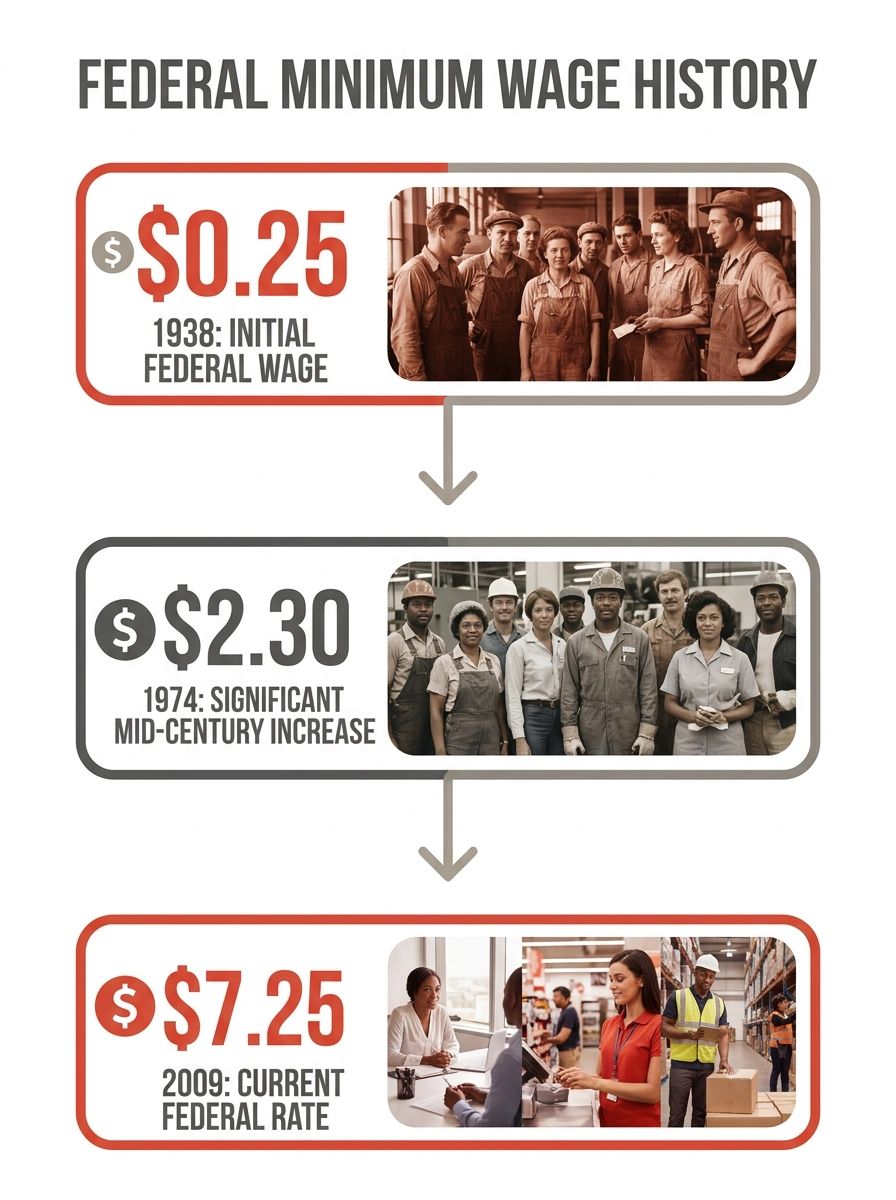
The federal minimum wage is $7.25 per hour, set by the Fair Labor Standards Act (FLSA) and enforced by the U.S. Department of Labor's Wage and Hour Division. That rate has been frozen since July 24, 2009, making it the longest period without an increase since the FLSA became law in 1938.

Federal Minimum Wage: How the Legal Floor Actually Works
The federal minimum wage is $7.25 per hour, set by the Fair Labor Standards Act (FLSA) and enforced by the U.S. Department of Labor's Wage and Hour Division. That rate has been frozen since July 24, 2009, making it the longest period without an increase since the FLSA became law in 1938. The gap between what the floor promises and what it delivers has widened every year since.
What the Fair Labor Standards Act Requires
The FLSA, signed into law in 1938, established the first minimum wage federal law mandated for covered workers in the United States. The original rate was $0.25 per hour, and Congress has raised it 22 times in the decades since, according to the Department of Labor's historical wage table. The most recent adjustment, effective July 24, 2009, brought the rate to $7.25.
The statute applies to "covered nonexempt employees," a legal category that sounds straightforward but contains real complexity. The Department of Labor defines the federal minimum wage for covered nonexempt employees as $7.25 per hour, and specifies that when an employee is subject to both state and federal minimum wage laws, the employee is entitled to the higher of the two rates.
That "higher rate" rule is the single most important structural feature of how the federal wage minimum interacts with state-level labor law. It means the federal floor functions as a backstop, catching workers in states that either have no minimum wage statute of their own or have set their rate below $7.25. Five states fall into the first category: Alabama, Louisiana, Mississippi, South Carolina, and Tennessee have no state minimum wage law at all, so the FLSA rate applies directly.
How Coverage Determines Who Gets Protected
The FLSA doesn't protect every worker automatically. Coverage flows through two distinct channels, and understanding them explains why some workers earning below $7.25 have no federal claim.
Enterprise coverage applies to employees who work for businesses with at least $500,000 in annual gross sales or business volume. It also applies to hospitals, schools, and government agencies regardless of their revenue. This is the broader net, and it captures the majority of U.S. workers.
Individual coverage reaches workers whose jobs involve interstate commerce or the production of goods for interstate commerce. The courts have interpreted this broadly over the decades, tracing back to the Supreme Court's ruling in United States v. Darby Lumber Co. (1941), which upheld Congress's power under the Commerce Clause to regulate employment conditions. The 1938 minimum wage law originally applied only to employees engaged in interstate commerce or in the production of goods for interstate commerce, but subsequent amendments expanded coverage substantially.
Workers who fall outside both channels aren't entitled to the federal minimum wage. This includes certain agricultural workers on small farms, some seasonal employees at amusement parks, and workers in specific categories that Congress has carved out over the years. The coverage mechanism is what makes the minimum wage for federal enforcement purposes a patchwork rather than a blanket guarantee.
The Exemption Architecture
Even workers who are "covered" under the FLSA aren't all guaranteed $7.25. The law contains a parallel structure of subminimum wages that operates alongside the standard floor.
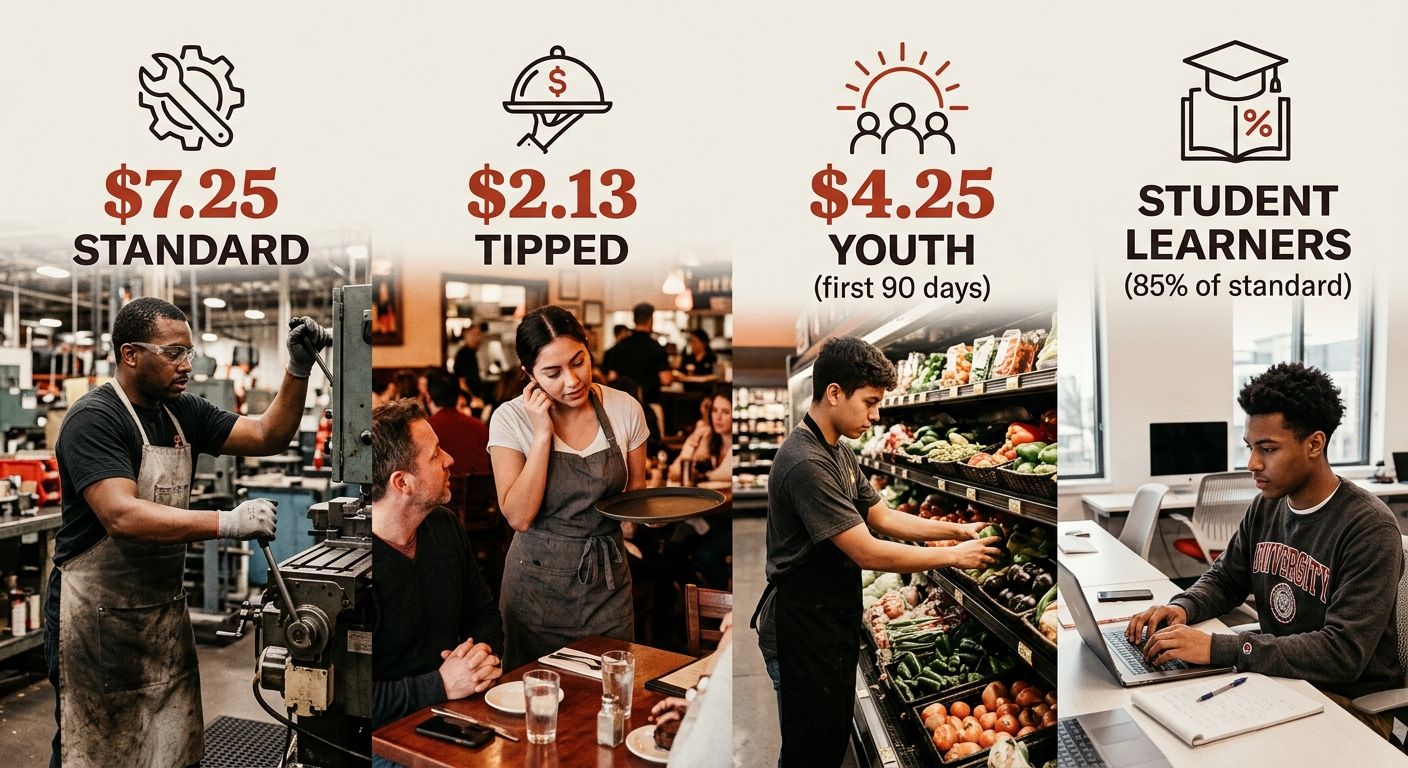
The tipped minimum wage sits at $2.13 per hour for employees who regularly receive more than $30 per month in tips. Employers are required to make up the difference if an employee's tips plus the $2.13 base don't reach $7.25, but enforcement of this "tip credit" provision has been notoriously weak. Cities like Chicago and Washington, D.C., have moved to phase out tipped subminimum wages entirely, and the Economic Policy Institute has advocated for eliminating the $2.13 rate at the federal level.
Student workers at retail or service establishments, farms, or colleges and universities can be paid as low as 85% of the minimum wage under a certificate issued by the Department of Labor. Workers with disabilities can be paid below the minimum wage under Section 14(c) certificates, though this provision has drawn increasing legal challenges and several states have banned subminimum wages for disabled workers outright.
Full-time students, student learners, and workers under 20 years old during their first 90 consecutive calendar days of employment each have their own subminimum provisions. The result is a federal wage minimum that contains multiple floors depending on a worker's age, employment status, and job category.
When State and Federal Floors Collide
The interaction between the minimum wage federal law sets and the rates individual states establish creates a layered system that determines what workers actually earn in practice.
As of March 2026, 30 states and the District of Columbia have minimum wages above the federal minimum wage, and 19 of those have set their floor at $15.00 or above. This means the $7.25 federal rate is the operative wage floor for a shrinking share of the American workforce, concentrated in Southern and some Mountain West states.
The variation is enormous. Washington State's minimum wage rises automatically each year based on a formula tied to the Consumer Price Index for Urban Wage Earners and Clerical Workers (CPI-W). That mechanism has pushed Washington's rate to $17.13, and workers in Washington benefit from a state system that adjusts annually without requiring new legislation. Georgia, by contrast, has a state minimum wage of $5.15 per hour frozen since 1999, but because the federal rate is higher, most workers in the state earn at least $7.25 under the FLSA's preemption rule. The interaction between Georgia's two-tier wage structure and federal law confuses employers and workers alike.
Two states maintain minimum wages below the federal floor: Georgia at $5.15 and Wyoming at $5.15. In both cases, the state adopts the federal minimum wage rate by reference when the federal rate exceeds the state rate.
State Category | Number of States | Effective Rate |
|---|---|---|
No state minimum wage law | 5 (AL, LA, MS, SC, TN) | $7.25 (federal applies) |
State rate below federal | 2 (GA, WY) | $7.25 (federal prevails) |
State rate equals federal | 13 | $7.25 |
State rate above federal | 30 + D.C. | Varies ($8.75–$17.13+) |
State rate at $15+ | 19 + D.C. | $15.00 or higher |
Why the Rate Has Been Frozen for 17 Years
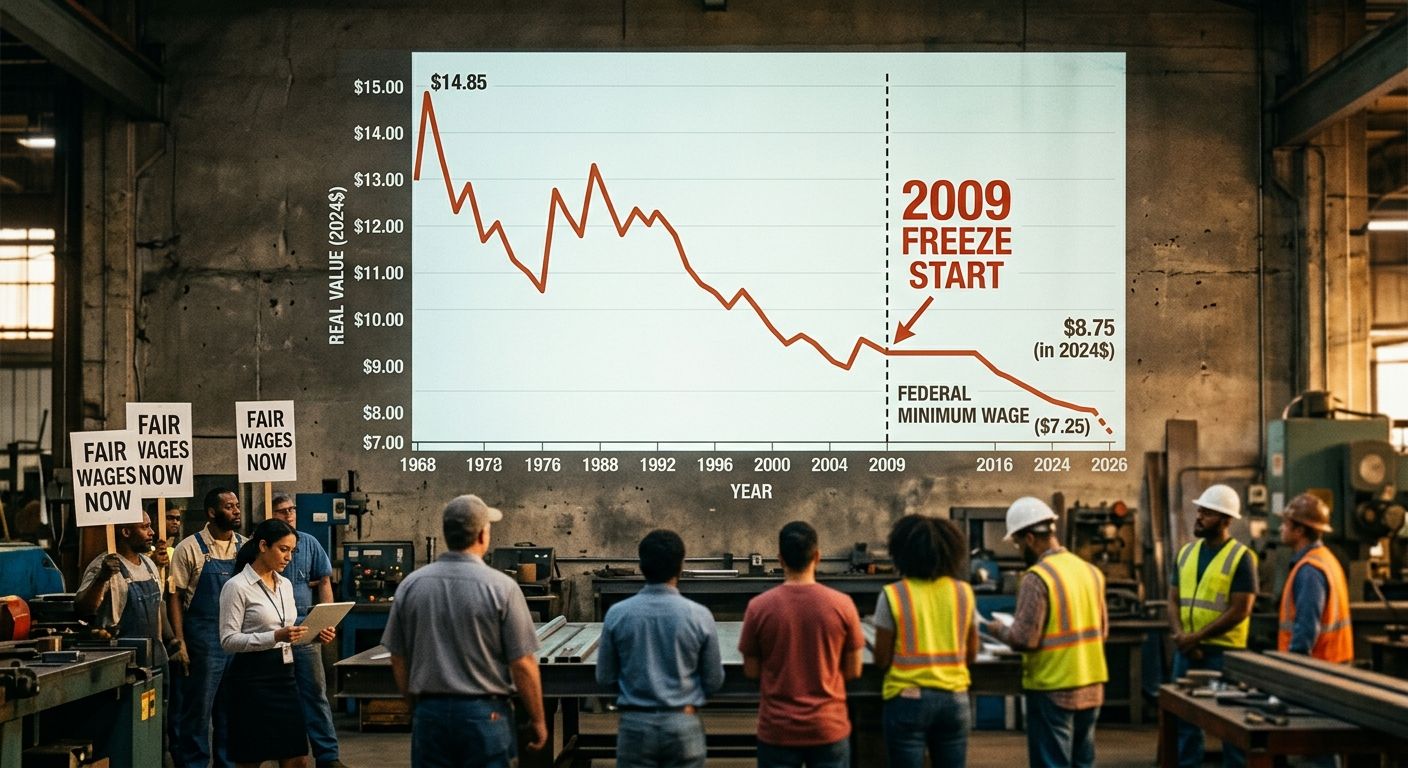
The federal minimum wage has not increased since July 24, 2009. That 17-year freeze is unprecedented in the law's history. The previous longest gap between increases was 10 years, from 1997 to 2007.
The purchasing power of $7.25 has eroded by roughly 30% since 2009, according to inflation-adjusted calculations. A worker earning the minimum wage federal law requires today takes home approximately $15,080 annually before taxes on a standard 40-hour week, 52 weeks a year. That falls below the federal poverty line for a family of two.
The mechanism for increasing the federal minimum wage requires an act of Congress signed by the president. Unlike Washington State's automatic CPI adjustment or other state-level indexing formulas, the FLSA contains no inflation trigger, no automatic escalator, and no scheduled increase. Every raise requires new legislation, committee votes, floor votes in both chambers, and a presidential signature. This design means the minimum wage for federal purposes degrades in real value every year Congress doesn't act.
The Economic Policy Institute and the Roosevelt Institute have advocated tying the federal floor to two-thirds of the national median wage, which they project would reach approximately $20 per hour by 2030. Research cited by these organizations suggests that raising the floor to that level would increase pay for 39.6 million workers with minimal negative employment impact.
The Relationship Between CEO Pay and the Frozen Floor
The federal minimum wage freeze exists alongside a dramatic expansion of executive compensation at the same companies employing minimum-wage workers. Analysis has found that CEOs at low-wage corporations earned 614 times median worker pay in 2025, a ratio that has widened substantially during the years the minimum wage federal rate has remained at $7.25. The contrast raises a structural question about where employer revenue goes when it doesn't flow to the wage floor.
Wage theft compounds the problem. Workers already earning at or near the minimum face the highest rates of employer violations, including unpaid overtime, off-the-clock work requirements, and illegal tip skimming. Cases like Chicago daycare workers demanding $24,000 in unpaid wages illustrate how the federal floor serves as a starting point that some employers still undercut. The FLSA provides for back pay and liquidated damages in wage theft cases, but individual enforcement requires workers to file complaints or pursue legal action, processes that benefit enormously from union representation and collective bargaining protections.
Where the Mechanism Breaks
The federal minimum wage system fails at several identifiable points, and understanding these failures explains why the $7.25 rate delivers less protection than it appears to on paper.
The coverage gaps are real. Workers in the five states with no state minimum wage law depend entirely on FLSA coverage. If their employer falls below the $500,000 enterprise threshold and their individual work doesn't involve interstate commerce, they have no legal minimum wage floor at all. This situation is rare but not hypothetical, particularly for domestic workers, small-farm laborers, and some home care aides.
The tip credit system relies on employer honesty. The $2.13 tipped minimum wage presumes that employers track tip income accurately and make up shortfalls to reach $7.25. In practice, the Department of Labor has documented widespread noncompliance, and workers in tipped occupations report some of the highest rates of wage violations in the economy.
The absence of indexing guarantees erosion. Every inflation-adjustment mechanism used by states that have adopted one produces a minimum wage that holds its purchasing power. The federal system's reliance on congressional action guarantees that the value of the minimum wage declines between increases, and the political difficulty of passing wage legislation means those gaps grow longer over time.
Enforcement depends on worker complaints. The Wage and Hour Division investigates violations, but its staffing levels have declined relative to the size of the workforce it covers. Workers who don't know their rights, fear retaliation, or lack access to legal resources rarely file. Unionized workplaces address this through grievance procedures and shop steward systems that catch violations at the point of occurrence.
Common Questions
Does the federal minimum wage apply to all workers?
No. The FLSA covers "nonexempt" employees who meet either enterprise coverage (working for a business with $500,000+ in annual revenue) or individual coverage (work involving interstate commerce). Workers who fall outside both channels, and workers in specifically exempted categories like certain agricultural and seasonal employees, are not guaranteed $7.25 under federal law. State law may provide additional protections depending on where you work.
What happens when my state minimum wage is higher than the federal rate?
You're entitled to the higher rate. The FLSA explicitly provides that when both state and federal minimum wage laws apply, the employee receives whichever rate is higher. As of March 2026, 30 states and D.C. have rates above $7.25, so workers in those states earn their state rate, and the federal floor is irrelevant to their paycheck.
Why hasn't the federal minimum wage gone up since 2009?
The FLSA does not include any automatic adjustment mechanism. Increasing the federal minimum wage requires a new act of Congress signed by the president. Congressional efforts to raise the rate, including proposals to reach $15 per hour, have repeatedly failed to clear procedural hurdles in the Senate. The 17-year freeze is the longest in the law's 88-year history.
Is the tipped minimum wage really $2.13?
The federal tipped minimum wage is $2.13 per hour, and it has been frozen at that level since 1991. Employers must ensure that an employee's tips plus the $2.13 base equal at least $7.25. If they don't, the employer is legally required to pay the difference. Several states and cities have eliminated the tip credit entirely, requiring employers to pay the full minimum wage before tips.
Can my employer pay me less than minimum wage if I'm under 20?
Under the FLSA's youth minimum wage provision, employers can pay workers under 20 years old a rate of $4.25 per hour during their first 90 consecutive calendar days of employment. After 90 days, or once the worker turns 20, the standard federal minimum wage of $7.25 applies. This provision is narrower than many workers realize, and employers sometimes apply it incorrectly beyond the 90-day window.
The Union Edge Staff
Frequently Asked Questions
- What is the current federal minimum wage?
- The federal minimum wage is $7.25 per hour, set by the Fair Labor Standards Act (FLSA) and enforced by the U.S. Department of Labor's Wage and Hour Division. This rate has been frozen since July 24, 2009.
- Do I have to be paid the federal minimum wage?
- Not all workers are covered by the federal minimum wage. You must work for a business with at least $500,000 in annual revenue (enterprise coverage) or perform work involving interstate commerce (individual coverage). Workers in specifically exempted categories, such as certain agricultural and seasonal employees, may not be entitled to the $7.25 minimum.
- What happens if my state minimum wage is higher than federal?
- You are entitled to the higher rate. The FLSA requires that when both state and federal minimum wage laws apply, the employee receives whichever rate is higher. As of March 2026, 30 states and D.C. have minimum wages above $7.25.
- Why hasn't the federal minimum wage increased since 2009?
- The FLSA contains no automatic adjustment mechanism—increasing the federal minimum wage requires a new act of Congress signed by the president. Unlike some states that tie their minimum wage to inflation, the federal system relies entirely on legislative action, which has repeatedly failed to pass.
- What is the tipped minimum wage?
- The federal tipped minimum wage is $2.13 per hour, frozen since 1991. Employers must ensure that an employee's tips plus the $2.13 base equal at least $7.25, and if they don't, the employer must make up the difference.
- Can my employer pay me less than minimum wage if I'm a student?
- Student workers at retail, service establishments, farms, or colleges can be paid as low as 85% of the minimum wage under a certificate issued by the Department of Labor. Full-time students and student learners have their own subminimum wage provisions under FLSA rules.
- Which states have no minimum wage law?
- Five states have no state minimum wage law at all: Alabama, Louisiana, Mississippi, South Carolina, and Tennessee. In these states, the federal FLSA rate of $7.25 applies directly.
- How do I report wage violations to the federal government?
- You can file a complaint with the Department of Labor's Wage and Hour Division at 1-866-487-9243. Retaliation against workers who file complaints is illegal under the FLSA.
Related Articles

Minimum Federal Wage: Current Rates & Policy
Congress sets the minimum federal wage; it does not update it. The $7.

Georgia Minimum Wage: Current Rates & 2024 Updates
Only two U.S. states maintain a minimum wage below the federal floor of $7.25 per hour: Georgia and Wyoming. Georgia's rate, $5.15 an hour and frozen since 1999, ranks among the lowest statutory wage floors in the country. But that $5.

State of Georgia Minimum Wage: 2024 Guide
Two minimum wage rates operate in the state of Georgia simultaneously: $5.15 under state statute and $7.25 under the federal Fair Labor Standards Act.
Also in the paper