
Maryland Minimum Wage 2024: Complete Guide
Maryland's minimum wage is $15.00 per hour for every employer in the state, regardless of business size, a rate that took effect January 1, 2024 under the Fair Wage Act of 2023.

Maryland Minimum Wage: How the State's Layered Wage Floor Actually Works
Maryland's minimum wage is $15.00 per hour for every employer in the state, regardless of business size, a rate that took effect January 1, 2024 under the Fair Wage Act of 2023. Three counties then stack their own higher floors on top, creating a tiered system where the wage a worker is owed depends on geography and employer size as much as state law.
What the Fair Wage Act of 2023 Changed
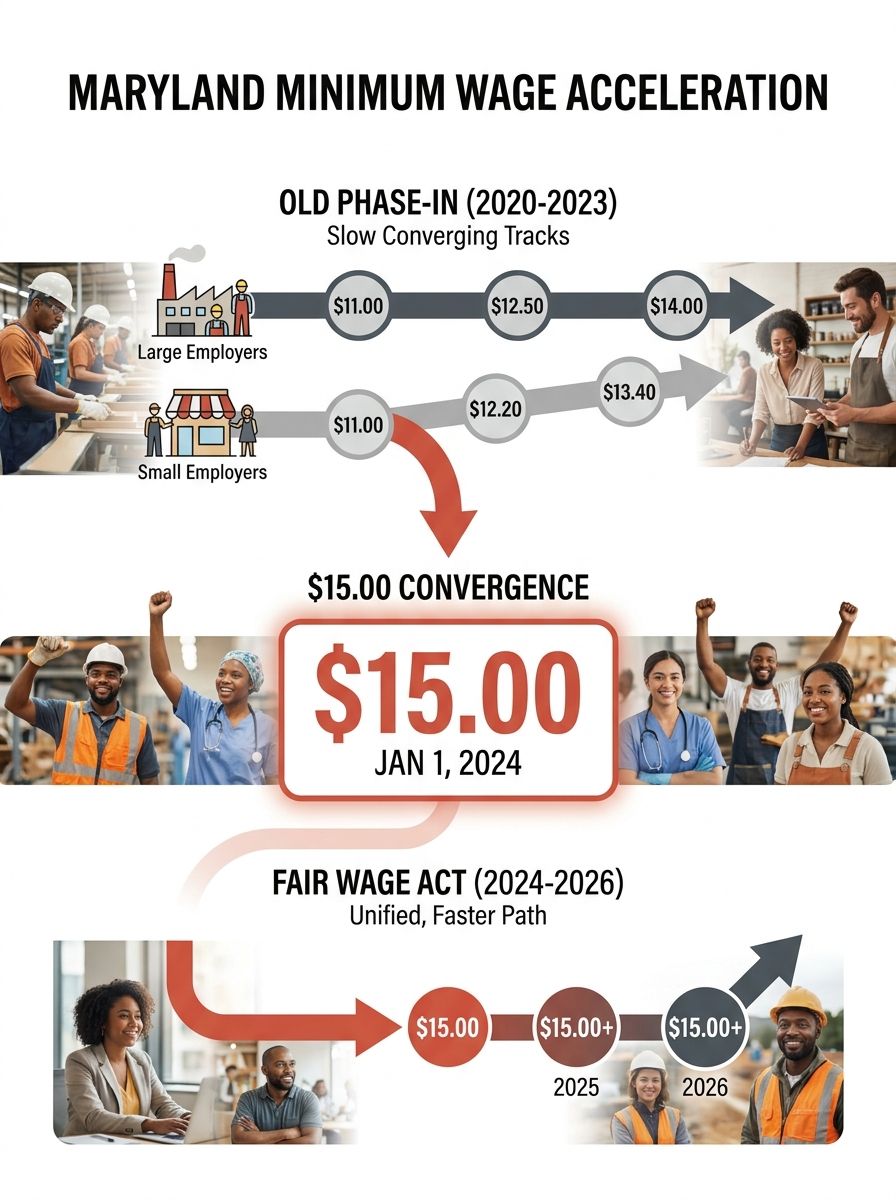
The Fair Wage Act of 2023 collapsed Maryland's multi-year phase-in schedule into a single deadline: January 1, 2024. Before that law passed, the minimum wage for Maryland had been climbing on separate tracks for large employers (those with 15 or more workers) and small employers (fewer than 15). Large employers were heading toward $15.00 by 2025; small employers wouldn't have reached that number until 2026. Governor Wes Moore signed the acceleration into law, a move projected to raise wages for approximately 163,000 workers and benefit an estimated 120,000 children in affected households.
The acceleration mattered because it eliminated a two-tier system that had made compliance confusing for multi-location businesses and shortchanged workers at smaller shops. Under the old timeline, a cashier at a 10-person store in Baltimore would have earned less per hour than a cashier doing identical work at a 20-person store across the street. That gap is gone. Every employer in Maryland now owes the same $15.00 floor, and as of 2026, the state has not indexed that rate to inflation or scheduled a further increase at the state level.
For context, Maryland's per capita personal income hit $73,849 in 2023, well above the national average of $68,499. The $15.00 minimum translates to roughly $31,200 annually for a full-time worker, which is less than half the state's per capita income figure. That disconnect between the wage floor and the actual cost of living in the state is part of why several counties have gone further.
County-Level Floors That Override the State Rate
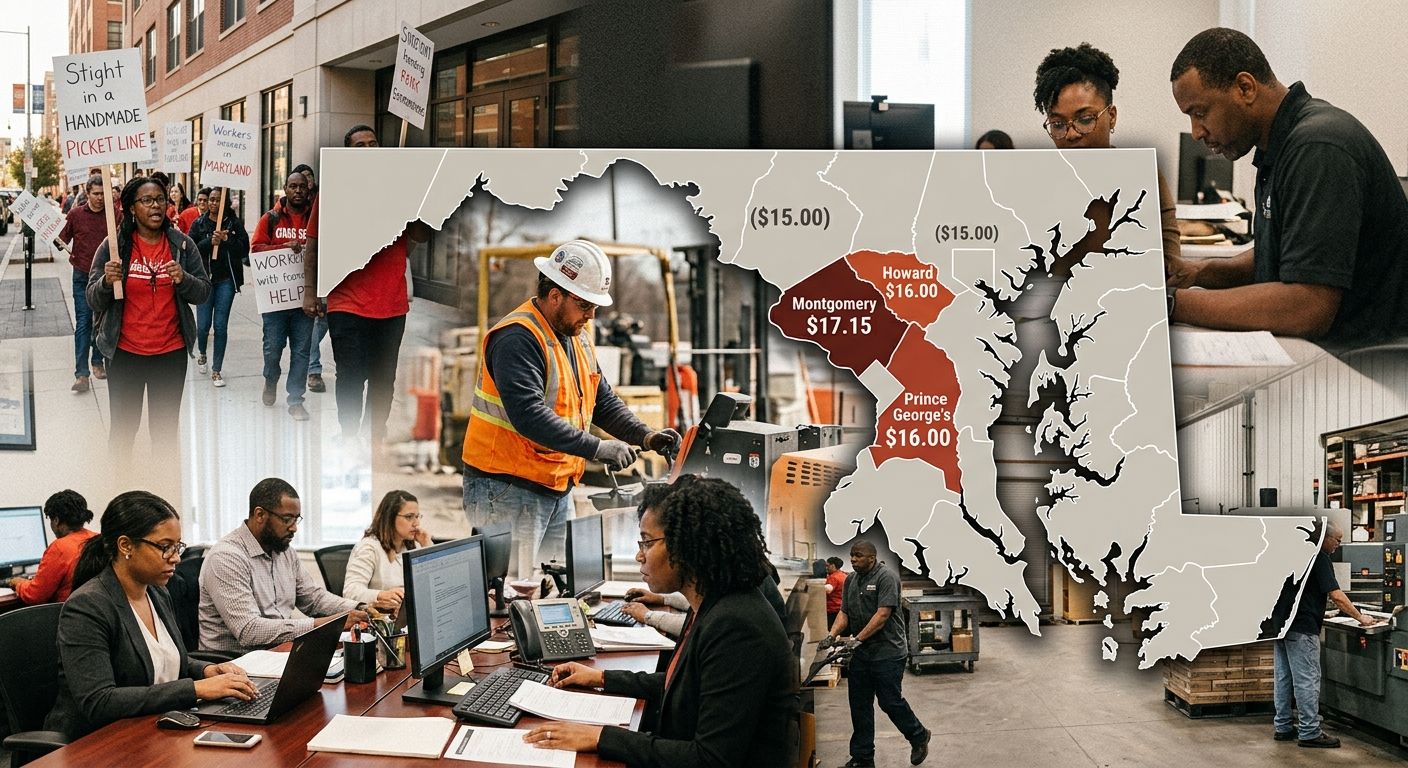
Three Maryland counties enforce minimum wages higher than $15.00, and employers within those jurisdictions must pay whichever rate benefits the worker more. This principle comes straight from the Maryland Employment Standards Service: when state and local laws conflict, the higher rate applies. The practical effect is a patchwork where an employer operating in multiple counties may owe different hourly rates to workers performing the same job at different locations.
Here's how the county rates break down:
Jurisdiction | Employer Size | Minimum Wage | Effective Date |
|---|---|---|---|
Montgomery County | Large (51+ employees) | $17.15 | July 1, 2024 |
Montgomery County | Mid-size (11–50 employees) | $15.50 | July 1, 2024 |
Montgomery County | Small (10 or fewer) | $15.00 | July 1, 2024 |
Howard County | 15+ employees | $16.00 | Current |
Prince George's County | All employers | $15.30 | January 1, 2026 |
Montgomery County stands out for two reasons. First, it retains a three-tier system based on employer size, which the state itself abandoned. Second, it indexes its minimum wage to regional inflation. The Montgomery County Office of Human Rights confirmed that on July 1, 2026, the large-employer rate will climb by $0.85 to $18.00 per hour. That's 20% above the state floor.
Howard County's $16.00 rate affects employers with 15 or more workers, while Prince George's County set its rate at $15.30 effective January 1, 2026. Businesses with locations spanning multiple counties should track each jurisdiction's schedule independently. The compliance burden falls entirely on the employer, and ignorance of a county rate is not a defense under Maryland wage law.
This layered structure is common across states that allow local wage ordinances. It functions similarly to what you'll find in Colorado's inflation-indexed minimum wage system, though Maryland's indexing happens only at the county level rather than statewide. And it contrasts sharply with states like Texas, which defer entirely to the federal rate and preempt local governments from setting higher wages.
How Tip Credits Work Under Maryland Law
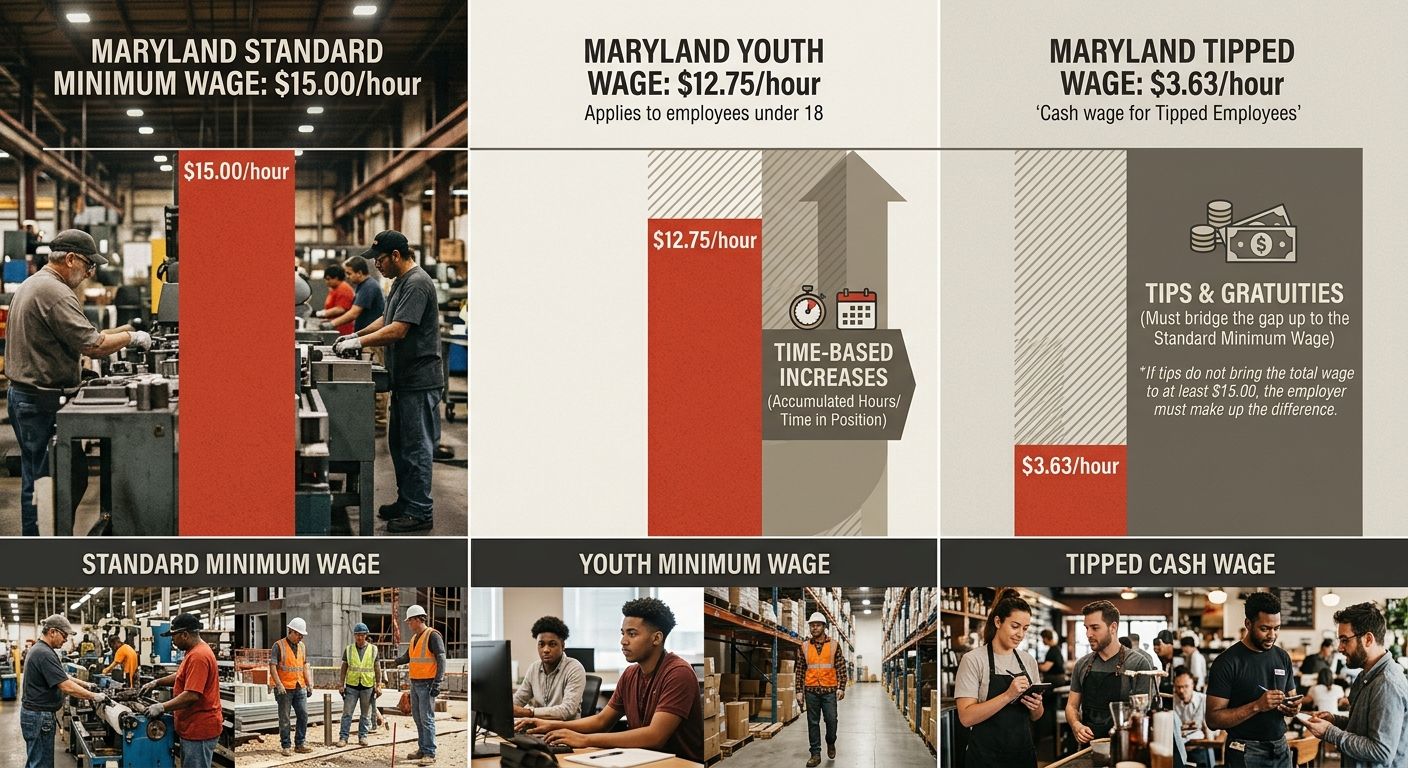
Maryland allows employers to pay tipped employees a direct cash wage below $15.00 per hour, provided tips bring the worker's total hourly earnings up to the full minimum wage. The state's Employment Standards Service defines a tipped employee as anyone who customarily and regularly receives more than $30 per month in tips. The minimum cash wage an employer must pay is $3.63 per hour statewide.
The gap between $3.63 and $15.00 is the tip credit: $11.37 per hour that the employer counts against the worker's tips rather than paying out of pocket. If a tipped worker's combined wages and tips fall short of $15.00 in any pay period, the employer must make up the difference. There is no exception.
Montgomery County adds a layer here. Tipped employees in the county must receive at least $4.00 per hour in direct wages, $0.37 above the state cash wage. And because Montgomery County's minimum wage for large employers is $17.15 (rising to $18.00 in July 2026), the tip credit in that jurisdiction is proportionally larger, but so is the employer's obligation to verify that total earnings meet the local floor.
The tip credit system is where wage theft most frequently occurs for Maryland workers. Workers should keep independent records of their tips and compare them against the wage statements their employer is required to provide. If the numbers don't add up, the employer is on the hook under Maryland Labor and Employment Code §3-413 to pay the shortfall. Workers dealing with systematic underpayment should understand how federal wage enforcement interacts with state law, because both layers of protection can apply simultaneously.
Youth Wages, Exemptions, and the 85% Rule
Workers under 18 years old in Maryland must earn at least 85% of the state minimum wage rate, which works out to $12.75 per hour. This reduced rate applies during the first six months of employment, according to the Maryland Division of Labor and Industry. After six months, the full minimum wage kicks in regardless of the worker's age.
Several other categories of workers fall outside the minimum wage entirely. Maryland's exemptions include:
Agricultural workers on farms that did not use more than 500 person-days of labor in any calendar quarter of the preceding year
Employees of establishments providing food or lodging to students, where the establishment is operated by a nonprofit educational institution
Outside salespersons who work away from the employer's place of business
Workers employed by certain amusement or recreational establishments that operate on a seasonal basis (fewer than 7 months per year)
Executive, administrative, and professional employees meeting specific salary and duties tests under federal and state law
These exemptions don't require employer registration or government approval. They apply automatically if the employee's job meets the legal definition. The danger for workers is that employers sometimes misclassify standard hourly roles as exempt to avoid paying the minimum wage. A restaurant cook cannot be classified as exempt just because the employer calls the position "kitchen manager." The duties test, not the job title, controls the classification.
If you suspect you've been misclassified, the NLRB and state labor agencies handle different aspects of workplace complaints, but wage-and-hour claims in Maryland go through the state Division of Labor and Industry's Employment Standards Service.
Where the Model Breaks
Maryland's minimum wage structure has several blind spots and boundary conditions where the rules produce results the law probably didn't intend.
The inflation gap. The state's $15.00 rate has no indexing mechanism. Montgomery County's rate adjusts for inflation annually; the statewide rate does not. Every year that passes without a legislative increase, the real purchasing power of $15.00 drops. If the state legislature doesn't act, workers outside Montgomery County will see their wage floor erode steadily. The county rate climbing to $18.00 in July 2026 while the state rate stays frozen at $15.00 will create a $3.00-per-hour gap between workers doing identical jobs on opposite sides of a county line.
Cross-county confusion. A delivery driver whose route spans Montgomery County, Howard County, and Baltimore City may be owed three different hourly rates during a single shift. Maryland law doesn't clearly address how to calculate wages for workers who move between jurisdictions during the workday. Employers tend to default to the lowest applicable rate, which may violate the higher-rate jurisdiction's ordinance for hours worked within its borders.
The tip credit verification problem. The law requires employers to prove that tips bring workers up to the full minimum wage, but enforcement depends almost entirely on the employer's own records. Workers who don't receive the mandated wage statements have limited visibility into whether their employer is actually complying. The Division of Labor and Industry investigates complaints, but it doesn't conduct proactive audits of tip credit compliance across the state's roughly 12,000 food service establishments.
Small employer exposure in Montgomery County. A business with 10 employees in Montgomery County pays $15.00, the same as the state rate. The moment it hires an 11th worker, it jumps to the mid-size tier at $15.50. At 51 employees, it hits $17.15 (soon $18.00). These thresholds create perverse incentives to keep headcount just below a tier boundary, which can mean more hours for fewer workers rather than new hires.
The structure works well for straightforward situations: a full-time, adult, non-tipped employee at a single fixed location in one county. The further you move from that archetype, the more the system creaks. Workers in complicated employment arrangements, like those covered in our guide to Pennsylvania's minimum wage, face similar structural gaps in different states, but Maryland's county-level layering makes the edge cases especially sharp.
Common Questions
Does the minimum wage in Maryland apply to all employers regardless of size?
Yes. Since January 1, 2024, every employer in Maryland owes $15.00 per hour to covered employees, whether the business has 5 workers or 5,000. The old size-based tiers were eliminated by the Fair Wage Act of 2023. County-level rates in Montgomery County still differentiate by employer size, but the state rate itself is uniform.
Can an employer in Montgomery County pay the state minimum wage instead of the county rate?
No. When a local jurisdiction's minimum wage exceeds the state rate, the employer must pay the higher amount. A large employer in Montgomery County (51 or more employees) owes $17.15 per hour as of July 2024, rising to $18.00 on July 1, 2026. Paying only the $15.00 state rate would be a wage violation under county law.
What happens if a tipped worker's tips don't bring them to the minimum wage?
The employer must pay the difference. Under Maryland law, tipped employees' combined cash wages and tips must equal or exceed the applicable minimum wage rate for every pay period. If a server earns $3.63 per hour in direct wages and receives $10.00 per hour in tips, total compensation is $13.63, which falls $1.37 short of $15.00. The employer owes that $1.37. No exceptions apply.
Is Maryland's minimum wage indexed to inflation?
The statewide rate is not. The $15.00 figure will remain in place until the state legislature passes new legislation. Montgomery County is the only jurisdiction in Maryland that currently indexes its minimum wage to regional inflation, which is why its rate adjusts annually each July. Howard County and Prince George's County set their rates through local ordinance rather than automatic adjustment.
Where do workers file a complaint about minimum wage violations?
Workers should contact the Maryland Division of Labor and Industry's Employment Standards Service. Complaints can be filed for unpaid wages, improper tip credit practices, or misclassification. The state investigates individual complaints and can order back-pay remedies. Workers covered by collective bargaining agreements may also have grievance procedures available through their union.
The Union Edge Staff
Frequently Asked Questions
- What is the minimum wage in Maryland for 2024?
- Maryland's statewide minimum wage is $15.00 per hour for all employers regardless of size, effective January 1, 2024. This rate was established by the Fair Wage Act of 2023 and applies uniformly across the state.
- Which Maryland counties have higher minimum wages than the state rate?
- Montgomery, Howard, and Prince George's counties enforce minimum wages higher than $15.00. Montgomery County has tiered rates ranging from $15.00 to $17.15 depending on employer size, Howard County is $16.00 for employers with 15+ employees, and Prince George's County is $15.30 effective January 1, 2026.
- How much can employers pay tipped employees in Maryland?
- Employers can pay tipped employees a direct cash wage of $3.63 per hour statewide, provided tips bring the worker's total earnings to at least $15.00 per hour. If tips fall short, the employer must pay the difference to meet the applicable minimum wage.
- What is the minimum wage for workers under 18 in Maryland?
- Workers under 18 in Maryland must earn at least 85% of the state minimum wage, which equals $12.75 per hour during their first six months of employment. After six months, they must receive the full $15.00 minimum wage regardless of age.
- Will Maryland's minimum wage increase in 2025 or 2026?
- The statewide $15.00 minimum wage has no indexing mechanism and will remain frozen at that rate unless the state legislature passes new legislation. Montgomery County is the only jurisdiction that indexes its rate to inflation, with its large-employer rate rising to $18.00 on July 1, 2026.
- What should I do if my employer isn't paying minimum wage in Maryland?
- Workers should file a complaint with the Maryland Division of Labor and Industry's Employment Standards Service, which investigates wage violations and can order employers to pay back wages. Workers should also keep independent records of their hours and tips to document underpayment.
- Can employers in Montgomery County pay the state minimum wage instead of the county rate?
- No, when a county's minimum wage exceeds the state rate, employers must pay the higher county rate. A large employer in Montgomery County with 51 or more employees must pay at least $17.15 per hour, not the $15.00 state rate.
Related Articles

Minimum Wage State of Maryland: 2024 Guide
The Fair Wage Act of 2023 set the minimum wage in the state of Maryland at $15.00 per hour for all employers regardless of size, effective January 1, 2024, pulling an estimated 163,000 workers above the previous $13.25 floor. But $15.00 is the baseline, not the ceiling.

Washington State Minimum Wage: 2024 Rates & Laws
Washington state doesn't have one minimum wage. It has at least seven. The statewide floor sat at $16.28 per hour for 2024 (rising to $17.

state of washington minimum wage: 2024 Guide
Initiative 1433, which Washington voters approved in November 2016, built an automatic escalator into state law: the minimum wage rises every January 1 by the percentage change in the Consumer Price Index for Urban Wage Earners and Clerical Workers (CPI-W), producing a 2024 rate of $16.
Also in the paper