
When Employers Fight Back: Recognizing and Countering Union-Busting Tactics During Your Organizing Campaign
U.S. employers are charged with violating federal law in 41.5% of all union election campaigns, according to a study from the Economic Policy Institute. The violations follow a predictable script.

When Employers Fight Back: Recognizing and Countering Union-Busting Tactics During Your Organizing Campaign
U.S. employers are charged with violating federal law in 41.5% of all union election campaigns, according to a study from the Economic Policy Institute. The violations follow a predictable script. Organizers who learn that script before it plays out hold a measurable advantage in building their organizing defense.
The Script Employers Use and the Statutes They Violate
Section 8(a)(1) of the National Labor Relations Act makes it illegal for employers to interfere with, restrain, or coerce workers exercising their Section 7 rights to organize. Section 8(a)(3) bars employers from discriminating against workers for union activity, including through firings, schedule changes, or benefit cuts. These two provisions form the legal backbone of every unfair labor practices complaint filed during an organizing campaign, and employers break them with startling regularity.
The union-busting tactics that show up most often in NLRB complaints fall into a handful of categories. Threats of job loss or plant closure rank at the top. The EPI study found that employers routinely tell workers their jobs will disappear if a union wins the election. They don't always say it in those exact words. Supervisors are coached to phrase the threat as concern: "I'd hate to see this location shut down" or "the company might not be able to keep everyone on." The effect is the same. Workers hear the message, and fear does the rest.
Captive-audience meetings are another standard play. The employer gathers workers in a room during paid time, locks the door, and delivers an anti-union presentation. Workers can't leave without risking discipline. They can't ask questions without drawing attention to themselves. These meetings happen in roughly 89% of union campaigns, according to data compiled by Cornell University's Kate Bronfenbrenner in her research on employer behavior during elections. The presentations mix legal half-truths with emotional appeals designed to make workers doubt whether the union can deliver.
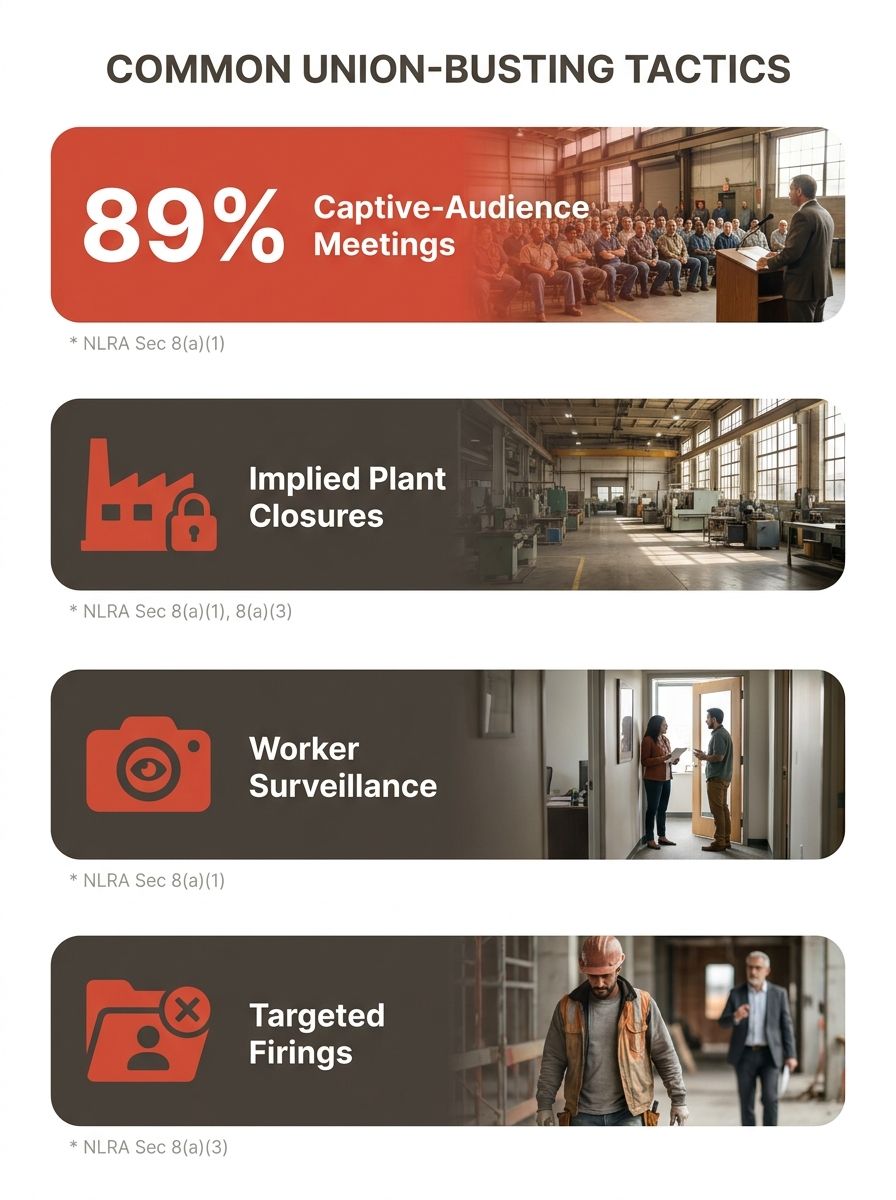
Surveillance of union supporters is subtler but equally effective as a suppression tool. Employers assign supervisors to track which workers attend meetings, who talks to organizers, and who signs authorization cards. Sometimes the surveillance is physical. Sometimes it's digital, with companies monitoring internal messaging platforms and email. Amazon spent $14 million on anti-union consultants in 2022 alone, part of a broader strategy that included tracking worker sentiment through data analytics. When workers know they're being watched, many pull back. The chilling effect is the point.
Targeted firings represent the most aggressive form of employer retaliation. An employer picks off one or two visible organizers early in the campaign. The firing sends a message to every other worker on the fence. Under Section 8(a)(3), these terminations are illegal when motivated by union activity, but proving motivation requires documentation. The fired worker files an NLRB complaint, the Board investigates, and the case can take months or years to resolve. During that time, the campaign either survives or dies.
How the Consultant Industry Fuels Anti-Union Campaigns
In three out of four worker organizing drives, employers hire outside consultants to run anti-union campaigns or "persuader" activities. These consultants charge between $350 and $3,000 per day, per consultant, and the industry generates hundreds of millions of dollars in annual revenue. The firms go by polite names. They call themselves "labor relations consultants" or "employee engagement specialists." Their job is to stop the union from winning the election.
The Union Busting Playbook, a resource built by labor organizers, documents how these consultants operate across industries. "Whether you are a bus driver, a nurse, a tech, or a call center worker, employers will hire union busters who will train supervisors in this anti-union script," the Playbook explains. The script follows a consistent pattern regardless of workplace or sector. Consultants coach supervisors to hold one-on-one conversations with workers on the fence, using talking points designed to raise doubt about union dues, strike risks, and the bargaining process.
Dr. John Logan, a labor studies professor at San Francisco State University, has spent years studying the persuader industry. Logan has emphasized that because penalties for federal labor law violations are often weak, employers treat them as a cost of doing business. A company that fires an organizer and gets caught faces a back-pay order, not a fine proportional to its revenue. For a firm like Amazon, with $575 billion in 2023 revenue, a back-pay settlement for one terminated warehouse worker registers as a rounding error. The financial incentive structure rewards law-breaking.
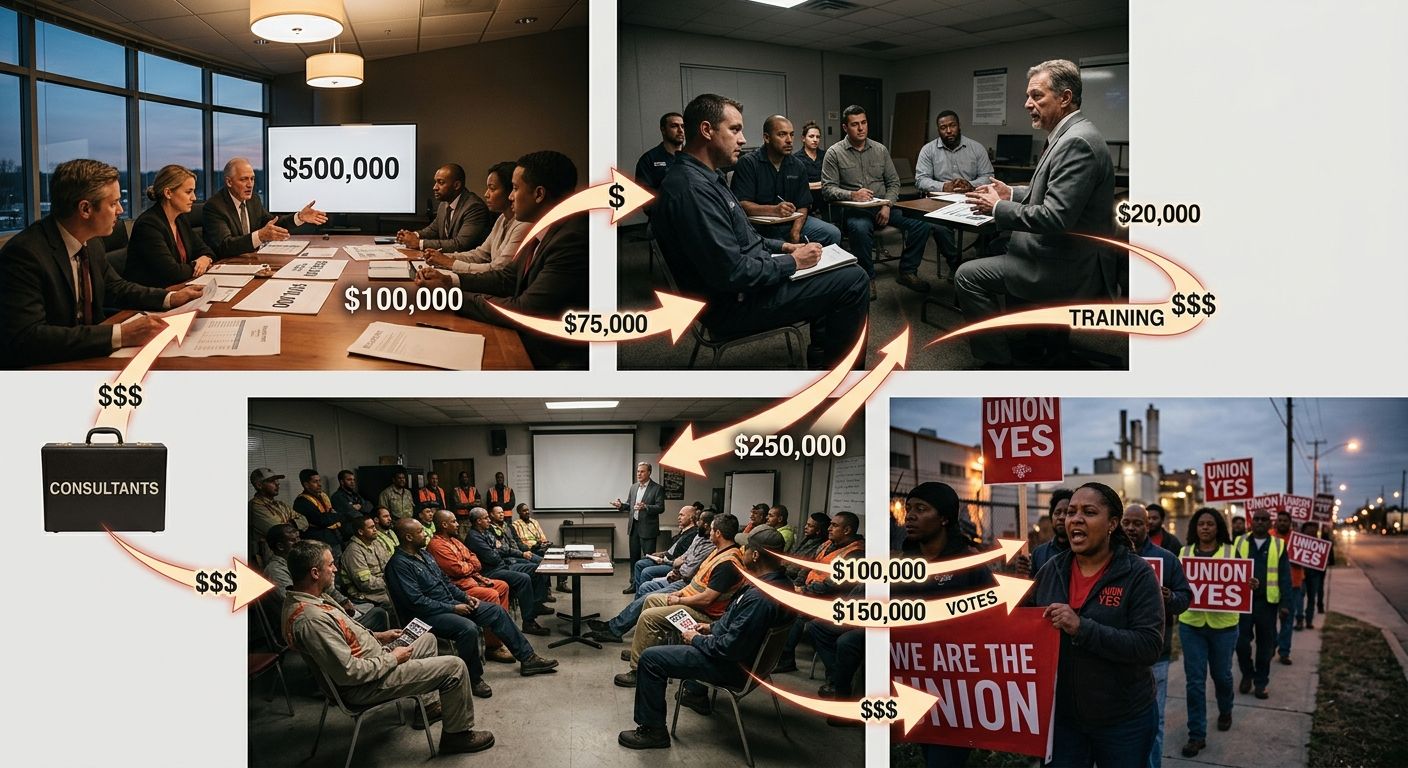
The Harvard-based Center for Labor and a Just Economy, along with Governing for Impact and LaborLab, published a report recommending that the Department of Labor and the Federal Trade Commission take stronger action against persuader firms. The report argued that existing disclosure rules under the Labor-Management Reporting and Disclosure Act of 1959 are poorly enforced. Consultants exploit a loophole known as the "advice exemption," which lets them avoid public disclosure as long as they claim to be advising the employer rather than communicating directly with workers. In practice, the line between advising an employer and scripting a supervisor's conversations with workers is paper-thin. The result is that workers often have no idea that the person in the room coaching their manager is a paid anti-union operative.
Building a strong organizing database that tracks employer behavior helps campaigns recognize these patterns as they unfold. When organizers log each captive-audience meeting, each supervisor conversation, and each schedule change, they create a record that serves two purposes: it feeds NLRB complaints with specific dates and facts, and it helps the organizing committee anticipate the next move in the employer's playbook.
Filing NLRB Complaints and Building a Paper Trail
Any worker who believes their Section 7 rights have been violated can file an unfair labor practice charge with the nearest NLRB regional office. The process starts with a charge form, available on the NLRB website. The Board has 26 regional offices across the country, each staffed with agents who investigate charges. But there's a critical deadline: you must file within six months of the incident for the complaint to be valid. Miss the window, and the charge gets thrown out regardless of the evidence.
The filing itself is straightforward, but what happens afterward is where campaigns win or lose. Once a charge is filed, an NLRB agent contacts the employer and begins gathering evidence. The agent interviews witnesses, reviews documents, and determines whether the charge has merit. If it does, the regional director issues a formal complaint and the case moves toward a hearing before an administrative law judge. If the agent determines the charge lacks merit, the charging party can appeal to the NLRB's Office of Appeals in Washington, D.C. The entire process, from charge to resolution, averages 120 to 483 days depending on complexity and whether the case settles.
That timeline matters for campaign strategy. Organizers experienced in building leadership density across a workplace know that a pending NLRB complaint can serve as a rallying point. It signals to workers that the employer's behavior has crossed a legal line. It also creates a public record. When a regional director issues a complaint against an employer, that complaint is a government finding of probable cause. It carries weight with undecided workers, local media, and community allies.
Inoculation is the organizing term for preparing workers before the employer's anti-union campaign begins. Organizer Mindy Isser has written about this approach extensively. The idea is simple: tell workers what the employer will do before the employer does it. Tell them about the captive-audience meetings. Tell them about the one-on-one supervisor conversations. Tell them that someone might get their hours cut or their schedule changed. When those things happen, the workers recognize the tactics for what they are instead of reacting with fear. Inoculation works because it reframes the employer's behavior as evidence that the campaign is succeeding, not failing. A company that spends $14 million on consultants is a company that takes the organizing effort seriously.
Documentation supports both the legal strategy and the inoculation strategy. Every conversation a supervisor initiates about the union should be written down, with the date, time, location, and names of anyone present. Every schedule change, every denied request, every shift in workload should be logged. Workers involved in salting campaigns inside resistant workplaces are often trained in this kind of detailed record-keeping from day one, because the legal record is the campaign's insurance policy. If the employer retaliates, the documentation turns a worker's word into a case file.

Understanding the timeline gaps that slow down organizing campaigns is also essential for managing expectations around NLRB complaints. Workers file charges expecting swift justice. The reality is that the Board's enforcement machinery moves slowly, and employers exploit that delay. The gap between filing a charge and getting a hearing can drain momentum if organizers don't plan for it.
The Gap Between the Law on Paper and the Law in Practice
The National Labor Relations Act was written in 1935 to protect workers' right to organize. Ninety-one years later, the penalties for violating it remain among the weakest in federal labor law. An employer that illegally fires a union organizer faces reinstatement and back pay, minus whatever the worker earned in the interim. There are no punitive damages. There are no per-day fines for delay. There is no criminal liability for a first offense. The maximum consequence for breaking the law is being told to do what you should have done in the first place.
This enforcement gap shapes every organizing campaign in the country. The EPI's finding that employers commit violations in 41.5% of election campaigns is a direct product of a system where the cost of compliance exceeds the cost of breaking the law. A company that calculates it can delay a union election by 6 to 12 months through legal challenges, fire 2 or 3 organizers, and ultimately pay back wages of $15,000 to $40,000 per worker will often choose that path. The math favors lawlessness when the penalties are this small relative to the stakes.
Legislation to strengthen penalties has repeatedly stalled in Congress. The Protecting the Right to Organize Act, which would have imposed personal liability on corporate officers and added civil penalties of up to $50,000 per violation ($100,000 for repeat offenders), passed the House in 2021 and 2022 but never advanced through the Senate. Without statutory reform, the NLRB's enforcement tools remain limited to remedial orders that many employers treat as a line item in their anti-union budget.
So what fills the gap? Collective solidarity and public pressure do the work that the law cannot. Workers who maintain strong internal organization, keep detailed records of every employer action, and use NLRB complaints as one tool among many create conditions where the employer's playbook becomes less effective. Filing charges matters, but filing charges while simultaneously building broad worker support, engaging community allies, and maintaining campaign discipline is what actually wins elections. The law provides a floor. Workers who organize with discipline and preparation build above it, knowing the floor has cracks they'll need to step around.
The uncomfortable truth is that the legal framework governing union elections in the United States was designed for a different era and has been deliberately weakened over decades. Workers who go into organizing campaigns expecting the law to protect them fully will be caught off guard. Workers who understand the law's limits, prepare for employer retaliation before it happens, and build the kind of collective strength that makes legal violations costly in the court of public opinion are the ones who win. The system is stacked. Knowing exactly how it's stacked is the first step toward organizing despite it.
The Union Edge Staff
Related Articles

NLRB: What Employers and Employees Need to Know
The National Labor Relations Board is the independent federal agency that decides whether your employer broke the law when it fired you for talking about wages, interrogated you about a union meeting, or refused to bargain after workers voted to organize.

How to File an Unfair Labor Practice Charge: A Step-by-Step Guide for Frontline Organizers
Amazon warehouse workers at the JFK8 fulfillment center on Staten Island filed their first unfair labor practice charge months before the April 2022 election that made them famous.

The $1.5 Billion Union-Busting Industry: How Employers Weaponize Legal Consultants and What Unions Should Know
Anti-union law firms, third-party persuader consultants, and employer-run internal campaigns form the three pillars of a $1.7 billion annual industry dedicated to stopping workers from organizing.
Also in the paper