
State of Florida Minimum Wage: 2024 Updates
Article X, Section 24 of Florida's constitution contains a wage-floor mechanism that advances automatically each September 30 without any legislative vote, gubernatorial signature, or agency rulemaking. The 2024 step brought the minimum wage in the state of Florida from $12.00 to $13.

State of Florida Minimum Wage: How the 2024 Constitutional Escalator Works
Article X, Section 24 of Florida's constitution contains a wage-floor mechanism that advances automatically each September 30 without any legislative vote, gubernatorial signature, or agency rulemaking. The 2024 step brought the minimum wage in the state of Florida from $12.00 to $13.00 per hour, the fourth increase in a six-year escalator that reaches $15.00 by September 2026.
How a Ballot Initiative Replaced the Legislature
Prior to 2004, Florida was one of seven states without any state-level minimum wage, according to researchers at the University of Florida Levin College of Law. Workers relied entirely on the federal floor of $5.15 per hour. That year, Florida voters passed a constitutional amendment creating a state minimum wage tied to inflation.
The mechanism proved popular but modest. Annual CPI adjustments added pennies per year, nudging the rate to $8.46 by 2020. Workers and advocacy groups pushed for something stronger.
On November 3, 2020, Florida voters approved Amendment 2 with 60.82% support, rewriting Article X, Section 24 to include a fixed $1.00-per-year escalator. The constitutional text declares that "all working Floridians are entitled to be paid a minimum wage sufficient to provide a decent and healthy life, that protects their employers from unfair low-wage competition, and that does not force them to rely on taxpayer-funded public" assistance. That language, embedded directly in the state constitution, puts the state of Florida minimum wage beyond the reach of any governor or legislative session.
A 2022 study published in the University of Florida Journal of Law and Public Policy by researchers Janice Fine and Daniel Galvin of Rutgers and Northwestern universities found that Florida's constitutional structure provides stronger protection than statutory minimum wages, which legislatures can repeal or freeze at will. The authors titled their analysis "Minimum Wage Enforcement: The Unfinished Business of Florida's Constitutional Amendment," underscoring that even constitutional guarantees depend on enforcement infrastructure to function.
The Six-Step Escalator: $10.00 to $15.00
The Amendment 2 schedule prescribes six $1.00 increases on September 30 of each year. Here's the full timeline, including the tipped wage at each step:
Effective Date | Minimum Wage | Tipped Wage | Annual Increase |
|---|---|---|---|
Sept. 30, 2021 | $10.00 | $6.98 | +$1.54 |
Sept. 30, 2022 | $11.00 | $7.98 | +$1.00 |
Sept. 30, 2023 | $12.00 | $8.98 | +$1.00 |
Sept. 30, 2024 | $13.00 | $9.98 | +$1.00 |
Sept. 30, 2025 | $14.00 | $10.98 | +$1.00 |
Sept. 30, 2026 | $15.00 | $11.98 | +$1.00 |
The 2024 increase represented a 53.7% cumulative rise from the pre-amendment rate of $8.46. For a full-time worker logging 40 hours per week, $13.00 per hour produces $27,040 in annual gross wages, compared to $17,596.80 under the old rate. That difference of $9,443.20 per year hits hardest for Florida's direct-care healthcare workers: home health aides, certified nursing assistants, and hospital housekeeping staff who disproportionately earn at or near the floor.
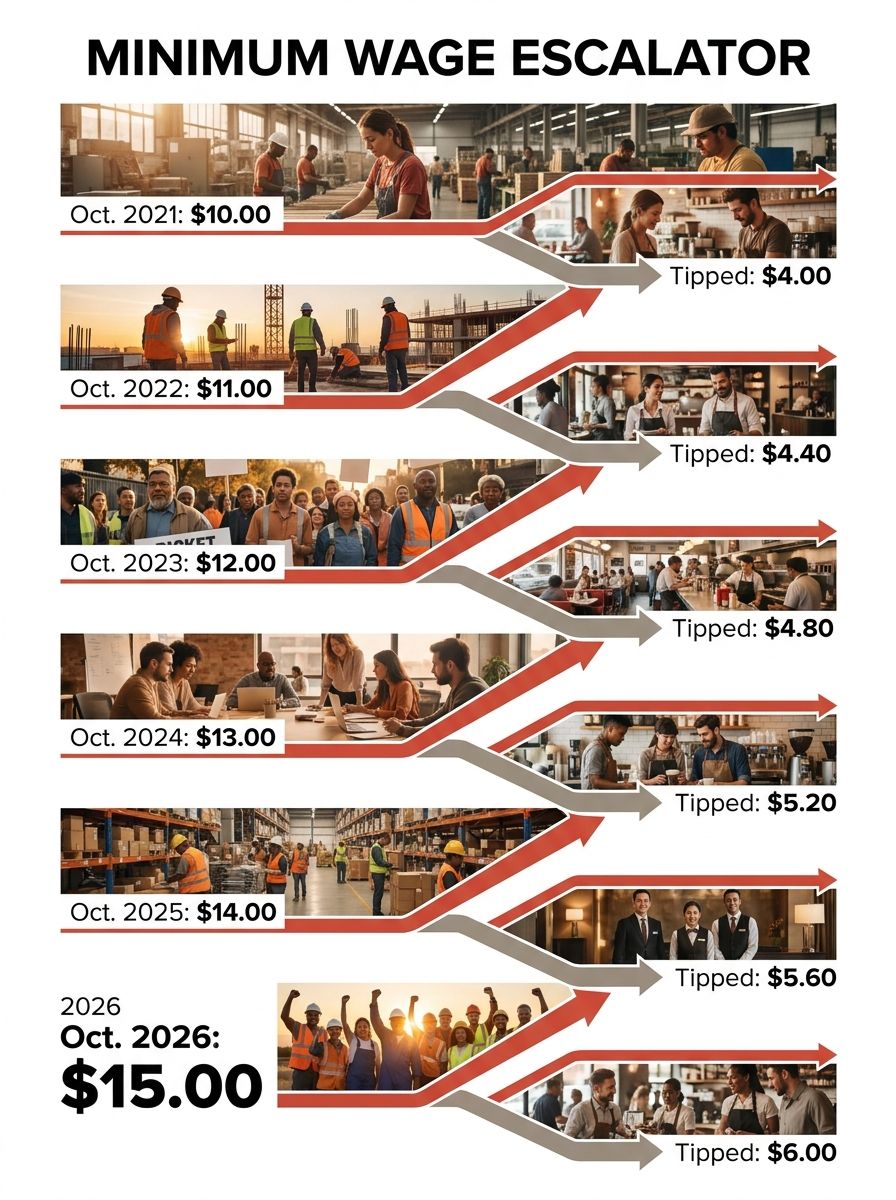
The mechanism's fixed-dollar structure differs from percentage-based increases used in states like Washington and California. A $1.00 annual increase on a $10.00 base is a 10% raise; the same $1.00 on a $14.00 base is 7.1%. The real purchasing-power impact shrinks as the base climbs, a design tradeoff the amendment's drafters accepted in exchange for political simplicity and voter clarity.
The Tipped Wage and the $3.02 Credit
Employers of tipped workers in Florida can claim a tip credit of $3.02 per hour, paying a direct cash wage of the full minimum minus $3.02. As the Florida Department of Economic Opportunity's official wage poster confirms, the tip credit amount has remained fixed at $3.02 throughout the escalator period, meaning the tipped wage rises dollar-for-dollar with the standard minimum.
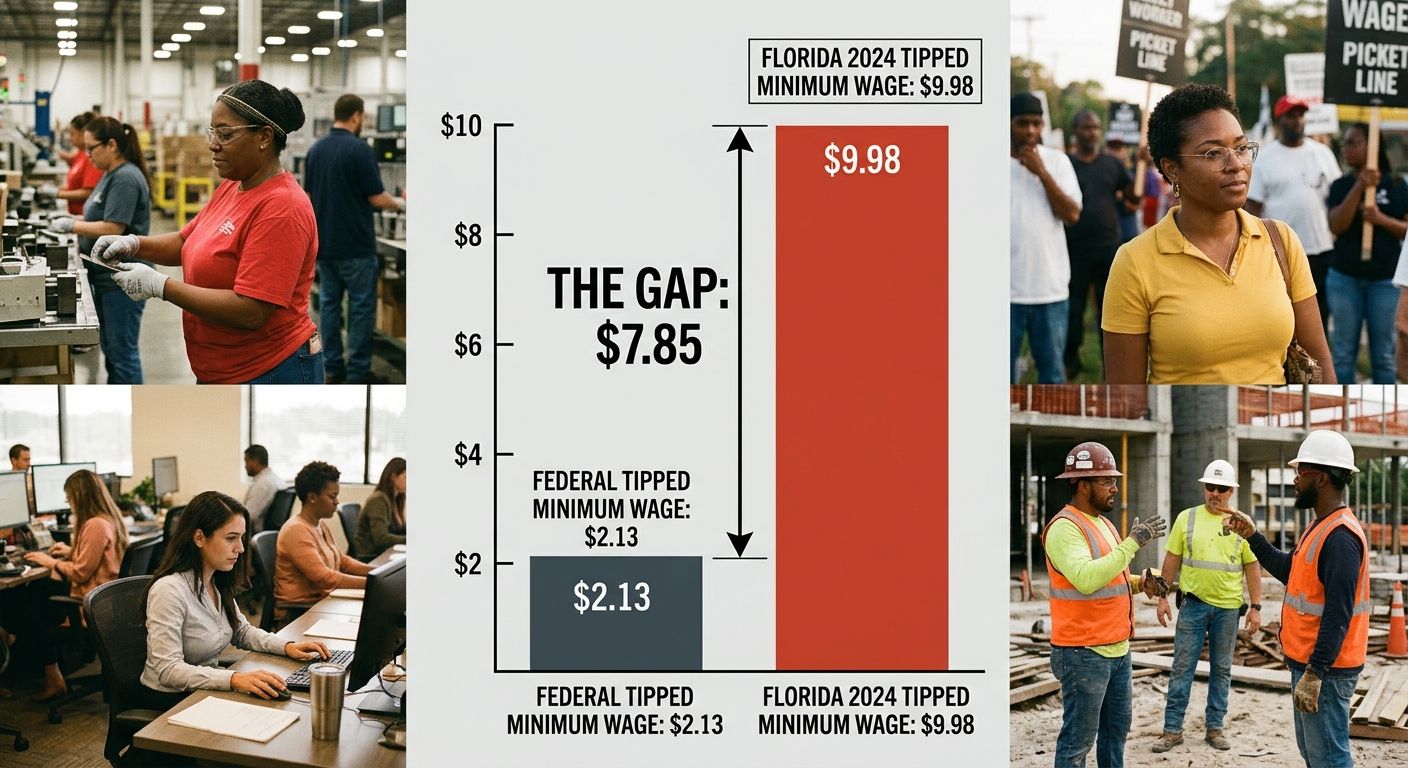
For 2024, that produced a tipped minimum of $9.98 per hour. If an employee's tips combined with the $9.98 direct wage don't reach $13.00 for every hour worked in a pay period, the employer must cover the shortfall. Failure to do so constitutes wage theft under both state and federal law.
This fixed-dollar tip credit contrasts with the federal model, where the tipped minimum wage has remained frozen at $2.13 per hour since 2009. The gap between Florida's tipped floor and the federal tipped floor widened to $7.85 as of 2024. Congressional efforts to eliminate the restaurant tip credit at the federal level have stalled, making state-level protections increasingly critical for tipped workers.
Healthcare workers in home care settings sometimes fall into an ambiguous zone. An aide employed by a home healthcare agency earns the full $13.00 minimum, but misclassification as an independent contractor, a persistent problem documented in the Florida Legislature's own bill analyses, can push workers below the floor entirely.
What Happens After $15.00: The CPI-W Switch
The escalator ends on September 30, 2026, when the state of Florida minimum wage reaches $15.00. But the mechanism doesn't stop. Amendment 2 requires that beginning in 2027, annual adjustments track the Consumer Price Index for Urban Wage Earners and Clerical Workers (CPI-W), the same index the original 2004 amendment used before Amendment 2 replaced it with fixed-dollar increases.
The CPI-W linkage means future increases depend entirely on inflation as measured by the U.S. Bureau of Labor Statistics. Under the 2004 amendment, CPI-W adjustments produced small annual increases during periods of low inflation, sometimes as low as $0.01 per hour. Between 2005 and 2020, the rate rose from $6.15 to $8.46, an average of $0.15 per year. If inflation runs at roughly 3% annually from 2027 forward, the $15.00 floor would reach approximately $17.39 by 2030.
This one-way ratchet protects workers from losing ground but also means the rate will lag behind inflation during any period where prices spike faster than annual adjustments can capture. For Florida's 440,000-plus healthcare support workers, the nursing aides, orderlies, home health aides, and psychiatric technicians tracked by the Bureau of Labor Statistics, the post-2026 CPI-W adjustment determines whether the $15.00 rate maintains its purchasing power or erodes over time. Understanding the full Florida minimum wage rate history helps put these future adjustments in perspective.
Enforcement Gaps and Who Falls Through
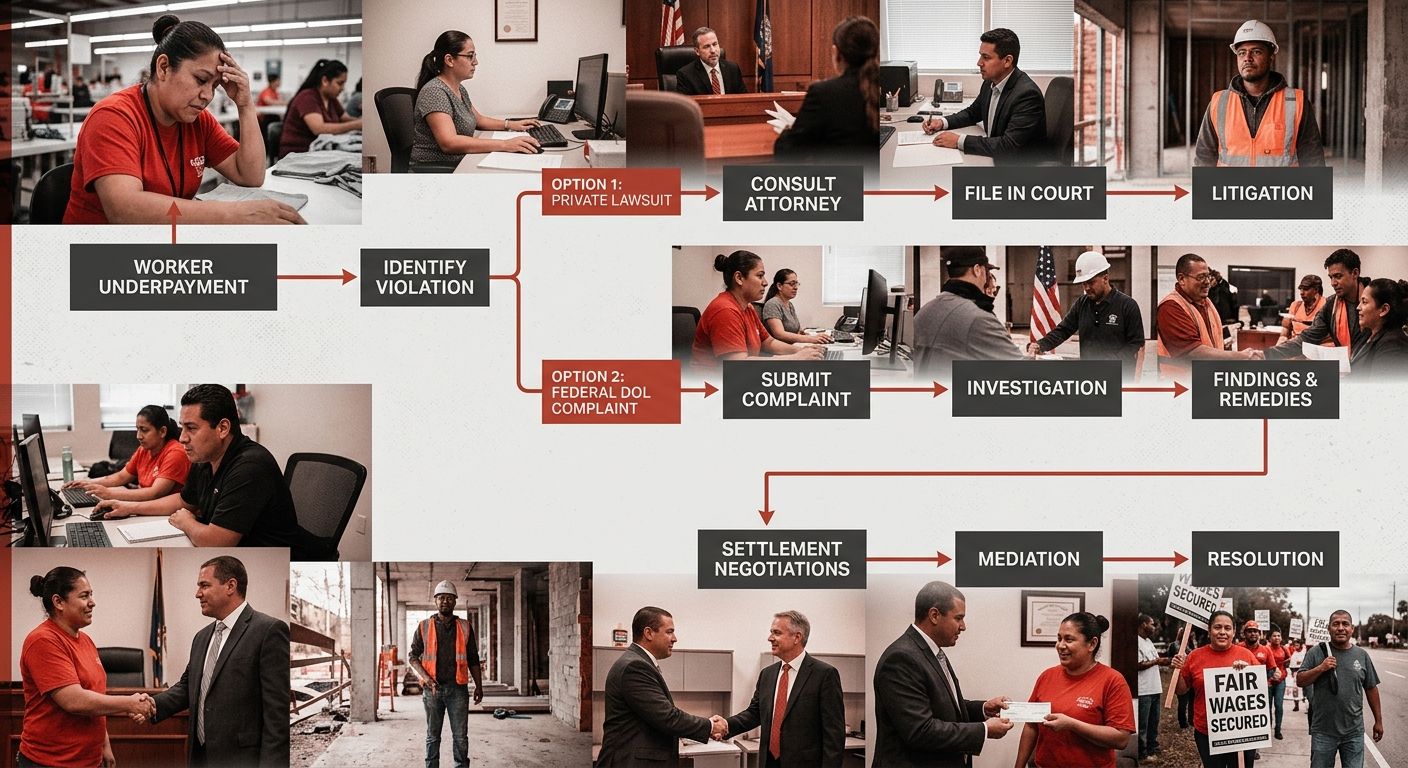
The constitutional amendment guarantees a wage floor but doesn't fund a dedicated enforcement agency. Florida has no state department of labor in the traditional sense. The Florida Department of Economic Opportunity handles posting requirements and public notices, but actual wage-theft claims route through private lawsuits or federal enforcement under the FLSA.
Fine, Galvin, and their co-authors at Rutgers documented this enforcement gap extensively, characterizing Florida's minimum wage framework as having "unfinished business" because the state lacks proactive investigation infrastructure. Workers must file individual complaints or retain attorneys, creating a structural barrier for low-wage employees, particularly in healthcare settings where chronic staff shortages make workers reluctant to challenge employers.
Exemptions also narrow the mechanism's reach. The state follows federal FLSA exemption categories: certain student workers in work-study programs, some agricultural laborers, and workers classified as independent contractors fall outside the minimum wage requirement. Misclassification remains the primary evasion strategy, especially in home healthcare and gig-adjacent care work.
Understanding how current Florida minimum wage rates apply to your specific work arrangement requires checking both the constitutional floor and your classification status. Workers covered under a union contract often negotiate floors well above the state minimum, but the constitutional rate serves as the absolute baseline below which no covered employer can pay.
Where the Mechanism Breaks
The constitutional escalator is one of the strongest minimum wage structures in the country, but it operates within clear boundary conditions where it underdelivers or produces unintended friction.
Geographic cost variation. The $13.00 rate in 2024 applies uniformly from the Florida Keys to the Panhandle. The MIT Living Wage Calculator estimated that a single adult in Miami-Dade County needed $21.55 per hour in 2024 to cover basic expenses, while a single adult in Holmes County needed $16.18. The statewide flat rate overshoots the cost of living in some rural counties and dramatically undershoots it in South Florida's metro areas. A healthcare aide earning $13.00 in Miami faces a $8.55-per-hour gap between their wage and what housing, food, and transportation actually cost.
Annual adjustment lag. The September 30 effective date means workers endure 12 months between increases. During 2022 and 2023, when CPI-W inflation exceeded 7%, the fixed $1.00 annual increase actually represented a real-wage cut when measured against price growth during the same period. Workers in hospitals and nursing homes felt this acutely, as the cost of housing in healthcare-corridor cities like Orlando and Tampa outpaced wage growth by a wide margin.
No sub-minimum for training or youth. Unlike some states, Florida's constitutional amendment contains no provision for a lower training wage or youth sub-minimum. While this protects young workers from earning less than their peers, some assisted living operators have argued it discourages hiring for entry-level healthcare positions, a claim that remains unsubstantiated by statewide employment data showing consistent job growth in healthcare support roles throughout the escalator period.
The frozen $3.02 tip credit. The tip credit hasn't adjusted since the escalator began, which benefits tipped workers by raising their direct cash wage. But the fixed credit also means employers face a rising direct-wage obligation each year, and some have responded by reducing tipped positions, restructuring compensation, or shifting to service-charge models. The full scope of Florida's evolving wage landscape continues to reshape how food service and hospitality employers structure pay.
Common Questions
Does the minimum wage in the state of Florida apply to all employers regardless of size?
Yes. The constitutional amendment covers all employers in Florida with no small-business exemption. The definitions of employer and employee align with the federal FLSA. If you employ even one covered worker, you must pay the state minimum.
What happens if my employer doesn't pay the new $13.00 rate?
You can file a civil action to recover unpaid wages, plus liquidated damages equal to the underpayment, plus reasonable attorney's fees. Florida's constitution specifically authorizes this private right of action. You can also file a complaint with the U.S. Department of Labor's Wage and Hour Division for FLSA violations.
Will the minimum wage state of Florida keeps raising after it hits $15.00?
Yes, through a different mechanism. Starting in 2027, annual increases will be based on the CPI-W inflation index rather than fixed $1.00 steps. The rate can never decrease, if the CPI-W shows deflation, the wage stays flat until inflation resumes.
Are healthcare workers covered?
Healthcare workers employed by hospitals, clinics, home health agencies, nursing homes, and assisted living facilities are covered. The primary exception involves workers misclassified as independent contractors, who are excluded from minimum wage protections. If you work a set schedule, use employer-provided equipment, and follow employer protocols, you are likely an employee regardless of how your employer classifies you on paper.
How did Florida's 2024 rate compare to other states?
At $13.00 per hour in 2024, Florida exceeded the federal minimum of $7.25 by $5.75. It fell below California ($16.00), Washington ($16.28), and New York City's higher metro rate, but exceeded neighboring Georgia ($7.25, which defaults to the federal rate) and Alabama, which has no state minimum wage at all.
The Union Edge Staff
Frequently Asked Questions
- What is Florida's minimum wage for 2024?
- Florida's minimum wage is $13.00 per hour as of September 30, 2024, increasing from $12.00 per hour under a constitutionally mandated schedule that rises $1.00 annually until reaching $15.00 in September 2026.
- How does Florida's tip credit work in 2024?
- Employers in Florida can claim a fixed tip credit of $3.02 per hour, paying tipped workers a direct wage of $9.98 per hour in 2024. If tips combined with the direct wage don't reach $13.00 per hour for the pay period, the employer must cover the shortfall.
- Will Florida's minimum wage continue to increase after 2026?
- Yes, after reaching $15.00 on September 30, 2026, Florida's minimum wage will adjust annually based on the Consumer Price Index for Urban Wage Earners and Clerical Workers (CPI-W). The wage can never decrease, remaining flat if inflation turns negative.
- How did Florida get a constitutional minimum wage?
- Florida voters approved Amendment 2 on November 3, 2020, with 60.82% support, rewriting the state constitution to include a fixed $1.00-per-year escalator from $10.00 to $15.00. This replaced the prior inflation-based mechanism that had been in place since 2004.
- What can I do if my employer doesn't pay Florida's minimum wage?
- You can file a civil action to recover unpaid wages plus liquidated damages equal to the underpayment and reasonable attorney's fees. You can also file a complaint with the U.S. Department of Labor's Wage and Hour Division for violations.
- Does Florida's minimum wage apply to all employers?
- Yes, Florida's constitutional amendment covers all employers with no small-business exemption. Any employer in Florida with covered workers must pay the state minimum wage.
- Are healthcare workers covered by Florida's minimum wage?
- Healthcare workers employed by hospitals, clinics, home health agencies, nursing homes, and assisted living facilities are covered by the minimum wage. The main exception is workers misclassified as independent contractors, who may fall outside protections.
- How much does a full-time worker earn at Florida's 2024 minimum wage?
- A full-time worker earning $13.00 per hour for 40 hours per week generates $27,040 in annual gross wages, compared to $17,596.80 under the previous $8.46 minimum wage rate.
Related Articles

Minimum Wage in Florida: 2024 Rate Changes
Before 2004, Florida had no state minimum wage at all. Voters fixed that twice through constitutional amendments, the second of which created a fixed $1.00-per-year escalator that brought the minimum wage in Florida to $13.00 per hour on September 30, 2024, with a $15.

What Is the State of Florida Minimum Wage
Amendment 2, ratified by Florida voters in November 2020, embedded a minimum wage escalator directly into Article X of the state constitution, removing the rate from legislative control entirely. The current floor is $14.00 per hour for non-tipped workers and $10.

Florida State Minimum Wage: 2024 Guide
Sixty percent of Florida voters wrote a minimum wage schedule directly into the state constitution in November 2020, creating a self-executing pay escalator that no governor or state legislator can override. The florida state minimum wage currently sits at $14.
Also in the paper