
Minimum Wage in New York: Current Rates & Updates
Depending on where you clock in, the minimum wage in New York ranges from $16.00 to $17.00 per hour, set by a two-zone structure that completed its final scheduled $0.50 increase on January 1, 2026, and will hand future adjustments to an inflation formula in 2027.

Minimum Wage in New York: Current Rates, Geographic Tiers, and the Inflation Switch Ahead
Depending on where you clock in, the minimum wage in New York ranges from $16.00 to $17.00 per hour, set by a two-zone structure that completed its final scheduled $0.50 increase on January 1, 2026, and will hand future adjustments to an inflation formula in 2027.
The Geographic Split: Two Zones, Two Floors
The New York State Department of Labor divides the state into two wage regions, each with its own hourly floor. The state doesn't set one universal rate. Where you physically perform your work determines which rate applies to you.
Region | 2024 Rate | 2025 Rate | 2026 Rate |
|---|---|---|---|
NYC, Nassau, Suffolk, Westchester | $16.00 | $16.50 | $17.00 |
Rest of New York State | $15.00 | $15.50 | $16.00 |
The downstate zone covers New York City plus the counties of Nassau, Suffolk, and Westchester. It has consistently carried a higher rate, reflecting the sharply higher cost of living in the metro area. The upstate zone covers every other county in the state, from Albany to Buffalo to the rural North Country.
This split hits healthcare workers hard. Home health aides, certified nursing assistants, and hospital support staff in the Hudson Valley or Capital Region earned $15.00/hour as recently as 2024, a dollar less than their counterparts twenty minutes south in Westchester. The 2026 upstate rate of $16.00 still trails the downstate floor by $1.00.
How the Phased $0.50 Increases Built These Rates
The current rates are the product of a three-year schedule of fixed increases that began on January 1, 2024. New York's earlier minimum wage history was more dramatic: beginning December 31, 2016, annual increases were determined by employment location, industry, and (in New York City) number of employees, according to the NYS Department of Labor's historical records. By 2019, NYC workers had reached $15.00/hour. As the NYC Comptroller's spotlight report documented, between 2013 and 2020 New York phased in increases to reach $15 for all workers statewide.
After a period of stagnation, the state legislature approved a new schedule of $0.50 annual increases beginning January 1, 2024:
January 1, 2024: Downstate rose from $15.00 to $16.00; upstate from $14.20 to $15.00
January 1, 2025: Downstate hit $16.50; upstate reached $15.50
January 1, 2026: Downstate reached $17.00; upstate hit $16.00
The $0.50 increment was a political compromise. Worker advocates pushed for larger jumps; business lobby groups argued for smaller ones. The result was a predictable, modest schedule, easy for employers to plan around, but insufficient to keep pace with inflation during years when the CPI-W for the Northeast exceeded 3%.
For context, the federal minimum wage has stayed frozen at $7.25 since 2009. New York employers must pay more than double that federal floor. Workers in states like Alabama or Tennessee can still legally be paid $7.25/hour, a stark contrast we've examined in our analysis of minimum wage requirements in Texas. New York's $16.00-$17.00 range looks generous by comparison, though anyone paying rent in Brooklyn or even Syracuse knows the gap between "generous" and "adequate" remains wide.
Tipped Workers and the Cash Wage Calculation
The headline minimum wage rate conceals a separate, lower system for tipped employees. New York allows employers to pay tipped workers a reduced "cash wage" and count tips toward the full minimum. The gap between the cash wage and the full minimum is the "tip credit," a dollar amount the employer doesn't have to pay as long as tips make up the difference.
As of 2026, the tipped wage structure for food service workers breaks down as follows:
Worker Category | Region | Cash Wage | Tip Credit | Full Min. Wage |
|---|---|---|---|---|
Tipped Food Service Workers | NYC/Downstate | $11.35 | $5.65 | $17.00 |
Tipped Food Service Workers | Rest of State | $10.70 | $5.30 | $16.00 |
The tip credit is the mechanism most frequently abused. When tips fall short on a slow Tuesday, the employer is legally required to make up the difference to reach the full minimum wage. In practice, many don't. Workers who can't track their hours and tips carefully, or who fear retaliation for speaking up, absorb the loss. This is wage theft, and it hits food service and hospitality workers hardest across the state.
We've covered how proposed federal legislation would eliminate the restaurant tip credit entirely, which would make the cash wage question irrelevant. Until that happens, New York's tip credit system remains the reality for hundreds of thousands of workers.
The 2027 Inflation-Indexing Switch
The most consequential change to New York's minimum wage system takes effect January 1, 2027, when an automatic formula replaces the legislature's role in setting annual rates. According to New York State's official minimum wage page, beginning in 2027, the minimum wage will annually increase by the three-year moving average of the Consumer Price Index for Urban Wage Earners and Clerical Workers (CPI-W) for the Northeast Region.
The state legislature will no longer vote on specific dollar increases. The formula takes over. Each year, the new rate will be the current rate adjusted by the three-year rolling average of inflation for the region's urban wage earners.
The upside for workers is clear: wages won't stagnate for years the way they did when increases depended on legislative action. But the downside deserves equal attention. A CPI-W formula ties wages to general consumer inflation, not housing costs specifically, not healthcare costs, not childcare. In periods when housing outpaces general inflation (as it has across most of New York for the past decade), the CPI-W adjustment will undercount the real squeeze on workers' budgets.
Several other states already use inflation-indexed minimum wages, including California, whose own tiered rate structure offers useful comparisons. The results are mixed: indexed wages prevent the dramatic erosion that happens when legislatures fail to act (the federal $7.25 has lost roughly 30% of its purchasing power since 2009), but they rarely produce the kind of above-inflation increases that actually improve workers' material conditions.
Exempt Salary Thresholds and the Healthcare Sector Squeeze
New York's minimum wage increase also pushes up the salary thresholds for exempt employees, which determines who qualifies for overtime protections and who doesn't. As of 2026, workers classified as executive or administrative must earn at least:
NYC, Long Island, and Westchester: $1,275.00/week ($66,300/year)
Rest of New York State: $1,199.10/week ($62,353.20/year)
These thresholds matter in healthcare settings, where job titles sometimes don't match actual duties. A "patient coordinator" who spends 80% of her shift doing clerical intake work might be classified as exempt when she shouldn't be. The higher salary threshold catches some of these misclassifications: if the employer isn't paying $66,300 in the downstate zone, the worker gets overtime regardless of title.
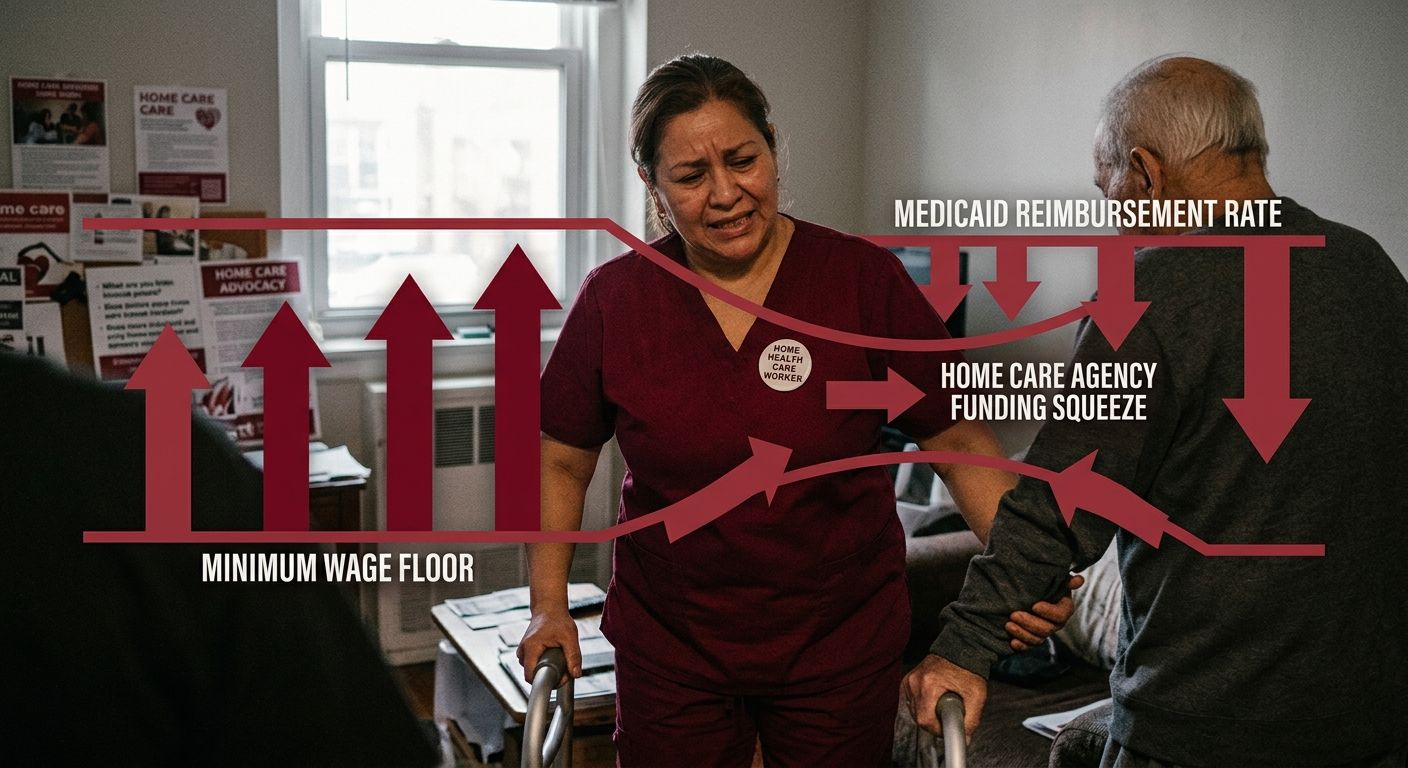
Home health aides represent one of the largest groups of workers earning at or near the minimum wage for New York. The state employs hundreds of thousands of home care workers, many through Medicaid-funded agencies. When the minimum wage rises, Medicaid reimbursement rates often lag behind, squeezing agencies and occasionally leading to reduced hours rather than higher total pay. Workers who fought for a raise find their weekly check unchanged because their hours were cut from 40 to 37.
This dynamic has fueled organizing efforts across the healthcare sector. We've tracked physician unionization campaigns and labor board jurisdiction battles that reflect the same tension: healthcare workers demanding better conditions while the funding structures resist change. The minimum wage floor is supposed to be a foundation. For many healthcare workers in New York, it functions more like a ceiling their employers build to.
Where the Model Breaks
New York's two-zone minimum wage system handles the broad NYC-versus-upstate divide, but it ignores several real-world complications that affect workers every pay period.
Border-zone workers get whipsawed. A home health aide who works three days in Westchester ($17.00/hour) and two days in Putnam County ($16.00/hour) earns two different minimum wages in the same week. Employers are supposed to track hours by job site and apply the correct regional rate for each location. Many don't, and the enforcement burden falls on the worker to document the discrepancy.
The formula only moves in one direction. The CPI-W index starting in 2027 will increase the wage, but it doesn't include a mechanism for decreasing it during deflationary periods. This sounds like pure upside, but the asymmetry creates political vulnerability. In a prolonged deflationary environment (unlikely, but possible), employers would argue the floor is artificially high, building pressure to scrap the formula entirely and return to legislative control.
Uniform maintenance costs erode the raise. Workers required to wear and maintain a uniform receive a weekly maintenance allowance that increased in 2026 across all tiers. But the allowance often falls short of actual laundering costs, especially in healthcare settings where scrubs must meet sanitation standards. A $0.50/hour raise that costs workers $3-5/week in unreimbursed uniform maintenance isn't the raise it appears to be on paper.
New compliance laws add friction without enforcement muscle. Beyond wages, employers in 2026 must comply with new prohibitions on "stay or pay" agreements (effective December 19, 2025) and bans on using consumer credit history for hiring decisions (effective April 18, 2026). These laws protect workers, but they create a compliance web that smaller employers, including small healthcare practices and home care agencies, struggle to navigate without legal counsel. The laws are only as good as their enforcement, and the NYS Department of Labor's investigative resources haven't grown at the same pace as its regulatory mandate.
Common Questions
Does New York's minimum wage apply to all workers, including part-time and temporary employees?
Yes. Every worker in New York State is entitled to the minimum wage, regardless of part-time, temporary, or seasonal status. The rate depends on where the work is performed, not the worker's home address or employment classification. The NYS Department of Labor confirms that everyone working in New York State is entitled to receive the state hourly minimum wage rates.
What should I do if my employer doesn't pay the correct New York minimum wage?
You can file a wage complaint with the New York State Department of Labor by calling 1-888-469-7365 or downloading a claim form from the DOL website. The state can investigate and order back pay. Retaliation for filing a complaint is illegal under New York Labor Law Section 215. Document your hours, pay stubs, and any communications with your employer before filing.
Will New York's minimum wage keep going up after 2026?
Yes, through a different mechanism. Starting January 1, 2027, rates will adjust annually based on the three-year moving average of the CPI-W for the Northeast Region. The increases will be automatic, requiring no legislative vote, but they'll track inflation rather than following a fixed dollar schedule. The exact dollar amount of each increase will depend on inflation data from the preceding three years.
How does the minimum wage of New York compare to the federal minimum?
The federal minimum wage is $7.25/hour and hasn't changed since July 24, 2009. New York's lowest current rate ($16.00 in the upstate zone) is $8.75 higher than the federal floor. When a state sets its minimum wage above the federal rate, the higher state rate applies to all covered workers in that state.
Are there different minimum wage rates for different industries in New York?
Yes. The general hourly minimum wage is $17.00 downstate and $16.00 upstate, but certain industries have separate cash wage and tip credit structures. Food service, hospitality, and some building service roles carry distinct rates. The NYS Department of Labor's Minimum Wage Lookup Tool identifies the specific rate for your industry, region, and job type.
The Union Edge Staff
Frequently Asked Questions
- What is the current minimum wage in New York in 2026?
- New York's minimum wage is $17.00 per hour in New York City, Long Island, and Westchester County, and $16.00 per hour for the rest of the state as of January 1, 2026.
- How much can employers pay tipped workers in New York?
- Employers can pay tipped food service workers a cash wage of $11.35/hour in downstate regions and $10.70/hour upstate, as long as tips bring the total to the full minimum wage of $17.00 or $16.00 respectively.
- When will New York minimum wage stop having fixed increases?
- Starting January 1, 2027, New York minimum wage will shift from fixed $0.50 annual increases to automatic adjustments based on a three-year moving average of the Consumer Price Index for Urban Wage Earners and Clerical Workers (CPI-W) for the Northeast Region.
- What should I do if my employer doesn't pay minimum wage in New York?
- You can file a wage complaint with the New York State Department of Labor by calling 1-888-469-7365 or downloading a claim form from the DOL website, and the state can investigate and order back pay. Retaliation for filing a complaint is illegal under New York Labor Law.
- Do part-time and temporary workers get minimum wage in New York?
- Yes, every worker in New York State is entitled to the minimum wage regardless of part-time, temporary, or seasonal status, and the rate depends on where the work is performed.
- What are the exempt salary thresholds for New York in 2026?
- Executive or administrative employees must earn at least $1,275.00 per week ($66,300 per year) in downstate regions or $1,199.10 per week ($62,353.20 per year) for the rest of the state to be classified as exempt from overtime protections.
- How does New York's minimum wage compare to the federal minimum wage?
- New York's minimum wage of $16.00-$17.00 is significantly higher than the federal minimum of $7.25 per hour, which has remained unchanged since 2009, and the higher state rate applies to all workers in New York.
Related Articles

Minimum Wage New York State 2024: Rates & Changes
New York State's minimum wage operates through a geographic tier system that splits the state into two wage zones, schedules $0.50 annual increases through 2026, and then hands rate-setting to an inflation index in 2027.

Minimum Wage NYC: 2024 Rates & Requirements
NYC's minimum wage operates through a system of geographic zones, industry-specific tip credits, and exempt salary thresholds that together produce at least five different legal pay floors. The base rate is $17.
NYS Minimum Wage 2026: What's Changing
New York's minimum wage operates through a three-layer structure: a regional hourly floor ($17.00 downstate, $16.00 upstate as of January 1, 2026), a set of sub-rates for tipped and salaried workers, and starting in 2027, an automatic inflation-indexing formula.
Also in the paper