
When Workers Speak Multiple Languages: 6 Organizing Communication Failures and How to Fix Them
Language barriers cause an estimated 25% of workplace accidents in industries with concentrated immigrant workforces, and they sabotage union campaigns at comparable rates.

When Workers Speak Multiple Languages: 6 Organizing Communication Failures and How to Fix Them
Language barriers cause an estimated 25% of workplace accidents in industries with concentrated immigrant workforces, and they sabotage union campaigns at comparable rates. Three strategic approaches fix multilingual union organizing failures, but each carries distinct tradeoffs that determine whether your campaign builds lasting power or fragments along language lines.
The Six Failures That Fracture Multilingual Campaigns
Before comparing solutions, organizers need an honest inventory of what's going wrong. These six failures appear across industries — from meatpacking to hospitality to construction — and each one undercuts the legal and relational foundations of a bargaining unit. Language access isn't a nicety. It's a civil right, and the National Labor Relations Act protects workers' ability to engage in concerted activity regardless of what language they speak at home.
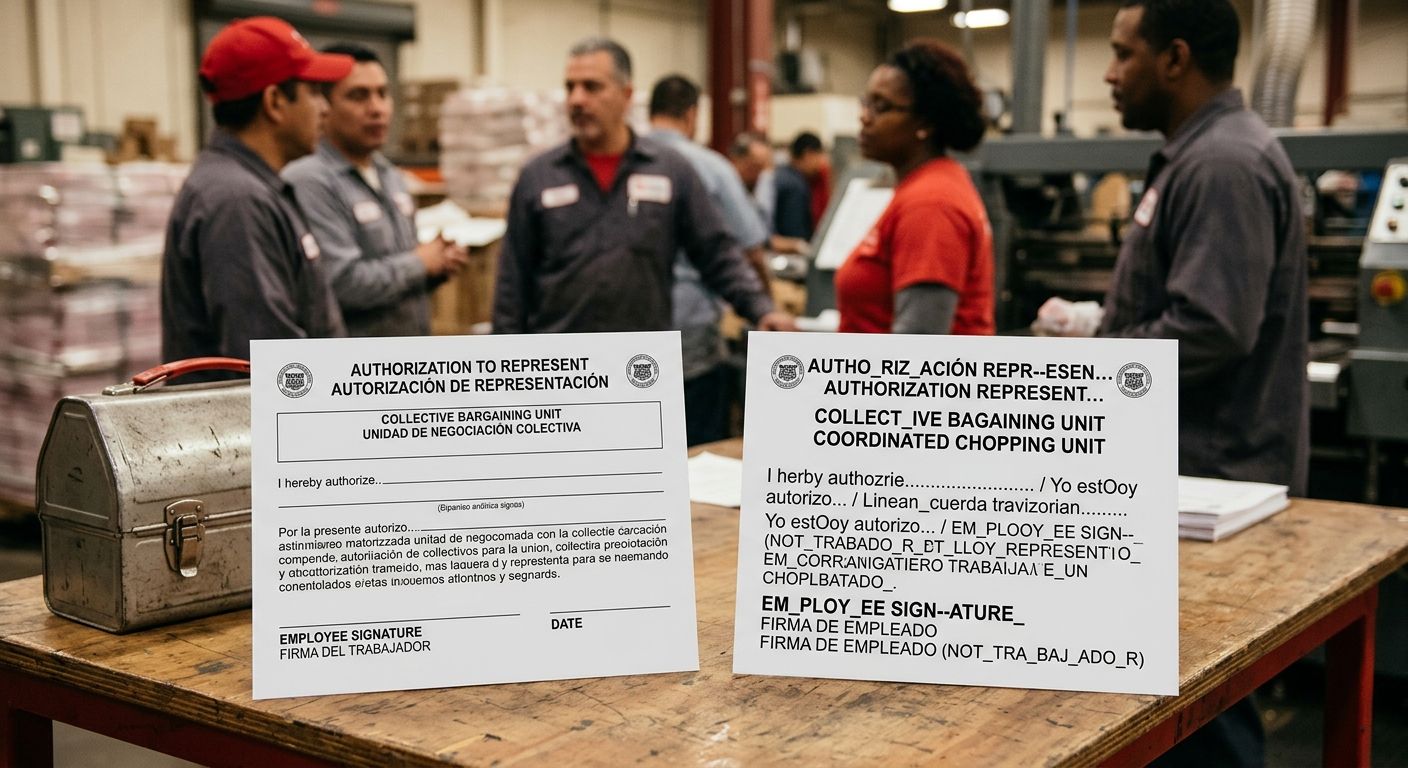
Failure 1: English-only printed materials. Authorization cards, contract summaries, fact sheets, and flyers distributed exclusively in English exclude workers who can't read them. The Emergency Workplace Organizing Committee's guidance on multilingual campaigns is direct: organizers should "listen to their co-workers and be willing to admit mistakes" when communication falls short. An authorization card a worker can't read is a card that won't get signed.
Failure 2: English-only meetings with no interpretation. When union meetings run entirely in English, non-English-speaking workers sit in silence or stop showing up. EWOC's immigrant worker organizing guide recommends providing "interpretation at all meetings, or conduct them in the workers' language," noting that when budgets allow, professional interpreters are ideal — and that monolingual English speakers should use interpretation equipment too, "so the playing field is leveled."
Failure 3: Burning out bilingual workers as unpaid interpreters. Campaigns that rely on the same two or three bilingual coworkers to translate everything — meetings, documents, one-on-one conversations — exhaust those workers and create bottlenecks. The bilingual worker becomes an unpaid staff member while still pulling a full shift.
Failure 4: Machine-translating materials without cultural review. Running a contract summary through Google Translate and printing it produces text that's technically in another language but often incomprehensible. Idioms fail. Legal terms get mangled. Workers who read the result trust the union less, not more.
Failure 5: Excluding non-English speakers from leadership. When steering committees, bargaining teams, and shop steward positions are held exclusively by English speakers, the campaign's power structure mirrors management's. Workers who speak Haitian Creole, Burmese, or Guatemalan Spanish see organizing as something done to them, not by them.
Failure 6: Ignoring cultural context beyond language. Translation handles words. It doesn't handle the fact that workers from different cultures have different norms around confrontation, authority, trust-building, and collective action. The Community Tool Box's framework for multicultural collaboration calls for starting with "a needs assessment and review of your collaborative's track record on cultural sensitivity" — examining past racial incidents, insults, and how the organization responded.
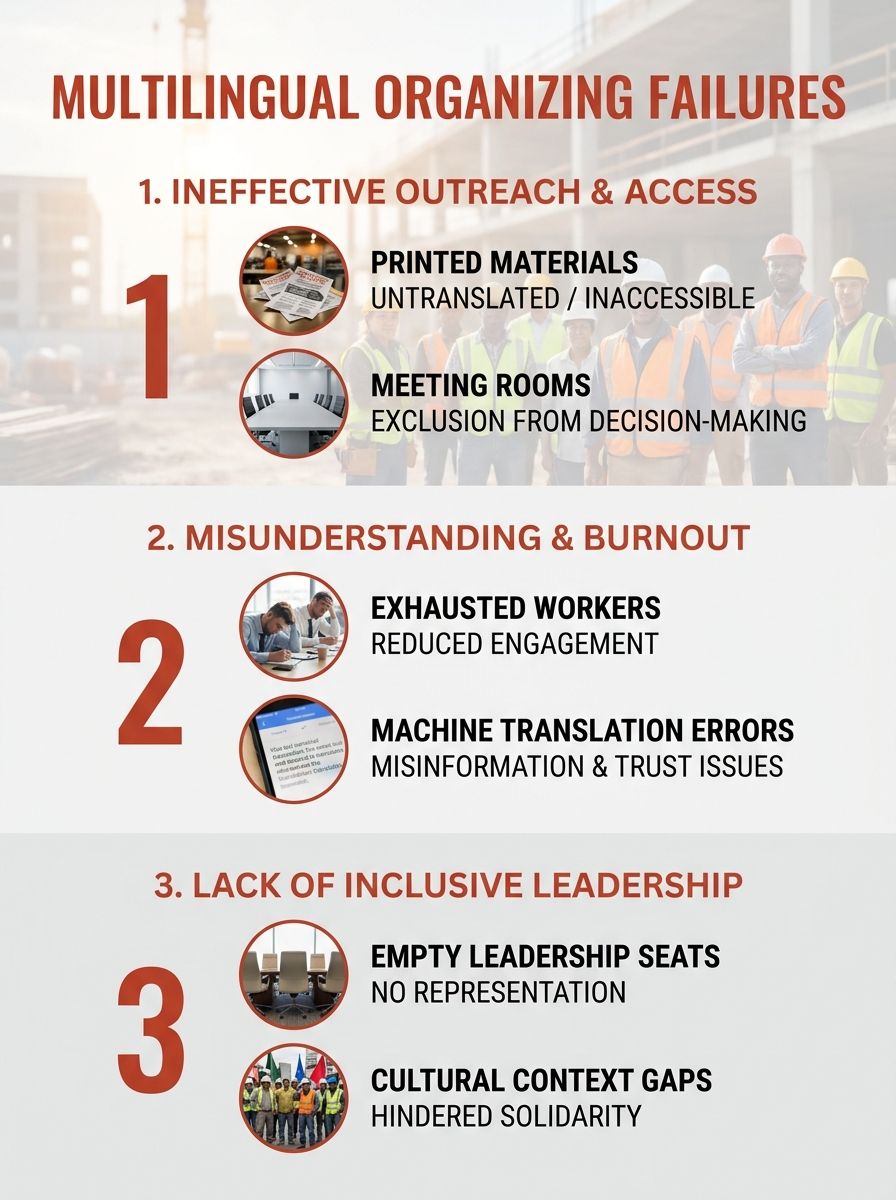
These failures interact. A campaign that fixes translation but ignores cultural competence will still lose workers. A campaign with perfect interpretation at meetings but English-only printed materials creates confusion. The question for organizers is which approach — or combination — addresses the most failures for the resources available.
Professional Translation and Interpretation Services
Hiring professional translators and interpreters addresses Failures 1, 2, and 4 directly. A certified translator produces materials that read naturally in the target language. A professional interpreter at meetings ensures real-time comprehension without burdening bilingual coworkers. Research on workplace communication shows that language barriers contribute to roughly $176.5 billion annually in safety-related costs for U.S. businesses, and professional translation is the most reliable way to eliminate misunderstanding in critical documents like grievance forms, safety protocols, and contract proposals.
The quality ceiling is high. Professional interpreters know how to handle consecutive and simultaneous interpretation. They understand confidentiality. They won't accidentally omit a key contract clause because they didn't know the legal term.
But the cost floor is high too. Professional translation runs $0.10 to $0.30 per word depending on language pair and specialization. A 15-page contract summary translated into four languages can cost $3,000 to $9,000. Professional simultaneous interpreters charge $400 to $800 per day, plus equipment rental for headsets and transmitters. For a local with 200 members and a thin budget, these numbers are prohibitive for anything beyond the most essential documents.
There's also a dependency problem. When professional services are the only translation infrastructure, the campaign stalls whenever the translator is unavailable. And professional translators, no matter how skilled, lack shop-floor context. They know the Haitian Creole word for "grievance" but might not know the informal term workers actually use for the loading dock procedure that's being grieved.
Best fit: Locals with budgets above $5,000 for communication infrastructure, campaigns involving legal documents or formal bargaining proposals, and workplaces where fewer than three languages are spoken. Professional translation is essential for the documents that carry legal weight — authorization cards, contract text, NLRB notices, and unfair labor practice filings.
Worker-Led Bilingual Organizing Committees
This approach addresses Failures 3, 5, and 6 by building translation infrastructure into the campaign's leadership structure. Instead of treating bilingual workers as informal interpreters who translate on top of their organizing duties, a bilingual organizing committee formalizes the role, distributes the labor across multiple people, and guarantees non-English speakers a seat at the decision-making table.
The EWOC's guidance on multiracial, multilingual campaigns identifies the core principle: organizers must take "principled stands against workplace racism, even if some co-workers object." A bilingual committee embeds that principle into the campaign's structure. When Guatemalan workers and Somali workers and English-speaking workers each have representatives who participate in strategy sessions, the campaign reflects the actual workforce.
The tradeoffs are real. Building a committee takes time. You need workers who are willing to serve, who have enough bilingual proficiency to handle organizing conversations (a different skill than casual bilingualism), and who are trusted by their language community. Training committee members in organizing fundamentals takes weeks, and turnover in high-churn industries like hospitality or food processing can dissolve a committee overnight.
Quality control is uneven. A bilingual committee member explaining a contract proposal in Burmese might emphasize different points than the English-language presentation. That's sometimes good — it means the message is culturally adapted. It's sometimes bad — it means key provisions get lost in informal translation.
The EWOC's immigrant worker organizing guide notes that interpreters "do not necessarily have to be professionals — they can even be the children of union members" for informal gatherings. That flexibility is a strength of the committee model. But informal interpretation at a formal grievance meeting or a bargaining session carries risk. Grievance arbitrators and NLRB hearing officers expect precision.
For organizers thinking through how captive audience meetings target multilingual workforces, bilingual committees provide a critical counter. When management runs an anti-union presentation in English only, committee members can debrief workers in their own languages immediately afterward, correcting misinformation before it hardens.
Best fit: Campaigns in workplaces with 50+ workers spanning three or more languages, campaigns with limited budgets but strong worker engagement, and long-duration organizing efforts where building leadership development into the campaign structure is worth the upfront time investment. This model works best for immigrant worker outreach where trust runs through community networks, not institutional channels.
Digital and Visual Communication Platforms
Text-based communication platforms with built-in translation features have changed the speed equation for multilingual union organizing. Current data shows these platforms achieve a 98% read rate with an average 90-second response time, compared to roughly 20% open rates for emails. For organizers coordinating across language groups, that difference determines whether a shift-change notice or a strike-authorization update reaches workers in time to matter.
Visual communication approaches — pictograms, diagrams, short video messages, hands-on demonstrations — bypass language barriers entirely. A diagram showing the grievance filing process doesn't need translation. A 60-second video of a shop steward demonstrating how to document a safety hazard works in any language. This approach addresses Failures 1 and 4 by reducing dependence on written text, and it partially addresses Failure 6 by removing the cultural assumptions embedded in English-language prose.
AI-powered translation tools have improved since 2024, and real-time messaging translation is now accurate enough for routine communication — shift schedules, meeting announcements, one-on-one check-ins. But accuracy drops sharply for specialized content. Union-specific vocabulary (seniority bidding, past practice, management rights clause, Weingarten rights) stumps even advanced translation models. A worker who receives a machine-translated message about "management rights" in Mandarin might read something closer to "the right of the managers" — technically accurate, legally meaningless.
The access gap matters. Workers in meatpacking plants, agricultural operations, and warehouse facilities don't always have smartphones. Workers on night shifts don't always check apps during the narrow windows organizers post updates. And older workers who immigrated decades ago may be less comfortable with digital platforms than younger colleagues. The Tent Partnership for Refugees' research documents how employers that overlook language proficiency barriers also tend to overlook digital literacy barriers — the two compound each other.
Privacy is another concern. Organizers using digital platforms to communicate with workers about union activity should understand how digital systems handle data security before routing sensitive organizing conversations through third-party apps.
Best fit: Large-scale campaigns with 100+ workers across four or more languages, campaigns in industries with high turnover where training a bilingual committee isn't sustainable, and supplementary communication for campaigns already using professional translation for formal documents. Digital tools are strongest as a coordination layer, weakest as a primary translation solution for legal or bargaining content.
Side-by-Side Comparison
Factor | Professional Translation | Bilingual Worker Committees | Digital/Visual Platforms |
|---|---|---|---|
Upfront cost | High ($3,000–$9,000 for multi-language document sets) | Low (volunteer labor, training time) | Medium ($50–$300/month for platforms) |
Speed of deployment | Slow (days to weeks per document) | Slow (weeks to build committee) | Fast (same-day setup) |
Translation quality | Highest for formal/legal content | Variable; depends on members' skill | Adequate for routine messages; poor for legal text |
Cultural adaptation | Low without cultural consultant | High (built into community knowledge) | Low (machine translation ignores context) |
Scalability across languages | Scales linearly with cost | Limited by available bilingual workers | Scales well across dozens of languages |
Leadership development | None | Strong (builds worker power directly) | None |
Failures addressed | 1, 2, 4 | 3, 5, 6 | 1, 4 (partially 6) |
How to Choose Between These Three
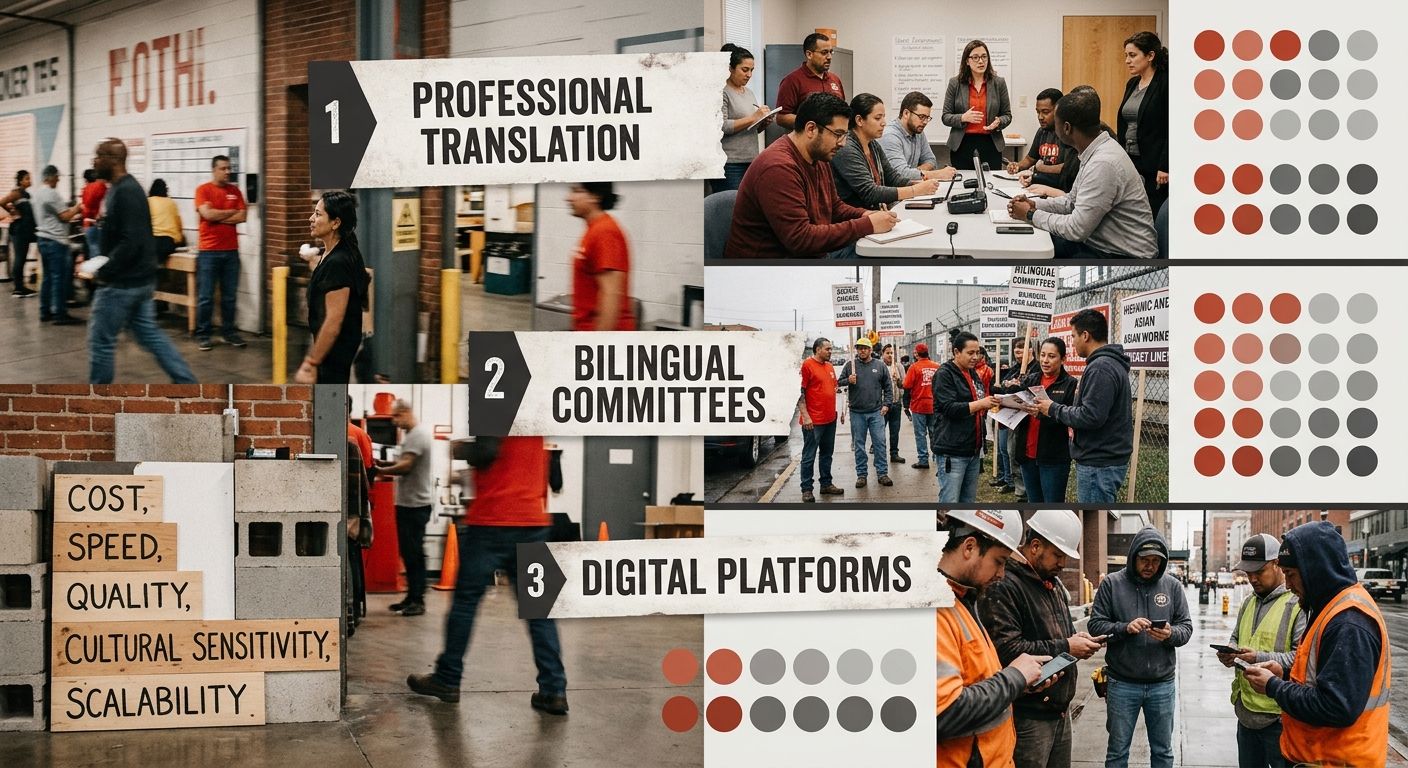
No single approach covers all six failures. The comparison table makes the gaps visible: professional translation handles documents but doesn't build leadership. Bilingual committees build power but can't scale to cover every language at every meeting. Digital platforms move fast but collapse on specialized content.
The strongest multilingual campaigns layer all three. They use professional translation for the documents that carry legal weight — authorization cards, contract proposals, unfair labor practice filings, and NLRB correspondence. They build bilingual worker committees to run meetings, conduct one-on-one conversations, and make strategic decisions that reflect the full workforce. And they deploy digital and visual tools for daily coordination, schedule updates, and rapid-response communication during critical campaign moments.
If your budget forces you to pick one starting point, the decision hinges on campaign phase. During early organizing and card-signing, bilingual committees are the highest-value investment because they build trust in language communities that won't sign cards for an organization they can't talk to. During formal bargaining and contract ratification, professional translation becomes essential because workers are voting on legal text. During contract administration and ongoing representation, digital platforms keep a dispersed, multilingual membership connected between meetings.
The language access question should also appear in your bargaining proposals. Negotiating a language access clause into the collective bargaining agreement — requiring the employer to provide translated safety materials, multilingual postings of worker rights, and interpretation at disciplinary meetings — shifts the cost burden where it belongs: on the employer who benefits from a multilingual workforce's labor. A language access bargaining unit provision makes the right to understand your working conditions a contractual guarantee, not a favor the union scrambles to provide.
The campaigns that fail hardest are the ones that treat translation union materials as a task to check off rather than an ongoing commitment to democratic participation. Workers who speak Creole or Karen or Mixtec deserve the same access to their union's decision-making as workers who speak English. That access requires money, time, and structural commitment. The approach you choose matters less than whether you sustain it through every phase of the campaign — from the first house visit to the ratification vote to the first grievance filed under the new contract.
The Union Edge Staff
Related Articles

The Migrant Worker Organizing Blind Spot: Why Standard Union Strategies Fail Vulnerable Workforces
In Malaysia, achieving official government recognition for a new trade union representing migrant workers takes between five and seven years, according to research from the Malaysian Trades Union Congress. The average guest worker visa in that country lasts two to three years.

Beyond the Union Office: Why Organizers Fail When They Wait for Workers to Come to Them
Campaigns that file for an NLRB election with 60–70% worker support win 78% of the time. Campaigns built primarily on walk-in interest at a union hall rarely come close to that success rate.

The Organizing Committee's Hidden Liability: Why Inadequate Worker Education Becomes Your Weakest Link
The AFL-CIO's Organizing Institute trains participants to have one-on-one organizing conversations, chart workplace leaders, and run mini-campaigns around live issues.
Also in the paper