
The Organizing Committee's Hidden Liability: Why Inadequate Worker Education Becomes Your Weakest Link
The AFL-CIO's Organizing Institute trains participants to have one-on-one organizing conversations, chart workplace leaders, and run mini-campaigns around live issues.

The Organizing Committee's Hidden Liability: Why Inadequate Worker Education Becomes Your Weakest Link
The AFL-CIO's Organizing Institute trains participants to have one-on-one organizing conversations, chart workplace leaders, and run mini-campaigns around live issues. The Emergency Workplace Organizing Committee takes a different path, rooting its curriculum in popular education where workers themselves define the starting point. And dozens of independent committees across the country still rely on the oldest method available: a staff organizer walks in with a slide deck, talks for ninety minutes, and hopes the information sticks.
All three approaches produce organizing committees. They don't all produce organizing committees that survive. The worker education gap between what committee members need to know and what they actually learn before facing management opposition is the single largest predictor of campaign failure that nobody tracks in a spreadsheet. Training programs fail for identifiable, structural reasons: unclear objectives, lack of ongoing support, poor coordination between leaders and participants, and methods that don't match the audience. These problems are well-documented across industries, and organizing is no exception.
So which education model actually prepares your committee for the pressure? We've spent years watching campaigns win and lose on this question, and the answer depends on tradeoffs most organizers never think through.
When Staff Run the Show: The Top-Down Briefing Model
The most common approach to organizing committee training is also the most expedient. A paid organizer or union staff representative schedules meetings, prepares materials, and walks committee members through the basics: what a union is, what the NLRA protects, how authorization cards work, what to say when management pulls someone aside. Information flows in one direction, from staff to rank-and-file, on a timeline dictated by the campaign's urgency.
This model has obvious advantages. It's fast. It's standardized. A skilled organizer can bring a committee from zero knowledge to card-signing readiness in two or three sessions. When an election petition needs to be filed within a window, or when management has already launched its anti-union campaign, speed matters enormously. UnionTrack's best practices for building organizing committees emphasize practical factors like willingness to serve and comfort level with being the public face of the campaign. The top-down briefing gets people functional on those fronts quickly.
But the tradeoffs are real. When staff control the curriculum, committee members learn to repeat talking points rather than think through arguments. They can recite the benefits of union representation without explaining how collective bargaining actually works at their specific workplace. They know what to say during a card-signing conversation but freeze when a skeptical coworker raises an objection that wasn't covered in training.
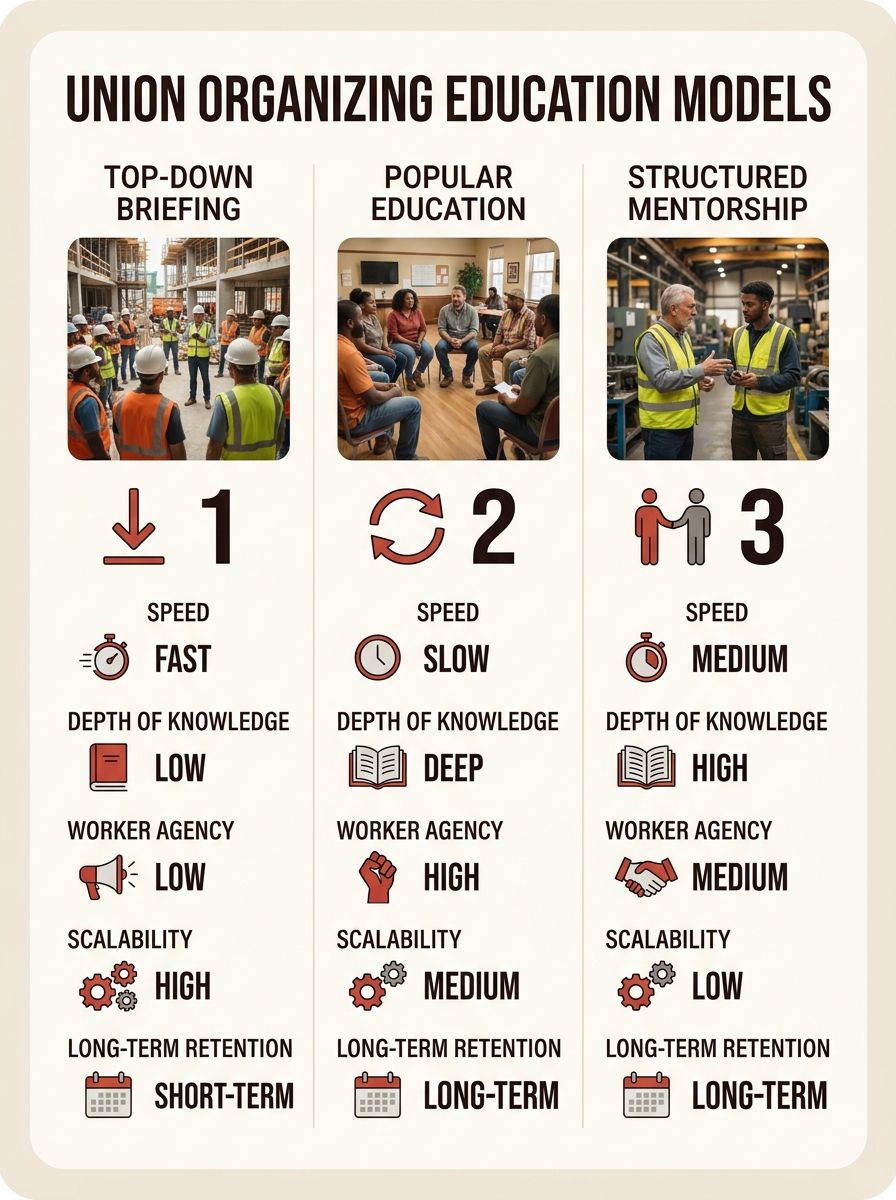
The deeper problem is what happens after the election. Committees trained through top-down briefings often struggle when the organizer leaves, or when bargaining begins and workers need to articulate their own priorities without a script. If you've read about building an organizing committee from scratch, you know that recruitment is only half the challenge. The other half is making sure the people you recruit can carry the campaign's weight independently.
We've seen this pattern repeat across sectors. A committee wins the election, and then the same workers who signed up coworkers can't explain the grievance procedure. They can't run a meeting. They defer every decision to staff. The union exists on paper, but the internal culture of the local is top-down from day one. That's a structural consequence of how people were trained, and it undermines rank-and-file democracy before it ever has a chance to develop.
When Top-Down Works
If your timeline is measured in weeks, or if you're facing an aggressive employer campaign and need to get people on the same page immediately, the briefing model buys you survival. The UE's organizing steps describe how a small group starts by privately discussing workplace issues before contacting a representative for help developing a plan. That early-stage coordination often looks like a briefing by necessity. Use it for what it's good at: rapid alignment on logistics, legal rights, and immediate messaging. Don't confuse it with education.
Popular Education Puts Workers in the Teacher's Chair
The alternative that's gained the most traction among independent and grassroots campaigns borrows from Paulo Freire's pedagogy and applies it directly to workplace organizing. Popular education, as practiced by groups like the Emergency Workplace Organizing Committee, starts from the premise that workers define the learning agenda. Instead of a staff organizer lecturing about union principles, a facilitator asks workers to name their own problems, analyze the power dynamics behind those problems, and practice the skills they'll need to change them.
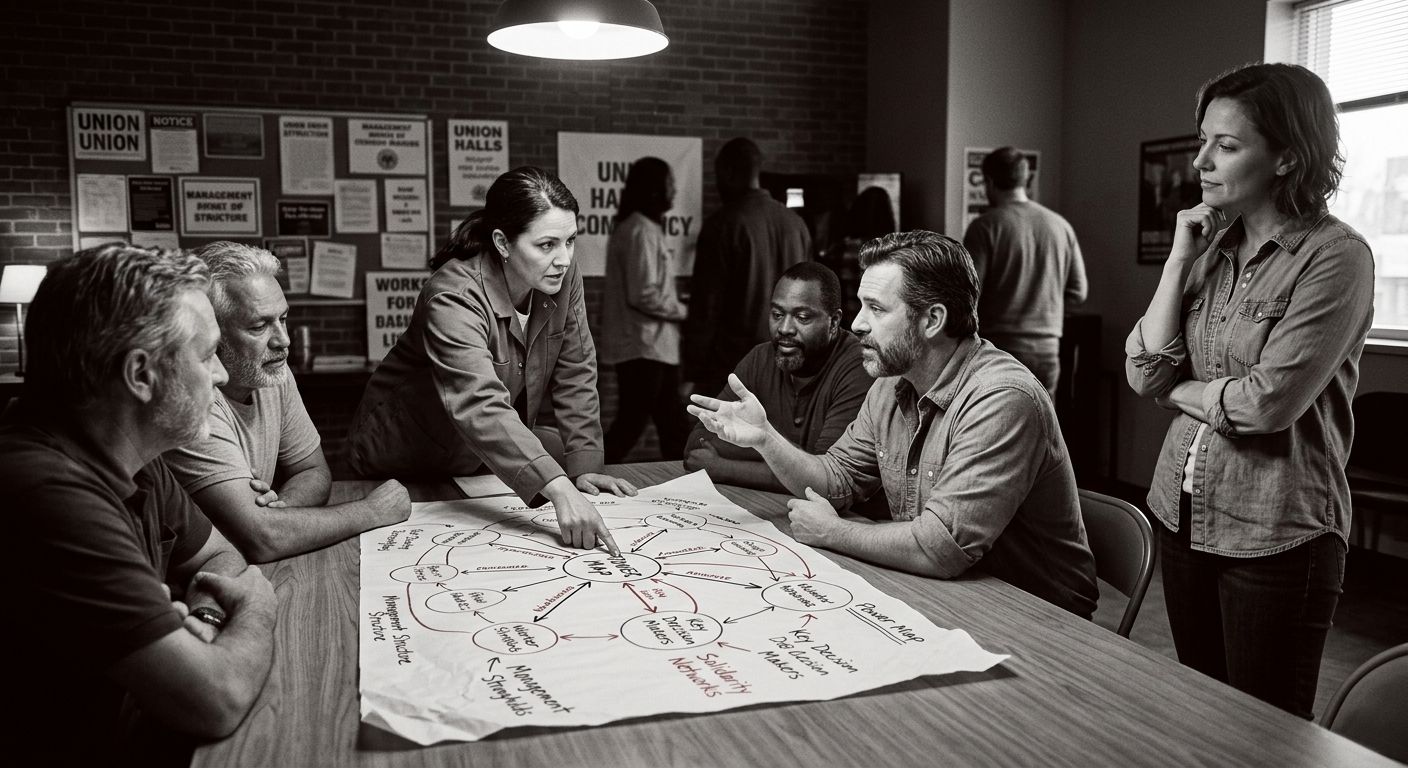
The sessions look different from traditional union training. Workers might map their workplace's power structure together on a whiteboard, role-play conversations with hostile supervisors, or break into small groups to develop their own answers to anti-union talking points. The facilitator guides the process but doesn't own it.
This model excels at building rank-and-file democracy because it treats democratic participation as a skill to be practiced, not a value to be preached. Committee members who've spent weeks analyzing their own workplace conditions can explain those conditions to coworkers in language that resonates, because they developed that language themselves. They're also better prepared for bargaining, since they've already practiced identifying priorities, debating tradeoffs, and reaching consensus.
The tradeoffs, though, are significant. Popular education takes time. You can't compress it into a two-hour session the week before you file a petition. The facilitator needs real skill, and finding people who can run a popular education workshop (as opposed to a standard training) is harder than finding someone who can deliver a briefing. The method also requires a baseline of trust among participants that doesn't always exist in a workplace where people barely know each other.
And there's a subtler risk: without enough structure, popular education sessions can drift into unfocused complaint sessions where everyone vents but nobody learns a specific skill. The difference between a transformative workshop and a group therapy session often comes down to the facilitator's ability to redirect energy toward concrete action. Assessing training needs before designing a program, as labor education researchers have emphasized, means identifying specific knowledge and skills gaps rather than assuming everyone needs the same thing.
Campaigns that successfully use popular education tend to start earlier, invest more in facilitator training, and accept that the payoff comes later in the process. They also tend to produce stronger locals after certification, because the workers have already learned how to convert workplace complaints into sustained campaigns through their own analysis rather than through someone else's template.
When Popular Education Works
If your campaign has a three-to-six month runway before an election, and if your committee includes workers who can facilitate (or who are willing to learn), this model builds the deepest foundation. It's especially effective in workplaces where the issues are complex, where workers come from diverse backgrounds and hold different priorities, and where long-term union strength matters more than short-term speed. The tech workers at the Alphabet Workers Union and organizers at Rideshare Drivers United have drawn on rank-and-file unionism principles that emphasize exactly this kind of self-directed education.
The One-on-One Pipeline: Structured Mentorship
The third model sits between the first two in both speed and depth. Structured mentorship pairs experienced organizers or senior committee members with newer workers for sustained, individualized skill development. The AFL-CIO's Organizing Institute curriculum emphasizes identifying, recruiting, and developing key workplace leaders through direct relationship-building. The mentorship pipeline takes that principle and extends it across the life of the campaign.
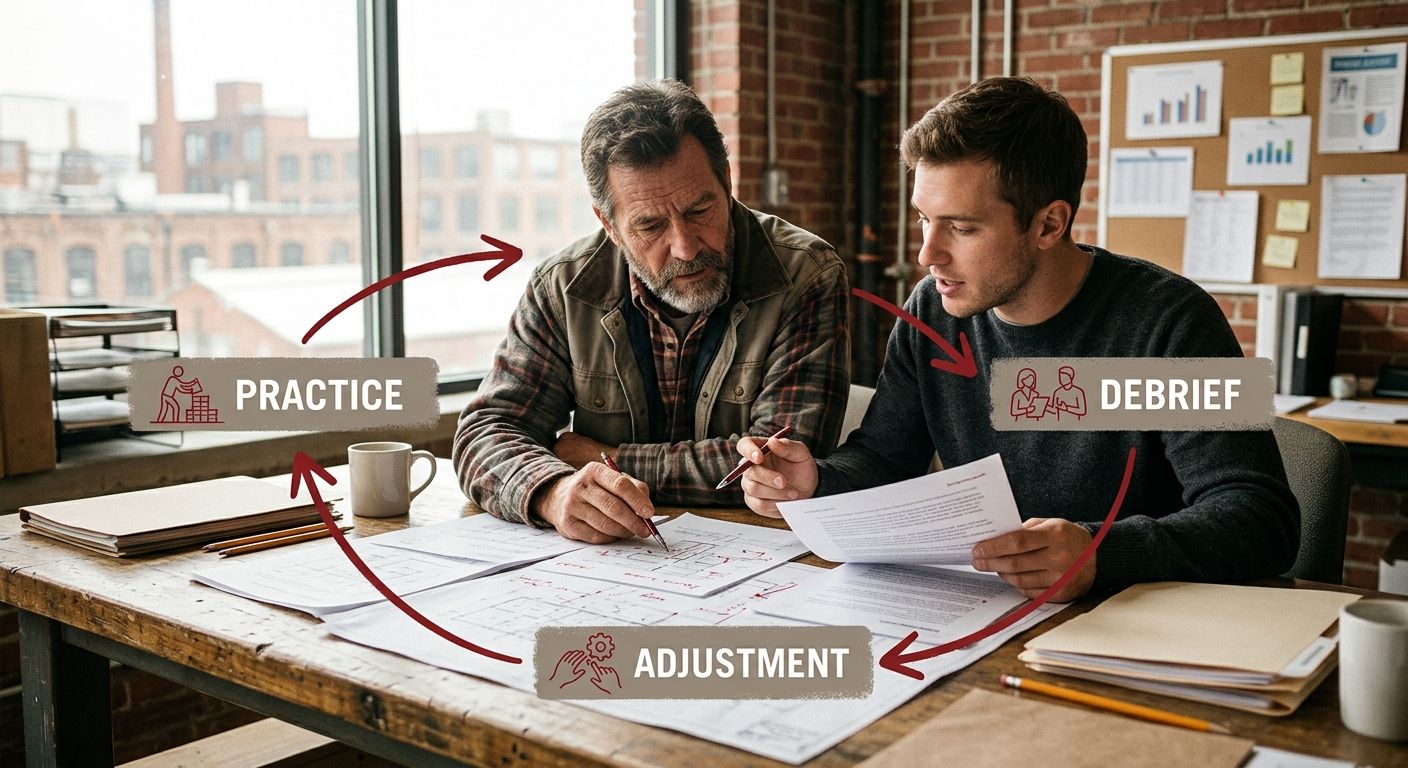
In practice, this looks like a veteran committee member walking a newer colleague through their first one-on-one conversation with a coworker, debriefing afterward, and doing it again the next day with adjustments. It looks like a steward teaching a new steward how to read contract language by working through a real grievance together. The knowledge transfer happens through doing, and the feedback loop is immediate and personal.
The UE's constitution, written in 1936, declared that the organization would unite all workers "on an industrial basis, and rank-and-file control, regardless of craft, age, sex, nationality, race, creed, or political beliefs." That language anticipated what modern organizing research has confirmed: control by the membership requires that the membership have the skills to exercise control. Mentorship is one of the most reliable ways to transfer those skills, because it adapts to the individual learner in a way that neither briefings nor group workshops can match.
The tradeoffs center on scalability and mentor quality. A mentorship pipeline is only as good as its mentors, and many campaigns don't have enough experienced people to pair with every new committee member. When mentors are stretched thin, the quality of the experience degrades. There's also the risk that an experienced mentor passes along their own bad habits, blind spots, or outdated assumptions. If the mentor was trained in the top-down model, they may reproduce that model's weaknesses without realizing it.
Understanding why organizers who assume workers' needs lose campaigns is essential context here. A mentor who tells a newer committee member what coworkers care about, instead of teaching them how to find out for themselves, undermines the entire purpose of the pipeline.
The structured mentorship model also struggles with documentation. Unlike a briefing (which has a slide deck) or a popular education workshop (which has a facilitation guide), mentorship relationships are hard to standardize or evaluate. Campaign leadership may not know whether the mentorship is working until they see the results, good or bad, during a critical moment.
When Mentorship Works
If your committee has at least a small core of experienced organizers and you're building a leadership pipeline for the long term, structured mentorship produces the most capable individual leaders. It's particularly effective for developing workers who will serve on bargaining committees or who will become the stewards responsible for enforcing contracts after recognition. The investment is high per person but pays compounding returns when those workers go on to mentor others.
How To Choose Between These Three
The honest answer is that most successful campaigns use a blend, weighted differently depending on where they are in the process and what resources they have. But the weighting matters enormously, and the default choice for too many organizing committees is to over-rely on top-down briefings because they're the easiest to execute under pressure.
If your campaign is in its earliest stages and you have time before any election timeline, invest heavily in popular education. Build the analysis skills, the democratic habits, and the shared language that will carry the committee through management opposition, internal disagreements, and the long grind of bargaining. Use briefings sparingly and only for logistical or legal content where accuracy matters more than internalization.
If you're already deep in a campaign and need to bring new committee members up to speed quickly, use a combination of targeted briefings for essential knowledge (your rights under Section 7, what constitutes an unfair labor practice, the mechanics of card-signing) and structured mentorship to develop the relational and strategic skills that briefings can't teach.
If your committee includes experienced workers from previous campaigns, give them formal mentorship roles with clear expectations and accountability. Pair them with newer members and build in regular check-ins so leadership can identify problems before they cost the campaign.
And regardless of which model you weight most heavily, do the thing that too many committees skip entirely: assess what your specific workers need to learn before you design how they'll learn it. The worker education gap in organizing campaigns persists because committees treat education as a one-size-fits-all checklist rather than a strategic question that deserves the same rigor as any other part of the campaign plan. The committees that close that gap are the ones that ask their members what they don't understand, design learning around those specific deficits, and keep checking whether the education is actually working as conditions change. That discipline, applied consistently, is what separates campaigns that win elections from campaigns that build lasting power in the workplace.
The Union Edge Staff
Related Articles

Beyond the Union Office: Why Organizers Fail When They Wait for Workers to Come to Them
Campaigns that file for an NLRB election with 60–70% worker support win 78% of the time. Campaigns built primarily on walk-in interest at a union hall rarely come close to that success rate.

Beyond the Organizing Committee: Building Durable Worker Power Through Rank-and-File Leadership Development
Rank-and-file leadership development works through a three-stage pipeline: identification of organic workplace leaders, structured skills training in bargaining and grievance handling, and deployment into accountable union roles.

The Organizer's Listening Framework: Moving Beyond Solutions to Root Causes
The biggest failure in organizer training is teaching people to solve problems before they understand them.
Also in the paper