
The Migrant Worker Organizing Blind Spot: Why Standard Union Strategies Fail Vulnerable Workforces
In Malaysia, achieving official government recognition for a new trade union representing migrant workers takes between five and seven years, according to research from the Malaysian Trades Union Congress. The average guest worker visa in that country lasts two to three years.

The Migrant Worker Organizing Blind Spot: Why Standard Union Strategies Fail Vulnerable Workforces
In Malaysia, achieving official government recognition for a new trade union representing migrant workers takes between five and seven years, according to research from the Malaysian Trades Union Congress. The average guest worker visa in that country lasts two to three years. The math is brutal: by the time a union wins legal standing, the workforce that organized it has already been rotated out of the country and replaced. This pattern repeats in construction corridors across the Gulf states, in agricultural regions of the American South, and in meatpacking towns throughout the Midwest. The visa clock runs faster than the organizing clock, every time.
Standard union organizing assumes a stable, documented workforce with a fixed employer, a single shared language, and legal protections against retaliation. Migrant worker organizing operates under the opposite conditions. The workforce is transient. The employer may be a subcontractor three layers removed from the company that actually controls working conditions. Workers speak four or five different languages on the same shift. And the most potent threat an employer can make isn't termination; it's deportation.
These six rules won't solve every structural problem, but they represent the minimum adjustments any union serious about reaching vulnerable workforces needs to internalize. Ignore them and you'll keep reproducing the same blind spot that's left millions of workers outside the labor movement's reach.
Abandon the union hall model entirely
The single most persistent failure in migrant worker organizing is waiting for workers to come to you. Union halls, organizing offices, and even public meetings assume that workers can show up voluntarily, without surveillance, during off-hours, at a fixed address. For migrant workers in employer-provided housing, working mandatory overtime, or living in rural areas without reliable transportation, this assumption is wrong in every particular.
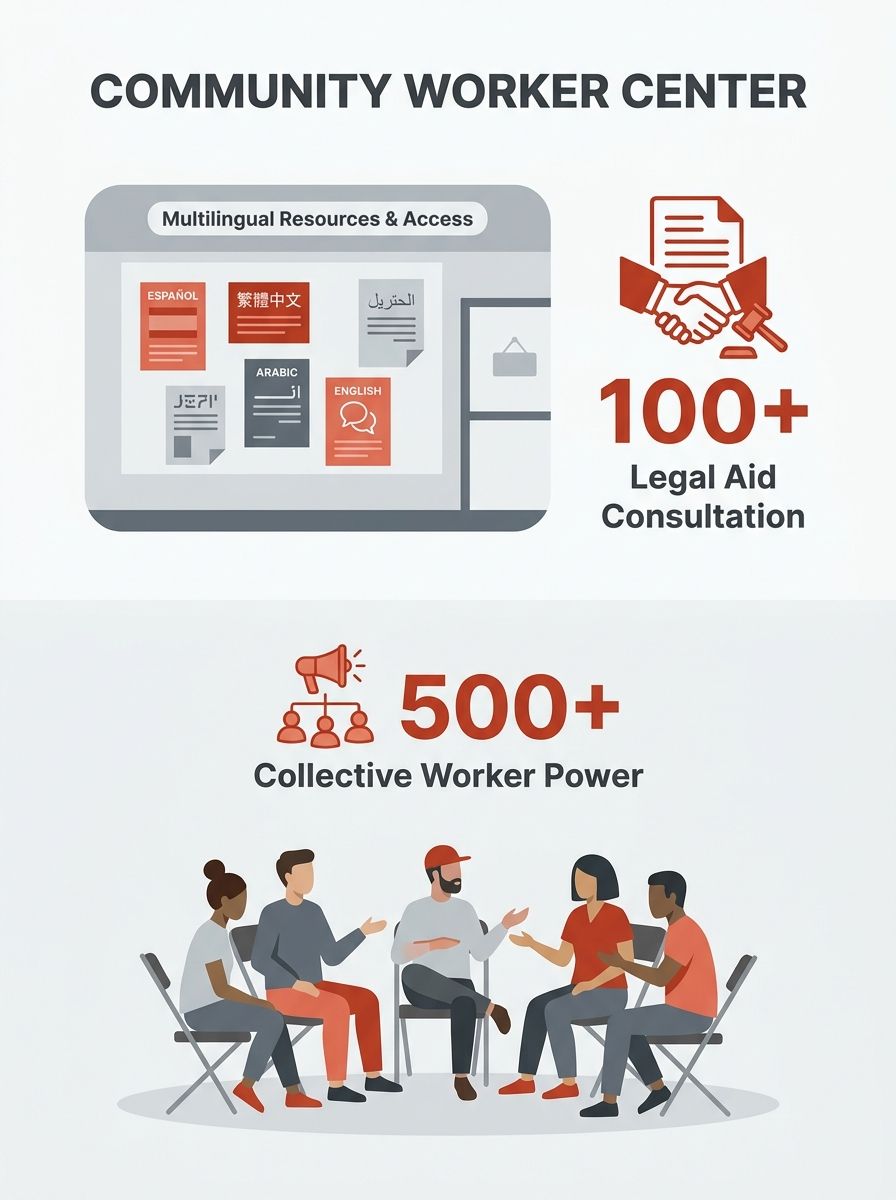
The organizers who've succeeded with migrant populations go to where workers already gather: laundromats, ethnic grocery stores, churches and mosques, remittance offices, community health clinics. Worker centers in the United States have succeeded in organizing low-wage immigrant workplaces precisely because they don't look or function like unions. They offer ESL classes, immigration legal aid, and know-your-rights workshops. The organizing conversation happens inside a relationship of trust that already exists.
This doesn't mean abandoning formal union structures. It means the formal structure arrives last, after the relationships are built and the workers themselves have decided what they need. As we've written before about why organizers fail when they wait for workers to come to them, the outreach model determines the outcome more than any other single variable.
When does this rule break? When a migrant workforce has already achieved enough density and stability in a single workplace that traditional shop-floor organizing can function. This happens in some hotel and casino properties, certain large-scale agricultural operations, and urban warehouse clusters where workers have long-term contracts.
Treat immigration enforcement as the employer's weapon
Employers don't need to call ICE themselves. The threat alone is enough. According to the Economic Policy Institute, employers are charged with making threats, engaging in surveillance activities, or harassing workers in nearly a third of all union election campaigns. For documented migrant workers on employer-sponsored visas, the threat of losing immigration status through job termination functions identically to a deportation threat. For undocumented workers, the threat is literal.
The United States currently spends roughly $25 billion annually on immigration enforcement compared to approximately $2.1 billion on labor standards enforcement across all ten federal agencies combined. That's a 12-to-1 ratio. The infrastructure of enforcement is oriented toward punishing workers, not employers. Any organizing strategy that doesn't account for this reality will fail migrant populations, because the cost of visible organizing activity is existentially higher for these workers than for their native-born coworkers.
Practical application means building immigration legal defense into the organizing budget from day one. It means having an immigration attorney on retainer before the first card gets signed. It means knowing, concretely, what prosecutorial discretion protections exist in your jurisdiction, and making sure every worker you talk to knows them too. The proposed POWER Act would formalize protections against deportation for workers with legitimate labor claims, but until it passes, unions have to build their own firewall.
When does this rule break? In countries or jurisdictions with strong firewalls between immigration enforcement and labor agencies. Some Canadian provinces and a handful of U.S. cities have established formal non-cooperation policies. Where those protections are real and tested, the immigration threat recedes.
Learn the recruitment debt trap before talking wages
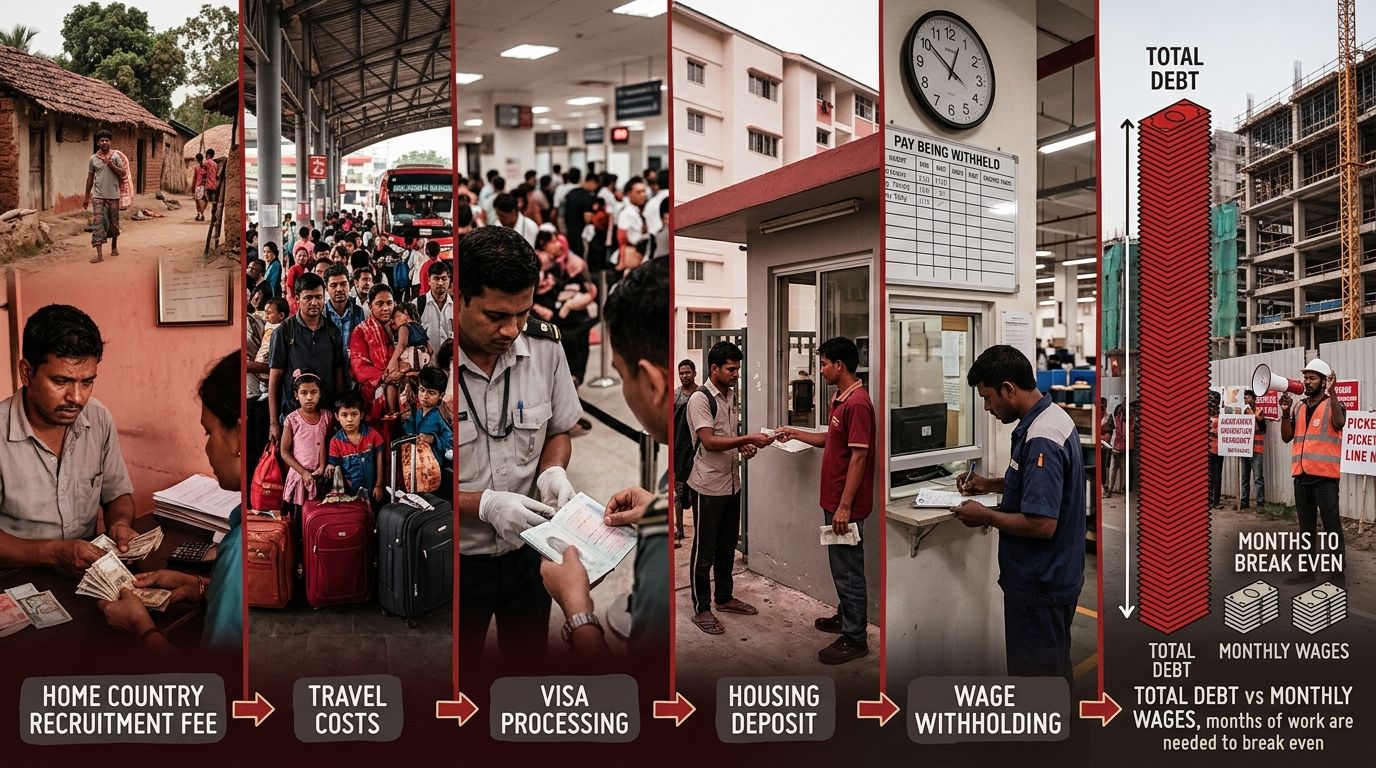
Before a migrant worker ever sets foot on a job site, they may already owe thousands of dollars. Labor recruitment systems in industries like construction, agriculture, seafood processing, and domestic work frequently charge workers fees for placement, travel, visa processing, and housing deposits. In Southeast Asian recruitment corridors, these fees can reach $5,000 to $10,000, financed at predatory interest rates. Workers arrive already indebted, sometimes with their passports confiscated by recruiters or employers.
This changes the calculus of organizing in a fundamental way. A worker carrying $7,000 in recruitment debt isn't weighing "better wages" against "employer retaliation." They're weighing the possibility of any wages at all against the certainty of debt default, family hardship back home, and possible violence from creditors. Talking to this worker about union authorization cards before you understand their financial trap is worse than useless; it demonstrates that you don't understand their situation.
Effective organizers map the recruitment chain before they begin outreach. They identify which labor recruitment agencies supply workers to a given employer, what fees were charged, and whether those fees violate the laws of the sending or receiving country. This intelligence becomes both an organizing tool (showing workers that the debt itself may be illegal) and a legal weapon (filing complaints with labor ministries, pursuing class action recovery of fees). Research into cross-border worker protections has documented how unregistered sub-agents and fraudulent documentation create chains of exploitation that begin long before workers reach the destination country.
When does this rule break? When workers migrated independently, without recruiters, and financed their own travel. Self-directed migration is common among workers moving within the European Union or between neighboring countries with open labor agreements. For these populations, the debt trap is less central to their vulnerability.
Staff organizers who share language, culture, and legal vulnerability
An English-speaking organizer with U.S. citizenship handing a Burmese-language flyer to a poultry plant worker who speaks Karen is performing outreach theater. The flyer might be accurately translated, but the interaction communicates nothing about trust, shared experience, or genuine understanding of what that worker fears.
The most successful migrant worker organizing campaigns worldwide have been led by organizers drawn from the same communities they're organizing. Spain's CCOO union established dedicated migrant worker centers where staff included former migrant workers who'd navigated the same immigration system, spoke the same languages, and understood the cultural norms around authority, conflict, and collective action. France's CGT runs weekly legal clinics in Paris staffed by organizers who themselves went through the regularization process for undocumented workers.
This isn't about cultural sensitivity training for existing staff, though that helps at the margins. It's about changing who does the organizing. We've covered the importance of treating migrant workers as individuals with distinct identities rather than as a monolithic group. A Guatemalan farmworker, a Filipino H-2B visa holder, and an undocumented Senegalese construction worker face overlapping but distinct barriers. An organizing team that reflects this diversity can navigate the differences. One that doesn't will flatten them into a single "immigrant worker" category and lose credibility with all three.
When does this rule break? Rarely. Even in campaigns where professional organizers from outside the community lead the strategic planning, the frontline contact work should involve community members. The exception might be very small workplaces where the entire migrant workforce is a handful of people from a single community, and a trusted community leader can serve as the bridge.
Build the worker center first and the bargaining unit second
The International Labour Organization identifies lack of social protection as a defining characteristic of the informal economy, a sector that employs the majority of migrant workers globally. These workers face what the ILO calls a trifecta of vulnerability: denial of rights at work, absence of quality employment opportunities, and lack of effective social protection. Standard union organizing targets the first problem (rights at work) through collective bargaining. But when workers don't have social protection or employment stability, collective bargaining is the third most urgent thing on their list, not the first.
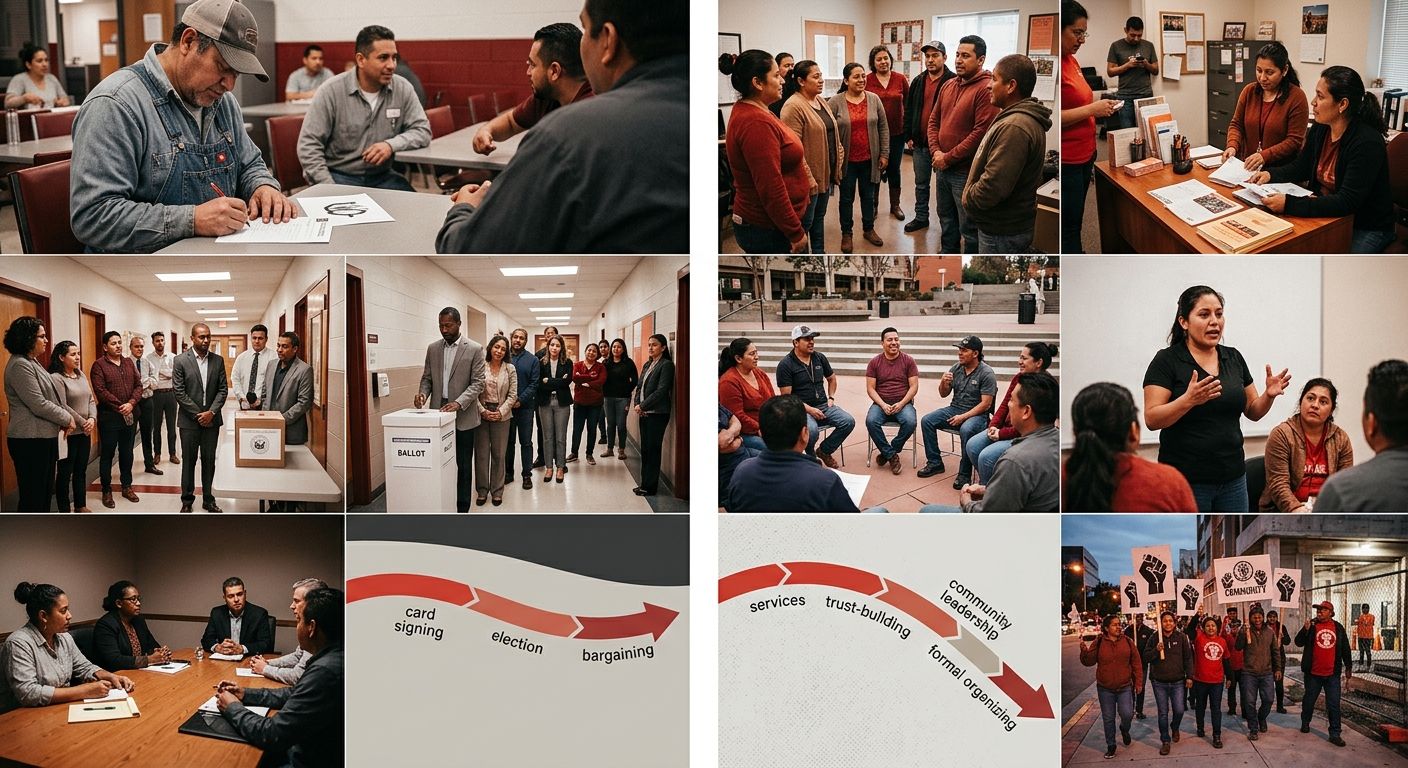
Worker centers address the first and second needs. They provide legal clinics for wage theft recovery, immigration consultations, safety training, health screenings, and financial literacy programs. Over time, these services build the trust and institutional knowledge necessary for workers to take the riskier step of formal organizing. In the United States, worker centers have expanded across industries where traditional unions struggled to gain any foothold: day labor, domestic work, restaurant work, and agricultural harvesting.
The tension here is real. Worker centers aren't unions. They can't bargain collectively under the NLRA, they often survive on foundation grants rather than dues, and they lack the structural power that comes with exclusive representation. But for workforces where the union organizing barriers are highest, worker centers function as an essential intermediate step. We've explored how to convert workplace complaints into sustained campaigns, and the worker center model is often where that conversion begins for migrant populations.
When does this rule break? When there's an existing union with the capacity and willingness to invest years of patient work before seeing a single dues-paying member. Some industrial unions with long time horizons have successfully organized migrant workforces directly, but they brought the services (legal aid, language support, community building) into the union apparatus rather than outsourcing them.
Encrypt everything or don't organize digitally
Migrant workers who are undocumented or on precarious visa status face a specific digital risk: any communication that identifies them by name, workplace, and immigration status becomes potential evidence for employers or enforcement agencies. An unencrypted group text about a workplace grievance, forwarded to the wrong person, can end an organizing campaign and endanger individual workers in ways that go far beyond job loss.
This means that digital organizing tools designed for standard campaigns need significant adaptation for migrant worker organizing. Group messaging should use end-to-end encrypted platforms. Sign-up forms should collect only the minimum necessary information. Worker databases must be stored with security protocols that assume hostile access attempts. If your campaign is using a spreadsheet on a shared Google Drive to track which undocumented workers have signed authorization cards, you've created a deportation list.
We've written extensively about how unions can build secure digital campaigns, and the principles apply with even greater urgency here. Voice notes in workers' native languages, shared through encrypted channels, have proven more effective than written materials in several campaigns involving workers with limited literacy. The digital infrastructure should match the threat model, and for migrant workers, the threat model is severe.
When does this rule break? When the entire workforce is documented, legally protected, and in a jurisdiction where immigration status is irrelevant to labor law enforcement. In that case, standard digital organizing tools work fine. But if you're unsure whether every worker on your list has secure status, default to maximum security. The cost of encryption is measured in setup time. The cost of a breach is measured in people's lives.
When These Rules Collide
Every one of these rules costs something. Staffing organizers from within migrant communities means paying for training and development over years, not weeks. Building worker centers before bargaining units means spending money without dues revenue. Encrypting everything slows communication. Learning the recruitment debt chain for a specific workforce takes investigative work that most locals aren't resourced to do.
And sometimes the rules conflict with each other. Going to where workers are (rule one) may mean showing up in spaces controlled by the same employers you're organizing against (employer-provided housing, company towns). Building trust through services (rule five) can create dependency relationships that complicate the shift to worker-led organizing. Recruiting organizers from vulnerable communities (rule four) means asking people who face the same deportation risks as the workers to take on an even more visible role.
The broader labor movement has to grapple with the reality that informal labor rights and cross-border worker protections exist in a different ecosystem than domestic collective bargaining law. The NLRA was written for a stable, documented, English-speaking workforce. The Fair Labor Standards Act technically covers undocumented workers, but enforcement depends on workers who are willing to be visible to government agencies. Every layer of the U.S. labor law framework assumes conditions that migrant workers don't have.
Unions that have succeeded with migrant populations share one quality: they committed to a timeline longer than any single visa cycle. They invested in communities, not campaigns. They accepted that the first three years might produce zero new members and measured success in trust built, legal cases won, and informal labor rights established. The Malaysian MTUC's five-to-seven-year struggle for recognition isn't an outlier. It's the baseline for what this work requires, and any organizing strategy that doesn't budget for that timeline is set up to fail before it begins.
The Union Edge Staff
Related Articles

Organizing Migrant Workers Across Borders: Why Traditional Union Strategies Fall Short and What Actually Works
Cross-border groups like the Coalition for Justice in the Maquiladoras helped workers organize independent unions at Sony, Alcoa, Custom Trim, and Sara Lee plants along the Mexico-U.S.

Beyond the Union Office: Why Organizers Fail When They Wait for Workers to Come to Them
Campaigns that file for an NLRB election with 60–70% worker support win 78% of the time. Campaigns built primarily on walk-in interest at a union hall rarely come close to that success rate.

When Workers Speak Multiple Languages: 6 Organizing Communication Failures and How to Fix Them
Language barriers cause an estimated 25% of workplace accidents in industries with concentrated immigrant workforces, and they sabotage union campaigns at comparable rates.
Also in the paper