
Safety Topics for Workplace: 10 Must-Know Guidelines
Slips, trips, and falls account for 25% of all injury claims filed each year and cost employers more than $10.5 billion annually. This guide covers ten critical safety topics for the workplace, each with a concrete action you can take and a way to verify you've done it right.

Safety Topics for the Workplace: 10 Guidelines Every Worker Should Know
Slips, trips, and falls account for 25% of all injury claims filed each year and cost employers more than $10.5 billion annually. This guide covers ten critical safety topics for the workplace, each with a concrete action you can take and a way to verify you've done it right. Plan for about 30 minutes to read through and build your checklist.
Before You Start
You don't need a safety certification to follow these steps, but you do need a few things in place. First, identify whether your workplace falls under OSHA's General Industry standards (29 CFR 1910) or Construction standards (29 CFR 1926), since the specific rules differ. Second, get a copy of your employer's current safety manual or written safety program, if one doesn't exist, that's your first red flag. Third, bring a notebook or digital tool for recording hazards as you work through each guideline. OSHA's General Duty Clause requires employers to keep their workplace free of serious recognized hazards, so documenting what you find creates a paper trail that matters if management drags its feet.
Time commitment: each step takes 15–45 minutes to assess, depending on your worksite. The full audit could take a half day, but you can space it across a week.
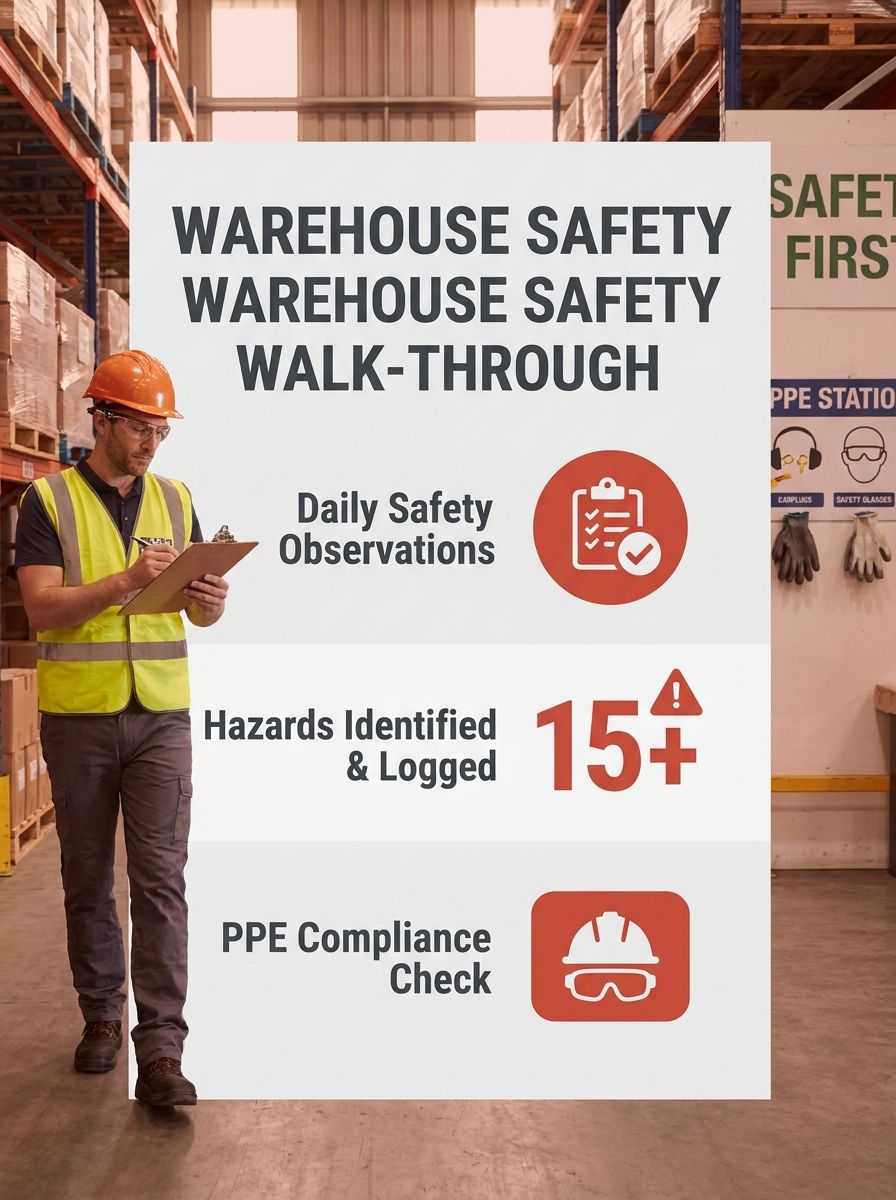
Step 1: Identify and Eliminate Slip, Trip, and Fall Hazards
Falls remain the single largest source of workplace injury claims across industries. OSHA mandates fall protection for any work surface above four feet in general industry and six feet in construction, and falls caused 17% of all workplace deaths documented in 2024. OSHA's hazard prevention guidance directs employers to "promptly implement any measures that are easy and inexpensive", including general housekeeping and removal of obvious tripping hazards like electrical cords.
Walk every area of your workplace, hallways, loading docks, stairwells, restrooms, parking lots. Look for wet floors without signage, loose cables, torn carpet edges, uneven surfaces, and missing handrails. Write down every hazard with its exact location.
Verification: You'll know this step worked when every identified hazard has either been corrected on the spot (tape down that cable, replace that burned-out stairwell light) or documented in a written request to management with a date and your signature.
Step 2: Audit Your Personal Protective Equipment
PPE misuse ranks among OSHA's most frequently cited violations year after year, and failure to provide appropriate personal protective equipment places the employer in violation of OSHA standards for each affected employee. The issue goes beyond having hard hats on a shelf. PPE has to be the right type for the hazard, properly fitted, and maintained.
Go through your worksite's PPE inventory. Check expiration dates on respirator cartridges, inspect safety glasses for scratches that impair vision, confirm that gloves match the chemical or cut hazard they're supposed to protect against, and verify that hearing protection carries the correct Noise Reduction Rating for your environment. If any item is damaged, expired, or the wrong rating, flag it immediately.
Verification: Every worker on site should be able to name the specific PPE required for their role and demonstrate how to put it on and take it off correctly. If they can't, the training is incomplete.
Step 3: Lock Out, Tag Out, and Verify Zero Energy
Lockout/Tagout violations ranked fourth on OSHA's top-cited list in 2025, and machine-related incidents cause roughly 800 fatalities per year. LOTO procedures prevent machines from starting up while someone is servicing or cleaning them, and getting this wrong kills people.
Review your facility's energy control procedures for every piece of equipment. Each machine should have a documented LOTO procedure that identifies all energy sources, electrical, hydraulic, pneumatic, thermal, chemical, gravitational. Walk through the procedure with the workers who actually perform maintenance and ask them to show you, step by step, how they isolate and verify zero energy.
Verification: After lockout, the worker attempts to restart the machine using normal operating controls. If the machine stays dead, the lockout holds. If there's any residual energy, a slow bleed on a hydraulic line, a capacitor that still holds charge, the procedure needs rewriting.
Step 4: Write and Drill Your Fire and Emergency Plan
Uncontrolled fires cause approximately 3,920 civilian deaths in the United States each year. Every workplace needs a written emergency action plan that covers evacuation routes, assembly points, employee headcount procedures, and the roles of designated fire wardens or floor monitors. OSHA's 29 CFR 1910.38 spells out the minimum requirements.
Map every exit in your building. Walk each route and check for blocked doors, propped-open fire doors (which should be closed), expired extinguishers, and missing or unlit exit signs. Schedule a drill and time it. If full evacuation takes longer than the target time for your building type, figure out why and fix the bottleneck.
Verification: After the drill, every employee should be accounted for at the assembly point. If someone was missed or a route was impassable, revise the plan and drill again within 30 days.
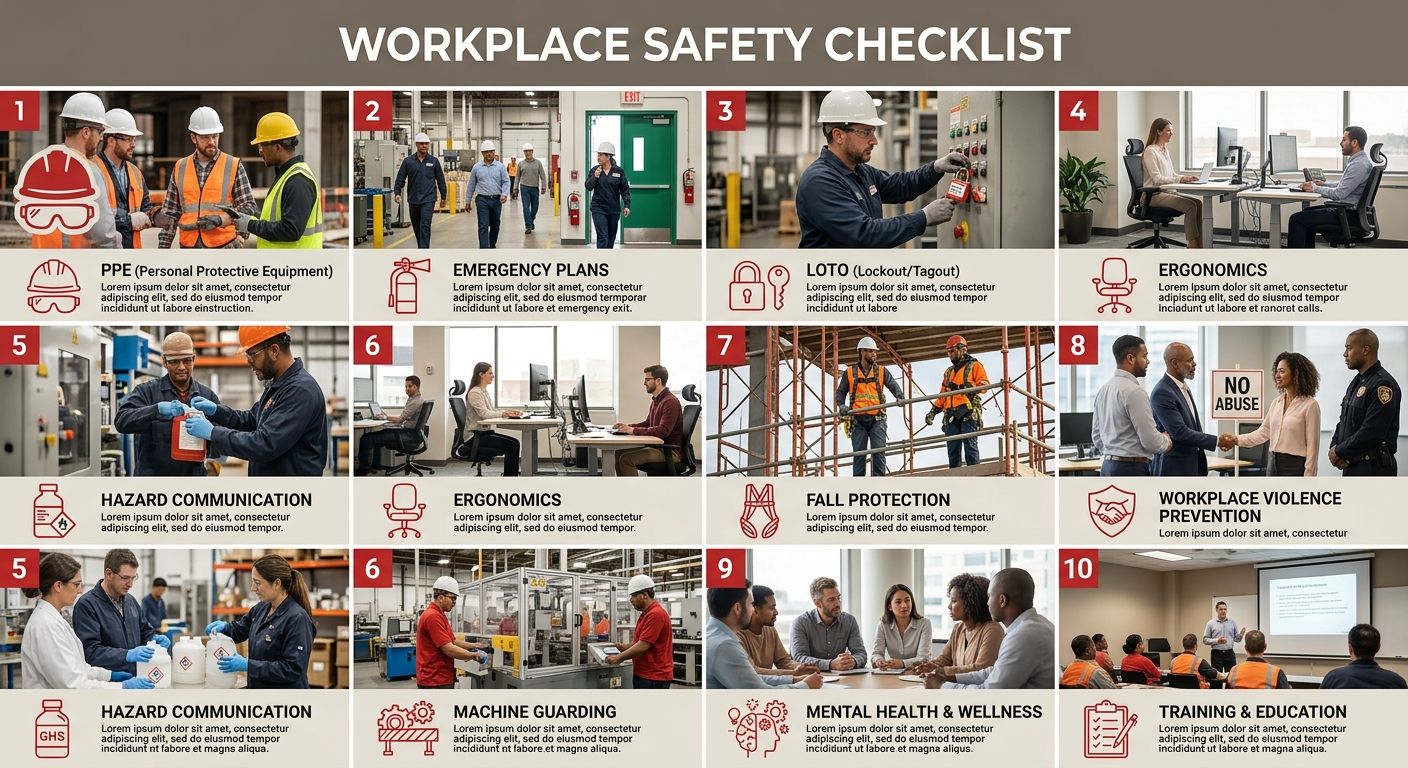
Step 5: Address Ergonomics Before the Damage Sets In
Musculoskeletal disorders account for 30% of all workplace injury claims and cost up to $50 billion annually in direct and indirect expenses. These injuries develop over weeks and months, by the time a worker reports chronic back pain or carpal tunnel, the damage has been accumulating for a long time.
Assess workstations for proper monitor height (top of screen at or slightly below eye level), chair support, keyboard positioning, and footrest availability. For manual labor, evaluate lifting techniques, the weight of loads, and whether mechanical aids (dollies, hoists, lift-assist devices) are available and actually used. Ask workers directly where they feel strain, they know their bodies better than any consultant does.
Verification: Conduct follow-up check-ins 30 and 60 days after ergonomic adjustments. If pain complaints have dropped and workers confirm the changes are holding, the intervention is working.
Step 6: Communicate Chemical Hazards Under GHS Standards
More than 100,000 chemicals are used across American workplaces, and OSHA's Hazard Communication Standard (29 CFR 1910.1200) requires employers to maintain Safety Data Sheets for every hazardous substance on site. These SDS documents must follow the Globally Harmonized System (GHS) format with 16 standardized sections covering identification, hazard classification, first aid, storage, and disposal.
Locate your facility's SDS binder or digital database. Confirm that every chemical in active use has a current SDS, that labels on containers match the SDS information, and that workers know where to find the SDS for any substance they handle. If your worksite handles chemicals and you're organizing around safety topics at the workplace, hazard communication gaps are often the easiest violations to document because the records either exist or they don't.
Verification: Pick three chemicals at random and ask the workers who handle them to name two hazards listed on the SDS. If they can't, training needs to happen before the next shift.
Step 7: Guard Every Machine, Every Time
A 2022 systematic review published in PMC found that physical training methods alone showed no measurable effect on reducing workplace accidents, but engineering controls like machine guards produced consistent results. The review concluded that behavioral approaches such as "general coaching and feedback or safety training are less effective" when implemented without physical safeguards.
Inspect every piece of moving equipment for proper guarding: point-of-operation guards, barrier guards, presence-sensing devices, and two-hand controls where applicable. Guards should be impossible to bypass without tools. Check that emergency stop buttons are within reach of the operator and clearly marked in red or yellow.
Verification: With the machine powered off, try to reach the point of operation with your hand or arm. If you can get past the guard, it doesn't meet OSHA's standard.
Step 8: Prevent Falls From Elevated Work Areas
Falls from elevation caused 17% of all workplace fatalities in 2024. OSHA requires fall protection systems, guardrails, safety nets, or personal fall arrest systems, for work above four feet in general industry and six feet in construction. This is one of the most heavily cited and most deadly safety topics in workplace enforcement.
Inventory every elevated work area: ladders, scaffolding, roofs, mezzanines, loading docks, and aerial lifts. Confirm that guardrails are 42 inches high with mid-rails, that personal fall arrest systems are inspected before each use, and that anchor points are rated for 5,000 pounds per attached worker. If workers are using portable ladders, verify that the ladders meet the weight rating for the worker plus their tools and materials.
Verification: Review your facility's fall protection plan. If one doesn't exist in writing, that's an OSHA violation under 29 CFR 1926.502. If one does exist, confirm it matches what's actually installed.
Step 9: Take Workplace Violence Seriously
Workplace violence accounted for 470 homicides in 2024, making it a leading cause of on-the-job death. Late-night retail workers, healthcare employees, and social service staff face the highest risk. OSHA doesn't have a specific workplace violence standard, but the General Duty Clause obligates employers to address recognized threats, and many states now require written prevention programs.
Evaluate your worksite's physical security: lighting in parking areas, functioning locks, visitor sign-in procedures, panic buttons, and sight lines at reception desks. If your employer handles money or serves the public after dark, cash handling procedures and buddy systems for closing shifts should be documented and followed. Workers who've experienced how employers respond to organizing pressure know that documentation and collective action carry weight when management is slow to address safety.
Verification: Ask front-line workers if they've received de-escalation training and whether they know the procedure for reporting threats. If the answer is no, push for both in writing.
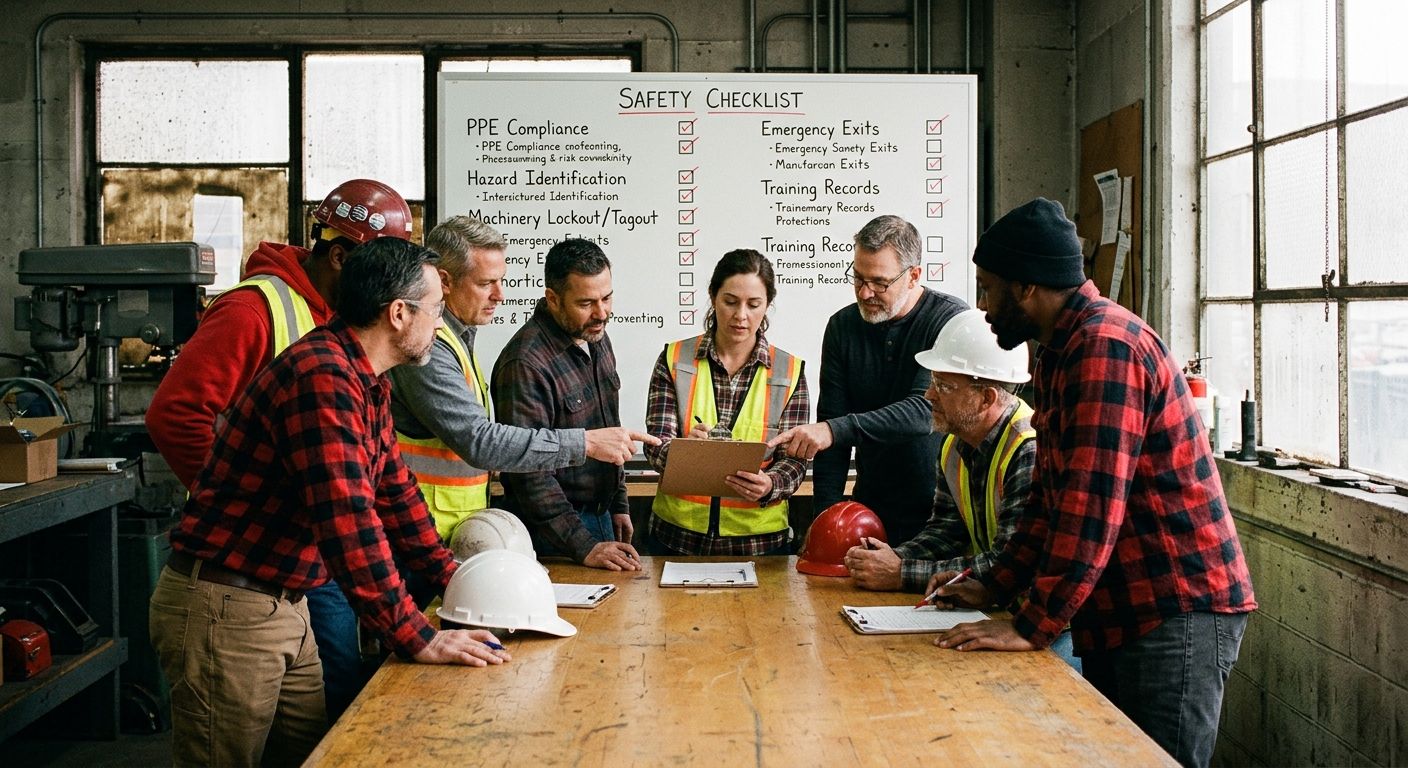
Step 10: Treat Mental Health as a Core Safety Metric
Research shows 77% of workers report being affected by burnout or workplace stress, and fatigued, distracted workers make the errors that lead to physical injuries. Mental health has become one of the fastest-growing safety at workplace topics because the connection between stress and accident rates is now well-documented. The U.S. Department of Labor funds OSHA grants specifically to help workers and employers recognize and prevent safety and health hazards, and psychological hazards increasingly fall under that umbrella.
Review your employer's policies on break schedules, shift rotation, workload management, and access to employee assistance programs. If workers are regularly skipping breaks, working mandatory overtime without adequate rest, or reporting high stress with no institutional response, those are safety topics for workplace meetings that deserve the same urgency as a broken guardrail.
Verification: Track incident reports alongside overtime and staffing data. If injuries spike during periods of heavy overtime or short staffing, the correlation supports a formal complaint or demand for corrective action.
When Things Go Wrong
Three situations account for most failures when workers try to address safety workplace topics on their own:
Management promises a fix but doesn't follow through. You documented the hazard, submitted it in writing, and nothing changed. The fix: file a formal complaint with OSHA's online complaint form or call your area office. Under Section 11(c) of the OSH Act, your employer cannot retaliate against you for filing. If they do, that's a separate federal violation. Understanding how the NLRA protects concerted activity strengthens your position when raising safety concerns as a group.
Workers don't report hazards because they fear discipline. This is common in non-union workplaces where safety reporting is treated as a productivity problem. The fix: organize. When workers raise safety topics at workplace meetings collectively, it becomes protected concerted activity under federal labor law. One worker complaining is easy to ignore. Ten workers signing a joint letter about inadequate fall protection is a different situation entirely, and employers who track how much companies spend to suppress worker organizing understand the math.
The safety program exists on paper but nobody follows it. OSHA's training requirements page provides free publications, videos, and educational materials that workers can use to hold their own training sessions when management fails to deliver. The agency's Safety and Health Fundamentals Certificate Program requires a minimum of 68 contact hours for General Industry, if your employer claims to have trained everyone but can't produce documentation of anything close to that standard, the program is a fiction.
Where the Standards Stand Today
OSHA's enforcement framework hasn't changed structurally since the OSH Act of 1970, but the agency's interpretation of what counts as a recognized hazard keeps expanding. Mental health, workplace violence, and heat illness are all areas where OSHA has increased attention and, in some cases, initiated rulemaking. For workers interested in safety in the workplace topics beyond the ten covered here, OSHA's free training library is the best starting point, it covers everything from asbestos to respiratory protection with no cost to the worker.
The real protection, though, comes from organization. Every one of these ten safety topics at the workplace becomes more enforceable when workers document hazards together, file complaints collectively, and hold management accountable through a union contract that includes safety language with teeth. Employers who understand how prevailing wage and labor standards work already know that written protections produce better outcomes than verbal promises. The same principle applies to safety: get it in writing, get it enforced, and don't let anyone tell you that reporting a hazard is the same as causing a problem.
The Union Edge Staff
Frequently Asked Questions
- What percentage of workplace injury claims are from slips, trips, and falls?
- Slips, trips, and falls account for 25% of all injury claims filed each year and cost employers more than $10.5 billion annually. Falls remain the single largest source of workplace injury claims across industries.
- What is OSHA's fall protection requirement for general industry?
- OSHA mandates fall protection for any work surface above four feet in general industry and six feet in construction. This includes guardrails, safety nets, or personal fall arrest systems.
- Why is lockout/tagout verification important?
- Lockout/tagout violations ranked fourth on OSHA's top-cited list in 2025, and machine-related incidents cause roughly 800 fatalities per year. The most common failure is skipping the verification step where a worker attempts to restart the machine to confirm the lockout holds and zero-energy state is achieved.
- How much do musculoskeletal disorders cost workplaces annually?
- Musculoskeletal disorders account for 30% of all workplace injury claims and cost up to $50 billion annually in direct and indirect expenses. These injuries develop over weeks and months of repetitive strain.
- What is the Hazard Communication Standard requirement for chemicals?
- OSHA's Hazard Communication Standard (29 CFR 1910.1200) requires employers to maintain Safety Data Sheets (SDS) in Globally Harmonized System (GHS) format with 16 standardized sections for every hazardous substance on site, with labels on containers matching the SDS information.
- Are safety training and coaching effective without physical safeguards?
- A 2022 systematic review found that physical training methods alone showed no measurable effect on reducing workplace accidents, but engineering controls like machine guards produced consistent results. Behavioral approaches such as general coaching are less effective when implemented without physical safeguards.
- What percentage of workers report being affected by burnout or workplace stress?
- Research shows 77% of workers report being affected by burnout or workplace stress, and fatigued, distracted workers make the errors that lead to physical injuries. Mental health has become one of the fastest-growing safety topics because the connection between stress and accident rates is well-documented.
- Can an employer retaliate against me for filing an OSHA complaint?
- Under Section 11(c) of the OSH Act, your employer cannot retaliate against you for filing a formal OSHA complaint. If they do retaliate, that is a separate federal violation.
Related Articles

Essential Workplace Safety: 10 Topics Every Business Needs
Fall protection has topped OSHA's most-cited violations list for over a decade, and the same ten health and safety topics in the workplace appear in the agency's enforcement data year after year, accounting for the bulk of preventable worker injuries and deaths across American industries.

10 Essential Safety Suggestions for Modern Workplaces
Workplace safety suggestions fall into three categories: compliance-only programs that meet OSHA's legal minimum, technology-driven systems that use data and wearables to track hazards, and worker-led safety committees where employees identify and fix risks themselves.

Workplace Safety Signage: Complete Guide
OSHA standard 1910.145 dictates exact colors, wording, and placement for every accident prevention sign in a general industry workplace.
Also in the paper