
NLRB Wagner Act: What You Need to Know
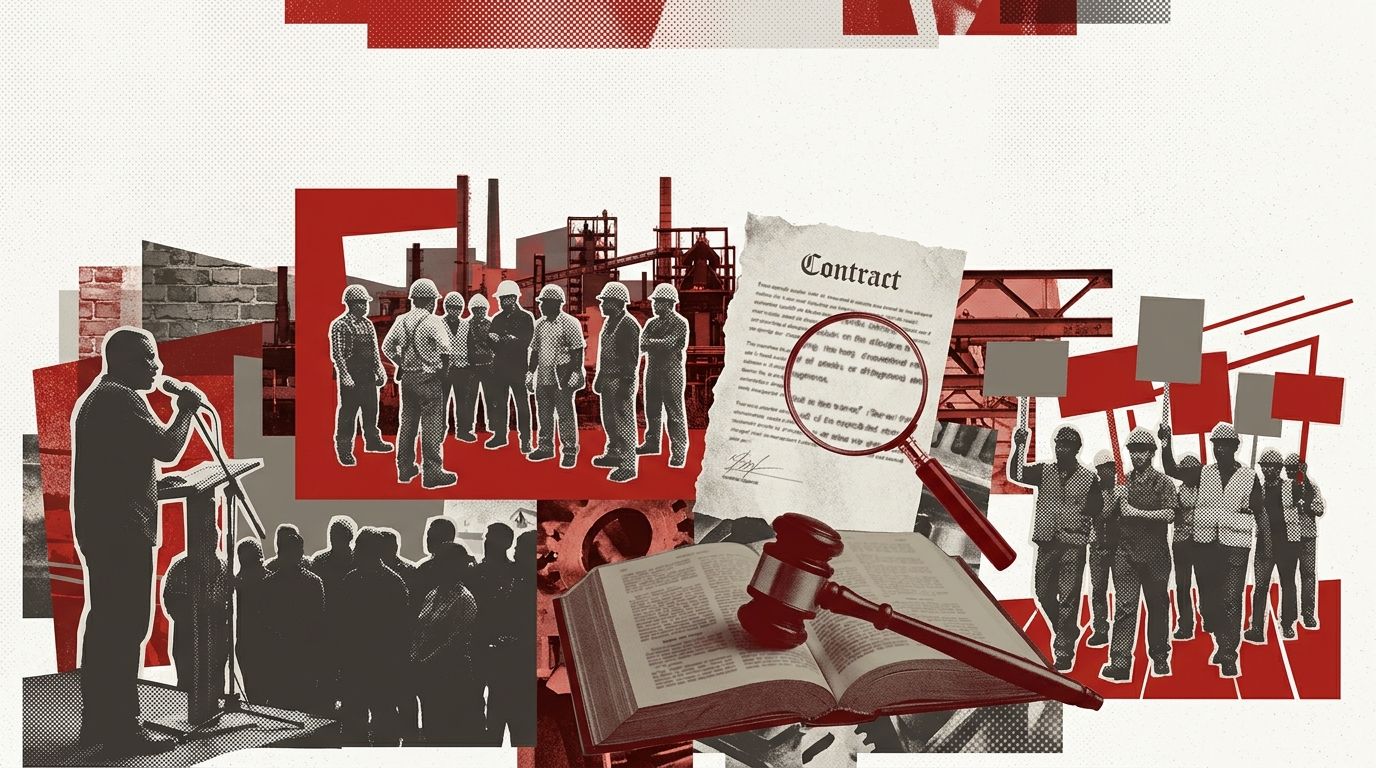
The National Labor Relations Act of 1935, commonly called the Wagner Act, is the federal statute that guarantees private-sector employees the right to organize unions, bargain collectively, and strike.
NLRB Wagner Act: What You Need to Know
The National Labor Relations Act of 1935, commonly called the Wagner Act, is the federal statute that guarantees private-sector employees the right to organize unions, bargain collectively, and strike. It created the National Labor Relations Board (NLRB) to enforce those rights, and it remains the single most important piece of labor law in the United States, covering an estimated 120 million private-sector workers.
How the Wagner Act Came to Exist
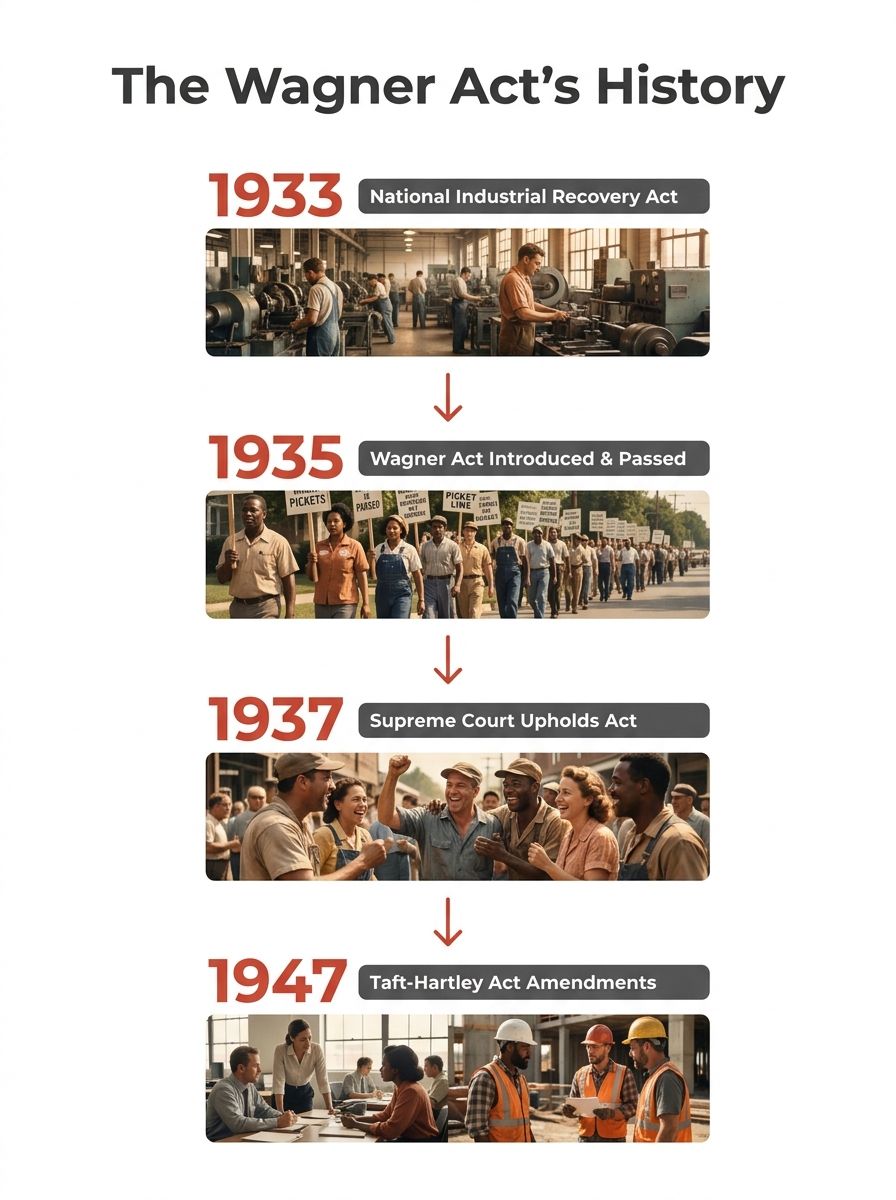
Senator Robert F. Wagner of New York introduced the National Labor Relations Act in the Senate in February 1935. The bill responded to a specific crisis: the Supreme Court had struck down the National Industrial Recovery Act (NIRA), which had contained the first federal protections for union organizing. Without the NIRA, employers faced no meaningful federal restriction on union-busting. Wagner's bill proposed to create a new independent agency, the NLRB, "to enforce employee rights rather than to mediate disputes," as the NLRB's own historical account describes it.
Congress passed the law in July 1935. According to the National Archives, the broad intention was to guarantee employees "the right to self-organization, to form, join, or assist labor organizations, to bargain collectively through representatives of their own choosing, and to engage in other concerted activities for the purpose of collective bargaining or other mutual aid or protection."
The Wagner Act established the federal government as, in Britannica's framing, "the regulator and ultimate arbiter of labour relations." It set up a permanent three-member board (later expanded to five members), each appointed by the President and confirmed by the Senate.
Two years after passage, the Supreme Court upheld the Wagner Act's constitutionality in NLRB v. Jones & Laughlin Steel Corp. (1937), clearing the last legal obstacle. Federal labor rights were here to stay.
Section 7 and the Rights That Make Everything Else Possible
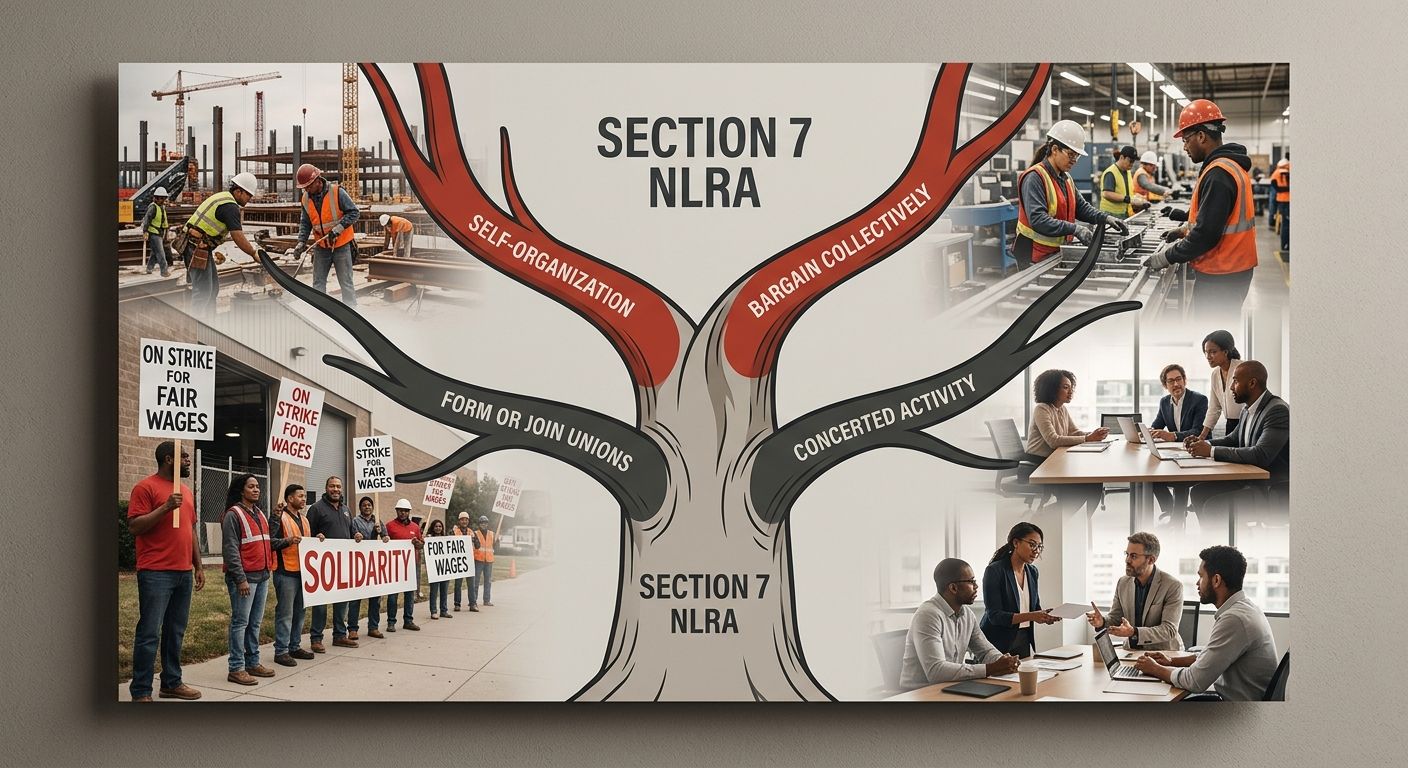
Section 7 of the NLRA is the foundation. Every other provision in the law exists to protect and enforce what Section 7 promises. The text grants employees five specific rights: the right to self-organization, the right to form or join labor organizations, the right to bargain collectively through representatives of their own choosing, the right to engage in concerted activities for mutual aid or protection, and the right to refrain from any of these activities.
That last phrase matters. Workers also have the right not to join a union, a protection that later legislation (particularly Taft-Hartley in 1947 and state-level right-to-work laws) expanded significantly.
The "concerted activity" language is broader than most people realize. As the NLRB's enforcement page states, the law "gives employees the right to act together to try to improve their pay and working conditions or fix job-related problems, even if they aren't in a union." Two coworkers discussing their wages at lunch? That's protected concerted activity under Section 7. A group text thread about unsafe conditions on the shop floor? Also protected. You don't need a union card to exercise these rights.
This is a critical point that workers often miss. The NLRB Wagner Act protects collective action by employees whether or not formal union representation exists. The Emergency Workplace Organizing Committee emphasizes that the law "guarantees the right to bargain collectively with employers over issues like pay, hours, and working conditions." The protection kicks in whenever employees act together, not when they file paperwork.
How the Unfair Labor Practice System Works
Section 8 of the Wagner Act defines employer conduct that violates workers' Section 7 rights. These violations are called unfair labor practices (ULPs), and understanding them is essential for anyone involved in organizing.
The original Wagner Act listed five categories of employer ULPs:
Interference with employees exercising Section 7 rights (Section 8(a)(1))
Domination of a labor organization or contributing financial support to one (Section 8(a)(2))
Discrimination in hiring or tenure to encourage or discourage union membership (Section 8(a)(3))
Retaliation against an employee for filing charges or giving testimony under the Act (Section 8(a)(4))
Refusal to bargain collectively with a properly certified union (Section 8(a)(5))
When an employer fires workers for discussing unionization, that's a textbook 8(a)(1) and 8(a)(3) violation. We've seen this pattern play out repeatedly, including the case of eleven Greenlight Dispensary workers in Missouri who were terminated after meeting to discuss unionization. The workers alleged that the company fired them specifically because of their organizing activity, exactly the kind of conduct the Wagner Act was designed to prohibit.
The process for filing a ULP charge is straightforward in theory. A worker or union files a charge with the nearest NLRB regional office. An NLRB agent investigates. If the regional director finds merit, the Board issues a complaint and the case goes before an administrative law judge. The judge's decision can be appealed to the full five-member Board in Washington, and from there to a federal court of appeals.
The Union Election Process
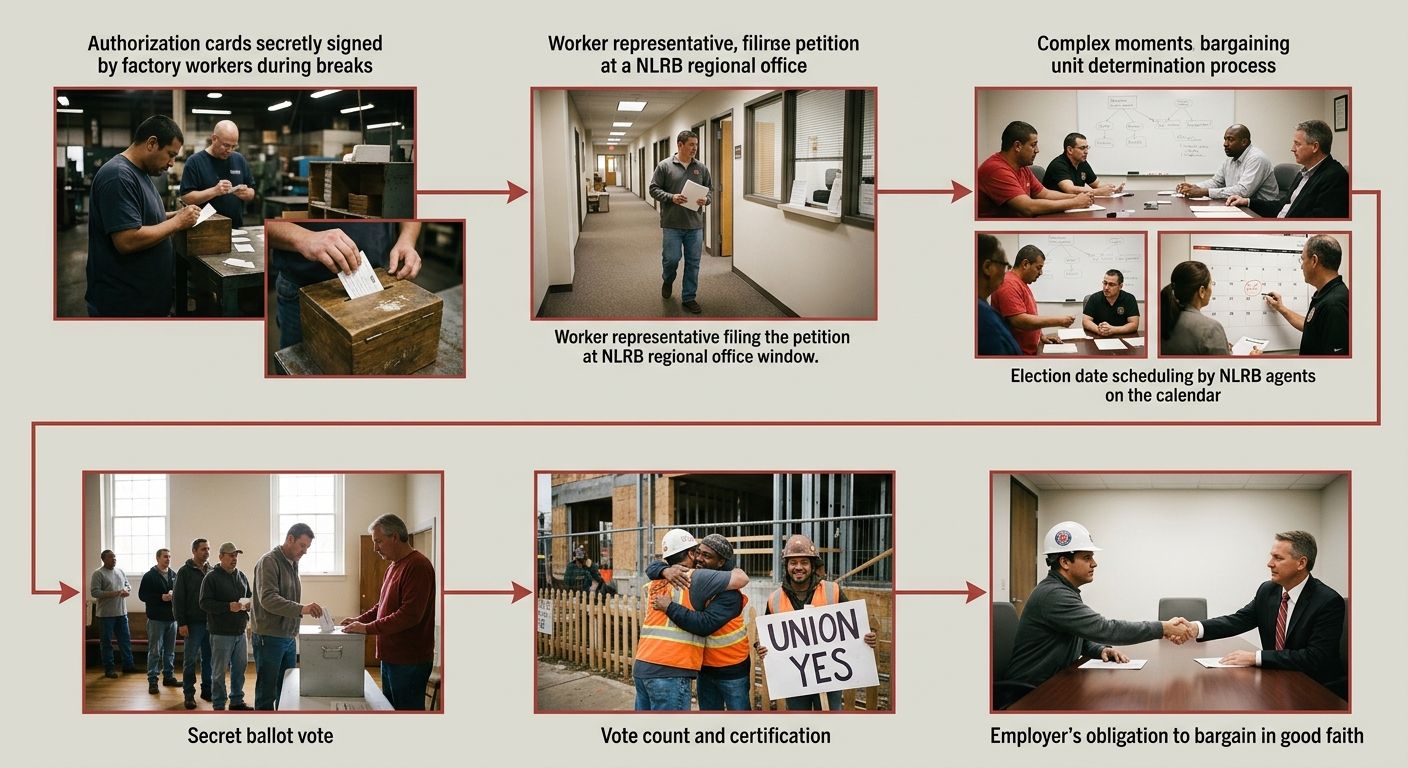
Workers petition the NLRB for a representation election by collecting signed authorization cards from at least 30% of the proposed bargaining unit. In practice, experienced organizers aim for 60-70% or higher before filing, because support tends to erode during the employer's anti-union campaign before the vote.
Once the petition is filed, the NLRB regional office determines the appropriate bargaining unit (which workers should be included), resolves disputes about unit composition, and schedules the election. A simple majority of votes cast wins the election, and the NLRB certifies the union as the exclusive bargaining representative.
After certification, the employer is legally obligated to bargain in good faith with the union over wages, hours, and working conditions. This obligation to bargain is one of the Wagner Act's most significant provisions, and it's the foundation for every collective bargaining agreement negotiated under federal labor law.
The election process has always been contested terrain. Employers routinely use the period between petition filing and the election date to campaign against the union. Mandatory captive-audience meetings, where employers require workers to attend anti-union presentations on company time, were a standard tactic for decades. The Biden-era NLRB ruled these meetings illegal, though enforcement has been inconsistent.
In 2024, only 107,000 workers participated in NLRB representation votes, a sharp decline from half a million annually in recent prior years. The drop reflects both the difficulty of the election process and the aggressive anti-union campaigns that employers wage during the organizing window.
The Penalties Problem
The NLRB Wagner Act's enforcement mechanism has a structural weakness that employers have exploited for nine decades: the penalties for violating the law are extraordinarily weak.
When an employer illegally fires a worker for union activity, the maximum penalty under the NLRA is reinstatement with back pay, minus whatever the worker earned (or should have earned) in the interim. There are no punitive damages. There are no fines paid to the government. There is no criminal liability for managers who order the illegal termination.
Labor historian Lichtenstein has described these penalties as "pocket change," arguing that they give companies a financial incentive to violate the law. The math is simple: if firing a key organizer derails a union campaign, the cost of back pay years later is a fraction of what the company would spend negotiating a collective bargaining agreement. The recent push in Congress to strengthen worker income protections reflects growing awareness that the current penalty structure fails to deter violations.
The delays compound the problem. A ULP case can take years to resolve through the NLRB's administrative process and subsequent court appeals. During that time, the fired worker is out of a job, the organizing campaign loses momentum, and coworkers get the message about what happens when you try to organize.
The result shows up in the numbers. Private-sector union density has fallen to 6%, the lowest level since 1900. Overall union density (including public-sector workers, who are covered by separate state and federal laws) stands at 10%. And 13,500 workers in over 600 locations have been waiting for a first contract since winning union representation after 2021. Winning the election, it turns out, is only half the battle.
Who the Wagner Act Doesn't Cover
The NLRA's protections have significant gaps that leave millions of workers outside its reach. The law excludes several categories of workers by explicit statutory language:
Agricultural laborers, excluded from the original 1935 act, a compromise widely understood as targeting Black and immigrant farmworkers
Domestic workers, similarly excluded in 1935 for reasons rooted in racial exclusion
Independent contractors, the classification fight is ongoing, as shown by cases like the Lyft driver misclassification settlement, where the company paid $272.5 million after allegedly misclassifying drivers
Supervisors and managers, excluded by the Taft-Hartley amendments of 1947
Public-sector employees, covered instead by state laws (which vary dramatically) or the Federal Service Labor-Management Relations Statute
Railroad and airline workers, covered by the Railway Labor Act, a separate statute with different procedures
The independent contractor exclusion has grown into one of the most contested areas of labor law. Companies that classify workers as contractors rather than employees effectively strip those workers of all NLRA protections. The question of who counts as an "employee" under the Wagner Act has generated decades of litigation and remains unresolved for entire industries.
The agricultural and domestic worker exclusions carry a specific historical weight. When the Wagner Act passed in 1935, these exclusions effectively denied organizing rights to the majority of Black workers in the United States. Some of these gaps have been partially addressed by state-level legislation, but no federal amendment has brought these workers under the NLRA's umbrella.
Where the Model Breaks
The NLRB Wagner Act was designed for a mid-20th-century industrial economy where workers reported to a single employer at a fixed worksite and held long-term jobs. The law's mechanisms strain when applied to workplaces that don't match that model.
Gig economy platforms, temp staffing agencies, and franchise structures all create ambiguity about who the "employer" is, and the NLRA requires a clearly identified employer for its election and bargaining processes to function. When a worker's pay is set by an algorithm and their schedule is determined by an app, the traditional framework of bargaining collectively over wages, hours, and working conditions becomes difficult to apply.
The Board's political composition creates another point of failure. Because Board members are presidential appointees, the NLRB's interpretation of the Wagner Act swings with each administration. Rules about joint employment, independent contractor status, and election procedures have been reversed and re-reversed multiple times across Republican and Democratic administrations. Workers trying to organize can find themselves operating under different legal standards depending on the year they file their petition. Recent NLRB rulings on privilege and information access show how Board decisions can shift the balance between employers and unions on procedural grounds alone.
Anti-union employers are also attempting to challenge the NLRA's constitutional foundations. Efforts to relitigate arbitration agreements and Board authority before the Supreme Court represent a direct attack on the framework the Wagner Act established 91 years ago. The law has survived previous constitutional challenges, but the current legal environment is less friendly to agency authority than at any point since the 1930s.
The Wagner Act remains the backbone of private-sector labor law in the United States, and its core promise, that workers have the right to organize and bargain collectively, has never been repealed. But the distance between that promise and what workers experience on the ground has widened into a gap that the law's original authors would find difficult to recognize. The mechanism works. The enforcement apparatus around it has been weakened through inadequate penalties, political manipulation of the Board, and statutory exclusions that leave entire categories of workers without protection. Understanding how the law actually functions is where any serious conversation about reform has to begin.
Common Questions
Does the Wagner Act apply to all workers?
No. The NLRA explicitly excludes agricultural laborers, domestic workers, independent contractors, supervisors, public-sector employees, and railroad and airline workers (who are covered by the Railway Labor Act). The independent contractor exclusion has become especially significant as companies in the gig economy classify workers as contractors to avoid NLRA obligations.
Can I be fired for talking about unions at work?
Firing an employee for discussing unionization or engaging in protected concerted activity violates Section 8(a)(1) and 8(a)(3) of the NLRA. The remedy is typically reinstatement with back pay, but the process can take years, and there are no punitive damages. The weak penalty structure means some employers treat the violation as a cost of doing business.
What percentage of workers need to sign cards before an election can happen?
The NLRB requires signed authorization cards from at least 30% of the proposed bargaining unit to schedule an election. In practice, organizers aim for 60-70% or higher before filing a petition, because support tends to erode during the employer's anti-union campaign before the vote.
Is the Wagner Act the same thing as the NLRA?
Yes. The National Labor Relations Act (NLRA) is the formal name. "Wagner Act" is the common name, after Senator Robert F. Wagner of New York, who introduced and championed the legislation. The terms are interchangeable, though the NLRA has been amended twice, by the Taft-Hartley Act in 1947 and the Landrum-Griffin Act in 1959, so the current law differs from Wagner's original bill.
What's the difference between the NLRB and the NLRA?
The NLRA is the law. The NLRB is the federal agency Congress created to enforce it. The NLRB conducts union elections, investigates unfair labor practice charges, and issues decisions interpreting the statute. The Board consists of five members appointed by the President and confirmed by the Senate to staggered five-year terms.
The Union Edge Staff
Frequently Asked Questions
- What rights do workers have under the Wagner Act?
- The Wagner Act grants workers five specific rights: the right to self-organization, form or join labor organizations, bargain collectively through representatives of their choosing, engage in concerted activities for mutual aid or protection, and the right to refrain from these activities. These protections apply whether or not workers are in a formal union.
- Can you be fired for discussing unionization at work?
- No. Firing an employee for discussing unionization or engaging in protected concerted activity violates Section 8(a)(1) and 8(a)(3) of the NLRA. The typical remedy is reinstatement with back pay, though the process can take years and there are no punitive damages.
- What percentage of workers need to sign cards for a union election?
- The NLRB requires signed authorization cards from at least 30% of the proposed bargaining unit to schedule an election. However, experienced organizers typically aim for 60-70% or higher before filing a petition because support tends to erode during the employer's anti-union campaign before the vote.
- Which workers are not covered by the Wagner Act?
- The Wagner Act excludes agricultural laborers, domestic workers, independent contractors, supervisors and managers, public-sector employees, and railroad and airline workers (covered instead by the Railway Labor Act). These exclusions leave millions of workers without NLRA protections.
- What is the difference between the NLRB and the NLRA?
- The NLRA is the law itself—the National Labor Relations Act. The NLRB is the federal agency created by Congress to enforce the law, conducting union elections, investigating unfair labor practice charges, and issuing decisions interpreting the statute.
- What are unfair labor practices under the Wagner Act?
- Unfair labor practices include: employer interference with Section 7 rights, domination of labor organizations, discrimination in hiring or tenure based on union membership, retaliation against employees for filing charges, and refusal to bargain collectively with a certified union.
- How long does it take to resolve an unfair labor practice case?
- A ULP case can take years to resolve through the NLRB's administrative process and subsequent court appeals. The delays mean fired workers remain out of work, organizing campaigns lose momentum, and coworkers receive a chilling message about the consequences of organizing.
Related Articles

NLRB: What Employers and Employees Need to Know
The National Labor Relations Board is the independent federal agency that decides whether your employer broke the law when it fired you for talking about wages, interrogated you about a union meeting, or refused to bargain after workers voted to organize.

New Deal NLRB: History & Modern Impact
Every major rollback of American labor rights has exploited the same structural weakness that Senator Robert Wagner left in his 1935 statute.

When Employers Fight Back: Recognizing and Countering Union-Busting Tactics During Your Organizing Campaign
U.S. employers are charged with violating federal law in 41.5% of all union election campaigns, according to a study from the Economic Policy Institute. The violations follow a predictable script.
Also in the paper