
Tech Workers Push Union Recognition at Google and Meta as AI Reshapes Job Security
The Alphabet Workers Union delivered a 4,500-signature job security petition to Google executives last week, capping a year in which union actions at Alphabet doubled from 2024 levels, according to The Guardian.

Tech Workers Push Union Recognition at Google and Meta as AI Reshapes Job Security
The Alphabet Workers Union delivered a 4,500-signature job security petition to Google executives last week, capping a year in which union actions at Alphabet doubled from 2024 levels, according to The Guardian. Workers at Google DeepMind and Meta's UK operations are simultaneously pursuing formal union recognition amid AI-driven layoffs and surveillance concerns, with Google DeepMind confirming it has entered the recognition process.
The organizing wave represents a fundamental shift in an industry where high salaries, unlimited vacation policies, and flat hierarchies once insulated workers from labor activism. Tech workers now face mass layoffs explicitly tied to AI implementation, heightened productivity monitoring, and pressure to build products whose applications conflict with employee values, union organizers said.
Surveillance and Cuts Drive Organizing at Meta
Meta cut thousands of workers in May and piloted an employee activity-tracking program, prompting a union drive among UK-based employees. "It's about us having a voice in all of the operations of the company, from products to employee experience," said a Meta employee involved in the organizing effort who spoke on condition of anonymity due to fear of employer reprisal.
The employee described the union push as "the best way to actually show up as owners, and take our seat at the table" after power shifted decisively toward management. Meta declined to comment on the organizing effort.
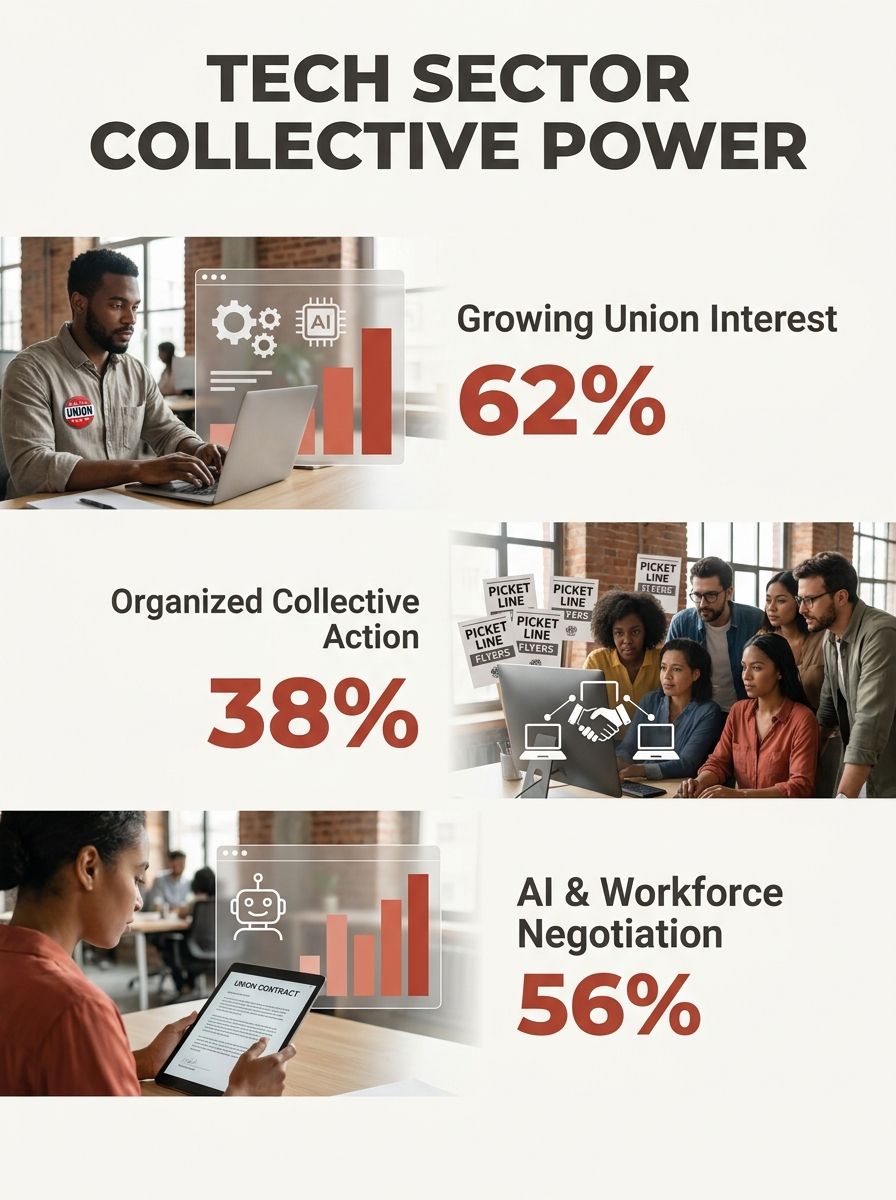
Workers at Google DeepMind and Meta's UK offices cited concerns about AI products being deployed for military applications and workplace surveillance. Google DeepMind said it is in the "early stages" of recognizing the union and plans to "continue to engage in good faith," according to a company statement.
Job Security Collapse Ends Tech Exceptionalism
"When I first started in tech, you could leave a job and have another one by the week with better pay," said John Chadfield, co-founder of United Tech and Allied Workers, the UK's only tech-industry-specific union. Engineers are now recognizing their diminished bargaining power, he said. "You might be well paid, but you are still workers."
The Alphabet Workers Union, which represents more than 1,400 employees across Google, YouTube, and Waymo, reported that participation in collective actions increased substantially in the past year. "In the age of AI, workers need a real say within our companies now more than ever," said Emma Jackson, senior staff program manager and AWU communications chair. Strong petition participation "shows workers' increasing willingness to take a stand and strengthen their agency."
Simone Robutti, a member of Tech Workers Coalition—an international grassroots network that has grown as companies restructure around AI—said the industry's sense of privilege has evaporated. "It's clear that with very few exceptions, tech workers are as replaceable as other workers," Robutti said.
Efficiency Promises Yield Heavier Workloads
A recent survey of information technology workers across University of California campuses found 65 percent reported taking on additional work due to vacant positions, even as managers expect AI tools to close productivity gaps. Only 22 percent said they felt secure in their jobs.
"We want to see the UC embody a new way of approaching technology that isn't just an echo of the consultant-driven layoffs that you see inside of Silicon Valley or the idea that AI can just be this cost-cutting measure," said Max Belasco, a business systems analyst at UCLA School of Law and union member who cited AI concerns as a main driver of spring organizing efforts.
University spokesperson Heather Hansen said the UC system focuses on using AI "thoughtfully and responsibly to strengthen its operations," with decisions guided by "operational needs" and "privacy, security, and policy considerations."
Pattern Spreads Beyond Silicon Valley
The tech sector's union activity mirrors organizing in other industries confronting AI deployment. National Nurses United has fought against AI in clinical settings, while SAG-AFTRA pushed back on AI replacement of creative workers in film and television. Tech workers' organizing success—or failure—may signal what awaits other sectors as AI adoption accelerates.
The tech unionization push builds on earlier campaigns at crowdfunding platform Kickstarter and Microsoft-owned gaming company ZeniMax, which successfully organized in recent years. Those victories demonstrated that traditional union-busting tactics could be overcome even in high-compensation environments where employers historically portrayed collective bargaining as unnecessary.
Why This Matters Now
The collapse of tech workers' perceived immunity from job insecurity marks a turning point for U.S. labor organizing in high-skill, high-wage sectors. For decades, Silicon Valley convinced engineers and developers that individual merit and market use offered better protection than collective bargaining. Artificial intelligence has dismantled that narrative in under two years.
The organizing drives at Google and Meta carry implications beyond their immediate workplaces. If tech workers—once the poster employees for union-free prosperity—now require collective representation to protect jobs and influence product decisions, the case for workplace organizing in every AI-affected industry strengthens considerably. Union organizers in healthcare, logistics, customer service, and white-collar professions can point to software engineers as proof that no job classification is too specialized or well-compensated to need a union.
The petition delivery to Google executives and the formal recognition process at DeepMind establish a concrete timeline for what may become the largest tech-sector organizing victories since the Communications Workers of America began representing call-center workers in the 1990s. How management responds will set precedents across an industry that employs millions and shapes product decisions affecting billions of users worldwide.
The Union Edge Staff
Related Articles

Tech Workers Gain Momentum in Union Organizing as AI Reshapes Industry
Tech industry workers are increasingly turning to union organizing after decades of resistance from employers, driven by mounting job losses, workplace discontent, and artificial intelligence implementation that threatens employment stability, according to an analysis published by the San Francisco

When AI Safety Tools Become Union-Busting Weapons: What Workers Need to Know About Algorithmic Surveillance
AI-powered surveillance systems sold to employers as workplace safety monitoring tools are being repurposed to track union sympathizers, suppress organizing conversations, and algorithmically discipline workers who exercise their legal right to collective action.

How Starbucks Workers United Turned Social Media Into a Bargaining Pressure Tool — and What Other Unions Can Learn
Starbucks Workers United's social media campaign didn't succeed because it generated public sympathy.
Also in the paper