
Florida State Minimum Wage: 2024 Guide
Sixty percent of Florida voters wrote a minimum wage schedule directly into the state constitution in November 2020, creating a self-executing pay escalator that no governor or state legislator can override. The florida state minimum wage currently sits at $14.

Florida State Minimum Wage: How the Constitutional Escalator Mechanism Actually Works
Sixty percent of Florida voters wrote a minimum wage schedule directly into the state constitution in November 2020, creating a self-executing pay escalator that no governor or state legislator can override. The florida state minimum wage currently sits at $14.00 per hour, with a final scheduled increase to $15.00 arriving on September 30, 2026, after which annual adjustments will track inflation through the Consumer Price Index.
Amendment 2 and the Constitutional Foundation
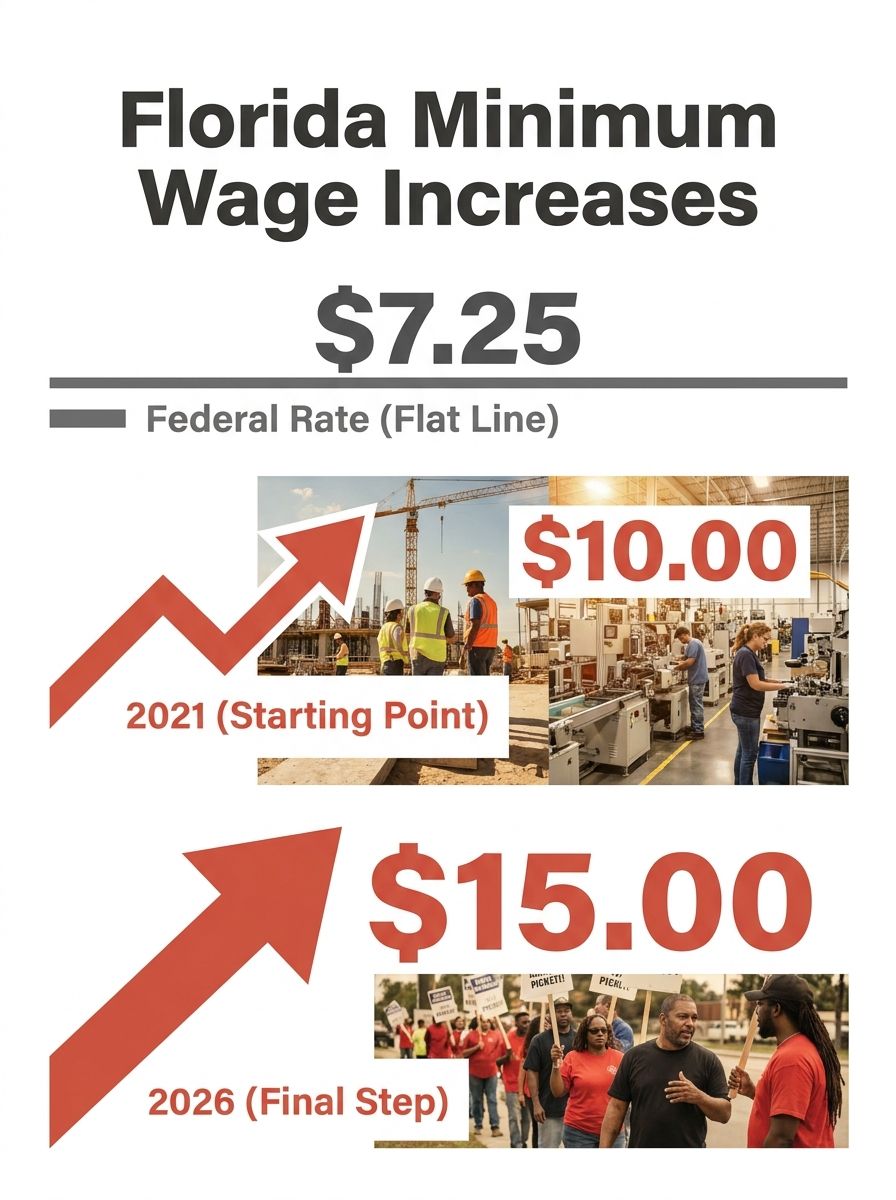
Amendment 2 passed on November 3, 2020, with 60.82% of the vote, clearing the 60% supermajority threshold required to amend Florida's constitution. The provision didn't invent minimum wage indexing in Florida, the state had been adjusting its wage floor based on inflation since a 2004 constitutional amendment, but it replaced the slow, inflation-linked creep with a fixed-dollar staircase: $1.00 per year, every year, from $10.00 to $15.00.
The constitutional basis matters for workers. A legislatively set minimum wage can be frozen, rolled back, or riddled with carve-outs in a single session. Florida's mechanism requires another constitutional amendment, and another 60% supermajority, to alter. The minimum wage in the state of florida is, by design, insulated from the kind of political paralysis that has kept the federal minimum wage stuck at $7.25 per hour since 2009.
The definitions of employer, employee, and wage under Florida's constitutional framework mirror those established under the federal Fair Labor Standards Act and its implementing regulations. This alignment means that if you're covered by the FLSA, you're covered by Florida's minimum wage, and the higher state rate is the one your employer owes you.
The $1.00-Per-Year Staircase: September 30 Effective Dates
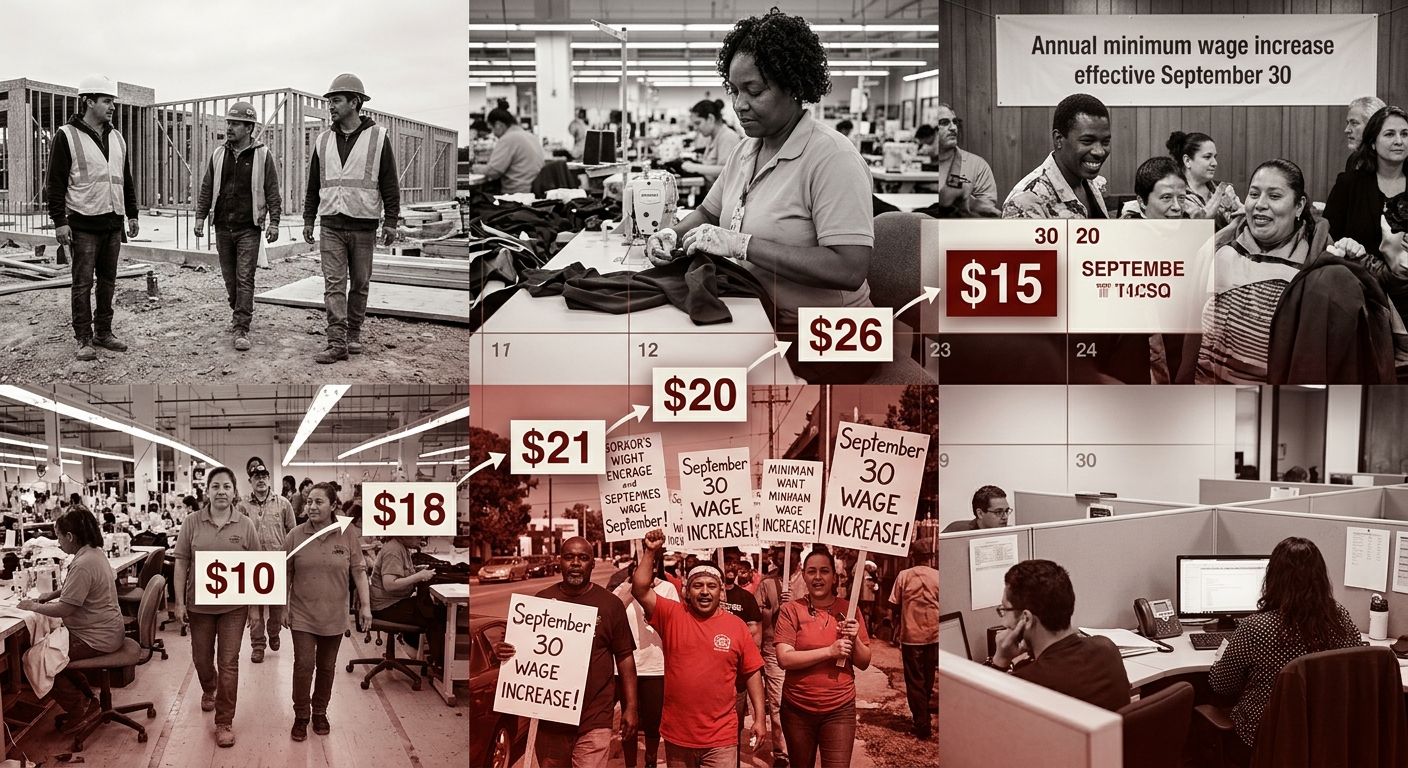
The mechanism operates on a rigid calendar. Every September 30, the minimum wage in the state of florida increases by exactly $1.00. The schedule, now largely completed, looks like this:
Effective Date | Non-Tipped Rate | Tipped Rate | Gap Over Federal ($7.25) |
|---|---|---|---|
Sept 30, 2021 | $10.00 | $6.98 | +$2.75 |
Sept 30, 2022 | $11.00 | $7.98 | +$3.75 |
Sept 30, 2023 | $12.00 | $8.98 | +$4.75 |
Sept 30, 2024 | $13.00 | $9.98 | +$5.75 |
Sept 30, 2025 | $14.00 | $10.98 | +$6.75 |
Sept 30, 2026 | $15.00 | $11.98 | +$7.75 |
As of this writing, the $14.00 rate has been in effect since September 30, 2025. The final $1.00 increase arrives on September 30, 2026, at which point Florida's minimum wage will be more than double the federal rate, a gap that has widened every year while Congress has failed to act on federal wage legislation.
The September 30 date is deliberate. It aligns with the start of Florida's fiscal year and gives employers a consistent, predictable adjustment window. Unlike states where wage changes take effect on January 1, Florida's fall schedule means workers see their raises as the tourism season ramps up, a timing that disproportionately benefits the hospitality and service workers who make up a large share of minimum-wage earners in the state.
If you're comparing Florida's trajectory to how other major states handle their wage floors, the constitutional lock-in is the distinguishing feature. States with legislatively set minimums can stall for years; Florida's escalator doesn't wait for anyone.
How the Tip Credit Carves $3.02 Off the Cash Wage
Florida employers who meet eligibility requirements for the tip credit under the FLSA can pay tipped employees a direct cash wage of $3.02 less per hour than the standard minimum wage. At the current $14.00 rate, that means tipped workers receive a guaranteed cash wage of $10.98 per hour, with the remaining $3.02 expected to come from tips.
The $3.02 figure is fixed by the amendment and does not change as the overall minimum wage rises. When the rate hits $15.00 in September, the tipped cash wage will be $11.98 per hour. This is a structural feature of the mechanism: the tip credit stays flat while the base rate climbs, which means tipped workers' guaranteed cash wages have grown at the same dollar pace as non-tipped workers' wages.
Employers carry a legal obligation here that many violate. If a tipped worker's combined cash wage and tips don't reach the full minimum wage for any pay period, the employer must make up the difference. Workers who suspect their employer is pocketing the tip credit without ensuring total compensation meets the $14.00 floor have grounds for a wage claim under Florida's constitutional provision. The proposed federal $25 minimum wage bill that would eliminate the tip credit entirely reflects growing national frustration with exactly this kind of compliance gap.
The CPI Switch After September 2026
The fixed $1.00 staircase ends when the rate hits $15.00. After 2026, the state Agency for Workforce Innovation will calculate an increased minimum wage rate based on the rate of inflation over the previous 12 months, using the federal Consumer Price Index for Urban Wage Earners and Clerical Workers (CPI-W).
This is actually a return to how Florida handled minimum wage adjustments before Amendment 2. From 2004 through 2020, a separate constitutional provision linked the state's minimum wage to annual CPI changes. That mechanism produced modest, inflation-tracking increases, pennies per year in low-inflation environments, and occasionally no increase at all when inflation was flat or negative.
The practical impact for workers is significant. The $1.00-per-year staircase delivered raises that outpaced inflation in every year from 2021 through 2026. CPI indexing will almost certainly produce smaller annual increases. If inflation runs at 3% on a $15.00 base, the 2027 adjustment would be roughly $0.45. At 2% inflation, it drops to $0.30.
The mechanism does contain one important protection: the wage floor cannot decrease. If the CPI shows deflation, the minimum wage holds at its current level. Florida's minimum wage can only go up, a ratchet built into the constitutional text that prevents the kind of rollback workers in legislatively governed states always face.
For workers tracking current Florida wage rates and how they've changed, the shift from fixed increases to CPI indexing is the most consequential transition since Amendment 2 passed.
Employer Compliance and Enforcement
The Florida Department of Commerce requires employers to display the official Florida Minimum Wage Poster in a conspicuous, accessible location. Updated posters are released annually in English, Spanish, and Creole. Failure to post is itself a violation, and it's one of the most common compliance failures across the state.
Florida's enforcement mechanism relies heavily on individual workers filing complaints. The state does not conduct proactive wage-and-hour investigations the way the federal Department of Labor does. Workers who believe they've been paid below the florida state minimum wage can file civil suits to recover back wages, liquidated damages equal to the amount of unpaid wages, and reasonable attorney's fees.
The constitutional provision also allows the state to impose fines of $1,000 per violation on non-compliant employers. But because enforcement is complaint-driven, wage theft often goes unreported, particularly among undocumented workers, workers in cash-heavy industries, and employees who fear retaliation. Union representation and community-based worker centers remain the most effective channels for identifying and pursuing minimum wage violations at scale. The kind of organizing database infrastructure that unions have been building is directly relevant to wage enforcement campaigns.
Where the Mechanism Breaks Down
The constitutional escalator has real limits. Several conditions undermine its effectiveness even when it's working as designed.
Preemption blocks local action. Florida law prohibits cities and counties from setting their own minimum wages. Miami, Orlando, and Tampa cannot adopt higher local floors to reflect their higher costs of living, even though the gap between $14.00 (or soon $15.00) and a living wage in South Florida is substantial. Workers in expensive metro areas receive the same constitutional minimum as workers in rural Panhandle counties where housing costs half as much.
Exemptions carve out vulnerable workers. Specific exemptions exist for student workers in work-study programs, certain agricultural workers, and employees under 20 during their first 90 days of employment. These carve-outs tend to affect exactly the workers who have the least bargaining power.
The federal floor hasn't moved. The federal minimum wage has been frozen at $7.25 per hour since 2009. Florida's $14.00 rate is $6.75 above that floor, but the federal stagnation means workers in the roughly 20 states that still default to $7.25 have no safety net at all. And because Florida's CPI indexing after 2026 is pegged to a national inflation measure, local cost-of-living pressures in Florida, particularly housing, may outpace the annual adjustments.
Legislative erosion attempts continue. State legislators have introduced bills to create sub-minimum wage categories for specific worker groups. As the Tallahassee Democrat reported in January 2026, at least one bill sought to reduce the minimum wage for certain categories of workers. While the constitutional floor can't be lowered without a voter-approved amendment, narrowing who qualifies as a covered "employee" is a legislative strategy that doesn't require one.
Common Questions
Does the florida state minimum wage apply to all workers?
The wage applies to all employees covered by the Fair Labor Standards Act, which includes most hourly workers in Florida. Exemptions exist for student workers in qualifying work-study programs, employees under 20 during their first 90 consecutive calendar days of employment, and certain categories of agricultural workers. Independent contractors are not covered, which is why employer misclassification of workers as contractors remains a persistent enforcement problem.
When does the minimum wage change each year?
Every September 30. The $15.00 rate takes effect on September 30, 2026. After that, the Agency for Workforce Innovation will announce the CPI-adjusted rate annually, with the new rate taking effect each subsequent September 30.
How does the tipped minimum wage work in Florida?
Employers can take a tip credit of $3.02 per hour, paying tipped employees a direct cash wage of $10.98 at the current $14.00 rate (rising to $11.98 when the rate hits $15.00). If an employee's tips plus cash wage don't equal the full minimum wage in any pay period, the employer must cover the shortfall. You can review more details in our full breakdown of Florida wage rates.
Can the Florida legislature lower the minimum wage?
No. The minimum wage is embedded in Article X, Section 24 of the Florida Constitution. Changing it requires a constitutional amendment approved by 60% of voters in a general election. The legislature cannot reduce the rate or eliminate the CPI indexing through ordinary legislation.
How does Florida's rate compare to other states?
At $15.00 (effective September 2026), Florida will be more than double the $7.25 federal minimum wage. The rate will be comparable to California, New York, and Washington state, though those states' rates vary by region and employer size. Florida's constitutional mechanism makes its floor uniquely resistant to political interference compared to states where the legislature sets the rate. For context on how New York City handles its own wage structure, the differences in enforcement and local control are striking.
The Union Edge Staff
Frequently Asked Questions
- What is the Florida minimum wage in 2024?
- Florida's state minimum wage is $14.00 per hour as of September 30, 2025, with a final increase to $15.00 scheduled for September 30, 2026.
- When does Florida minimum wage increase each year?
- Florida's minimum wage increases every September 30. Until 2026, increases are fixed at $1.00 per year; after September 30, 2026, increases will be based on the Consumer Price Index.
- What is the tipped minimum wage in Florida?
- Florida employers can pay tipped employees a cash wage of $10.98 per hour at the current $14.00 minimum wage rate (rising to $11.98 when the rate hits $15.00), with employers required to make up any shortfall if tips don't bring total compensation to the full minimum wage.
- Can the Florida legislature lower the minimum wage?
- No, the minimum wage is embedded in the Florida Constitution and cannot be lowered without a constitutional amendment approved by 60% of voters; the legislature cannot reduce the rate through ordinary legislation.
- How much will Florida minimum wage be in 2026?
- Florida's minimum wage will reach $15.00 per hour on September 30, 2026, which will be more than double the federal minimum wage of $7.25.
- What happens to Florida minimum wage after 2026?
- After September 30, 2026, annual minimum wage increases will be based on the Consumer Price Index inflation data, calculated by the state Agency for Workforce Innovation, replacing the fixed $1.00-per-year increases.
- Who is exempt from Florida's minimum wage requirements?
- Exemptions exist for student workers in work-study programs, employees under 20 during their first 90 days of employment, certain agricultural workers, and independent contractors.
- What are the penalties for employers violating Florida minimum wage?
- Employers who violate Florida minimum wage face fines of $1,000 per violation, plus civil liability for back wages, liquidated damages equal to unpaid wages, and reasonable attorney's fees.
Related Articles

Minimum Wage in Florida: 2024 Rate Changes
Before 2004, Florida had no state minimum wage at all. Voters fixed that twice through constitutional amendments, the second of which created a fixed $1.00-per-year escalator that brought the minimum wage in Florida to $13.00 per hour on September 30, 2024, with a $15.

State of Florida Minimum Wage: 2024 Updates
Article X, Section 24 of Florida's constitution contains a wage-floor mechanism that advances automatically each September 30 without any legislative vote, gubernatorial signature, or agency rulemaking. The 2024 step brought the minimum wage in the state of Florida from $12.00 to $13.

Minimum Wage at Florida: 2024 Guide & Updates
Amendment 2 to Florida's constitution, approved by voters on November 3, 2020, hardwired a $1.00-per-year minimum wage escalator into state law that bypasses the legislature entirely. That mechanism set the minimum wage in Florida at $13.
Also in the paper