
UAW 4811 Adds 12,000 University of California Workers in Largest Single-Year Expansion
United Automobile Workers Local 4811 added 12,000 University of California employees to its membership rolls, according to The Daily Californian, bringing the union's total membership to 60,000 across all UC campuses. The expansion incorporates Student Services and Advising Professionals and Researc

UAW 4811 Adds 12,000 University of California Workers in Largest Single-Year Expansion
United Automobile Workers Local 4811 added 12,000 University of California employees to its membership rolls, according to The Daily Californian, bringing the union's total membership to 60,000 across all UC campuses. The expansion incorporates Student Services and Advising Professionals and Research and Public Service Professionals, with 1,700 of the new members working at UC Berkeley.
The membership addition represents a 25% increase for UAW 4811, which previously organized graduate student researchers, academic researchers, and postdoctoral scholars across the ten-campus UC system. The Student Services and Advising Professionals unit includes academic advisors, financial aid counselors, admissions officers, and student affairs coordinators. The Research and Public Service Professionals category covers research administrators, lab managers, extension specialists, and policy analysts working in UC's public-service mission.
UC Berkeley accounts for 1,700 of the 12,000 new members, the largest single-campus cohort in the expansion. The distribution reflects Berkeley's status as the system's flagship campus and its concentration of research infrastructure and student support operations. The remaining 10,300 members span UCLA, UC San Diego, UC Davis, UC Irvine, UC Santa Barbara, UC Riverside, UC Santa Cruz, UC Merced, and UC San Francisco.
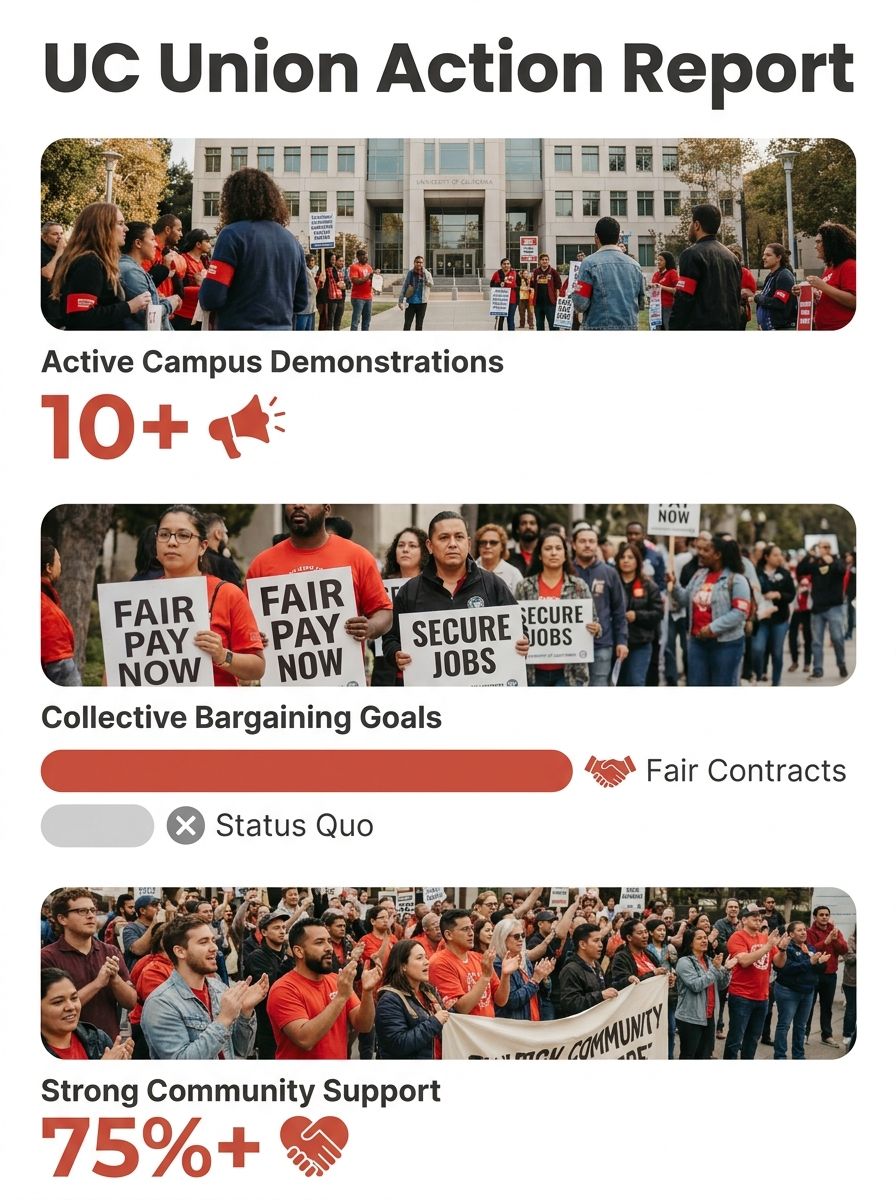
Scale of Professional Staff Organizing
The 12,000-member expansion marks one of the largest single additions to a higher-education union in 2026. Professional staff organizing campaigns at public universities typically proceed campus-by-campus rather than system-wide, making the simultaneous UC-wide incorporation unusual in scope. The bargaining unit structure consolidates workers across job classifications that traditionally negotiate separately or remain unorganized.
UAW 4811's organizing success builds on momentum from the union's 2024 expansion into academic research titles and its May 2024 system-wide strike over workplace safety protections related to protest response. The union previously represented approximately 48,000 academic workers before this expansion, based on the new 60,000 total membership figure. The addition of administrative and student-services professionals diversifies the union's occupational composition beyond academic appointments.
Student Services and Advising Professionals face distinct workplace challenges from academic researchers, including higher caseloads, performance metrics tied to student retention outcomes, and year-round employment without academic-calendar breaks. Research and Public Service Professionals frequently work on grant-funded contracts with less job security than faculty counterparts. Both units share concerns about wage compression, where starting salaries for new hires approach or exceed the pay of long-tenured staff.
UC System Labor Landscape
The expansion positions UAW 4811 as the largest union at the University of California, surpassing AFSCME 3299, which represents approximately 26,000 service and patient-care workers. The UC system employs roughly 230,000 people system-wide, including faculty, staff, and student employees. UAW 4811's 60,000 members now constitute approximately 26% of the total UC workforce.
The University of California avoided a strike by 40,000 healthcare workers in November 2024 through a last-minute agreement with AFSCME 3299, demonstrating the system's vulnerability to coordinated labor action across large bargaining units. That agreement included wage increases and staffing commitments but left unresolved questions about the university's capacity to meet simultaneous demands from multiple unions.
UC management has not publicly commented on the UAW 4811 expansion. The university's prior statements during organizing campaigns emphasized its commitment to competitive compensation and collaborative labor relations, while expressing concern about operational complexity when negotiating with multiple unions representing similar job functions.
Context and Outlook
The 12,000-member addition to UAW 4811 reflects a broader shift in public-sector organizing strategy, where unions pursue comprehensive wall-to-wall campaigns covering multiple job classifications rather than incremental, single-title campaigns. The approach reduces employer opportunities to whipsaw units against each other during contract negotiations and creates leverage through the threat of coordinated strikes across interdependent campus functions.
For labor organizers watching higher-education campaigns, the UAW 4811 expansion demonstrates the viability of organizing professional staff who occupy the ambiguous middle ground between faculty and classified employees. These workers often possess bachelor's or master's degrees but lack the academic freedom and tenure protections of faculty, while earning salaries that place them above entry-level clerical positions. Their willingness to unionize challenges the assumption that professional identity and union membership are incompatible.
The expanded bargaining unit will face immediate questions about contract integration: whether the new members negotiate separate agreements or merge into UAW 4811's existing contracts, and how the union balances the distinct priorities of academic researchers, student-services professionals, and public-service specialists. The organizing model's emphasis on member participation will be tested as the local absorbs a membership base that doubled its size in a single action. The success of that integration will determine whether the expansion translates into sustained bargaining power or administrative fragmentation.
The Union Edge Staff
Related Articles

UC Attending Physicians Launch Nation's Largest Doctor Unionization Campaign
Attending physicians at the University of California health system launched a union organizing campaign on July 31 that organizers describe as the largest effort among attending doctors in the United States, according to an announcement reported by The Daily Californian.

University of California Averts Strike With Last-Minute Deal for 40,000 Healthcare Workers
The University of California and AFSCME Local 3299 reached a tentative labor agreement late on May 13, preventing a planned strike by more than 40,000 healthcare and service workers hours before a May 14 walkout deadline, according to Bloomberg Law. The deal secures minimum wage increases to $30.10

Examples of Collective Bargaining Success
At nearly 3am on November 25, 2024, graduate workers at the University of Minnesota and university administrators finalized a tentative first collective bargaining agreement after more than 30 hours of continuous mediation over two days, according to UE News.
Also in the paper