
The $1.5 Billion Union-Busting Industry: How Employers Weaponize Legal Consultants and What Unions Should Know
Anti-union law firms, third-party persuader consultants, and employer-run internal campaigns form the three pillars of a $1.7 billion annual industry dedicated to stopping workers from organizing.

The $1.5 Billion Union-Busting Industry: How Employers Weaponize Legal Consultants and What Unions Should Know
Anti-union law firms, third-party persuader consultants, and employer-run internal campaigns form the three pillars of a $1.7 billion annual industry dedicated to stopping workers from organizing. A joint EPI and LaborLab report released May 20, 2026, maps how each arm operates and where federal disclosure rules fail.
The EPI and LaborLab report dropped this week and immediately reframed the scale of employer anti-union spending. Earlier estimates put the figure at $340 million, then $433 million. The new research, drawing on federal LM-10 and LM-20 disclosure forms, employer SEC filings, and consultant advertising data, puts the real number at roughly $1.7 billion per year. Even that figure is likely low. A 2024 Department of Labor Inspector General report confirmed that nearly half of required disclosure filings arrived late or never showed up at all.
For healthcare workers mounting card drives, hospital techs bargaining first contracts, and home care aides fighting for shift-pay reform, these numbers land hard. Hospital systems and healthcare corporations are among the most active buyers of union avoidance tactics. Understanding which type of consultant you're up against is the first step in neutralizing them.
The three categories below represent distinct business models with different price points, different legal exposure, and different vulnerabilities. Each one calls for a different union response.
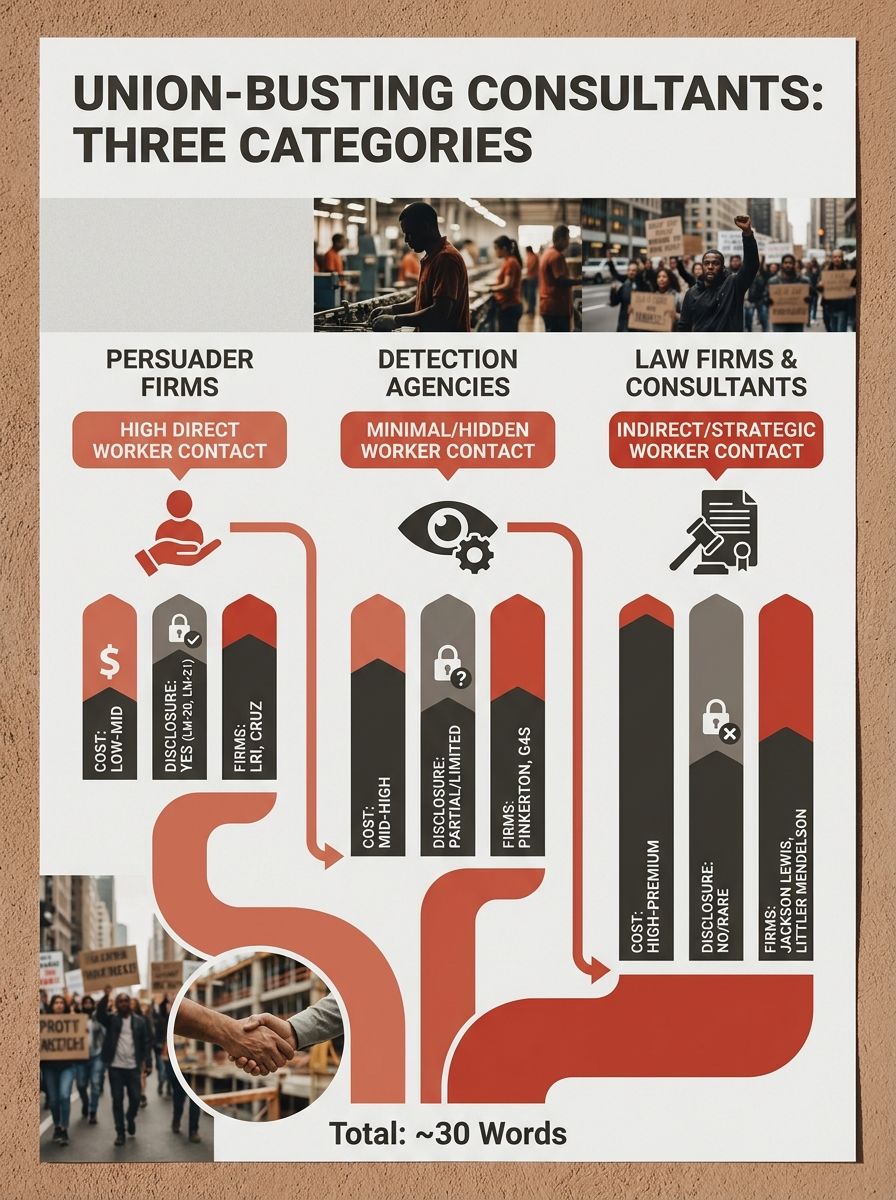
Anti-Union Law Firms | Third-Party Persuaders | Internal Management Campaigns | |
|---|---|---|---|
Typical cost | $400–$425/hour | $2,625+/day | Staff time (largely unreported) |
Worker contact | Indirect (advise management) | Direct (one-on-one, group meetings) | Direct (supervisors, HR) |
Federal disclosure | Often avoids LM-20 filing | Required to file LM-20 | No disclosure required |
Primary vulnerability | Public client lists, lobbying records | LM-20 filing complaints | NLRB unfair labor practice charges |
Known firms | Littler Mendelson, Jackson Lewis, Morgan Lewis | Labor Information Services, IRI Consultants | Varies by employer |
How Anti-Union Law Firms Run Legal Interference
Firms like Littler Mendelson, Jackson Lewis, and Morgan Lewis sit at the top of the union avoidance food chain. They don't typically talk to workers face-to-face. Instead, they advise management on how to respond to organizing campaigns, coach supervisors on what to say in one-on-one meetings, and file legal challenges to union certification.
"Union avoidance law firms have constructed an industry providing counsel on union busting," the EPI/LaborLab report states, as Truthout reported on the findings. Barnes & Thornburg, another firm in this space, boasts on its own website that its clients "obtained favorable results in more than 96% of the campaigns in which we have been involved."
The billing rates tell the story. Consultants at these firms charge $400 to $425 per hour. An average Amazon delivery driver, LaborLab calculated, works 45 days to earn what a union-busting consultant makes in a single day. Amazon alone spent $26.6 million on union avoidance consultants in 2025, according to the EPI report. Other large employers spent between $400,000 and $2 million per campaign.
These firms exploit a critical gap in labor law compliance. Because they advise management rather than speaking to workers directly, they often avoid filing the LM-20 forms that the Labor-Management Reporting and Disclosure Act (LMRDA) requires of "persuaders." Littler Mendelson, for instance, advised Starbucks management throughout its nationwide anti-union campaign without meeting employees directly, sidestepping federal disclosure rules entirely. This legal loophole makes these firms attractive to employers and difficult for unions to track.
But law firms do leave a paper trail. Their client lists, lobbying activities, and public filings with the SEC offer organizing intelligence that unions can use. LaborLab has built a searchable database tracking which firms work for which employers. Jackson Lewis, as LaborLab has documented in detail, maintains offices in nearly every major U.S. metro area and has represented employers across healthcare, retail, manufacturing, and tech.
Littler Mendelson operates a Workplace Policy Institute that actively lobbies against worker-friendly legislation. The firm opposed California's AB5 and backed Proposition 22 to keep gig workers classified as independent contractors. So the same firms billing $400 an hour to defeat your organizing drive are also working to weaken the laws that protect your right to organize in the first place.
What unions should watch for: If management suddenly starts using precise legal language in anti-union communications, or if the employer files procedural challenges to your election petition, a law firm is almost certainly directing the campaign. Check LaborLab's database and the OLMS filing system for names.

The Persuader Consultants Workers Never See Coming
Why do some campaigns feel like the opposition appeared overnight? Third-party persuaders represent the most aggressive and most regulated arm of the union-busting industry. These consultants work on-site, hold group meetings with employees, and conduct one-on-one conversations designed to change minds. Labor Information Services, one of the more visible firms, advertises itself as providing "labor relations consultants as third party persuaders to communicate to employees the advantages of staying union free."
The daily rates are steep. UPS paid its union-busting consultants $2,625 per day during organizing campaigns, according to EPI's earlier research into employer spending. Some persuaders earn more than $3,000 daily. Amazon's Bessemer, Alabama operation saw the company spend at least $4.3 million on external anti-union consultants alone, per EPI's documentation of employer tactics.
Under the LMRDA, these consultants are supposed to file LM-20 reports disclosing their activities and payments. Employers hiring them must file corresponding LM-10 reports. The system was designed to give workers transparency about who is being paid to talk them out of unionizing.
The system is broken. LaborLab filed complaints over 782 missing or incomplete LM-20 and LM-10 reports as of July 2024. The Department of Labor's Office of Labor-Management Standards (OLMS) acknowledges "significant under-reporting" and is pursuing new rulemaking on "split income" reporting, an attempt to capture how much time supervisors spend on anti-union activity. Those rules haven't taken effect.
Healthcare employers rely heavily on persuader consultants. When nurses at hospitals like the UnityPoint system pushed for union recognition, they faced the kind of coordinated resistance that persuader firms specialize in: captive-audience meetings where attendance is mandatory, one-on-one conversations between consultants and individual workers, and talking points that frame the union as a threat to the employer-employee relationship.
The persuader model has a built-in weakness: federal law requires disclosure, even if enforcement is spotty. Unions can file complaints when those disclosures don't happen. Every missing LM-20 form is a potential unfair labor practice charge and a piece of evidence that the employer is spending thousands per day to suppress organizing rather than investing in wages, staffing, or patient care. Workers who learn their employer paid a consultant $2,625 a day while short-staffing their unit tend to get angry in ways that build solidarity.
When Management Becomes the Anti-Union Campaign
The third arm of the union-busting industry operates inside the building, with no outside consultants visible and no federal disclosure required. Employers train their own supervisors and managers to deliver anti-union talking points, conduct captive-audience meetings, monitor worker sentiment, and identify union supporters.
A McKinsey survey of 423 organizations employing 12 million people found that close to 35% of firms added or expanded employee resource groups since 2020. The EPI research flags a troubling use of these groups: some employers run ERGs as internal pseudo-unions that channel worker dissent into management-controlled forums, keeping a watchful eye over the workforce without giving up any bargaining power.
This is where employer anti-union spending gets hardest to measure. The EPI report notes that internal anti-union staffing and legal costs aren't captured in public data. When Amazon ran its campaign against the RWDSU in Bessemer, the external consultant spending hit $4.3 million. But the internal operation was equally aggressive: workers alleged that Amazon monitored which employees voted and how. The company launched websites, funded community advertisements, and deployed supervisors to deliver scripted anti-union messages throughout the facility.
Healthcare systems run similar internal campaigns with particular sophistication. Hospital administrators hold department-by-department meetings to discuss what a union "would mean for patient care." Nurse managers get coaching on steering conversations away from wages and toward fears about dues, strikes, and disruption. These union avoidance tactics land hard in healthcare because workers genuinely care about patient outcomes, and management exploits that commitment by framing unionization as a threat to the mission.
For unions building an organizing committee with strong worker education, the internal campaign is the most common and most difficult obstacle. There's no LM-20 to pull. No outside consultant to identify by name. The anti-union message comes from people workers already know and may trust.
What unions should watch for: Sudden changes in supervisor behavior. Managers who start holding one-on-one conversations about "concerns." New posters about "direct relationships." Surprise benefits announcements timed to coincide with your card drive. Document everything with dates and specifics. These actions can form the basis of NLRB unfair labor practice charges if they constitute threats, surveillance, or promises of benefit. Forty-four percent of newly certified unions never reach a first contract, and a major reason is that employers use this internal machinery to delay and stall bargaining even after workers win an election.

The Verdict
The three arms of the union-busting industry serve different functions, carry different legal exposure, and respond to different counter-strategies. Knowing which one you face changes how you fight.
Against law firms, your best tool is public records. Check LaborLab's consultant database, search OLMS filings, and review employer SEC disclosures. When you know which firm your employer hired, you can anticipate the legal moves before they arrive: procedural challenges to your election petition, objections to bargaining unit composition, delays designed to sap momentum. That organizing intelligence makes your campaign sharper and your post-election bargaining preparation stronger from day one.
Against persuader consultants, your strongest weapon is the disclosure system itself, broken as it is. File OLMS complaints when LM-20 reports are missing. Make the employer's spending visible to your coworkers. A nurse who learns the hospital spent $2,625 a day on a consultant while refusing to fill vacant positions on her unit doesn't need much convincing about why the union matters.
Against internal campaigns, documentation is everything. Keep detailed records of supervisor statements, mandatory meeting dates and content, and any changes to workplace policies that coincide with your organizing timeline. These records fuel labor law compliance complaints and NLRB charges.
The $1.7 billion figure from the EPI report represents a staggering imbalance of resources. Employers have spent decades building this industry. And yet, unionization efforts have reached their highest levels in 15 years despite that opposition. Every dollar an employer spends on union-busting consultants is a dollar it didn't spend on the workers who generate its revenue. Making that tradeoff visible to coworkers, to the public, and to regulators remains the most effective way to turn the industry's own spending into an argument for the union.
The Union Edge Staff
Related Articles
Florida Union-Busting Consultants Earned Up to $3,900 Per Day in September Campaign Filings
Federal labor filings submitted in late September 2026 show Florida-based union avoidance consultants charged employers between $2,200 and $3,900 per day to persuade workers against organizing, according to reports filed with the U.S. Office of Labor-Management Standards.

LaborLab Releases Tools to Track Union-Busting Campaign Costs as Employers Evade Disclosure Law
LaborLab, a workers' rights watchdog organization, released a search tool and cost estimator on September 8 designed to expose the spending patterns of the $1.7 billion union-busting industry, according to The American Prospect.

U.S. Employers Spent $1.7 Billion Fighting Unions in 2025 as Membership Hits 16-Year High
U.S. employers spent an estimated $1.7 billion in 2025 hiring consultants and attorneys to oppose union organizing efforts, according to a study released Tuesday by union-busting watchdog LaborLab and the Economic Policy Institute, even as union membership climbed to 16.5 million workers—the highest
Also in the paper