
Union Organizing Software vs. Digital Organizing Tools: Choosing the Right Tech Stack for Your Campaign
Union organizing software and general digital organizing tools serve fundamentally different purposes, and picking the wrong one can expose worker data, slow your campaign timeline, and fracture member engagement.

Union Organizing Software vs. Digital Organizing Tools: Choosing the Right Tech Stack for Your Campaign
Union organizing software and general digital organizing tools serve fundamentally different purposes, and picking the wrong one can expose worker data, slow your campaign timeline, and fracture member engagement. Dedicated platforms like Broadstripes, UnionTrack ENGAGE, and Union Impact bundle grievance workflows, dues management, and secure communications into systems purpose-built for labor campaigns.
The Civil Rights Stakes of Your Tech Choice
The right to organize is federally protected under the National Labor Relations Act. But that legal protection means little if your campaign's digital infrastructure leaks member lists to management or stores sensitive conversations on servers you don't control. The technology you select is a civil rights decision, because it determines who can access worker data, how grievances get documented, and whether communications stay confidential during a recognition fight.
Social media platforms limit organic reach to roughly 20% of followers, according to union technology analysts. That means 4 out of 5 workers on your contact list may never see a critical update posted to Facebook or X. Algorithmic filtering decides which workers receive information and which don't. During a card-signing push or a contract ratification vote, that kind of information gap kills campaigns.
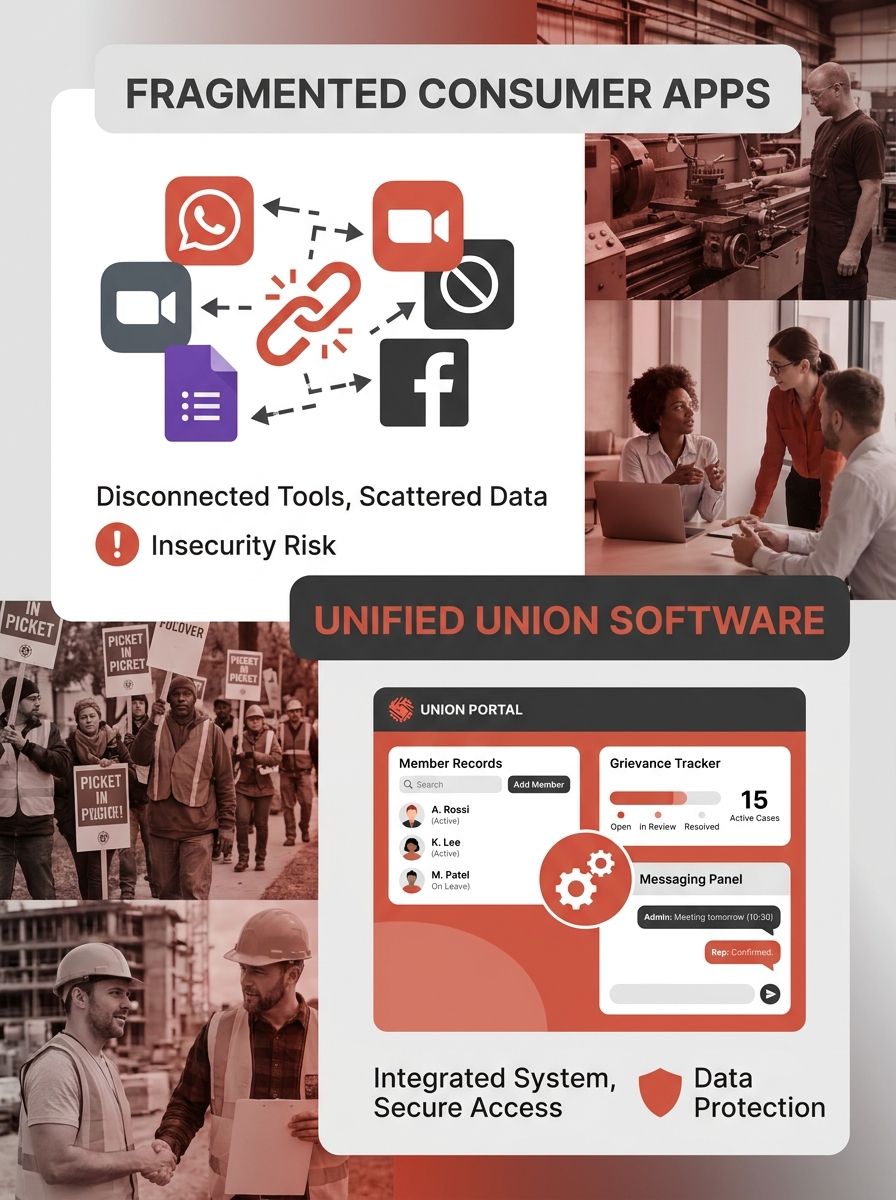
The privacy problem runs deeper than reach. Informal apps like WhatsApp and Signal offer encrypted messaging but store no organizing-specific data. They can't track who signed authorization cards, which workers attended a committee meeting, or where a grievance stands in the pipeline. When a campaign runs on scattered consumer apps, institutional knowledge lives in individual phones. If one organizer leaves, that data disappears with them.
What Union-Specific Platforms Provide
Organizing-specific software matters because labor campaigns have workflows that general digital organizing tools were never designed to handle. Here's how the major campaign management platforms break down.
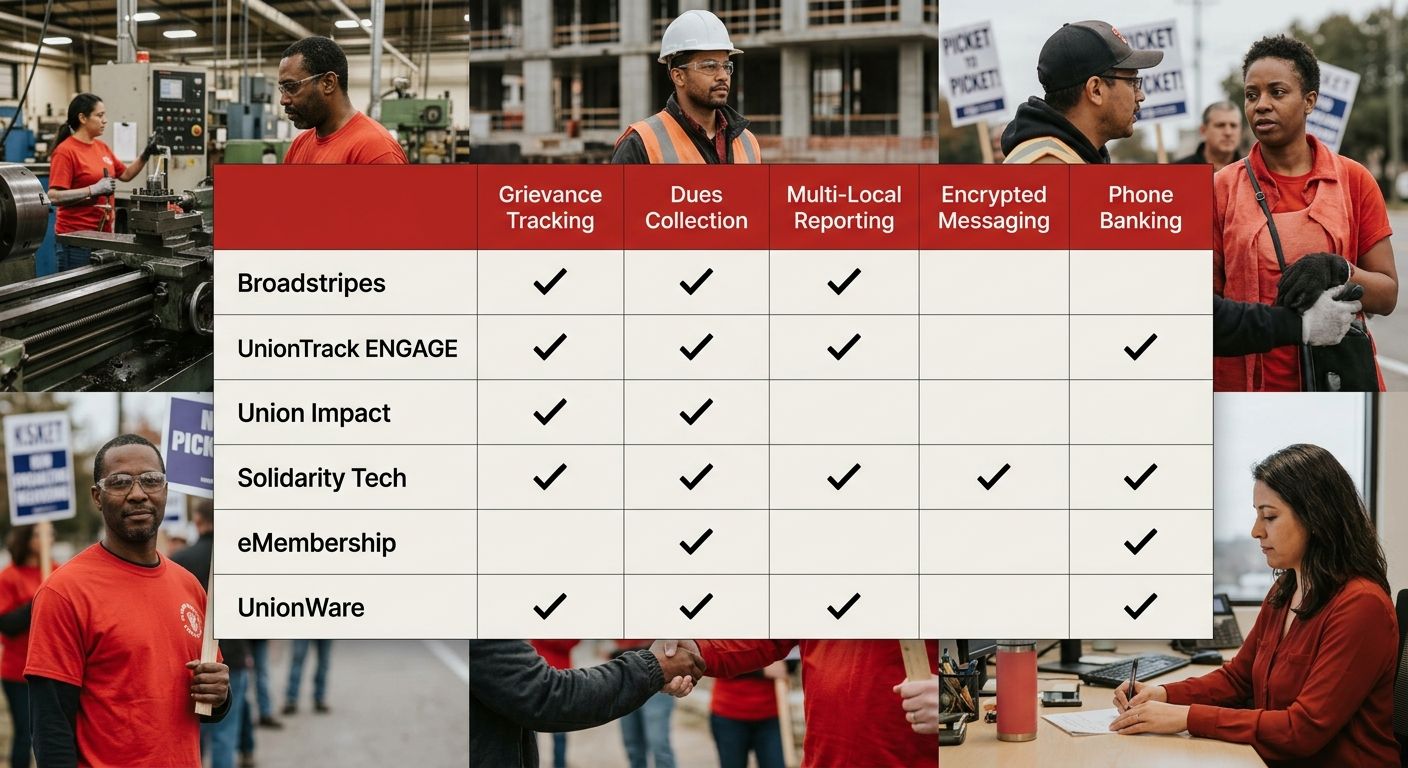
Broadstripes, which independent software directories describe as "the world's leading software platform for labor organizing," gives unions tools to track current and potential members, then reach them through online forms, text messages, email, and phone banks. A campaign with 500 contacts needs to know each worker's authorization status, shift pattern, department, and engagement level at a glance. Spreadsheets collapse under that weight.
UnionTrack ENGAGE combines member communications, dues collection, a grievance workflow builder, and organizing tools into a single application. The grievance workflow builder matters for campaigns approaching or past recognition, because it creates a documented paper trail that protects workers during NLRB proceedings.
Union Impact provides what its developers call "one connected operating system" for member records, dues, dispatch, grievances, files, reporting, websites, portals, and member communication. That's 10 distinct functions in a single platform, replacing the patchwork of 6 to 8 separate apps many locals currently run.
Solidarity Tech targets multi-local structures specifically. Its reporting system spans multiple chapters for national campaigns, and its comparison tools let organizers measure metrics across locals to identify what's working. For a national union running 15 simultaneous organizing drives, that cross-local visibility separates coordinated strategy from isolated guesswork.
One software evaluator with experience across both the U.S. and Canadian markets wrote in a published assessment that eMembership "stands head and shoulders above the competition" after reviewing options in both countries. A documented CUPE airport workers local case study showed how replacing legacy software with eMembership centralized members, dues, grievances, and bargaining unit reporting into one system, cutting the administrative burden that pulls organizers away from actual worker contact.
UnionWare rounds out the field with features for coordinating internal and external calls, emails, and SMS on a union-wide scale, plus built-in contact information verification that eliminates bounced emails during time-sensitive votes.
General Digital Tools and Where They Fall Short
Nearly every campaign uses general digital tools in some capacity. Zoom and Microsoft Teams run virtual meetings, webinars, and training sessions that make organizing accessible to members who can't attend in-person events. Virtual town halls and digital Q&A sessions give workers in remote locations a seat at the table. With over 90% of Americans owning smartphones and checking their devices 96 or more times per day, push notifications through any app reach workers faster than printed flyers or mailed newsletters.
But general tools carry 3 specific risks for organizing campaigns.
Data residency. Zoom recordings and Google Drive documents sit on corporate servers governed by terms of service that can change without notice. During an organizing campaign, an employer's legal team can subpoena communications stored on third-party platforms. Union-specific member engagement software typically stores data under agreements designed for labor organizations, with explicit prohibitions on sharing information with employers.
No organizing workflow. Google Forms can collect authorization card signatures digitally, but it can't route that data into a member database, trigger a follow-up text to a worker who hasn't responded in 7 days, or flag when a bargaining unit hits the 30% threshold required for an NLRB election petition. Every manual step between data collection and action is a place where campaigns lose momentum. The average path from first contact to a signed first contract already stretches across months of delay. Adding manual data transfer between disconnected apps extends that timeline further.
Fragmentation. Analytics and measurement tools capture 29% of planned technology investments across organizations, according to a 2025 Digital Bloom analysis of technology stacks. Content management systems attract 24%, and customer data platforms take 20%. Those numbers reveal a pattern: organizations spread their technology budgets across 5 to 8 categories of tools, creating integration headaches. Unions operating on tight budgets face the same fragmentation problem but with fewer IT staff to manage it.
Feature Comparison Across Platform Types
Feature | Union-Specific Software | General Digital Tools |
|---|---|---|
Member database with organizing status | Built-in across all 6+ platforms | Requires manual spreadsheet |
Grievance workflow tracking | Automated pipeline with documentation | No equivalent |
Dues collection and reporting | Integrated with member records | Separate payment processor needed |
Encrypted member communications | Purpose-built for labor data | Varies: Signal yes, Zoom partial |
Multi-local/chapter reporting | Solidarity Tech, eMembership, Union Impact | Manual consolidation required |
Phone banking | Broadstripes, UnionTrack | Third-party add-on needed |
Virtual meetings and webinars | Limited or via integration | Zoom, Teams (strong) |
Cost per local per month | $50-$500+ depending on unit size | Free to $20/user/month |
NLRB-ready documentation | Formatted for regulatory filings | Manual formatting required |
Authorization card tracking | Automated threshold alerts at 30%+ | Manual count |
The table shows why most campaigns need both categories. Union-specific software dominates in 7 of the 10 feature areas. General tools win on virtual meetings and sometimes on per-user cost for small shops. The practical answer for the majority of campaigns is a blended stack: one union-specific platform as the backbone, supplemented by Zoom or Teams for live gatherings and Signal for quick informal coordination.
How Blended Stacks Protect Workers in Practice
Building leadership density across your committee depends on knowing which workers are engaged, which are persuadable, and which face retaliation risk. That knowledge lives in your tech stack. A union-specific platform lets organizers tag each worker's engagement level from 1 to 5, log every conversation, and set automated reminders for follow-up contacts.
When CUPE's airport workers local switched from legacy software to eMembership, they consolidated 4 separate systems into 1. Grievance data that used to sit in filing cabinets became searchable. Dues records that required manual reconciliation synced automatically. Bargaining unit composition reports that took hours to compile generated in minutes.
That kind of consolidation has direct civil rights implications. When a worker files a grievance about discrimination or unsafe conditions, the speed and completeness of documentation affects whether the grievance survives arbitration. A platform that auto-timestamps every communication and stores every document in a structured database produces stronger evidence than a folder of screenshots from 3 different messaging apps.
Mobilize notes in their analysis of union technology options that advocacy software and volunteer management platforms built for mission-based organizations offer a middle path. These tools handle event coordination, volunteer scheduling, and mass communications better than generic business software, even though they lack grievance-specific features. For campaigns in early stages that haven't yet filed for recognition, these platforms can serve as a bridge before investing in full union management software.
Security Features That Matter During Active Campaigns
Worker privacy during an organizing drive is a civil rights issue under Section 8(a)(1) of the NLRA. Employer surveillance of union activity is illegal, but violations happen regularly. Your digital organizing tools comparison should start with security, not features.
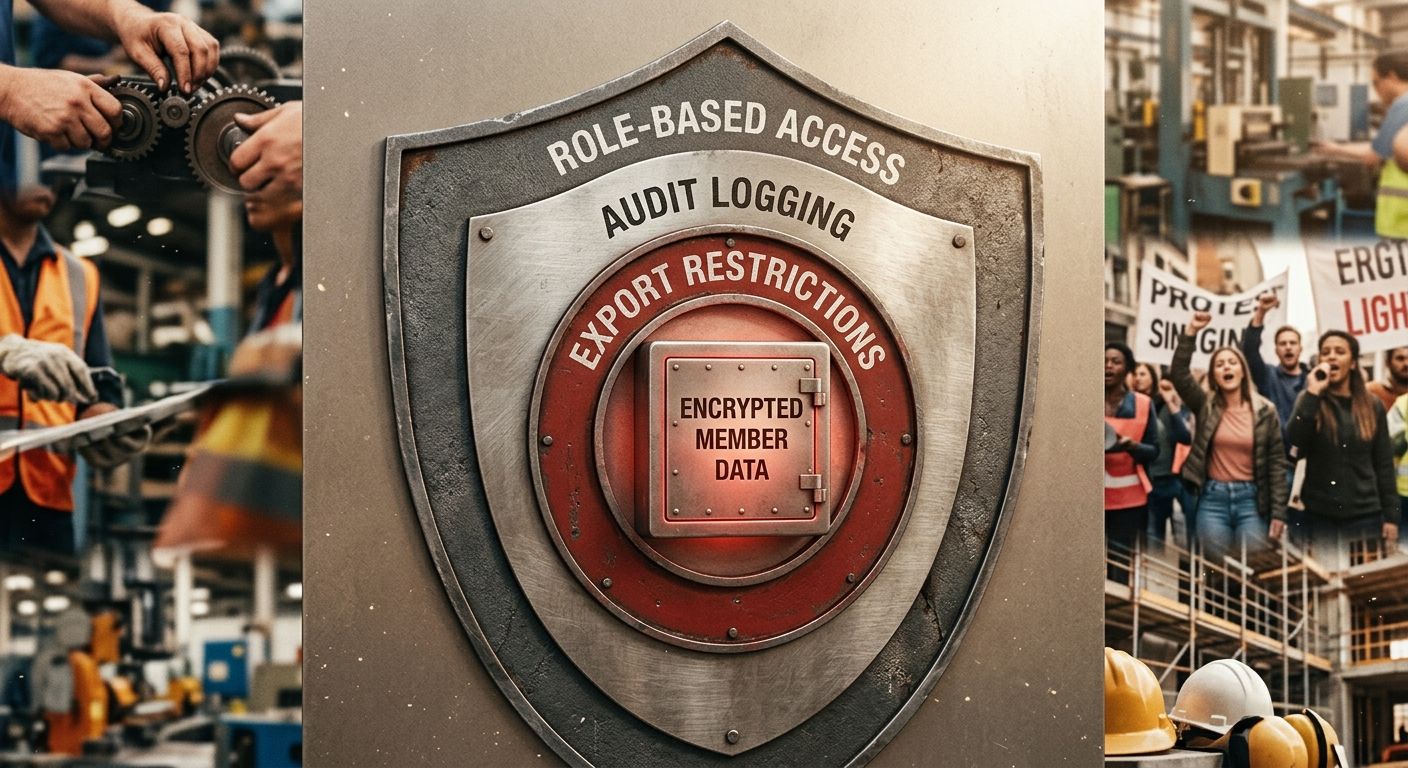
Union-specific platforms typically offer 4 security features that general tools lack: role-based access controls that limit which organizers see which worker records; audit logs that track every data access event; data export restrictions that prevent bulk downloading of member lists; and server agreements that prohibit data sharing with employers or third parties.
Compare that to a Google Sheets member tracker shared via a link. Anyone with the URL can access it. There's no access log that would hold up in an unfair labor practice hearing. And Google's terms of service grant broad rights to scan document content for service improvement purposes.
What Still Isn't Settled
Several open questions hang over the union technology landscape. No independent organization currently certifies union organizing software for data security the way SOC 2 certification covers enterprise platforms. Unions are left to evaluate vendor security claims on their own, often without dedicated IT staff to conduct meaningful audits.
Pricing transparency remains poor. Of the 6 major platforms we reviewed, only 2 publish pricing on their websites. The rest require sales calls, which creates a barrier for small locals with annual budgets under $50,000. A local with 200 members paying $30 per month in dues generates $72,000 per year in revenue. Spending $3,000 to $6,000 annually on software, roughly 4% to 8% of revenue, is a real tradeoff against strike funds, legal fees, and organizer salaries.
Interoperability between platforms barely exists. A local using Broadstripes for organizing and eMembership for post-recognition management faces a manual data migration with no standard data format connecting the two systems. Until the labor technology ecosystem develops common APIs or data standards, switching costs will keep locals locked into their first choice, whether that choice was good or bad.
The union tech stack conversation will keep evolving as more workers exercise their right to organize across new industries. What won't change is the underlying principle: the tools you choose shape the campaign you can run, the data you can protect, and the workers you can reach. Treat your technology decisions with the same seriousness you'd bring to selecting a labor attorney or drafting a bargaining proposal.
The Union Edge Staff
Related Articles

From Data Silos to Member Intelligence: Building a Union Organizing Database That Actually Drives Campaigns
The NLRB requires a 30% showing of interest before scheduling a union election, and organizers need 50% plus one vote to win. Those two numbers define every campaign's math.

Digital Member Systems and Union Data Security: What Organizers Need to Know Before Going Digital
Every union digital organizing platform stores names, addresses, phone numbers, employer information, and authorization signatures. A breach of that data hands management a complete map of your organizing committee. These six rules protect your members and your campaign.

The Privacy-First Organizing Playbook: How Unions Can Build Secure Digital Campaigns Without Compromising Security
Hospital and clinic networks run some of the most sophisticated internal surveillance systems of any employer in the country, and that infrastructure, originally justified by HIPAA compliance and patient safety, gives healthcare management an unusual capacity to monitor the very same digital channel
Also in the paper