
Beyond the Organizing Committee: Building Durable Worker Power Through Rank-and-File Leadership Development
Rank-and-file leadership development works through a three-stage pipeline: identification of organic workplace leaders, structured skills training in bargaining and grievance handling, and deployment into accountable union roles.

Beyond the Organizing Committee: Building Durable Worker Power Through Rank-and-File Leadership Development
Rank-and-file leadership development works through a three-stage pipeline: identification of organic workplace leaders, structured skills training in bargaining and grievance handling, and deployment into accountable union roles. The widespread assumption that winning an organizing campaign creates durable power is wrong. The pipeline built after the election win is what determines union sustainability.
The Misunderstanding That Kills New Locals
The organizing committee gets all the attention. It's the group that collects authorization cards, runs the campaign, and wins the NLRB election. Then, in too many cases, those same committee members burn out, leave, or get promoted, and the local collapses into passivity within 18 to 24 months. According to research compiled by Walden University, U.S. union membership has been declining at high rates for decades (Fiorito & Jarley, 2012; Sharma, 2012), and worker retention within existing locals is a core driver of that decline.
The mechanism that prevents this collapse is systematic rank-and-file leadership development. It's different from campaign organizing in three specific ways: it's ongoing rather than election-focused, it distributes authority across 10 to 15 members instead of concentrating it in 3 to 5, and it trains people for governance (running meetings, filing grievances, reading financials) rather than mobilization alone.
Think of it this way. The organizing committee is built for a sprint. The leadership pipeline is built for a decade.
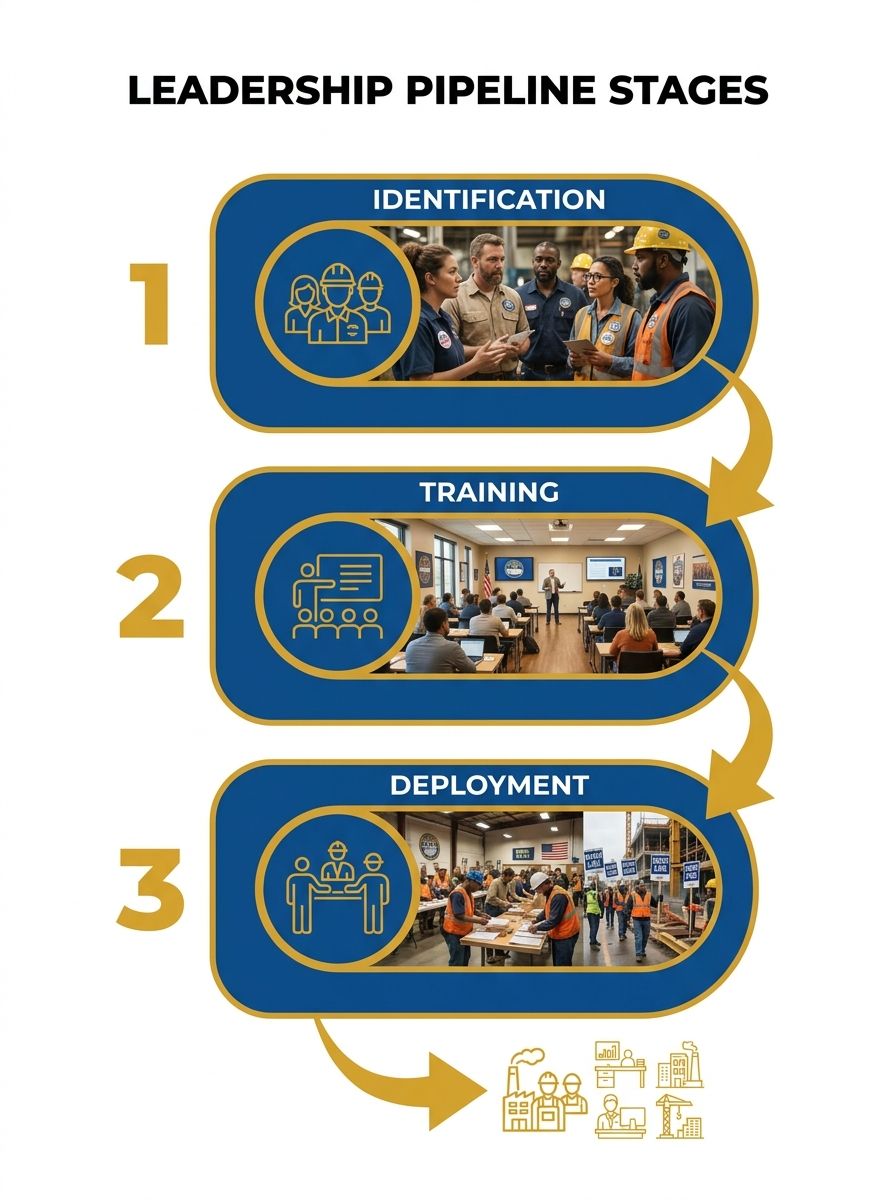
Stage One: Finding the Leaders Who Already Exist
Why does identification matter before training? Because unions that recruit volunteers based on enthusiasm alone end up with dedicated but isolated activists. The research on democratic unionism is clear: members should have the right to organize in independent committees and caucuses, publish rank-and-file newsletters, and run candidates for union office. The people who naturally do these things, before anyone asks them to, are your pipeline candidates.
Identification works through a method organizers call "workplace mapping." You chart every department, shift, and work area, then note who coworkers go to with problems, who speaks up in break rooms, and who other workers trust. These organic leaders aren't always the loudest voices. They're the ones whose opinions move groups of 5 to 10 coworkers at a time.
A useful framework for evaluating potential rank-and-file leaders scores candidates on three axes. Call it the OAR score: Organic influence (do coworkers already follow this person?), Availability (can they commit 3 to 5 hours per week?), and Resilience (have they handled management pressure without backing down?). Any single axis without the other two produces a weak leader. Someone with high organic influence but low resilience folds during the first contract fight. Someone with high resilience but no organic influence becomes a lone crusader nobody follows.
Good identification also means reaching across demographic lines. The Century Foundation's research on rebuilding worker power found that voters of color are 9.3% less likely to vote in districts without active union campaigns. The same pattern holds inside locals: when leadership pipelines don't actively identify leaders from every shift, every language group, and every department, whole sections of the membership disengage.
Stage Two: Structured Organizer Training Programs
Once you've identified 10 to 15 pipeline candidates in a local of 100 to 200 members, training has to be both rigorous and practical. Two institutional programs show how this works at scale.
The Rutgers University Union Leadership Academy requires participants to complete 6 courses to earn a certificate. Each course demands attendance at 5 of 6 class meetings. That structure, spread across months, is deliberate. It filters for commitment while building skills incrementally. Topics cover labor law, financial stewardship, grievance arbitration, and political action.
Cornell University's ILR School runs a parallel program focused on leadership in unions that works to "enrich leadership qualities of union officers, management, and rank and file in real-world situations." The emphasis on real-world application matters. Classroom theory without shop-floor practice produces articulate members who can't run a meeting or handle a hostile supervisor.
The United Electrical Workers (UE) has taken a more grassroots approach. Their education policy statement describes how "we have refocused our education program to empower rank-and-file leaders with trainings on the skills and knowledge needed to run their locals, regions, and national union, and to collectively fight the bosses and the politicians who support their interests." The UE model pushes training down to the local level rather than requiring members to travel to a university campus, which removes cost and access barriers for workers earning $15 to $25 per hour who can't take a week off.
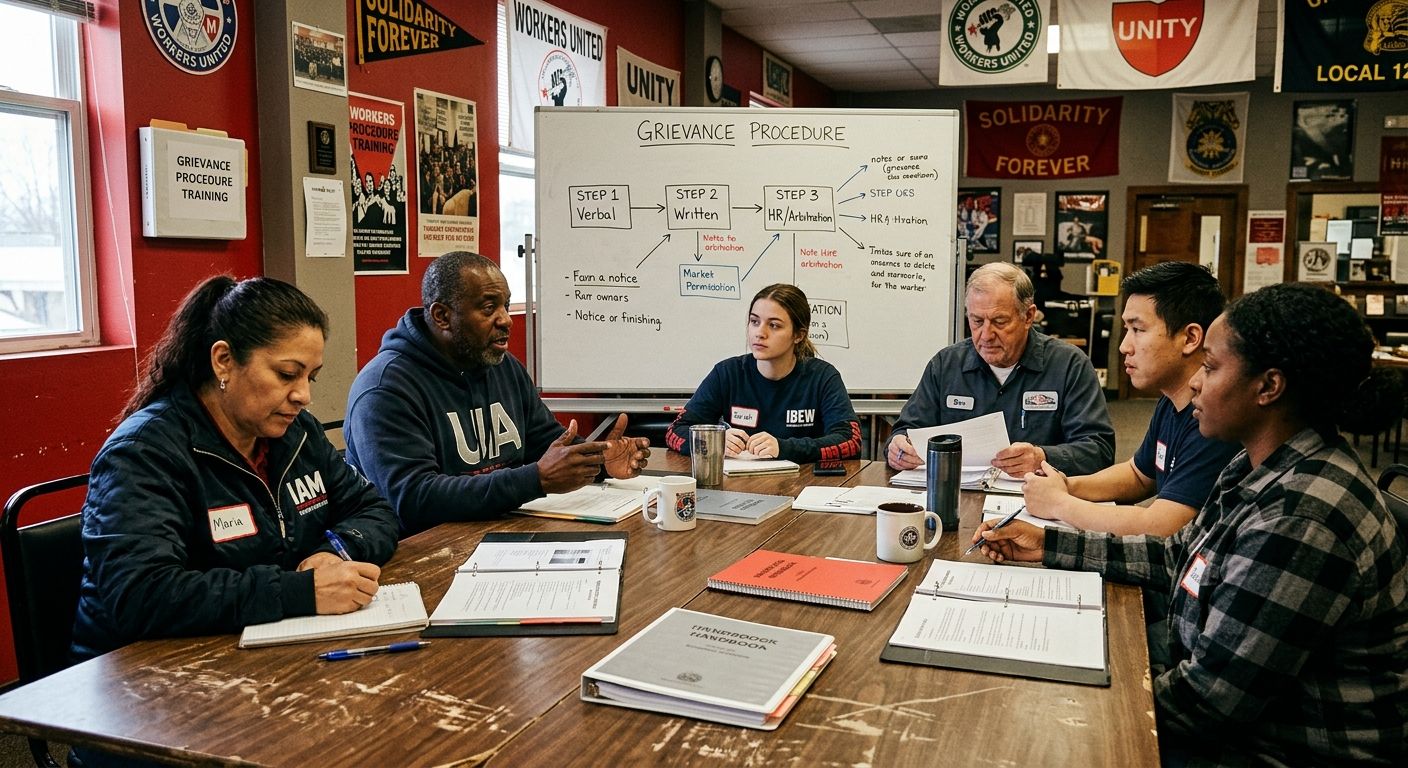
The best organizer training programs share four features: they run for at least 12 weeks (not a single weekend), they pair each trainee with a mentor who holds a current union role, they require trainees to handle at least 2 real grievances under supervision, and they assess competence through observed performance rather than written tests. Programs that hit all 4 benchmarks produce leaders who stay active for an average of 4 to 7 years. Programs that skip the mentorship or real-grievance components see most trainees drop out within 12 months.
Stage Three: Deployment Into Accountable Roles
Training without deployment is a hobby. The third stage of the pipeline places trained members into roles with real authority and real accountability: chief steward, bargaining committee member, safety committee chair, political action coordinator, financial secretary.
The key word is "accountable." Democratic unions, as described in the organizing model literature, "involve as many members as possible in all functions of the union." That means deployed leaders report back to members at monthly meetings, face election or re-election every 1 to 3 years, and can be recalled by membership vote. When you've seen examples of successful collective bargaining, the locals behind those wins almost always have 8 to 12 active stewards per 100 members, not the more typical 2 to 3.
Deployment also solves the single biggest threat to union sustainability: leadership turnover. When a local depends on 1 or 2 charismatic officers, retirement or job change creates a vacuum that management exploits within weeks. A pipeline local with 10 to 15 trained members can absorb the loss of any 3 to 4 leaders without losing institutional knowledge or bargaining capacity.
This connects directly to worker retention in the broader sense. Union workers have a 25% greater likelihood of obtaining employer-sponsored retirement plans and health insurance, according to research by Jones and Schmitt (2014) cited in the Walden University study. But those benefits only exist if the union survives long enough to negotiate and enforce them. Deployed leaders who understand the contract and can file grievances on benefit violations are the enforcement mechanism.
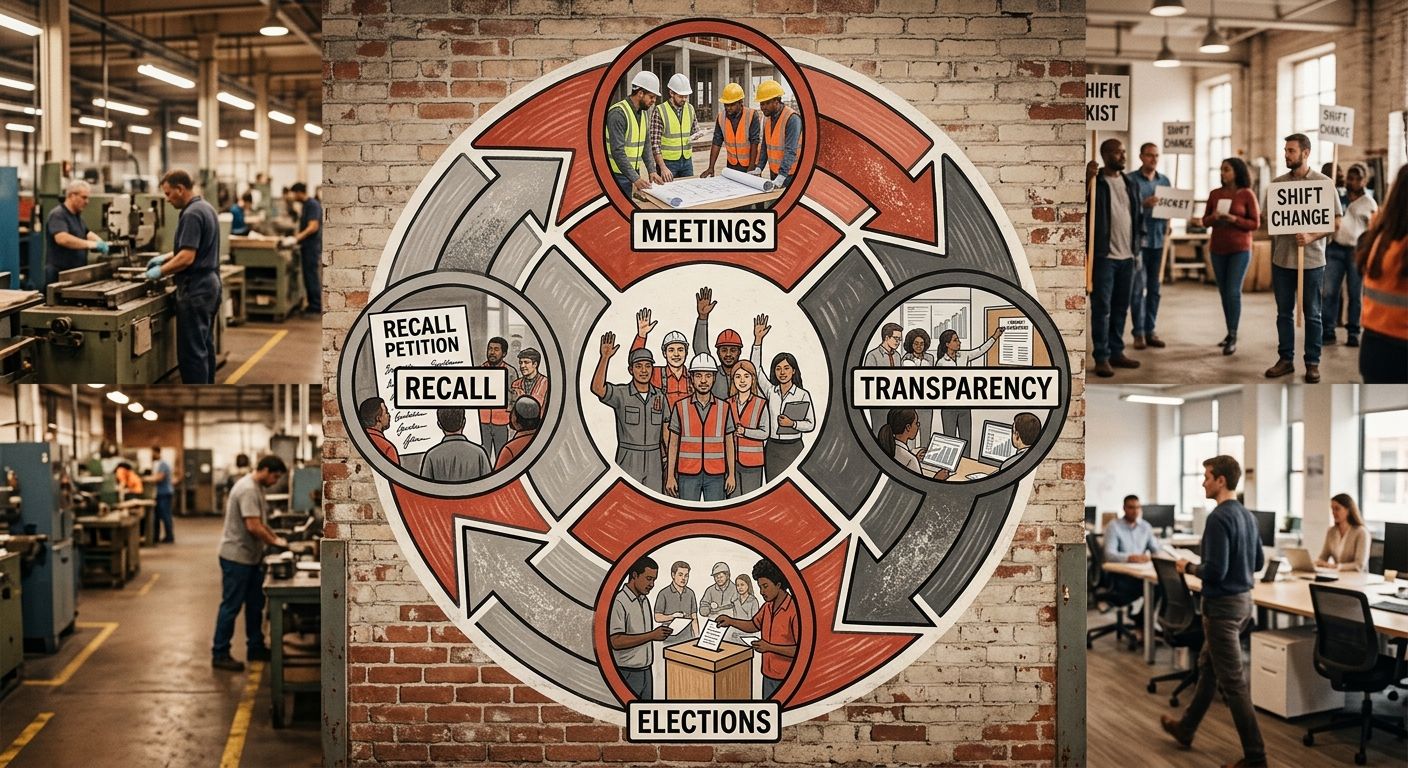
The Democratic Accountability Loop
Deployment without accountability creates a different problem: entrenched officers who stop listening to members. This is where the pipeline loops back on itself.
The Center for American Progress identifies 6 evidence-based policies that increase union membership, and several of them (workplace organizing access, dues transparency, sectoral bargaining structures) work precisely because they create accountability channels between leaders and members. When members see their dues producing results, and when they have democratic pathways to challenge leaders who aren't performing, retention rates climb.
The accountability loop has four moving parts: regular membership meetings (at least monthly, with quorum requirements of 10 to 15% of the local), financial transparency (quarterly reports to all members showing income, expenses, and strike fund balances), contested elections (at least 2 candidates for every officer position), and accessible recall procedures (requiring petition signatures from 25 to 30% of members). Locals that maintain all 4 parts see member participation rates of 35 to 45% at meetings. Locals missing 2 or more parts often see attendance drop below 10%.
This matters for how unions approach legislative battles and contract fights alike. Leaders who face regular accountability from their membership negotiate differently. They bring bigger committees to the table, they poll members before accepting proposals, and they don't settle for weak contracts that protect officer jobs while selling out rank-and-file interests.
How This Pipeline Connects to Broader Worker Power
The three-stage pipeline doesn't operate in isolation. Locals with strong rank-and-file leadership development programs also tend to engage more effectively in political action, community coalitions, and solidarity campaigns. The North Shore AFL-CIO's 2025 report described a year of "supporting new organizing, mobilizing in solidarity, winning elections, advancing pro-worker legislation, and celebrating union power." Those outcomes required hundreds of trained local leaders willing to show up for actions beyond their own workplace.
The history of the American labor movement is full of periods where top-down structures ossified and membership disengaged. The CIO's explosive growth in the 1930s came from rank-and-file leadership in auto plants, steel mills, and electrical factories. The stagnation of the 1950s and 1960s came when those same unions centralized authority and stopped developing new leaders.
Modern examples show the pattern repeating. Unions that have used social media as a bargaining pressure tool succeeded because they had dozens of trained worker-leaders who could speak to media, post content, and organize actions without waiting for instructions from a central office. The pipeline made that distributed action possible.
Where the Pipeline Breaks
The three-stage leadership pipeline fails in predictable ways, and understanding those failure points is as important as understanding the mechanism itself.
The first failure point is Stage One neglect. Locals that skip systematic identification and instead accept whoever volunteers end up with passionate but unrepresentative leadership. The pipeline produces officers who look and sound like each other, alienating members from other shifts, departments, or backgrounds.
The second failure is training without resources. Organizer training costs money: $500 to $2,000 per participant for a 12-week program, plus lost wages for attendees and mentor time. Locals that treat education as a luxury rather than a line-item budget category produce undertrained leaders who make costly mistakes at the bargaining table or in grievance hearings. Unions preparing for high-stakes actions should be building financial readiness that includes leadership development funds, not treating them as separate budget categories.
The third failure is deployment without accountability. When trained leaders take office and face no democratic checks, the pipeline produces a new generation of entrenched officers who resist the very development process that elevated them. They stop training replacements because replacements are potential challengers.
The fourth, and arguably most damaging, failure is treating the pipeline as a one-time project. Rank-and-file leadership development works only when it runs continuously, identifying new leaders every 6 to 12 months, cycling trainees through programs year after year, and rotating deployed leaders between roles. The locals that treat it as a 3-year initiative and then stop find themselves, 5 years later, in the same hollowed-out condition that prompted the initiative in the first place.
The pipeline is simple to describe and difficult to sustain. It requires dues money, volunteer hours, institutional patience, and a willingness among current leaders to train the people who might eventually replace them. Those aren't qualities that emerge on their own. They're qualities that rank-and-file members have to demand, and that democratic structures have to enforce, every single year the local exists.
The Union Edge Staff
Related Articles

The Organizing Committee Trap: Why Worker Committees Fail and How to Build Leadership Density That Actually Wins
Organizing committees at VW Chattanooga failed twice before the plant's 2024 election finally succeeded. The difference was structural: the winning campaign built trained leadership at a ratio of one worker-leader for every twenty-five employees, covering 90 percent of the plant by election day.

The Organizing Committee's Hidden Liability: Why Inadequate Worker Education Becomes Your Weakest Link
The AFL-CIO's Organizing Institute trains participants to have one-on-one organizing conversations, chart workplace leaders, and run mini-campaigns around live issues.

From Recognition to Results: The Post-Election Bargaining Roadmap Unions Get Wrong
Forty-four percent of newly certified unions between 1999 and 2004 never reached a first contract, according to a study of more than 8,000 successful elections by sociologist John-Paul Ferguson. The election was the easy part.
Also in the paper