
The Privacy-First Organizing Playbook: How Unions Can Build Secure Digital Campaigns Without Compromising Security
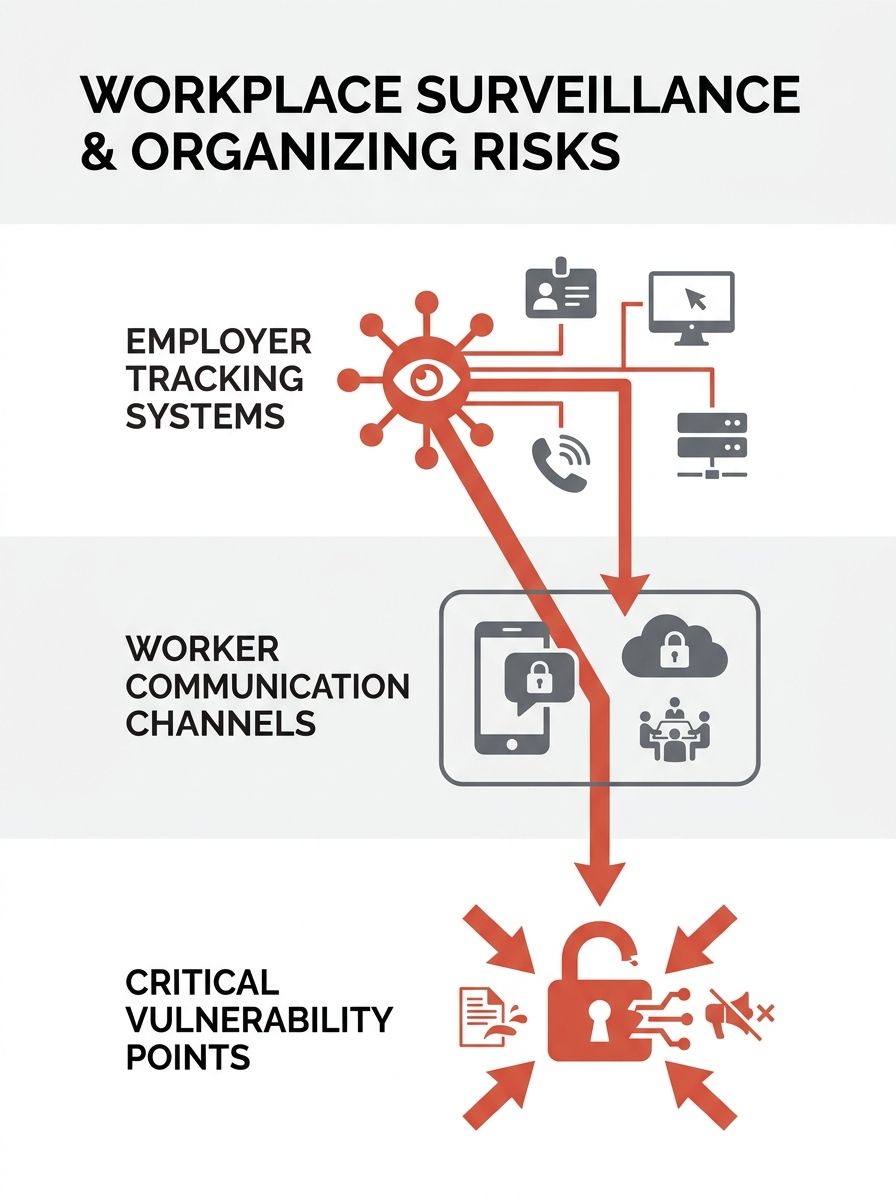
Hospital and clinic networks run some of the most sophisticated internal surveillance systems of any employer in the country, and that infrastructure, originally justified by HIPAA compliance and patient safety, gives healthcare management an unusual capacity to monitor the very same digital channel

The Privacy-First Organizing Playbook: How Unions Can Build Secure Digital Campaigns Without Compromising Member Confidentiality
Hospital and clinic networks run some of the most sophisticated internal surveillance systems of any employer in the country, and that infrastructure, originally justified by HIPAA compliance and patient safety, gives healthcare management an unusual capacity to monitor the very same digital channels workers use to organize. Every unencrypted text message about a union meeting, every email thread discussing grievances on a hospital server, every spreadsheet of supporter names stored on a personal laptop connected to facility Wi-Fi represents a potential exposure point that anti-union consultants know how to exploit.
That reality makes union organizing security a front-line concern for any healthcare campaign, not a back-office IT question. When an employer can plausibly claim it scanned internal communications for "regulatory compliance" and happened to discover organizing activity, the legal gray zone is wide enough to drive a bus-sized retaliation campaign through. Workers need digital organizing infrastructure that keeps their conversations, their supporter lists, and their strategic plans entirely outside the employer's reach.
Why Healthcare Organizing Faces Elevated Surveillance Risk
Healthcare employers sit at the intersection of two forces that magnify digital risk for organizers. The first is the sheer volume of monitoring they already conduct. Hospitals track badge swipes, log keystrokes on clinical workstations, record calls through their phone systems, and analyze network traffic for unauthorized data transfers. All of this monitoring exists for legitimate patient-protection reasons. But once an organizing campaign begins, the same systems become a surveillance toolkit.
The second force is money. The American Hospital Association reports that U.S. hospitals and health systems employ roughly 6.4 million people. Unionization in healthcare has been climbing steadily, and employer opposition budgets have grown to match. Anti-union law firms specializing in healthcare routinely advise clients to monitor employee communication patterns for early signs of organizing, focusing on sudden spikes in group messaging or unfamiliar apps appearing on facility networks.
Together, these forces create an environment where data privacy in campaigns is existential. A leaked supporter list in a retail organizing drive is damaging. A leaked supporter list in a hospital, where the employer controls scheduling, shift assignments, and performance evaluations tied to patient outcomes, can destroy a campaign in days.
Encrypted Organizing Platforms and What to Look For
The good news: the tools to protect organizing communications have improved dramatically. The bad news: choosing the wrong tool creates a false sense of security that's worse than having no tool at all.
End-to-end encryption is the baseline requirement. This means messages are encrypted on the sender's device and only decrypted on the recipient's device. The platform operator itself can't read the content. Signal remains the standard for one-to-one and small group conversations. For larger campaign coordination, platforms purpose-built for labor organizing offer end-to-end encryption alongside features like petition tracking, event management, and member databases.
When evaluating encrypted organizing platforms, organizers should look for several specific features:
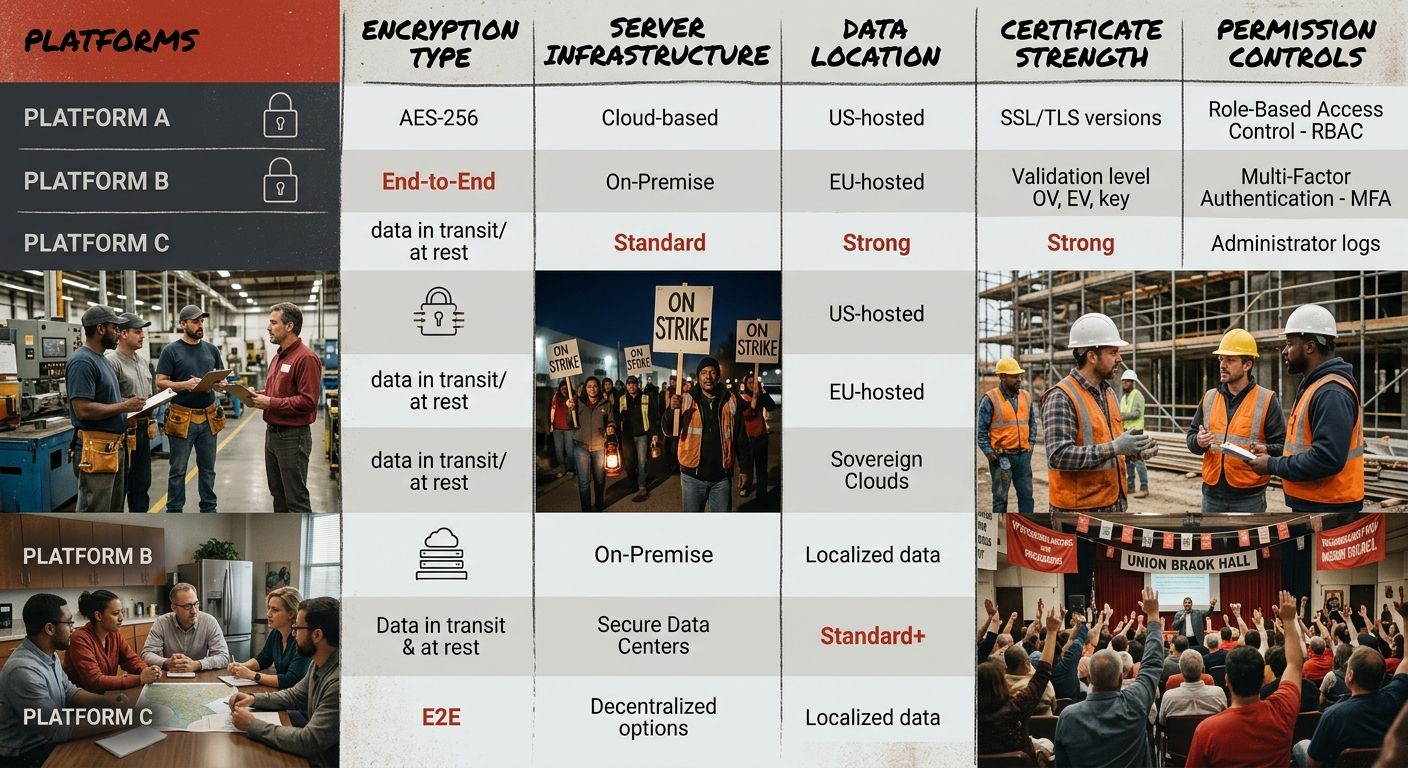
Encryption at rest and in transit. Your data should be encrypted both while it's being sent and while it's sitting on a server. As Union Impact's security documentation notes, every piece of sensitive data—dues transactions, grievance records, internal messages—should be encrypted using industry-standard protocols at both stages.
Dedicated server infrastructure. Shared hosting environments mean your organizing data sits on the same physical hardware as other organizations' data. Dedicated servers eliminate that co-mingling risk.
Data sovereignty guarantees. Know where your data is physically stored. U.S.-based campaigns should confirm that servers are located within the United States, subject to U.S. legal protections. Canadian campaigns need data hosted in Canadian data centers to comply with provincial privacy laws.
HTTPS with 2048-bit TLS certificates. This is the encryption standard for data in transit between your browser and the platform. Anything less than 2048-bit is outdated.
Granular user permissions. Different committee members need different levels of access. A shop steward collecting authorization cards doesn't need access to the full campaign strategy database.
Campaigns looking for multipurpose digital organizing suites with secure performance should also evaluate tools like Impactive, which offers peer-to-peer texting, phone banking, and event management with built-in security features. NGP VAN provides labor-specific software with compliance tools, audit trails, and flexible user permissions.
The Seven Protocols Every Healthcare Organizing Committee Needs
Technology alone won't protect a campaign. The most common security failures we've seen come from human behavior, not software vulnerabilities. An organizer with Signal on their phone who also discusses campaign strategy in a Facebook Messenger group has undermined the entire security architecture.
These seven protocols form the core of digital organizing best practices for healthcare campaigns:
1. Separate devices for organizing. Ideally, organizers should use a personal phone or tablet that never connects to facility Wi-Fi for all campaign communications. If a separate device isn't feasible, a dedicated secure messaging app that the employer's IT department can't access through mobile device management software is the minimum.
2. No organizing activity on employer systems. This means no emails from hospital accounts, no documents stored on employer-issued laptops, no conversations on hospital phone lines. The National Labor Relations Act protects organizing activity, but Section 7 protections don't override an employer's ability to enforce policies about using its own equipment.
3. Encrypted contact lists stored off-site. Supporter lists, authorization card records, and committee contact information should live on encrypted platforms, never in a personal email account, a Google Sheet, or a paper list left in a locker. If your campaign is building toward the 30% authorization card threshold, protecting the names of early signers is critical because those workers are the most vulnerable to targeted retaliation before an election is secured.
4. Regular security training for committee members. We've written about why inadequate worker education becomes a campaign's weakest link, and that principle applies with extra force to digital security. Every person added to the organizing committee should receive a 30-minute training on which platforms to use, which to avoid, and what to do if they suspect their communications have been compromised.
5. Two-factor authentication on everything. Every account associated with the campaign—email, cloud storage, organizing platforms, social media—should require a second verification step beyond a password. Authenticator apps are preferable to SMS codes, which can be intercepted through SIM-swapping attacks.
6. Disappearing message defaults for sensitive conversations. Signal and several other platforms allow you to set messages to auto-delete after a specified period. For strategic discussions about campaign timing, employer vulnerabilities, or worker concerns shared in confidence, 24-hour message expiration prevents archived conversations from becoming a liability.
7. An incident response plan. Before a breach happens, the committee should know exactly who to contact, what steps to take, and how to notify affected workers. The UC Berkeley Labor Center's model language recommends that unions and employers each designate a Point of Contact for data security matters, with the employer required to promptly notify the union's POC of any breach regardless of the data's origin.
Bargaining for Data Privacy Protections After You Win
Security during an organizing campaign is essential. But the need for member confidentiality doesn't end when a union wins recognition. If anything, it intensifies. A ratified collective bargaining agreement should include explicit data privacy provisions that govern how the employer collects, stores, shares, and deletes employee data.
The UC Berkeley Labor Center has documented model contract language that we recommend adapting for healthcare settings. Key provisions to negotiate include:
Quarterly joint meetings between union and employer data security contacts to review privacy practices and address emerging risks
Mandatory breach notification requirements with specific timelines (48 hours is the standard we recommend)
Limits on employer use of electronic monitoring data for disciplinary purposes
Worker consent requirements before any biometric data collection (fingerprint scanners, facial recognition for timekeeping)
Data retention limits that require the employer to delete personal information within a defined period after an employee's departure
Healthcare workers face a unique wrinkle here: employers often argue that patient safety requires extensive employee monitoring. Strong contract language should distinguish between monitoring that serves genuine patient safety purposes and monitoring that functions as workplace surveillance. The line matters, and it should be drawn in writing.
If your campaign reaches the bargaining table, this is one area where building a workplace-specific contract with precise data privacy terms pays dividends for years.
Lessons from Recent Healthcare and Tech Organizing Campaigns
The healthcare sector can learn from how tech workers have approached digital security in their own organizing efforts. When Google DeepMind employees in London organized over military AI contracts, they did so knowing their employer had among the world's most capable surveillance and data analysis systems. The protocols those workers developed—using personal devices exclusively, compartmentalizing information so no single person held the complete strategic picture, and conducting sensitive conversations in person rather than digitally—translate directly to hospital and clinic settings. You can read more about how tech workers approached their organizing challenges and what healthcare organizers can borrow from that playbook.
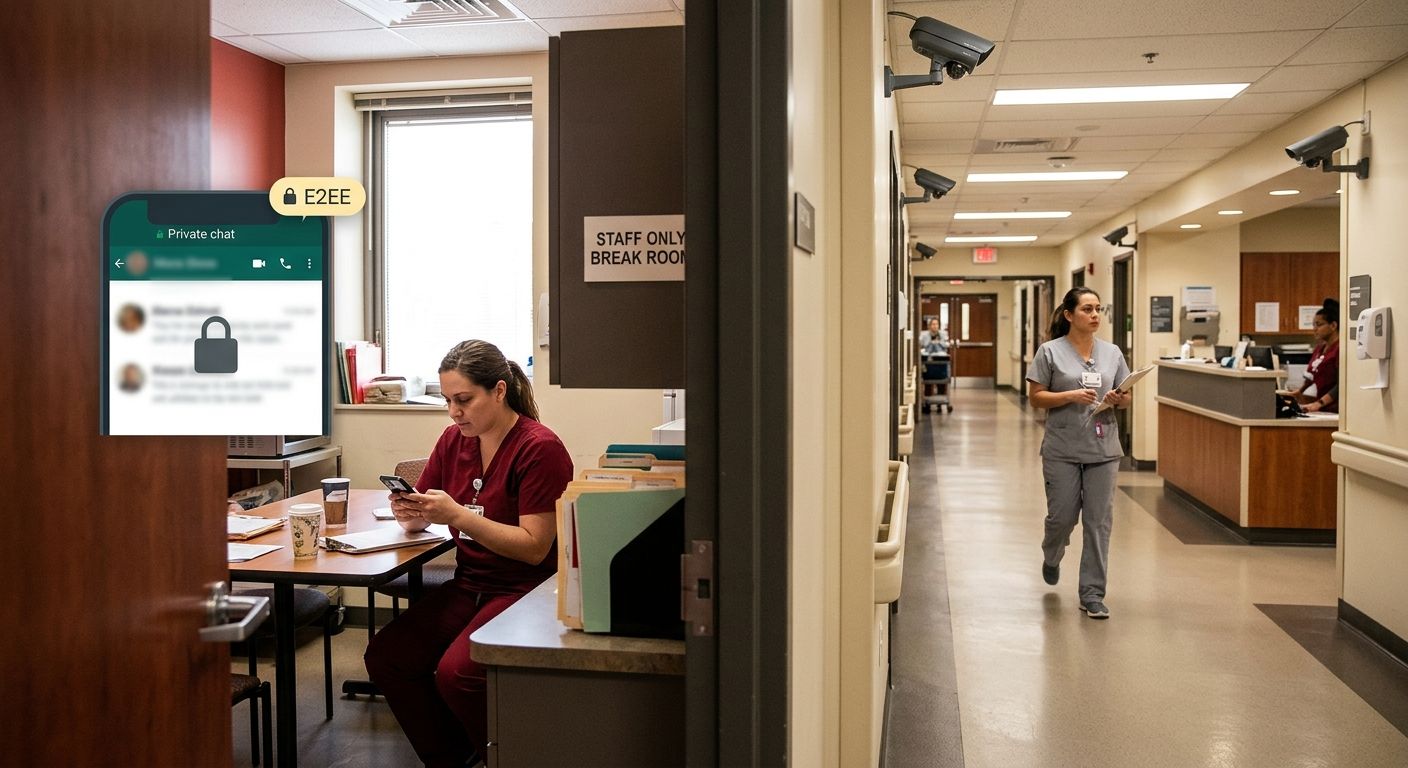
Similarly, campaigns building a digital-first organizing strategy need to treat platform selection as a security decision, not a convenience decision. The platform that's easiest to use is often the one with the weakest privacy protections. WhatsApp, for example, offers end-to-end encryption for messages but collects extensive metadata about who contacts whom, when, and how often. For an employer hiring a union avoidance firm that specializes in social network analysis, that metadata alone can map an entire organizing committee.
Common Mistakes That Compromise Campaigns
Three patterns show up repeatedly in campaigns that suffer security failures:
Mixing personal and organizing communications. When organizers use the same group chat for shift-swap requests and campaign strategy, one screenshot from a hostile coworker can expose everything. Maintain strict separation between social communication channels and organizing channels.
Over-centralizing data access. If one person's phone or laptop holds the complete supporter database, the entire campaign is one lost device away from exposure. Distribute access through a secure platform with role-based permissions, and ensure that no single device contains the full picture.
Failing to update security practices as campaigns scale. The protocols that work for a five-person organizing committee break down when the campaign grows to fifty active supporters. Security practices need to scale with the campaign. What starts as a single Signal group should evolve into a tiered communication structure with different channels for different levels of sensitivity.
What Still Isn't Settled
Several questions remain genuinely unresolved in the intersection of digital privacy and labor organizing, and we think it's important to name them rather than pretend the playbook is complete.
The NLRB has not issued definitive guidance on whether employer monitoring of employee communications on personal devices connected to workplace Wi-Fi constitutes unlawful surveillance of protected concerted activity under Section 8(a)(1) of the National Labor Relations Act. Several unfair labor practice charges touching on this question are pending, but no clear standard exists yet. Until one does, the safest approach is to keep organizing communications off employer networks entirely.
State-level biometric privacy laws, led by Illinois' Biometric Information Privacy Act, are creating a patchwork of protections that complicate multi-state healthcare campaigns. A hospital system operating in twelve states may face twelve different legal frameworks governing fingerprint scans, facial recognition, and other biometric data. Unions bargaining data privacy protections need to account for this fragmentation.
And the rise of AI-powered communication analysis tools has outpaced legal frameworks. Employers can now purchase software that analyzes communication patterns, sentiment, and network relationships within their organizations to predict organizing activity before a single authorization card is signed. Whether the use of such tools constitutes illegal surveillance is a question that labor law hasn't caught up to.
What we can say with confidence: the campaigns that treat digital security as a core organizing discipline from day one consistently outperform those that treat it as an afterthought. The technology to protect worker communications exists and is accessible even to campaigns with limited budgets. The gap isn't in the tools available. It's in the training and discipline required to use them consistently, every day, across every member of the organizing committee.
The Union Edge Staff
Related Articles

Digital Member Systems and Union Data Security: What Organizers Need to Know Before Going Digital
Every union digital organizing platform stores names, addresses, phone numbers, employer information, and authorization signatures. A breach of that data hands management a complete map of your organizing committee. These six rules protect your members and your campaign.

Leadership Density Over Card Counts: Why Union Authorization Metrics Fail and What Actually Predicts Organizing Success
Authorization cards measure interest, not resilience.

Union Organizing Software vs. Digital Organizing Tools: Choosing the Right Tech Stack for Your Campaign
Union organizing software and general digital organizing tools serve fundamentally different purposes, and picking the wrong one can expose worker data, slow your campaign timeline, and fracture member engagement.
Also in the paper