
From Data Silos to Member Intelligence: Building a Union Organizing Database That Actually Drives Campaigns
The NLRB requires a 30% showing of interest before scheduling a union election, and organizers need 50% plus one vote to win. Those two numbers define every campaign's math.

From Data Silos to Member Intelligence: Building a Union Organizing Database That Actually Drives Campaigns
The NLRB requires a 30% showing of interest before scheduling a union election, and organizers need 50% plus one vote to win. Those two numbers define every campaign's math. The databases most unions use to track that math were designed to manage dues records, not to predict which workers will vote yes or identify which shop-floor leaders can move 12 coworkers in a single conversation.
The Single-Technician Bottleneck
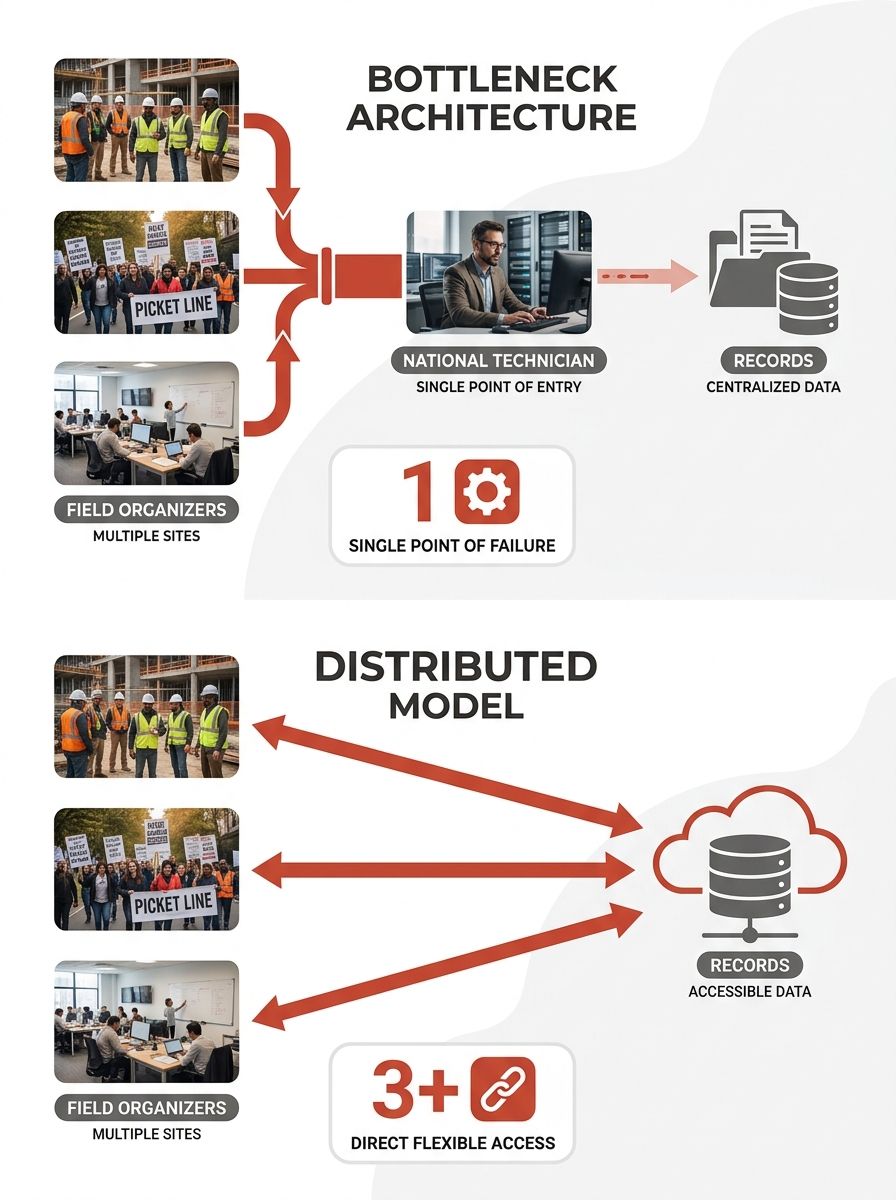
A Cornell University study on data practices inside labor organizations, published at the ACM CHI 2020 conference, documented a pattern that still defines most union data operations. One organizer described the situation this way: "There was a guy who was national level [data technician]. Normally what would happen is that anything that had to be bulk uploaded or any changes to the data architecture, I would be consulted, most of the time." Every data request, every structural change, every bulk upload ran through one person at the national level.
That architecture has consequences. When a single technician controls all changes to data structure, field organizers wait days or weeks for updates to contact records. During a 42-day NLRB election window, those delays eat into the time organizers need for one-on-one conversations. A database that requires a specialist to modify becomes a bottleneck at the exact moment speed matters most.
The Cornell researchers found that this wasn't a technology problem. It was a power-distribution problem. Data architecture decisions mirrored the union's organizational hierarchy, concentrating control at the top while the people who needed the data most, field organizers, had the least ability to shape how it was structured. When we talk about union member database design, this governance question matters as much as any software feature.
Why CRM Software Doesn't Solve an Organizing Problem
UnionWare's documentation draws a useful distinction between 3 types of systems: a Customer Relationship Management (CRM) system that tracks stakeholder interactions, an Association Management System (AMS) that handles membership and events, and a Union Management System (UMS) built specifically for labor organizations. Most unions that try to build organizing campaign data architecture end up jamming campaign data into tools designed for one of the first 2 categories.
The mismatch shows up in the data fields. A CRM stores a contact's name, email, phone number, and interaction history. A union organizing database needs to track at least 7 additional data points: workplace location, shift assignment, department, relationship map (who influences whom), assessment score (a 1-to-5 scale of support), issues that matter to the individual worker, and whether that worker has taken a public action like signing a card or attending a meeting.
Solidarity Tech's platform defines a contact as "any person stored in your union's database, such as members, supporters, volunteers, or potential recruits," with fields for "names, phone numbers, email addresses, and engagement history." That's a solid starting layer. But engagement history alone doesn't capture the relational intelligence that wins elections. The question of which metrics actually predict organizing success depends on tracking leadership density, not just raw card counts.
The Three-Layer Member Intelligence Model
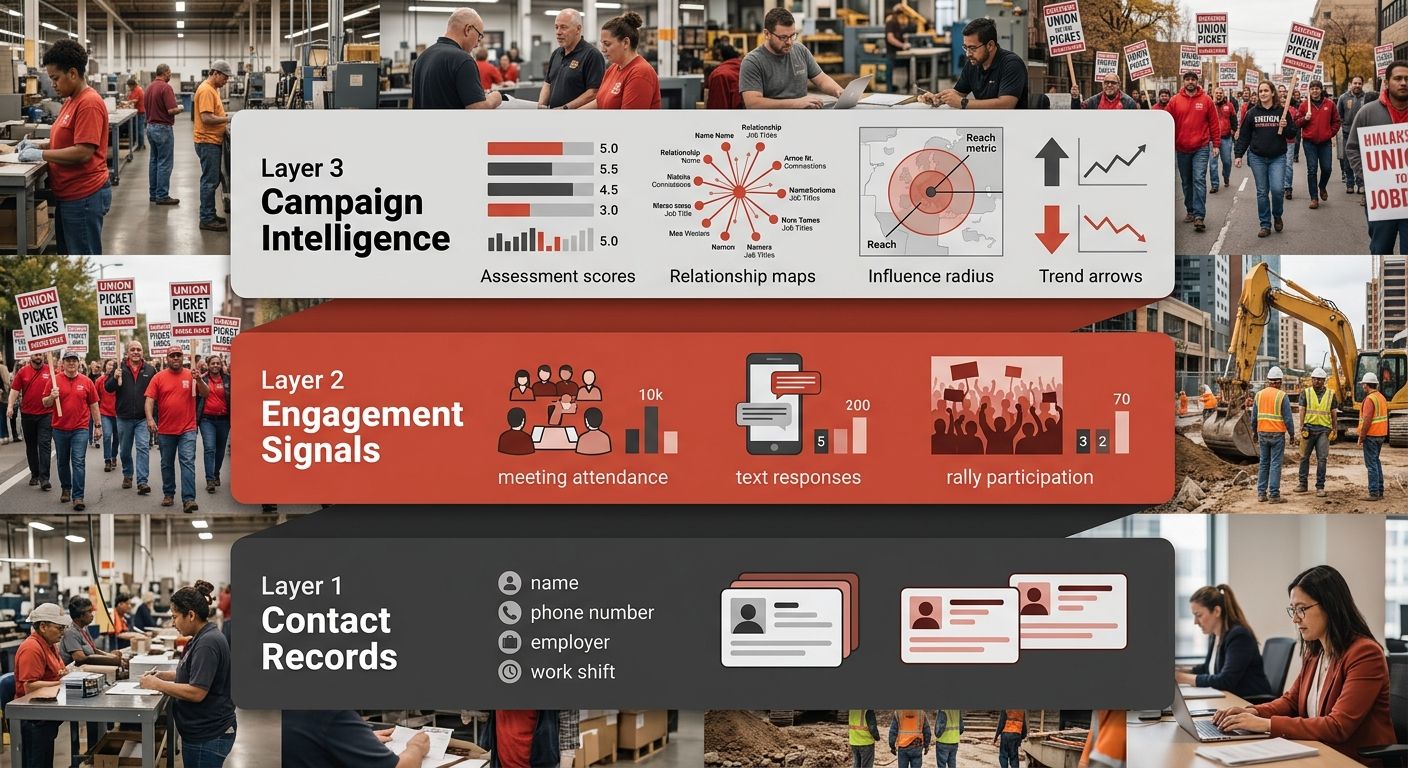
Effective organizing campaign data architecture breaks into 3 distinct layers, each serving different users at different stages of a campaign. We call this the Three-Layer Member Intelligence Model: Contact, Engagement, and Intelligence.
Layer 1: Contact Records. This is the foundation. Name, phone, email, address, employer, worksite, department, shift, job title, hire date. Every union platform handles this. Union Impact's member management system tracks "every member record in one place," including info, history, and communications. UnionTrack's Engage platform claims to let unions "use the same profile across Union Membership, Training and Organizing-related activities," which means a single worker record follows that person from first contact through bargaining. At this layer, the target is 100% coverage of every worker in a bargaining unit, with 0 duplicate records.
Layer 2: Engagement Signals. This layer answers the question: what has this person done? It tracks meeting attendance, rally participation, text message responses, petition signatures, social media shares, phone banking shifts, and door-knocking hours. Broadstripes, a membership management platform for unions, was built to "track events, send texts, and share campaign data in the cloud." The signal layer matters because organizing metrics require frequency data, not just yes/no flags. A worker who attended 4 of 5 meetings tells you something different from someone who came once and disappeared.
Layer 3: Campaign Intelligence. This is where member lifetime value tracking happens. Intelligence combines Layer 1 and Layer 2 data with organizer assessments, relationship maps, and predictive scores. How many coworkers can this person influence? What's their assessment score today versus 3 weeks ago? Have they moved from "undecided" to "yes" after a specific conversation? This layer turns a database into a campaign intelligence system.
Comparing Platforms Built for Union Organizing
The market for union-specific digital organizing tools includes at least 5 platforms designed for labor organizations. Each handles the 3 layers differently.
Platform | Contact Management | Engagement Tracking | Grievance Tools | Communication Channels | Mapping/Visual Reports |
|---|---|---|---|---|---|
Solidarity Tech | Full contact profiles with engagement history | Organizing activity tracking | Not primary focus | Built-in messaging | Campaign dashboards |
Broadstripes | Member records in cloud | Event tracking, text tracking | Limited | Text and email | Cloud-based data sharing |
UnionTrack Engage | Unified profiles across membership, training, organizing | Activity and case tracking | Full grievance workflow with deadline alerts | Email, text, polls, surveys | Standard reporting |
UnionWare | UMS-specific member records | Event and activity logs | Integrated | Multi-channel | Visual reporting and mapping |
Union Impact | Centralized member records | Communication history | Not highlighted | Targeted text and email | Standard |
The meaningful differences sit in Layers 2 and 3. UnionTrack's grievance tracking, which promises to "track all case activity, consolidate case notes, communications, and documents, with alerts for each step," addresses a contract-enforcement need that matters after you've won an election. Broadstripes and Solidarity Tech lean toward the organizing side, where engagement tracking and campaign data sharing carry more weight during the 30-to-50-day sprint before a vote.
Member Lifetime Value Tracking as a Civil Rights Practice
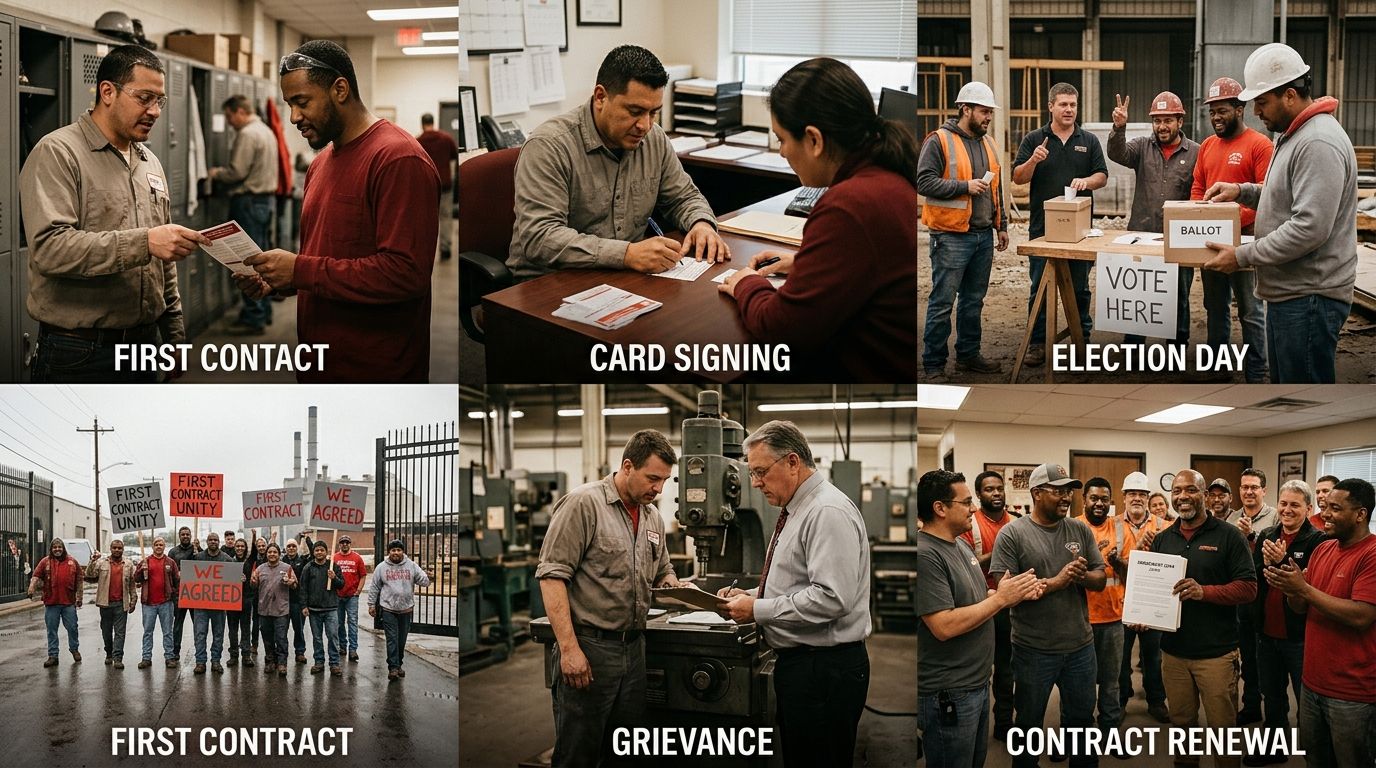
Member lifetime value tracking borrows language from the corporate world, but the concept carries specific meaning for labor organizations. When a worker signs a card, that's the start of a relationship, not a transaction. Tracking that relationship over time (from first contact through election, first contract negotiation, grievance filing, steward training, and contract renewal) reveals which organizing practices produce lasting union density and which produce short-term wins that collapse at the first contract stage.
The civil rights dimension is direct. Workers who organize face retaliation in approximately 41.5% of NLRB election campaigns, according to data compiled by the Economic Policy Institute. A campaign intelligence system that tracks employer behavior patterns alongside worker engagement can document unfair labor practices in real time. When an employer fires 3 union supporters from the same department within 2 weeks of a card-signing drive, the pattern should surface automatically, not through a steward's memory.
This kind of tracking also protects against discrimination within organizing efforts. If your engagement data shows that outreach consistently misses night-shift workers, non-English-speaking members, or workers at satellite locations, you've identified a civil rights gap in your own campaign. The remedy is architectural: build the database so that every shift and every language group gets tracked as a distinct segment with its own engagement metrics.
Real-Time Labor Market Data and Organizing Targets
Gartner's 2026 reviews of labor market intelligence software describe tools that "access real-time labor market information, analyze talent availability, and evaluate workforce composition across various industries and geographies." That capability was built for employers. Unions can use the same data in reverse.
Real-time labor market intelligence tools now aggregate job listings from over 35,000 sources, according to research funded by the Lumina Foundation. When a nonunion employer in your sector posts 200 open positions in 3 months, that's a signal of high turnover. High turnover correlates with worker dissatisfaction. Worker dissatisfaction is where organizing campaigns begin.
Pairing internal organizing metrics (assessment scores, engagement rates, leadership density) with external labor market data (turnover rates, wage benchmarks, job posting volume) creates a targeting system. Unions can prioritize worksites where conditions most favor an organizing win, directing limited staff and budget toward the 10 targets with the highest probability of success rather than spreading across 40.
Labor force metrics tracked by the Bureau of Labor Statistics include employment levels, unemployment rates, labor force participation, turnover rates, average hours, and average earnings. Each of those 6 metrics maps to a question organizers should ask: Are workers at this site earning below area median? Is turnover above 25%? Are average weekly hours exceeding 44? The answers help build a leadership density strategy grounded in data rather than guesswork.
Data Security and Worker Protection
Every contact record in a union organizing database represents a worker who has exercised a federal right under NLRA Section 7. A database breach doesn't expose customer preferences. It exposes workers to potential retaliation, discipline, or termination. The security architecture of organizing campaign data systems carries civil rights weight that typical CRM platforms weren't designed to bear.
At minimum, a union member database design should enforce role-based access controls (limiting which staff can see assessment scores and relationship maps), end-to-end encryption for all communications stored in the system, automatic data deletion policies for workers who withdraw from organizing, and audit logs that track every access event. These 4 requirements go beyond standard software security because the stakes for the people in the database are higher.
Questions These Systems Still Can't Answer
The tools exist. The frameworks make sense on paper. But organizing campaign data architecture still has blind spots that no platform has solved.
Can a database capture trust? Assessment scores try to quantify a worker's level of support on a 1-to-5 scale, but trust between an organizer and a worker resists reduction to a number. The Cornell researchers found that data practices inside unions often reflected institutional priorities rather than organizing realities. A database can tell you that a worker attended 6 meetings. It can't tell you whether that worker will stand up in front of 200 coworkers and speak.
Can metrics replace relationships? Every number in this article points toward the same conclusion: data helps organizers make better decisions about where to spend their time. But the conversation at the kitchen table, the 45-minute phone call after a bad shift, the handshake on the picket line, those are the moments that move workers from "maybe" to "yes." No database records them with the fidelity they deserve.
And can unions afford the infrastructure? The platforms listed above charge per-seat or per-member fees. A local with 200 members and a $15,000 annual budget faces different constraints than an international with 500,000 members and a dedicated IT department. The data architecture that works for SEIU won't scale down to a newly formed independent union at a 30-person coffee roaster. The gap between what's technically possible and what's financially accessible remains the hardest number in this entire equation to change.
The Union Edge Staff
Related Articles

Union Organizing Software vs. Digital Organizing Tools: Choosing the Right Tech Stack for Your Campaign
Union organizing software and general digital organizing tools serve fundamentally different purposes, and picking the wrong one can expose worker data, slow your campaign timeline, and fracture member engagement.

Digital Member Systems and Union Data Security: What Organizers Need to Know Before Going Digital
Every union digital organizing platform stores names, addresses, phone numbers, employer information, and authorization signatures. A breach of that data hands management a complete map of your organizing committee. These six rules protect your members and your campaign.

From Recognition to Results: The Post-Election Bargaining Roadmap Unions Get Wrong
Forty-four percent of newly certified unions between 1999 and 2004 never reached a first contract, according to a study of more than 8,000 successful elections by sociologist John-Paul Ferguson. The election was the easy part.
Also in the paper