
Building Union Power in Design Professions: The Architecture Workers' Organizing Blueprint
Architectural Workers United announced its affiliation with the International Association of Machinists and Aerospace Workers in 2021, then set a goal no design-profession campaign had attempted: organizing enough private-sector architecture offices to form a self-sustaining local lodge with shared

Building Union Power in Design Professions: The Architecture Workers' Organizing Blueprint
Architectural Workers United announced its affiliation with the International Association of Machinists and Aerospace Workers in 2021, then set a goal no design-profession campaign had attempted: organizing enough private-sector architecture offices to form a self-sustaining local lodge with shared bargaining infrastructure. That strategy, born from early failures and small wins, now serves as the clearest organizing model for creatives in any white-collar field.
The path from that announcement to where architecture workers organizing stands today runs through a public campaign collapse, a quiet first contract, and a structural insight about how small firms can build collective power when individual offices employ 15 to 50 people. Each phase reshaped what professional workers unionization looks like in practice.
The Conditions That Built the Pressure
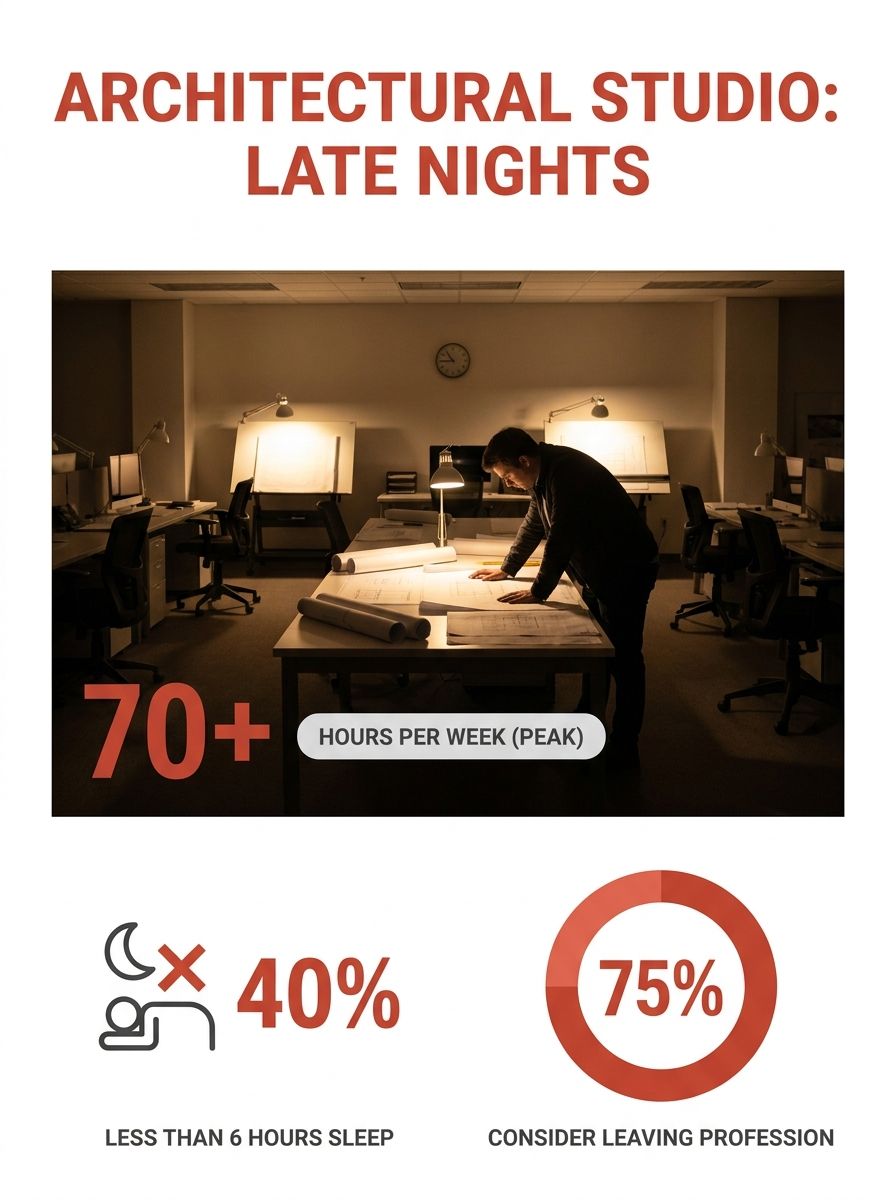
Architecture has operated for decades on an economic model that depends on long hours, modest pay relative to comparable professions, and the idea that the work itself is its own reward. Entry-level architects with professional degrees routinely earn less than entry-level engineers despite similar educational debt loads. Unpaid overtime during project deadlines is treated as standard practice, not a labor violation. Firms rarely offer overtime pay to salaried designers.
These conditions didn't emerge from nowhere. The profession's culture wraps exploitation in the language of passion. You're told you're an artist, a creator, someone who shapes cities. That framing makes it psychologically difficult to stand up at a staff meeting and say the pay structure is broken, that working until 11 p.m. three nights a week for no additional compensation is a wage issue, not a dedication issue. Danielle Aubert, a graphic designer and educator, described the dynamic bluntly in an AIGA Eye on Design roundtable: "Graphic designers are the ultimate precariat, we're just these free floating agents."
That precarity runs through architecture, interior design, urban planning, and landscape architecture. The barrier to organizing these workers has been the same across all of them: professional identity weaponized against class identity. If you see yourself as an artist first and a worker second, you're less likely to file an authorization card. The firms know this. They've relied on it for generations.
The SHoP Architects Fight
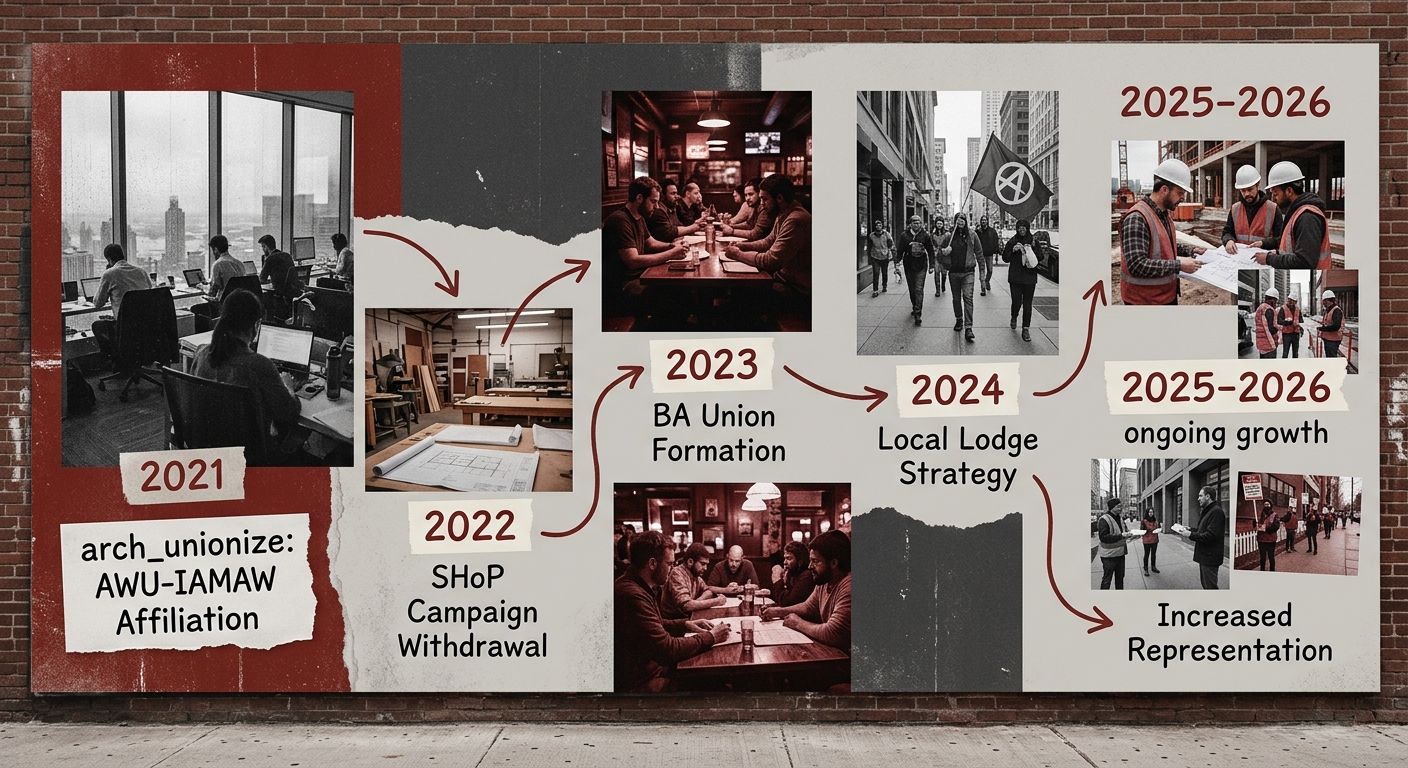
In December 2021, Architectural Workers United brought its organizing campaign to SHoP Architects, a prominent New York firm with roughly 150 employees. The choice was deliberate. SHoP was a high-profile target: the firm had a public reputation for progressive design values, which organizers believed would make management less likely to wage an aggressive anti-union campaign. They were wrong.
AWU, working through the IAMAW, began collecting authorization cards and building toward an NLRB election. As Archinect documented in its coverage of the broader movement, the AWU model starts with a group of workers collaborating with a union organizer to build majority support, then uses signed cards to demonstrate that interest formally. The 30% authorization card threshold required for an NLRB election is a legal checkpoint that determines everything about timing and momentum, a dynamic we've covered in our breakdown of why that threshold shapes your entire campaign.
At SHoP, the campaign went public before it had locked in supermajority support. Management responded with classic anti-union tactics adapted for a white-collar setting: one-on-one meetings framed as "listening sessions," messages from firm leadership about the "collaborative culture" they'd built, and implicit warnings about what unionization would mean for the firm's ability to win projects. Within weeks, the campaign stalled. Workers who'd signed cards began to waver. By early 2022, AWU withdrew its petition at SHoP.
The defeat was public and painful. Architecture media covered it as evidence that design industry labor organizing was premature, that these firms were too small and too culturally resistant to sustain a union drive. That interpretation missed what actually happened: AWU didn't dissolve. It studied the loss and changed its approach.
What Bernheimer Architecture Changed
BA Union formed at Bernheimer Architecture in New York in 2022, becoming one of fewer than 5 unionized private-sector architecture firms in the entire United States. The firm is small. The bargaining unit is small. And that's precisely why it mattered.
Where the SHoP campaign had gone big and public, the Bernheimer effort stayed quiet until the organizers were confident in their numbers. The firm's smaller size meant the organizing committee could have genuine one-on-one conversations with every employee, rather than relying on mass communication that's easier for management to intercept and counter. BA Union reached voluntary recognition without a contentious NLRB election.
The early contract conversations at Bernheimer demonstrated something the broader architecture profession hadn't seen: what it looks like when architects actually sit across the table from their employer and negotiate wages, hours, and benefits as a collective unit. As Jacobin reported, BA Union's first meetings with other firms exploring unionization started generating interest across the industry, proving that this model could replicate.
For anyone following white-collar union strategy, the Bernheimer story answered a question that the SHoP defeat had left open. The answer wasn't that architecture firms can't unionize. The answer was that architecture firms need a specific sequence: quiet supermajority building, voluntary recognition when possible, and a first contract that creates proof of concept. Moving from recognition to a strong first contract is where many new unions fail, a pattern we've traced in detail in our post-election bargaining roadmap.
AWU's Lodge Strategy
The structural insight that emerged from both the SHoP loss and the Bernheimer win was about scale. Architecture firms are small. Even major firms rarely employ more than a few hundred people in a single office. Many employ 10 to 30. Organizing one firm at a time produces bargaining units too small to fund a full-time union representative, maintain a strike fund, or exert meaningful pressure on industry-wide standards.
AWU's response was to pursue what Progressive.org described as a plan to "organize enough offices to establish a substantial local lodge, creating a centralized place for strategizing." A local lodge within the IAMAW structure would pool resources from multiple small bargaining units, giving each firm's workers access to legal support, contract negotiation expertise, and coordinated bargaining strategy that no single 20-person office could afford on its own.
This model has precedent in the building trades, where local unions represent workers across dozens or hundreds of employers. But it's almost unheard of in white-collar professional settings. The lodge strategy treats architecture workers organizing as an industry project, not a firm-by-firm effort. Each new office that signs cards strengthens the infrastructure for every office that came before.
RV Dougherty, an organizer with Workers Union Local 1010, framed the broader significance of white-collar organizing in a UnionTrack interview: "Labor efforts in the space are demystifying the idea that all tech workers have good working conditions." The same demystification is happening in architecture. The profession's prestige has long served as a shield against organizing. The lodge strategy pierces that shield by making unionization a collective industry norm rather than an individual firm's anomaly.
Collective bargaining, as the AFL-CIO defines the process, takes place between corporate management and elected labor union leaders. Research on collective bargaining outcomes shows unions tend to equalize income distribution between skilled and unskilled workers, with the associated economic cost estimated at only 0.2% to 0.5% of GDP, according to research compiled by the Hans Böckler Foundation. For architecture, where the pay gap between principals and junior designers is extreme, that equalizing function addresses one of the profession's deepest structural problems.
Design Beyond Architecture Picks Up the Thread
Architecture workers were the first in the design professions to formalize their campaigns through established union infrastructure, but the conversations they started have spread into graphic design, industrial design, and UX research. The barriers are familiar everywhere in the design industry labor landscape: small firms, strong professional identity, employer relationships that feel personal rather than institutional, and a gig economy that fragments the workforce.
What separates the firms that have successfully organized from those where campaigns collapsed? The pattern across architecture, tech, and media suggests 3 conditions that must be present simultaneously.
First, the organizing committee needs members from every department and seniority level, not a cluster of junior employees who can be dismissed as inexperienced. Second, the campaign needs to stay below management's radar until card signing crosses 60% to 65%, well above the legal 30% floor, because white-collar employers are sophisticated at deploying soft anti-union messaging once they detect organizing activity. Third, the union's value proposition has to be concrete and specific to the workplace's actual grievances. Abstract solidarity doesn't move someone earning $52,000 with a master's degree to sign a card. A detailed comparison of their salary to industry benchmarks, documented overtime hours, and the firm's revenue per employee does. We've written about exactly how to convert workplace complaints into a sustained union campaign using that kind of documentation.
The unique obstacles facing professional workers in architecture and design are well-documented. The fear of being blacklisted in a small industry, the blurred boundaries between mentor and employer, and the cultural expectation that creative work is inherently fulfilling all suppress organizing. We've explored these white-collar organizing barriers in depth, and every one of them has appeared in the architecture campaigns that stalled.

Where This Lands Now
The architecture workers' organizing blueprint has produced a small but growing number of unionized firms, a functioning relationship with the IAMAW, and a replicable strategy that other design professions can adapt. The lodge model remains in early stages. Whether AWU can reach the critical mass needed for a self-sustaining local will depend on how many firms move from quiet conversations to signed cards over the next 2 to 3 years.
What's already clear is that the old argument against professional workers unionization, the claim that educated workers in creative fields don't need unions because their skills give them individual bargaining power, has been tested and found empty. Individual bargaining power means nothing when an entire industry's business model depends on low labor costs and unpaid overtime. The architecture profession generates billions in annual revenue. The workers who produce the drawings, models, and construction documents that drive that revenue deserve collective representation over the terms of their labor. Section 7 of the National Labor Relations Act guarantees that right. It applies to architects the same way it applies to machinists, nurses, and warehouse workers.
The chronological trace from AWU's founding through the SHoP defeat, the Bernheimer win, and the lodge strategy reveals an organizing model for creatives that accounts for the specific structural challenges of small-firm, prestige-driven industries. The campaign didn't follow a linear path to victory. It failed, adapted, succeeded on a smaller scale, and then designed a systemic strategy to grow from that smaller success. That sequence is the blueprint. For workers in graphic design, UX, industrial design, and landscape architecture watching from the sidelines, the question has shifted from whether professional workers can organize to whether they're willing to begin the quiet work of signing cards, one office at a time.
The Union Edge Staff
Related Articles

The Architecture Industry's Unionization Crisis: Why White-Collar Professional Workers Face Unique Organizing Barriers
BA Union, formed in 2022 at Bernheimer Architecture in New York, remains one of fewer than five unionized private-sector architecture firms in the United States.

How Starbucks Workers United Turned Social Media Into a Bargaining Pressure Tool — and What Other Unions Can Learn
Starbucks Workers United's social media campaign didn't succeed because it generated public sympathy.

Leadership Density Over Card Counts: Why Union Authorization Metrics Fail and What Actually Predicts Organizing Success
Authorization cards measure interest, not resilience.
Also in the paper