
The Salting Strategy Playbook: How Pro-Union Workers Organize From Inside High-Resistance Workplaces
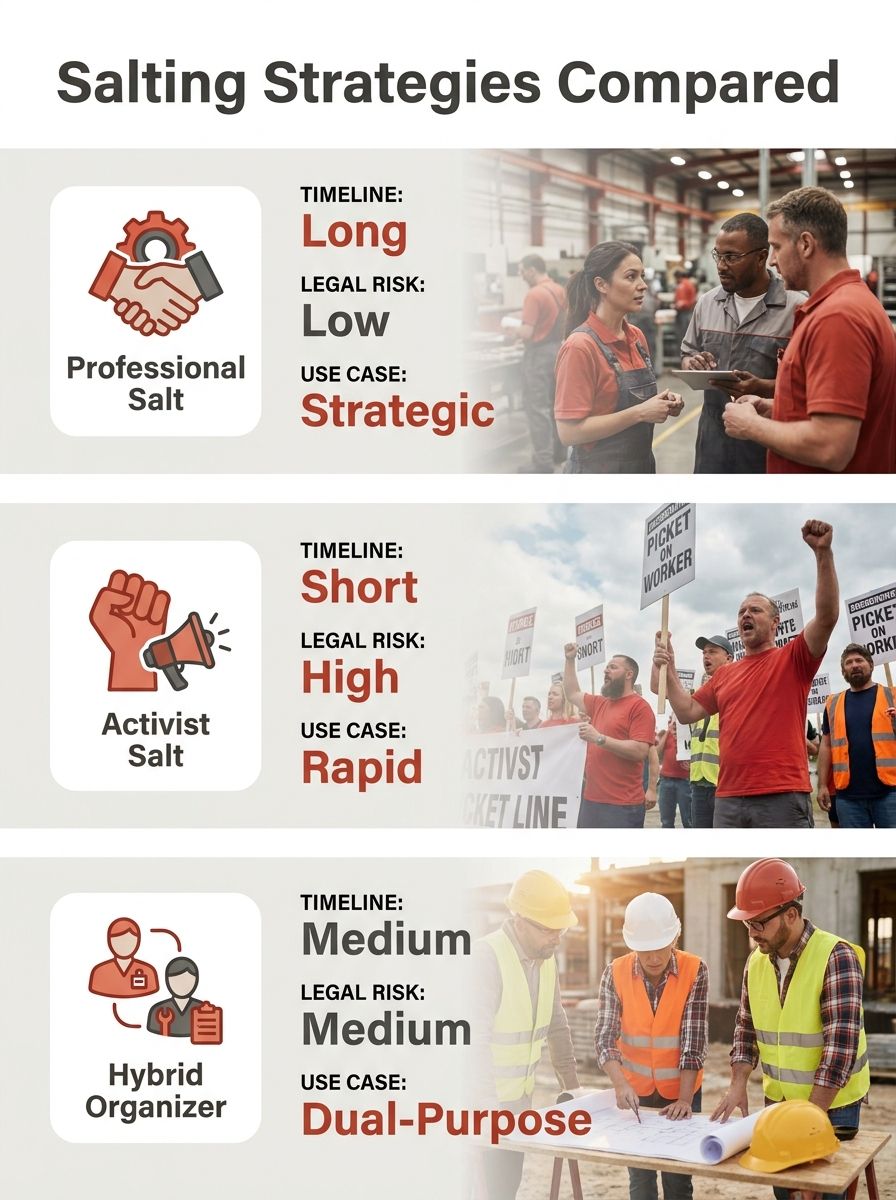
Three distinct salting tactics dominate internal union organizing in high-resistance workplaces: professional salts paid by unions, covert activist salts driven by ideology, and hybrid organizers trained at schools like the Inside Organizer School.

The Salting Strategy Playbook: How Pro-Union Workers Organize From Inside High-Resistance Workplaces
Three distinct salting tactics dominate internal union organizing in high-resistance workplaces: professional salts paid by unions, covert activist salts driven by ideology, and hybrid organizers trained at schools like the Inside Organizer School. Each carries different legal risks, different timelines, and different win rates, and the wrong choice can collapse a campaign.
The stakes are real. Union petitions filed with the NLRB jumped 27% in fiscal year 2024 compared to 2023, more than doubling the volume filed in 2021. Union election win rates hit 79% that same year, up from historical averages around 60%. A significant share of that growth came from internal workplace infiltration strategy campaigns where organizers embedded themselves inside resistant employers. Starbucks Workers United now represents 507 stores and over 11,500 workers, a campaign sparked by salts who got hired at Buffalo-area stores.
But salting is not one tactic. It's three, and each demands a different kind of person, a different legal posture, and a different definition of success.
Professional Salt | Activist Salt | Hybrid Organizer | |
|---|---|---|---|
Who pays them | Union staff salary | Self-funded, genuine employee | Self-funded with union training stipend |
Primary goal | Expose ULP violations | Win an election through trust | Build leadership density, then go public |
Cover story | Often thin or none | Authentic (they actually need the job) | Authentic with organizing skill set |
Legal risk to campaign | Moderate (employer may refuse to hire) | Low (hard to identify) | Low to moderate |
Timeline to election petition | 2-6 months | 6-18 months | 4-12 months |
Best against | Employers already breaking the law | High-turnover, low-trust workplaces | Large facilities with complex shift patterns |
Professional Salts Run an Overt Pressure Campaign
Professional salts are union employees or paid organizers who apply for jobs at a target company with one explicit purpose: to organize and, when the employer retaliates, to document unfair labor practices. This approach treats the workplace as a legal battlefield. The salt's real value often comes after they're fired, not while they're employed.
The union busting playbook documents how companies "send managers and supervisors to union-busting seminars and follow consultant-prepared 'scripts' for keeping unions at bay." Professional salts exploit this predictability. When management follows the script and terminates a salt for union activity, the NLRA's Section 7 protections kick in. The salt files an unfair labor practice charge. The NLRB investigates. If the employer is found guilty, remedies include back pay, reinstatement, and posted notices informing all employees of their rights.
This creates a powerful ripple effect. Workers who were afraid to speak up see the federal government side with the fired organizer. That visible enforcement shifts the power dynamic.
The numbers back this up. The NLRB processed over 21,000 unfair labor practice charges in fiscal year 2024. Employers who fire salts for organizing activity face reinstatement orders and financial penalties that can reach six figures when combined with back pay, legal fees, and compensatory damages under recent NLRB remedial standards.
But professional salts carry a structural weakness. As the labor consulting firm PSLabor noted in its overview of salting tactics, "operating a clandestine organizing drive (undercover) will usually be the best way to infiltrate the workforce with little to no resistance from management." Professional salts are often the opposite of clandestine. Employers in anti-union industries have learned to screen applicants through background checks, social media sweeps, and reference calls designed to flag union affiliations. A 2022 Workforce.com report documented that many employers now train hiring managers specifically to identify professional salts during interviews.
The professional salt approach works best when the employer is already violating labor law and the union needs documented evidence to build a broader legal case. It's a blunt instrument. And in workplaces where management hasn't yet committed clear violations, sending in an overt salt can actually accelerate the employer's anti-union response before workers are ready.
If you're weighing this option, understanding how leadership density matters more than card counts will help you gauge whether your coworkers are ready for the heat that comes with a professional salt's presence.
Activist Salts Build Trust Before Revealing Intent
Activist salts are workers who take jobs at target employers because they genuinely believe in organizing, often without any formal union backing or paycheck. They apply, get hired, do the work, and quietly build relationships for weeks or months before raising labor issues with coworkers.
Jaz Brisack's campaign at Starbucks in Buffalo, New York, remains the clearest example. As Teen Vogue reported, Brisack had learned about salting at the Inside Organizer School and "decided to start working at Starbucks after witnessing what they believed was a friend's unjust firing." Brisack wasn't on a union payroll. They got hired, made coffee, built friendships with coworkers, and within a year helped launch Starbucks Workers United, which has since expanded to 507 stores.

The Inside Organizer School, which trained Brisack and other key figures in the Starbucks campaign, has now trained over 1,000 people since its founding in 2018. Its curriculum focuses on the covert organizing campaigns model: get hired, map the workplace, identify natural leaders among your coworkers, and build a committee before management knows an organizing effort exists.
This approach works because it creates something professional salts rarely achieve, authentic trust. When your coworker who closes with you every Thursday starts a conversation about wages, that lands differently than when someone management already suspects is a union agent does the same thing.
The tradeoff is time. Activist salts often spend 6 to 18 months building the internal committee needed to file a petition. During that window, the employer's own surveillance systems can catch up. The Economic Policy Institute documented how companies like Amazon and Starbucks now use "increasingly sophisticated tactics, including data analytics, employee data surveys, covert surveillance, and anti-union 'heat maps' in their union avoidance activities." Every additional month an activist salt spends building relationships is another month the employer has to detect and counter the campaign.
There's also a personal cost. Activist salts work real shifts at often-low wages for months. They take on genuine physical and emotional labor. Many burn out before reaching the petition stage. And because they're self-funded, they lack the institutional support that professional salts receive when things go wrong.
The legal protections are identical to those covering any worker. Section 7 of the NLRA guarantees the right to organize regardless of your personal motivations for taking the job. An employer who fires an activist salt for organizing activity faces the same unfair labor practice liability as one who fires a professional salt.
Building strong rank-and-file leadership networks is where activist salts spend most of their energy, and it's the foundation that determines whether the campaign survives its first public test.
Hybrid Organizers Blend Formal Training With Shop-Floor Authenticity
The hybrid model has gained ground since the Starbucks campaign proved that trained activists working real jobs can outperform traditional organizing drives. Hybrid organizers attend programs like the Inside Organizer School, the Labor Notes Troublemakers School, or union-sponsored training academies, then apply for jobs at target employers with both the skills of a professional and the authentic cover of someone who needs the work.
This model addressed the core weakness of each pure approach. Professional salts get detected because their cover is thin. Activist salts succeed at building trust but often lack the tactical training to convert relationships into a winning campaign. Hybrid organizers carry both assets.
The Emergency Workplace Organizing Committee, a joint project of the Democratic Socialists of America and United Electrical Workers, has served as an incubator for this approach. EWOC documented the counter-tactics hybrid organizers face, including how "management can cynically weaponize" workplace bonds by accusing organizers "of ruining" coworker relationships, throwing pizza parties, and playing "nice" to undermine solidarity. Trained organizers recognize these moves from their curriculum. Untrained activist salts often don't.
The timeline for hybrid campaigns typically falls between 4 and 12 months. That compressed window reflects the training advantage. Hybrid organizers arrive knowing how to map a workplace, identify the 10-15% of coworkers who function as natural social leaders, and structure one-on-one conversations that move people from complaint to commitment.
The risk profile sits between the other two approaches. Hybrid organizers are harder to detect than professional salts because they genuinely need the income and don't carry union staff credentials. But their training connections create a paper trail. An employer running background checks through specialized anti-union consulting firms (an industry worth an estimated $340 million annually in the U.S., according to the Economic Policy Institute) may flag attendance at known organizing schools.
One practical consideration: hybrid organizers should understand the full timeline from first contact to first contract, because winning the election is only the midpoint. Employers in high-resistance industries routinely stall bargaining for 12 to 24 months after certification, counting on turnover to erode the unit.

How To Choose Between These Three
The right salting tactic depends on three variables: the employer's existing legal behavior, the available workforce terrain, and the union's institutional capacity to support the campaign over time.
Choose professional salts when the employer is already breaking the law. If workers report wage theft, safety violations, or retaliation against complainers, a professional salt creates documented evidence that converts individual grievances into unfair labor practice charges. This approach works in construction, meatpacking, and other industries where workplace safety violations are common and visible. The 27% jump in NLRB petition filings between 2023 and 2024 reflects partly this strategy's growing use in industries where employer misconduct provides a natural opening.
Choose activist salts when the workplace has high turnover and low existing trust. Fast food, retail, warehouse, and gig economy employers churn through workers fast enough that a new hire attracts zero suspicion. The 79% union election win rate in fiscal year 2024 owes something to activist salts who spent months building the kind of deep leadership density that survives employer counter-campaigns. If the target employer hasn't yet committed obvious legal violations, and the workforce needs months of relationship-building before a majority will sign cards, activist salts are the right tool.
Choose hybrid organizers when the target is a large, sophisticated employer with an active union-avoidance program. Companies that spend hundreds of thousands on anti-union consultants, data analytics, and captive-audience meetings require organizers who can both blend in and execute a disciplined campaign. The Starbucks campaign showed what happens when trained organizers hit a major corporation before its union-avoidance infrastructure catches up. Within months of the first Buffalo store filing, workers at hundreds of other locations followed.
Whichever approach you pick, the underlying principle holds: the right to organize is a federally protected civil right under Section 7 of the NLRA. Salting is legal. The Supreme Court confirmed in NLRB v. Town & Country Electric (1995) that paid union organizers qualify as "employees" under the Act, entitled to the same protections as any other worker. Employers who refuse to hire, who terminate, or who discriminate against salts for union activity violate federal law.
The Inside Organizer School has trained over 1,000 people since 2018. Starbucks Workers United grew from one store to 507. Union election win rates are running nearly 20 percentage points above their historical average. The tools and training for high-resistance organizing exist now in a way they didn't a decade ago. What matters is matching the right tool to the right fight, then holding the line long enough to reach a first contract that locks in the gains workers organized to win.
The Union Edge Staff
Related Articles

From Salting to Sustained Campaigns: How Unions Plant Organizers and Build Lasting Workplace Power
Salting, the practice of trained union organizers taking jobs at non-union workplaces to build support from the inside, drove the first successful Starbucks organizing campaign in decades.

The Salting Strategy Exposed: How Unions Plant Organizers and What Employers Should Know About Detection
Salting puts trained union organizers on a company's payroll by having them apply for real jobs at non-union workplaces. The NLRA has protected this organizing strategy since 1935.

When Employers Fight Back: Recognizing and Countering Union-Busting Tactics During Your Organizing Campaign
U.S. employers are charged with violating federal law in 41.5% of all union election campaigns, according to a study from the Economic Policy Institute. The violations follow a predictable script.
Also in the paper