
NLRB: What Employers and Employees Need to Know
The National Labor Relations Board is the independent federal agency that decides whether your employer broke the law when it fired you for talking about wages, interrogated you about a union meeting, or refused to bargain after workers voted to organize.

The NLRB: What Employers and Employees Need to Know
The National Labor Relations Board is the independent federal agency that decides whether your employer broke the law when it fired you for talking about wages, interrogated you about a union meeting, or refused to bargain after workers voted to organize. Every private-sector workplace dispute over collective action in the United States runs through this single agency's investigation and prosecution machinery.
The Law the Board Enforces: Section 7 of the NLRA
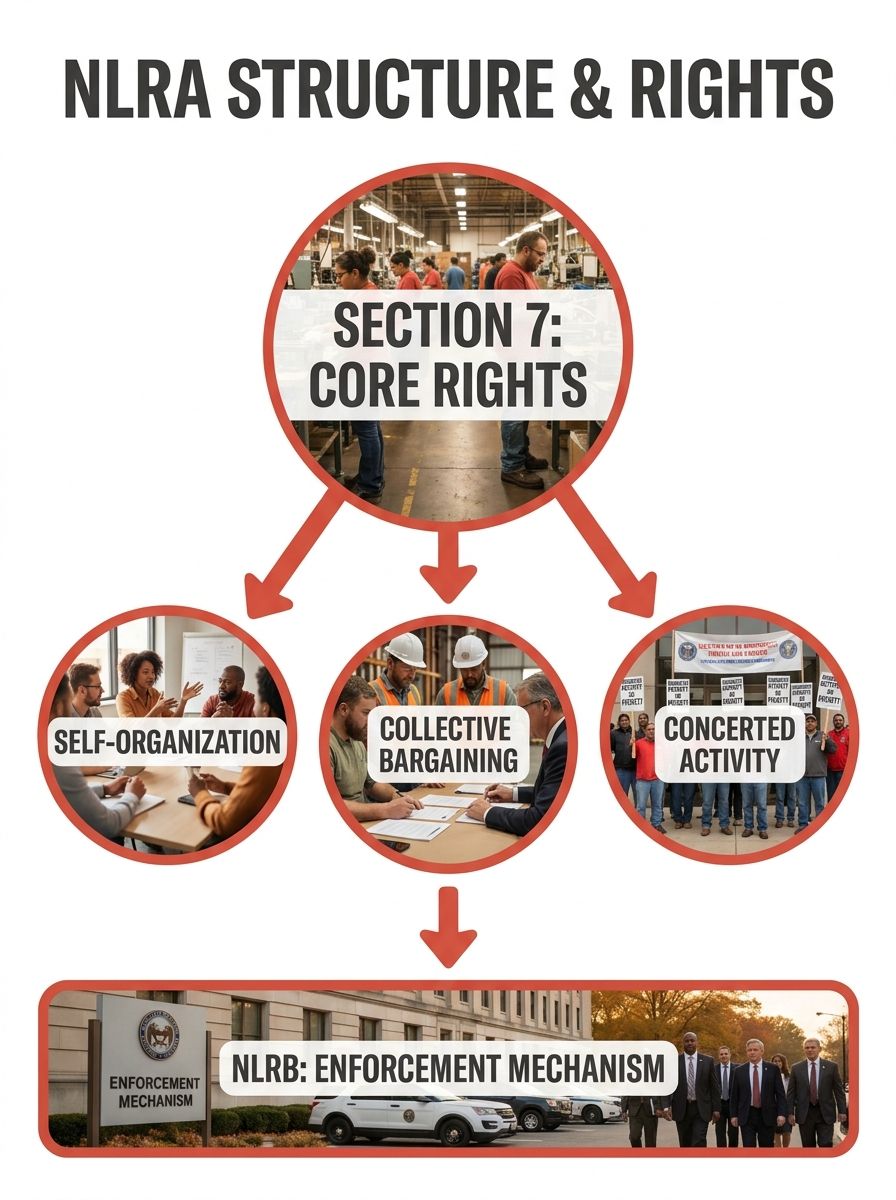
The National Labor Relations Act, signed in 1935, created both the legal rights and the agency responsible for enforcing them. Senator Robert R. Wagner of New York authored the statute to guarantee employees "the right to self-organization, to form, join, or assist labor organizations, to bargain collectively through representatives of their own choosing, and to engage in concerted activities for the purpose of collective bargaining or other mutual aid and protection," according to the National Archives' record of the act.
That guarantee lives in Section 7 of the NLRA. It covers roughly 120 million private-sector workers in the U.S. and applies whether a workplace has a union or not. Two employees discussing unsafe conditions at lunch, a group of warehouse workers circulating a petition about scheduling, a retail team comparing pay rates in a group chat, all of these qualify as protected concerted activity under Section 7.
The NLRB exists as the enforcement arm of this section. Without the agency, the rights described in Section 7 would be words on paper with no investigatory body, no prosecutors, and no adjudicatory panel to order remedies. The Board's entire organizational purpose traces back to a single statutory provision written 91 years ago.
What "Protected Concerted Activity" Actually Covers
The NLRB protects the rights of employees to engage in "concerted activity," which is when two or more employees take action for their mutual aid or protection regarding terms and conditions of employment. This protection extends to workers who have no union and no interest in forming one.
The word "concerted" does real legal work here. A single employee complaining privately about their schedule is generally not protected. But when that same employee raises the complaint on behalf of coworkers, or when two employees discuss the issue together and bring it to management, the activity becomes concerted and falls under the NLRB's jurisdiction.
Here's what the protection looks like in practice. Your employer cannot legally:
Fire, discipline, demote, or reassign you for discussing wages with coworkers
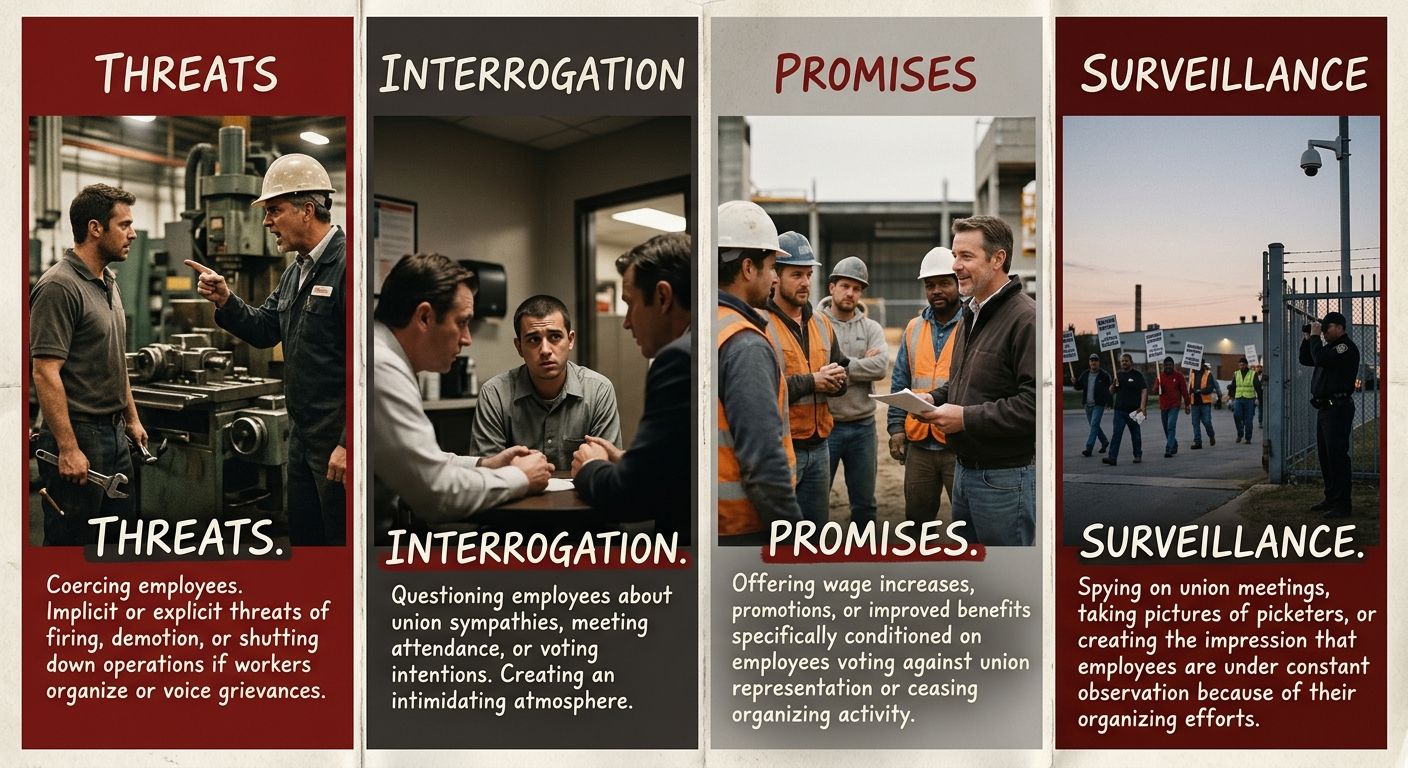
Spy on union meetings or create the impression of surveillance
Interrogate you about your organizing activities or those of your coworkers
Threaten plant closures, benefit cuts, or job losses if workers unionize
Promise raises or promotions to discourage union support
The NLRB's own guidance on rights during union organizing specifies that "supervisors and managers cannot spy on you (or make it appear that they are doing so), coercively question you, threaten you or bribe you regarding your union activity." Organizers have long used the acronym TIPS, Threats, Interrogation, Promises, Surveillance, to help workers identify violations as they encounter them. And these protections apply regardless of immigration status, a fact the NLRB has reaffirmed explicitly on its enforcement guidance pages.
The boundary workers need to understand is the "working time" exception. Employers can enforce non-discriminatory rules restricting organizing activity during hours when you're supposed to be working. But the same employer cannot selectively enforce that rule against union supporters while allowing other non-work conversations to continue unchecked. As organizing efforts spread into tech companies navigating AI disruptions, the concerted-activity protection has become the legal foundation workers cite most frequently.
How an Unfair Labor Practice Charge Moves Through the System
When an employer or union violates Section 7, the enforcement process follows a three-stage pipeline: charge filing, regional investigation, and Board adjudication. Understanding this pipeline matters because the NLRB does not act on its own. Someone has to file.
Stage 1: Filing. Any employee, union, or employer can file an unfair labor practice (ULP) charge at one of the NLRB's 26 regional offices. There's a 6-month statute of limitations from the date of the alleged violation. The charge is free to file and doesn't require a lawyer. The regional office assigns an agent to investigate.
Stage 2: Regional investigation and complaint. The regional director's office interviews witnesses, reviews documents, and determines whether the charge has merit. If it does, the regional office issues a formal complaint, the NLRB's equivalent of a prosecutorial indictment. If the regional director dismisses the charge, the charging party can appeal to the General Counsel's office in Washington. According to the Board's own process documentation, a significant share of charges are settled or withdrawn at this stage before formal litigation begins.
Stage 3: Board adjudication. Cases that aren't settled go before an administrative law judge (ALJ) for a hearing. The ALJ issues a decision, which either party can appeal to the five-member Board in Washington. The Board's decision is legally binding, and it can order reinstatement of fired workers, back pay, posting of notices informing employees of their rights, and the rescission of unlawful policies.
If an employer refuses to comply with a Board order, the case moves to a U.S. Circuit Court of Appeals for enforcement. The Board cannot hold anyone in contempt on its own, it needs the federal courts to compel compliance. This bottleneck is one of the agency's structural limitations, and it adds months or years to cases where employers choose to litigate rather than settle.
The Union Election Process
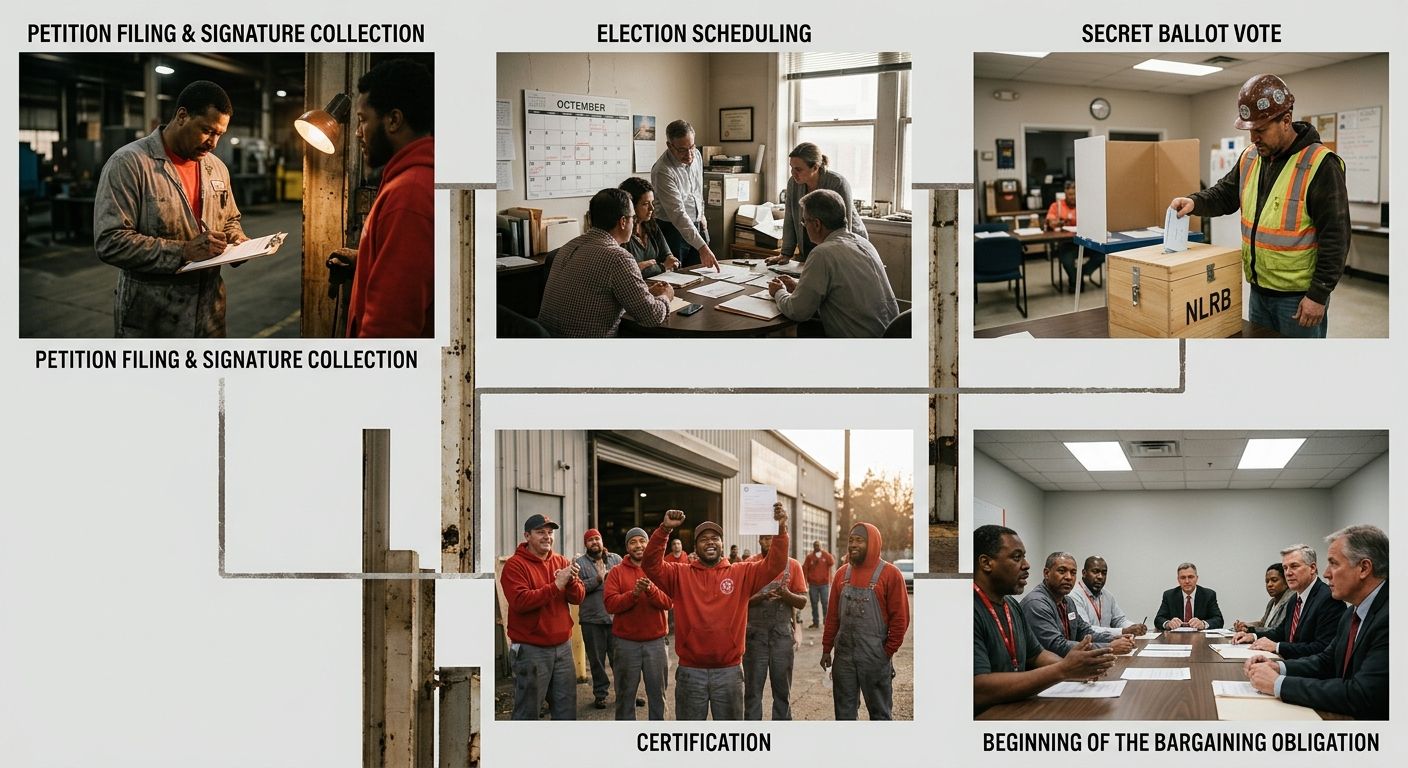
When workers want formal union representation, the NLRB oversees the election machinery. The standard path, what the Board designates an "RC" petition, requires signatures from at least 30% of workers in a proposed bargaining unit showing interest in union representation. The NLRB then schedules a secret-ballot election supervised by Board agents.
Three types of representation elections exist under NLRB procedures:
RC elections: Filed by workers or a union seeking to gain representation rights
RD elections: Filed by workers seeking to decertify (remove) an existing union
RM elections: Filed by an employer when confronted with a union's claim to represent workers
The Board requires what it calls "laboratory conditions" during the election period, an environment where workers can make a free and uncoerced choice. Recent decisions have upheld rerun elections when these conditions were compromised. In late April 2026, the Board ordered a rerun after finding that defective multilingual ballots had undermined the integrity of the voting process.
After a union wins an RC election, the employer is legally obligated to bargain in good faith. That obligation includes meeting at reasonable times, considering proposals, and making counteroffers. But "bargaining in good faith" has never meant an employer has to agree to anything. The NLRB itself determines whether true impasse has been reached when employers claim they can't negotiate further. If the agency finds impasse was premature, the employer gets sent back to the table.
The growth of union interest nationally, with 411,000 workers joining unions in 2025 alone, has pushed the NLRB's election workload higher while the agency's budget and staffing have remained flat.
The Board's Political Composition and Why It Matters
The NLRB's five Board members are appointed by the president and confirmed by the Senate, each serving staggered 5-year terms. The General Counsel, the agency's chief prosecutor who controls which complaints move forward, serves a 4-year term. This structure guarantees that the Board's interpretive direction shifts with each administration.
The current Board, with a Republican majority restored in early 2026 under Chairman James R. Murphy, has moved in a distinctly employer-friendly direction. Three specific policy shifts illustrate the scale of the change:
Joint-employer standard. The Board formally withdrew the 2023 Biden-era rule in February 2026 and reinstated the narrower 2020 standard. Under the current rule, a company qualifies as a joint employer only when it exercises "substantial direct and immediate control" over core workplace conditions like wages, scheduling, and benefits. The broader 2023 standard had included reserved and indirect control, which would have expanded liability for franchisors, staffing agencies, and subcontracting arrangements.
Cemex bargaining orders. The Sixth Circuit Court of Appeals rejected the NLRB's Cemex framework in March 2026, limiting the Board's ability to issue automatic bargaining orders when employers commit serious ULPs during an election campaign. The ruling pushes the Board back toward the older Gissel standard, which required a higher showing that traditional remedies couldn't undo the damage.
Workplace handbook scrutiny. General Counsel Crystal Carey issued GC Memo 26-03, pulling back from aggressive review of facially neutral workplace policies. Under the prior Stericycle framework, handbooks were evaluated based on whether a reasonable employee might interpret a rule as chilling Section 7 rights. Carey's guidance shifts focus toward actual intent and enforcement, a significant retreat from the standard that had been generating scrutiny of employer anti-union spending.
With the quorum restored, the Board is actively clearing a backlog of over 500 pending cases, which means decisions on long-stalled ULP charges and representation disputes are arriving faster than they have in years.
Where the NLRB's Authority Runs Out
The NLRB's jurisdiction has hard boundaries that exclude large categories of American workers from its protection.
Federal, state, and local government employees fall outside the NLRA entirely. Federal workers are covered by the Federal Service Labor-Management Relations Statute, administered by the Federal Labor Relations Authority, a separate agency with different rules. Recent moves to eliminate impartial discrimination hearings for federal workers highlight how different the protections landscape looks outside the NLRB's reach.
Agricultural laborers and domestic workers were explicitly excluded from the NLRA in 1935. That exclusion, widely recognized as racially motivated given the demographics of those workforces in the 1930s, remains in the statute 91 years later. Some states have passed their own agricultural labor relations acts, but there's no federal equivalent.
Independent contractors are not "employees" under the NLRA, which means the Board has no jurisdiction over their organizing rights. The classification question, whether a worker is an employee or a contractor, is itself a major area of NLRB litigation, and the standard for making that determination has shifted repeatedly between administrations.
Supervisors and managers, as defined by the NLRA, are excluded from the act's protections. They can be fired for union sympathies without recourse to the Board. The definition of "supervisor" has been the subject of decades of contested Board and court decisions.
And the agency's remedy authority has structural limits. The NLRB cannot impose punitive damages, cannot fine employers, and cannot send anyone to jail. Its strongest remedies, reinstatement with back pay and notice-posting requirements, are restorative, not punitive. An employer doing the math on whether to violate the law sometimes concludes that the cost of eventual compliance is lower than the cost of a successful union drive. That calculus is a design flaw the statute has never fixed.
Common Questions
Does the NLRB protect workers who aren't in a union?
Yes. The NLRB protects all private-sector employees who engage in concerted activity for mutual aid or protection, regardless of union membership. Two or more workers discussing pay, working conditions, or safety concerns are protected under Section 7 of the NLRA. The Board's own guidance on employee rights explicitly states this protection applies to workers "not represented by a union."
How long do I have to file an unfair labor practice charge?
Six months from the date of the alleged violation. After that window closes, the NLRB cannot accept the charge. There is no cost to file, and you don't need a lawyer. Charges are submitted to the NLRB regional office covering your workplace location.
Can my employer campaign against a union during an election?
Yes, within limits. Employers can hold meetings, distribute literature, and express opinions about unionization. They cannot threaten, interrogate, promise benefits, or conduct surveillance, the TIPS violations. The Board enforces a "laboratory conditions" standard and will order a rerun election if employer conduct created an atmosphere of coercion during the campaign period.
Does the NLRB cover gig workers?
Only if the Board classifies them as employees rather than independent contractors. Independent contractors fall outside the NLRA's protections entirely. The test for distinguishing employees from contractors has changed across administrations, making this one of the most unstable areas of NLRB law.
What happens if my employer ignores an NLRB order?
The Board petitions a U.S. Circuit Court of Appeals to enforce its order. The NLRB cannot hold employers in contempt or impose fines on its own. Court enforcement can add significant time, sometimes years, to the resolution of a case, which is why settlement at the regional level remains the fastest path to a remedy for most workers.
The Union Edge Staff
Frequently Asked Questions
- What is protected concerted activity under the NLRB?
- Protected concerted activity occurs when two or more employees take action together for their mutual aid or protection regarding terms and conditions of employment. Examples include employees discussing wages, circulating petitions about scheduling, or comparing pay rates in group chats, regardless of whether a union is involved.
- What can employers not do during union organizing?
- Employers cannot spy on union meetings or create the impression of surveillance, interrogate employees about organizing activities, threaten plant closures or job losses if workers unionize, promise raises or promotions to discourage union support, or fire or discipline workers for discussing wages with coworkers. The acronym TIPS—Threats, Interrogation, Promises, Surveillance—helps workers identify violations.
- How long do I have to file an unfair labor practice charge with the NLRB?
- You have 6 months from the date of the alleged violation to file an unfair labor practice charge. The charge is free to file, does not require a lawyer, and is submitted to the NLRB regional office covering your workplace location.
- Does the NLRB protect workers without a union?
- Yes, the NLRB protects all private-sector employees who engage in concerted activity for mutual aid or protection, regardless of union membership. Protection under Section 7 of the NLRA applies to roughly 120 million private-sector workers whether or not their workplace has a union.
- What is the process for a union election under the NLRB?
- Workers or a union must collect signatures from at least 30% of workers in the proposed bargaining unit showing interest in representation, after which the NLRB schedules a secret-ballot election supervised by Board agents. The Board enforces "laboratory conditions" during the election period to ensure workers can make a free and uncoerced choice.
- Who is not protected by the NLRB?
- Federal, state, and local government employees, agricultural laborers, domestic workers, independent contractors, and supervisors and managers are excluded from NLRB protections. These exclusions have remained largely unchanged since the National Labor Relations Act was signed in 1935.
- What happens if an employer ignores an NLRB order?
- The NLRB petitions a U.S. Circuit Court of Appeals to enforce its order, as the Board cannot impose fines or hold employers in contempt on its own. Court enforcement can add months or years to case resolution, which is why settlement at the regional level is often the fastest path to a remedy.
Related Articles
NLRB Wagner Act: What You Need to Know
The National Labor Relations Act of 1935, commonly called the Wagner Act, is the federal statute that guarantees private-sector employees the right to organize unions, bargain collectively, and strike.

When Employers Fight Back: Recognizing and Countering Union-Busting Tactics During Your Organizing Campaign
U.S. employers are charged with violating federal law in 41.5% of all union election campaigns, according to a study from the Economic Policy Institute. The violations follow a predictable script.

How to File an Unfair Labor Practice Charge: A Step-by-Step Guide for Frontline Organizers
Amazon warehouse workers at the JFK8 fulfillment center on Staten Island filed their first unfair labor practice charge months before the April 2022 election that made them famous.
Also in the paper