
Minimum Wage by County in California 2024
California operates at least 40 distinct minimum wage floors simultaneously. The statewide base of $16.00 per hour that took effect January 1, 2024, functions as a starting point from which dozens of cities, counties, and industry-specific mandates build upward, creating gaps as wide as $4.

Minimum Wage by County in California: How the Layered System Actually Works
California operates at least 40 distinct minimum wage floors simultaneously. The statewide base of $16.00 per hour that took effect January 1, 2024, functions as a starting point from which dozens of cities, counties, and industry-specific mandates build upward, creating gaps as wide as $4.00 per hour between neighboring jurisdictions.
What "Minimum Wage by County" Means in California
The phrase "minimum wage by county in California" describes a legal structure where the state government sets a baseline hourly rate, but individual cities and counties pass their own ordinances requiring higher pay within their borders. According to the UC Berkeley Labor Center's inventory of local wage ordinances, 67 cities and counties across the United States now enforce their own minimum wage laws. Before 2012, only five localities had such laws. California accounts for the largest concentration.
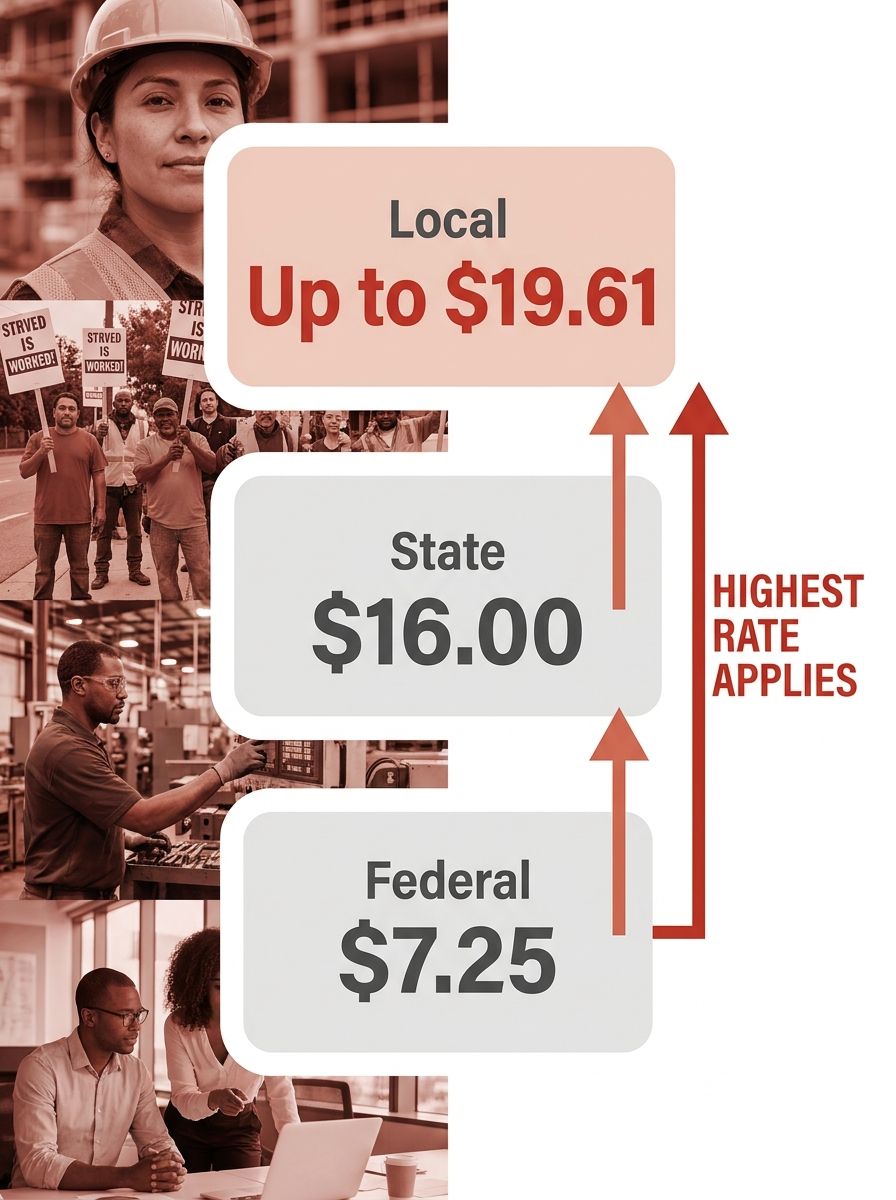
The legal principle is straightforward: when a conflict exists between federal, state, and local wage floors, the employer must follow the stricter standard, whichever rate is highest. A home health aide working in the city of Los Angeles earns at least $17.28 per hour under the city ordinance, even though the state rate is $16.00 and the federal minimum remains stuck at $7.25. The worker gets the highest applicable number. No exceptions.
This isn't an obscure technicality. For workers who cross city or county lines during a shift, delivery drivers, home care aides, traveling nurses, the applicable rate can change depending on where the hours are physically worked. Employers with remote and hybrid employees face the same complexity, as California Payroll noted in their July 2024 compliance guidance: employers must adjust wages according to the city or county employees work from.
The State Baseline in 2024: $16.00 Per Hour
Beginning January 1, 2024, the California Department of Industrial Relations set the statewide minimum wage at $16.00 per hour for all employers regardless of company size. California eliminated the two-tier system (which previously differentiated between employers with 25 or fewer employees and larger companies) and consolidated into a single rate.
The state adjusts this baseline annually using the Consumer Price Index for Urban Wage Earners and Clerical Workers, or CPI-W. Two guardrails limit the adjustment mechanism: increases are capped at 3.5% per year, and the wage can never be lowered even when CPI goes negative. The governor can no longer pause scheduled increases. By January 1, 2026, this mechanism pushed the statewide floor to $16.90 per hour.
For workers and organizers, this automatic adjustment mechanism matters because it removes the political fight from annual increases. Compared to states like Florida, where the wage floor advances each September 30 through a constitutional mechanism, California's CPI-W tether means the state rate tracks actual inflation, with a ceiling, but without the legislative gridlock that has frozen the federal rate at $7.25 since 2009.
County and City Rates That Exceed the State Floor
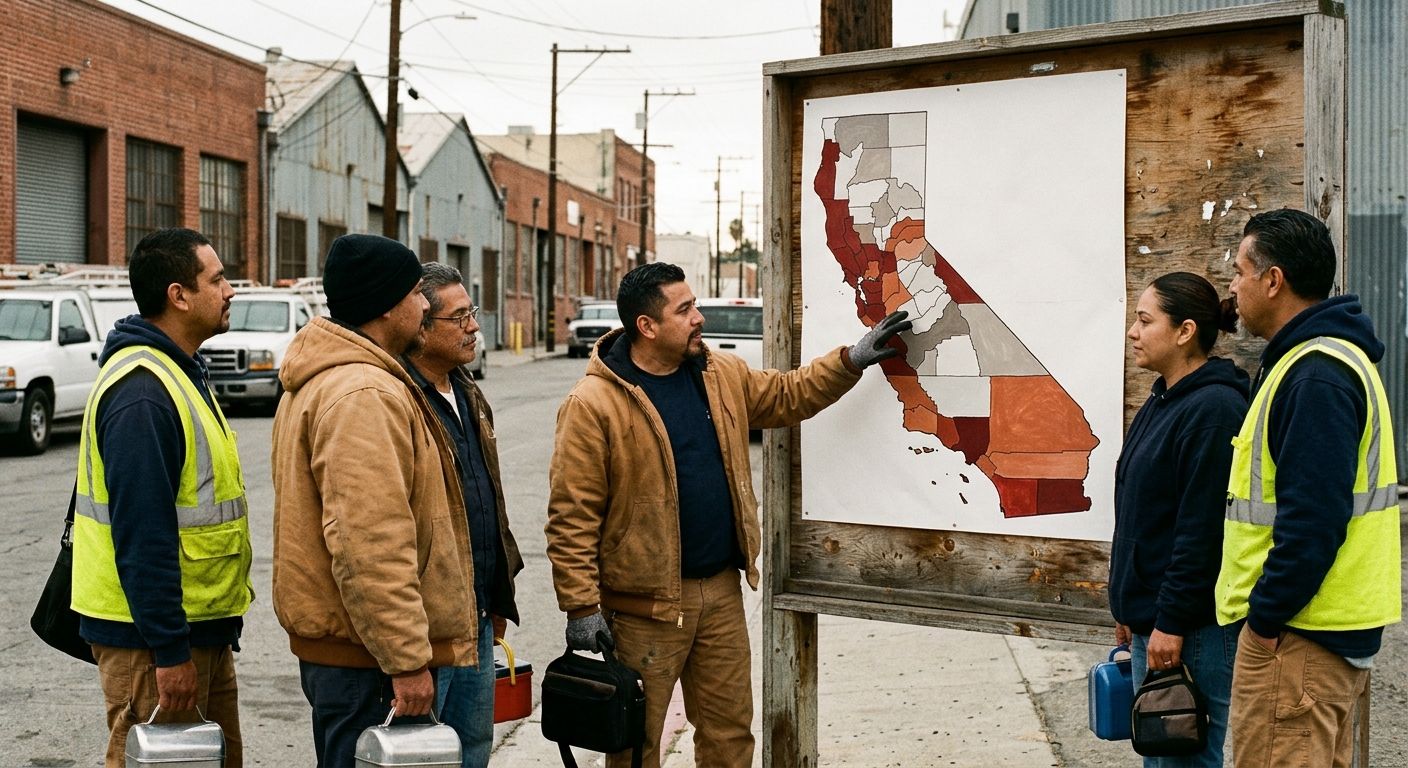
The real variation in minimum wage by county in California shows up at the local level. Multiple Bay Area cities enforce rates more than $2.50 above the state floor, and several jurisdictions in Los Angeles County have their own ordinances. The UC Berkeley Labor Center's archived rate table tracks these rates from January through June 2024, with a second round of increases hitting on July 1, 2024.
Here are the key local rates workers should know from the 2024 cycle:
Jurisdiction | Rate (Jan–June 2024) | Rate (July 1, 2024) | Notes |
|---|---|---|---|
West Hollywood | $19.08 | $19.61 | Highest local rate in the state |
Emeryville | $18.67 | $19.36 | Historically among the highest |
San Francisco | $18.07 | $18.67 | Covers all employers within city limits |
Berkeley | $18.07 | $18.67 | Same rate as San Francisco |
Los Angeles (City) | $16.78 | $17.28 | Applies within city boundaries only |
Los Angeles County (Unincorp.) | $16.90 | $17.27 | Covers unincorporated county areas |
Milpitas | $17.20 | $17.70 | Silicon Valley jurisdiction |
Pasadena | $17.50 | $17.50 | Set by local ordinance |
Fremont | $16.80 | $17.30 | Separate from Alameda County rate |
Alameda | $16.52 | $17.00 | City-level ordinance |
Notice the geographic clustering. Bay Area cities dominate the top of the table, reflecting both higher costs of living and stronger local organizing coalitions that pushed these ordinances through city councils. Southern California jurisdictions tend to run $1.00–$2.50 lower than their Bay Area counterparts.
An important detail: San Leandro, which previously had its own minimum wage ordinance, has been surpassed by the state rate, according to UC Berkeley's inventory. When a city's rate falls below the state floor, the state floor controls. The local ordinance doesn't disappear, but it becomes functionally irrelevant until the city raises its rate above the state level again.
Industry-Specific Floors: Fast Food and Healthcare
Two industry mandates created additional wage layers in 2024 that override both the state baseline and most local ordinances. These are the provisions that place this article squarely in the intersection of healthcare and labor policy.
Fast food workers at restaurants belonging to chains with 60 or more locations nationally became entitled to $20.00 per hour effective April 1, 2024. This rate exceeds every city and county rate in the table above. A fast food worker in Emeryville, previously one of the highest-paid minimum wage workers in the state at $19.36, saw their legal floor jump to $20.00 under the industry mandate. Fast food employers must also prominently post the Minimum Wage Order Supplement for Fast Food Restaurant Employees at every location.
Healthcare facility workers received their own elevated floor effective October 16, 2024. Rates vary by facility type and size, with the specifics detailed in the Healthcare Minimum Wage Order from the Department of Industrial Relations. This mandate covers hospitals, clinics, skilled nursing facilities, and other care settings where workers have historically faced some of the most dangerous conditions in the state. The connection between wage floors and staffing levels in healthcare is direct, facilities that can't retain workers at low wages create the short-staffing crises that, as reporting on nurse workplace violence in Ohio has documented, put both patients and workers at physical risk.
These industry-specific mandates represent a structural shift in how California thinks about wage floors. Rather than assuming geography alone determines cost of living, the state legislature recognized that certain industries have specific market failures, high turnover, low bargaining power, dangerous working conditions, that a single geographic rate can't fix.
How the "Highest Rate Applies" Rule Works in Practice
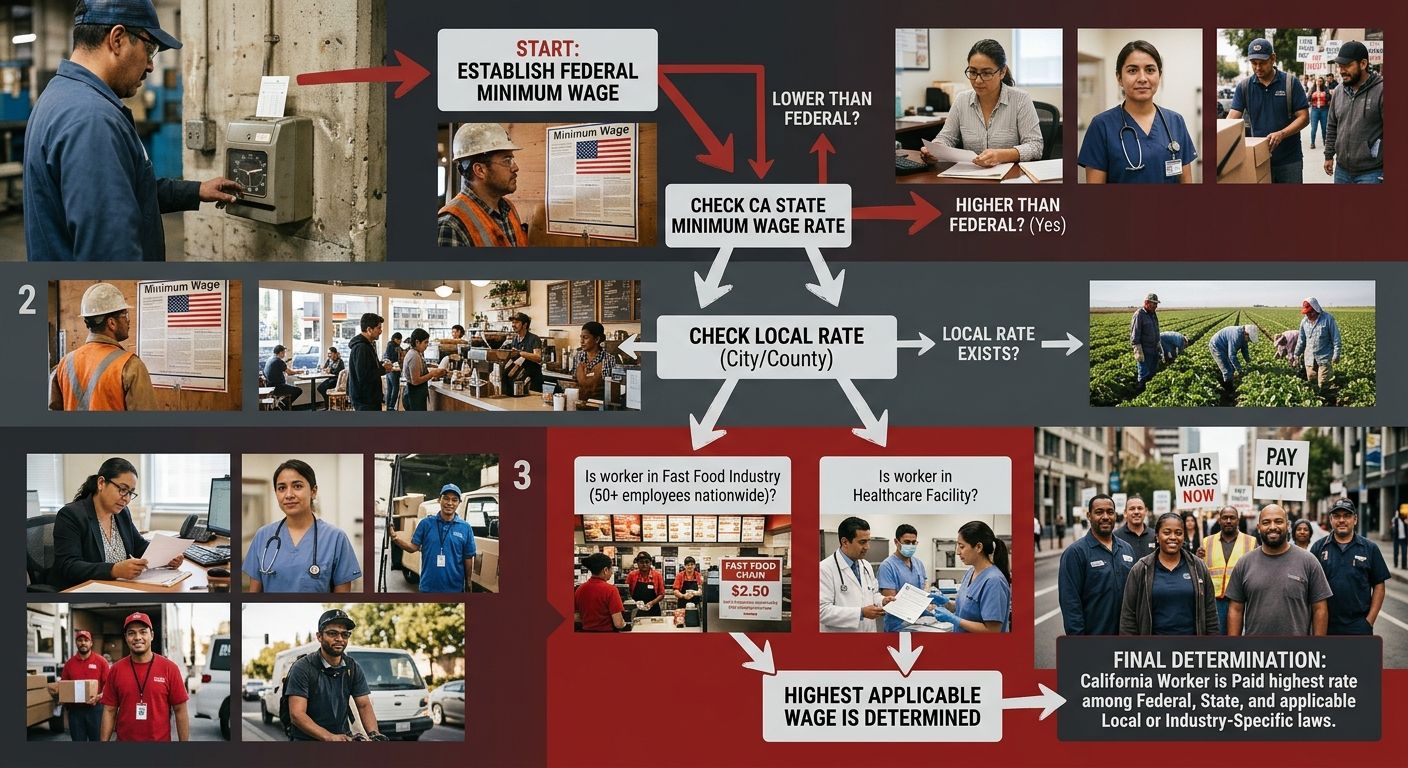
The interaction between federal, state, local, and industry-specific rates follows a clear hierarchy, but the practical application gets complicated fast. Here's the mechanism:
A healthcare worker employed at a hospital in the city of Los Angeles has four potentially applicable rates: the federal minimum ($7.25), the California state minimum ($16.00 in early 2024), the Los Angeles city minimum ($17.28 after July 1), and the healthcare facility minimum (which took effect October 16, 2024, at rates varying by facility type). The worker is entitled to whichever number is highest.
The complication arises for workers who move between jurisdictions. An employer based in unincorporated Los Angeles County ($17.27 after July 1) who sends a worker into the city of Pasadena ($17.50) for an afternoon owes that worker the Pasadena rate for those hours. The increased wages apply only to hours worked within the higher-rate jurisdiction. This matters enormously for home healthcare aides, who may visit three or four patients in different cities during a single day.
Union representatives and worker advocates dealing with wage compliance issues should know that New York City operates a similar multi-layered system with geographic zones and industry carve-outs. California's system is more granular because it distributes authority across many more individual cities, but the underlying legal logic, highest applicable rate wins, is the same.
Where the Model Breaks
The layered minimum wage system has structural weaknesses that no rate increase can fix on its own.
Enforcement gaps are the largest problem. California's Division of Labor Standards Enforcement, which handles wage claims, relies heavily on workers filing complaints. Workers in the industries most affected by local wage ordinances, fast food, retail, home healthcare, are disproportionately immigrants, part-time employees, and workers without union representation. The fear of retaliation suppresses complaints. A $19.61 minimum wage in West Hollywood means nothing if a worker's employer pays $16.00 and the worker doesn't know they're owed more, or knows but fears losing the job.
Boundary arbitrage is real. An employer choosing between opening a location in West Hollywood ($19.61) or an adjacent unincorporated Los Angeles County area ($17.27) faces a $2.34 per hour per worker cost difference. Over a year, for a single full-time employee, that gap exceeds $4,800. Multiply across a 20-person staff and you're looking at nearly $100,000 annually. Cities with aggressive local minimums risk pushing low-wage employers just outside their borders, concentrating poverty in areas with weaker ordinances.
The system doesn't cover everyone. Independent contractors fall outside all minimum wage protections. Despite California's AB 5 law tightening independent contractor classifications, misclassification remains rampant. Workers who are functionally employees but classified as contractors, a pattern documented in gig economy fights from California to Telangana, receive no minimum wage protection at all, regardless of which city they work in.
Industry mandates create cliff effects. A restaurant with 59 locations pays the local minimum or state rate. The moment it opens a 60th location, every worker across all locations is owed $20.00. The incentive to stay at 59 locations, or to franchise in ways that keep each entity below the threshold, is obvious. This is the same structural problem that the proposed federal $25 minimum wage bill would face at a national scale.
Common Questions
Does my employer get to pick which minimum wage rate to follow?
No. California law requires employers to follow the highest applicable rate among federal, state, local, and industry-specific minimums. If you work in a city with a $18.67 local minimum and you're in the fast food industry at $20.00, you're owed $20.00. The employer has no discretion to select a lower rate.
What if I work in multiple cities during the same day?
You're owed the applicable local minimum wage for each jurisdiction where you physically perform work. If you spend four hours in San Francisco ($18.67) and four hours in an unincorporated area at the state rate ($16.00), your employer must pay the respective rate for each set of hours. This is especially relevant for home healthcare workers, delivery drivers, and mobile service workers.
Are tipped workers subject to different minimum wages in California?
California does not allow a tip credit. Unlike most states, and unlike the federal system, California employers must pay the full minimum wage before tips. Tips are entirely separate compensation. A server in San Francisco earns at least $18.67 per hour regardless of tip income.
When do California minimum wage rates change?
The state rate adjusts annually on January 1, tied to CPI-W with a 3.5% cap. Many local jurisdictions adjust on either January 1 or July 1 (some do both). Industry-specific mandates have their own effective dates: April 1, 2024, for fast food and October 16, 2024, for healthcare. Workers should check rates twice per year at minimum.
Has any California city's local minimum wage been overtaken by the state rate?
Yes. San Leandro's minimum wage, for example, has been surpassed by the state of California's rate, according to UC Berkeley's inventory. When this happens, the state rate controls and the local ordinance becomes effectively dormant until the city raises its rate above the state floor.
The Union Edge Staff
Frequently Asked Questions
- What is the California minimum wage in 2024?
- California's statewide minimum wage is $16.00 per hour as of January 1, 2024. However, many cities and counties enforce higher rates, and certain industries like fast food ($20.00/hour) and healthcare have even higher mandates, so the applicable rate depends on your location and industry.
- Which California city has the highest minimum wage?
- West Hollywood has the highest local minimum wage rate in California at $19.61 per hour as of July 1, 2024, followed by Emeryville at $19.36 per hour.
- Do California employers have to pay tips on top of minimum wage?
- No. California does not allow a tip credit, meaning employers must pay the full minimum wage before tips are added. Tips are entirely separate compensation and cannot be counted toward minimum wage obligations.
- What minimum wage do fast food workers get in California?
- Fast food workers at restaurant chains with 60 or more locations nationally are entitled to $20.00 per hour effective April 1, 2024, which supersedes all state and local minimum wage rates.
- What if I work in multiple cities in California during the same day?
- You're owed the applicable minimum wage for each jurisdiction where you physically work. If you work four hours in San Francisco at $18.67 and four hours in an area with the $16.00 state rate, your employer must pay the respective rate for each set of hours.
- When do California minimum wages increase each year?
- The state minimum wage adjusts annually on January 1 based on the Consumer Price Index for Urban Wage Earners (CPI-W), with increases capped at 3.5% per year. Local jurisdictions adjust on January 1, July 1, or both, and industry-specific rates have their own effective dates.
- What is the healthcare worker minimum wage in California?
- Healthcare facility workers received an elevated minimum wage effective October 16, 2024, with rates varying by facility type and size as detailed in the Healthcare Minimum Wage Order from the Department of Industrial Relations.
- Can my employer choose which minimum wage rate to pay me?
- No. California law requires employers to pay the highest applicable rate among federal, state, local, and industry-specific minimums. The employer has no discretion to select a lower rate.
Related Articles

California Minimum Wage 2025: What's Changed
Three separate legal floors governed what California employers owed their workers during 2025: a $16.50 statewide baseline, a $20.00 fast-food sector rate, and a healthcare scale climbing as high as $23.00 per hour at large hospital systems.

Minimum Wage in California: 2024 Rules & Requirements
California's minimum wage is a formula-driven system that recalculates every January 1 based on changes in the Consumer Price Index, capped at 3.5% annually. The statewide floor rose from $16.00 per hour in 2024 to $16.

Minimum Wage California: 2024 Updates & Rates
AB 1228, SB 525, Labor Code Section 1182.12, and at least 38 local ordinances all set binding minimum wages in California, and the highest rate that applies to a given worker is the one the employer must pay.
Also in the paper