
Minimum Wage in California: 2024 Rules & Requirements
California's minimum wage is a formula-driven system that recalculates every January 1 based on changes in the Consumer Price Index, capped at 3.5% annually. The statewide floor rose from $16.00 per hour in 2024 to $16.

Minimum Wage in California: 2024 Rules & Requirements
California's minimum wage is a formula-driven system that recalculates every January 1 based on changes in the Consumer Price Index, capped at 3.5% annually. The statewide floor rose from $16.00 per hour in 2024 to $16.90 in 2026, but separate, higher rates cover fast food workers, healthcare employees, and workers in dozens of cities and counties.
How the California Department of Industrial Relations Defines the Rate
The California Department of Industrial Relations sets the statewide minimum wage for California under a formula established by Assembly Bill 1228, signed in 2023. The mechanism pegs annual increases to the CPI-W (Consumer Price Index for Urban Wage Earners and Clerical Workers), with two guardrails: a maximum annual increase of 3.5% and no provision for decreases. If inflation runs below 3.5%, the increase matches CPI-W exactly. If inflation exceeds that threshold, the raise is capped.
This indexing replaced the old system of fixed legislative increases that required new bills for every adjustment. Under the previous approach, California's minimum wage pay climbed through a multi-year phase-in from $10.00 in 2016 to $15.00 in 2022 and $15.50 in 2023. Each step required separate political action, which left wages stagnant during the years between legislative sessions.
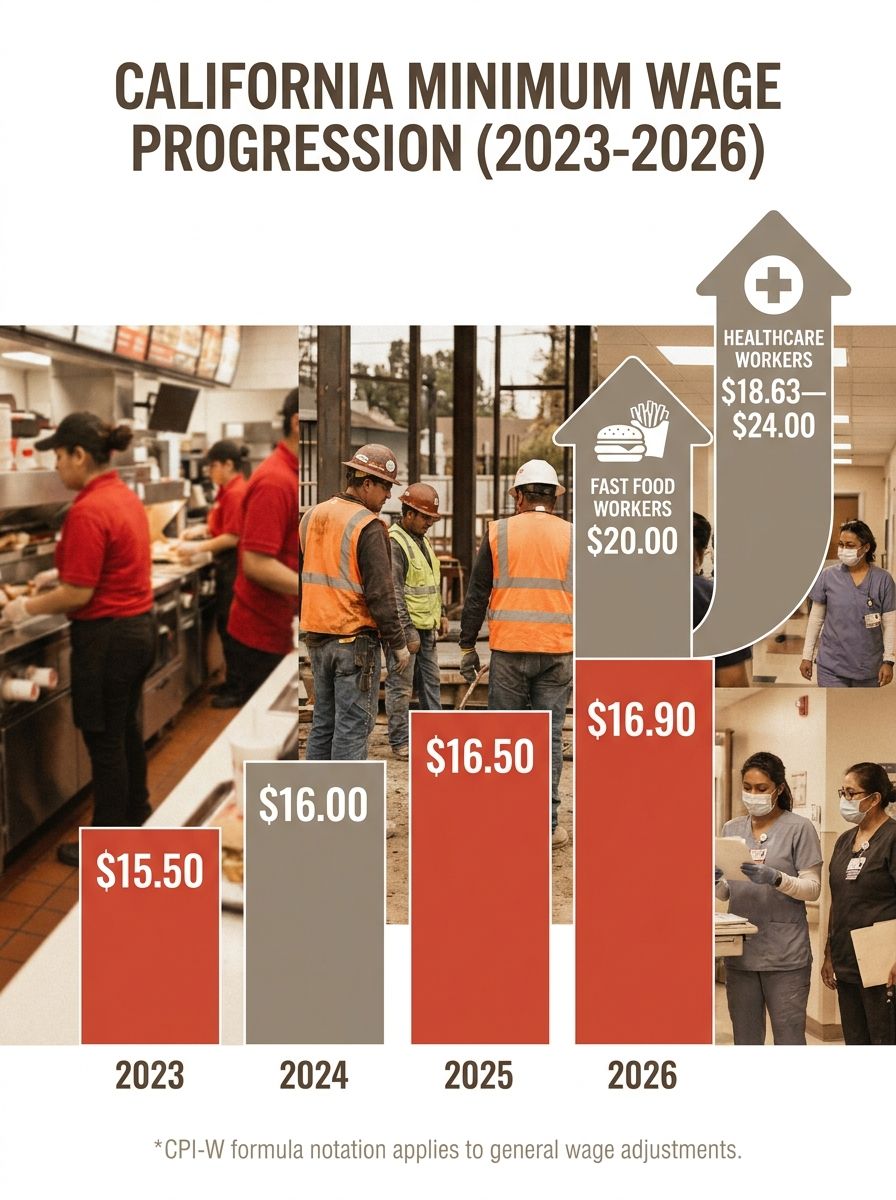
The practical progression under the current formula:
January 1, 2024: $16.00 per hour for all employers
January 1, 2025: $16.50 per hour for all employers
January 1, 2026: $16.90 per hour for all employers
California eliminated the employer-size distinction that once set different rates for businesses with 25 or fewer employees versus larger firms. Every employer in the state, regardless of headcount, must pay the same statewide floor. The DIR's minimum wage FAQ page confirms the $16.90 rate applies "for all employers, not otherwise covered by a higher minimum wage specific to an industry or a locality."
Fast Food Workers and the $20.00 Floor
Starting April 1, 2024, covered fast food restaurant employees must be paid at least $20.00 per hour under AB 1228, which created the Fast Food Council within the Department of Industrial Relations. The law defines "fast food restaurant" as any establishment that is part of a chain with 60 or more locations nationally, requires customers to pay before eating, and provides limited or no table service.
The $20.00 rate represents a 25% premium over the 2024 statewide floor of $16.00 and an 18.3% premium over the 2026 statewide floor of $16.90. The Fast Food Council has authority to adjust this rate annually, also capped at 3.5% per year, and localities cannot set a separate fast food minimum that exceeds the Council's rate.
For the approximately 500,000 fast food workers in the state, this created the first industry-specific minimum wage floor in California history. Workers at McDonald's, Starbucks, Subway, and similar chains saw immediate pay increases. Workers at independent restaurants with fewer than 60 national locations remain covered only by the statewide rate or their local ordinance, whichever is higher.
The Council also has authority to recommend workplace safety and anti-wage-theft standards, which ties back to the broader labor compliance framework. If your workplace falls under this provision and you're being paid less, the California Labor Commissioner's Office accepts wage claims regardless of immigration status.
Healthcare Worker Minimums Under Senate Bill 525
Senate Bill 525 created a phased minimum wage schedule for healthcare workers that began October 16, 2024, with a target of $25.00 per hour by 2034. The initial rates vary by facility type, ranging from $18.63 to $24.00 per hour depending on where a worker is employed.
This is a critical provision for the hundreds of thousands of workers who staff California's hospitals, clinics, nursing homes, and dialysis centers. The rate structure breaks down by employer category:
Facility Type | Initial Rate (Oct 2024) | Target Rate | Target Year |
|---|---|---|---|
Large health systems (10,000+ FTEs), dialysis clinics | $23.00 | $25.00 | 2026 |
Hospitals (non-rural) | $23.00 | $25.00 | 2028 |
Clinics, community health, rural hospitals | $21.00 | $25.00 | 2033 |
Other covered facilities | $18.63 | $25.00 | 2034 |
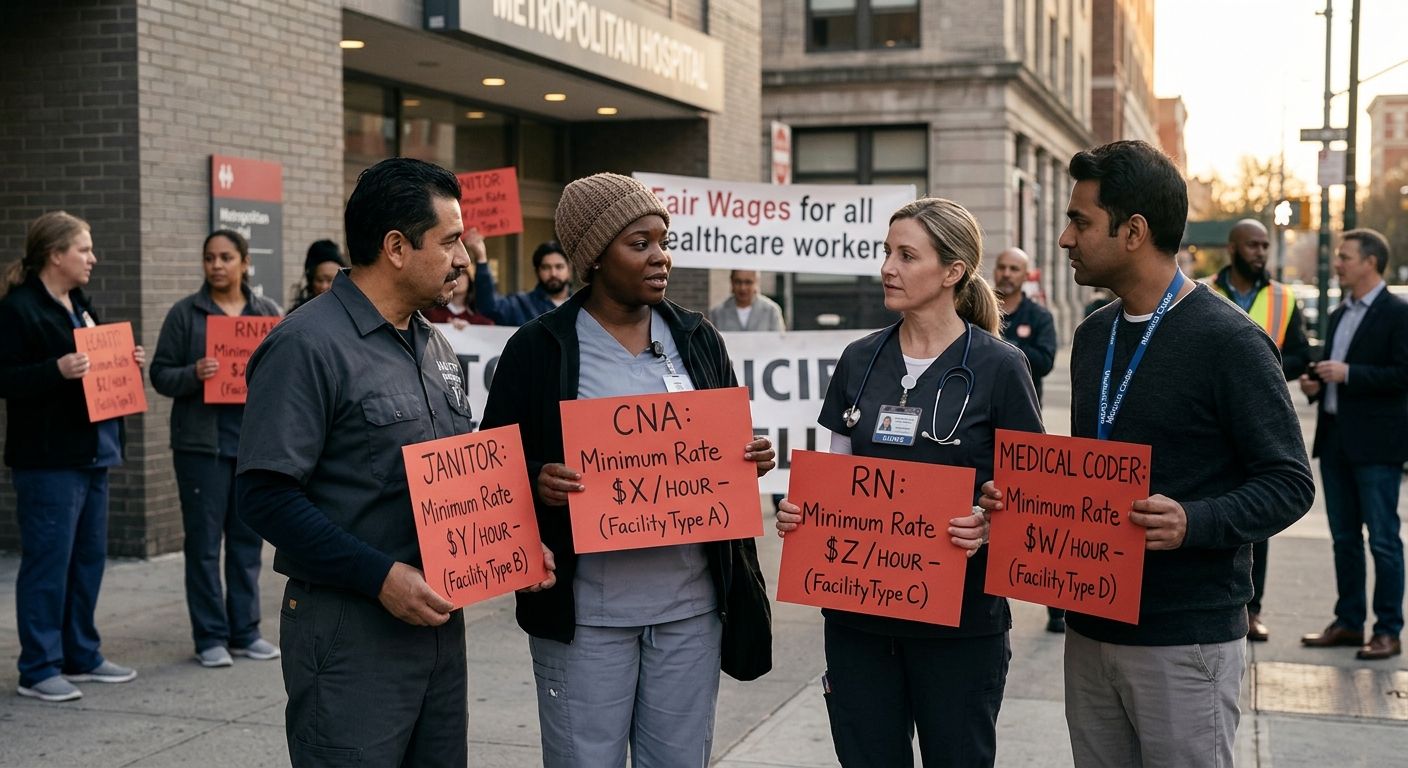
The legislation covers a broad range of roles: nurses, certified nursing assistants, janitorial staff, food service workers in hospitals, medical coders, and many administrative positions within covered facilities. Workers in healthcare settings who've watched their wages erode against housing costs for years pushed hard for SB 525 through organizing campaigns led by SEIU-UHW and other unions. The recent nurses' strike in Massachusetts over stalled wage negotiations underscores why healthcare workers across the country view minimum wage floors as existential.
California's healthcare minimum wage is the first statewide sectoral wage law of its kind in the United States. The mechanism is distinct from the fast food provision: rather than a council with ongoing rate-setting authority, SB 525 establishes a fixed statutory schedule with built-in milestone dates. The DIR enforces it through existing wage claim processes.
Local Ordinances That Stack on Top
California's statewide rate functions as a floor, not a ceiling. The UC Berkeley Labor Center, which tracks local minimum wage ordinances nationwide, documents that 67 counties and cities across the country have enacted their own minimum wage laws. A significant share of those are in California, where the tradition of local wage-setting runs deep. Before 2012, only five localities in the entire country had minimum wage laws. California cities led the expansion.
As of 2026, local rates in California run from slightly above the $16.90 statewide floor to $20.34 per hour in Emeryville, the highest citywide rate in the state. Other notable local rates that exceed the state floor include San Francisco, Berkeley, Los Angeles, West Hollywood, and Mountain View. Each city adjusts its rate on its own schedule, often using local or regional CPI data rather than the statewide CPI-W.
The compliance rule is straightforward: employers must pay the highest applicable rate among federal, state, local, and industry-specific minimums. For a fast food worker in Los Angeles, that means comparing the statewide $16.90, the fast food council's $20.00, and L.A.'s local minimum, then paying whichever is greatest. Our breakdown of minimum wage rates by county across California covers the local patchwork in greater detail.
This layering creates real complexity for multi-location employers and real protection for workers. A worker who commutes from unincorporated Contra Costa County to a job in Emeryville is entitled to Emeryville's rate while working there, even though home is outside city limits.
The Exempt Salary Threshold Derived from the Base Rate
California's minimum wage of $16.90 in 2026 also determines who qualifies as an exempt (salaried) employee under state law. To be classified as exempt from overtime protections, an employee must earn at least twice the state minimum wage for full-time work. The Labor Commissioner's Office confirmed that for 2025, this threshold was $68,640 annually; for 2026, it rises to $70,304 per year ($5,858.67 per month).
This linkage matters enormously. Every time California's minimum wage increases, the exempt salary threshold ratchets up automatically. An employer who paid a salaried manager $67,000 in 2025 could legally classify that person as exempt. That same salary in 2026 falls below the $70,304 threshold, meaning the employee is no longer exempt and is entitled to overtime pay, meal and rest breaks, and other hourly-worker protections.
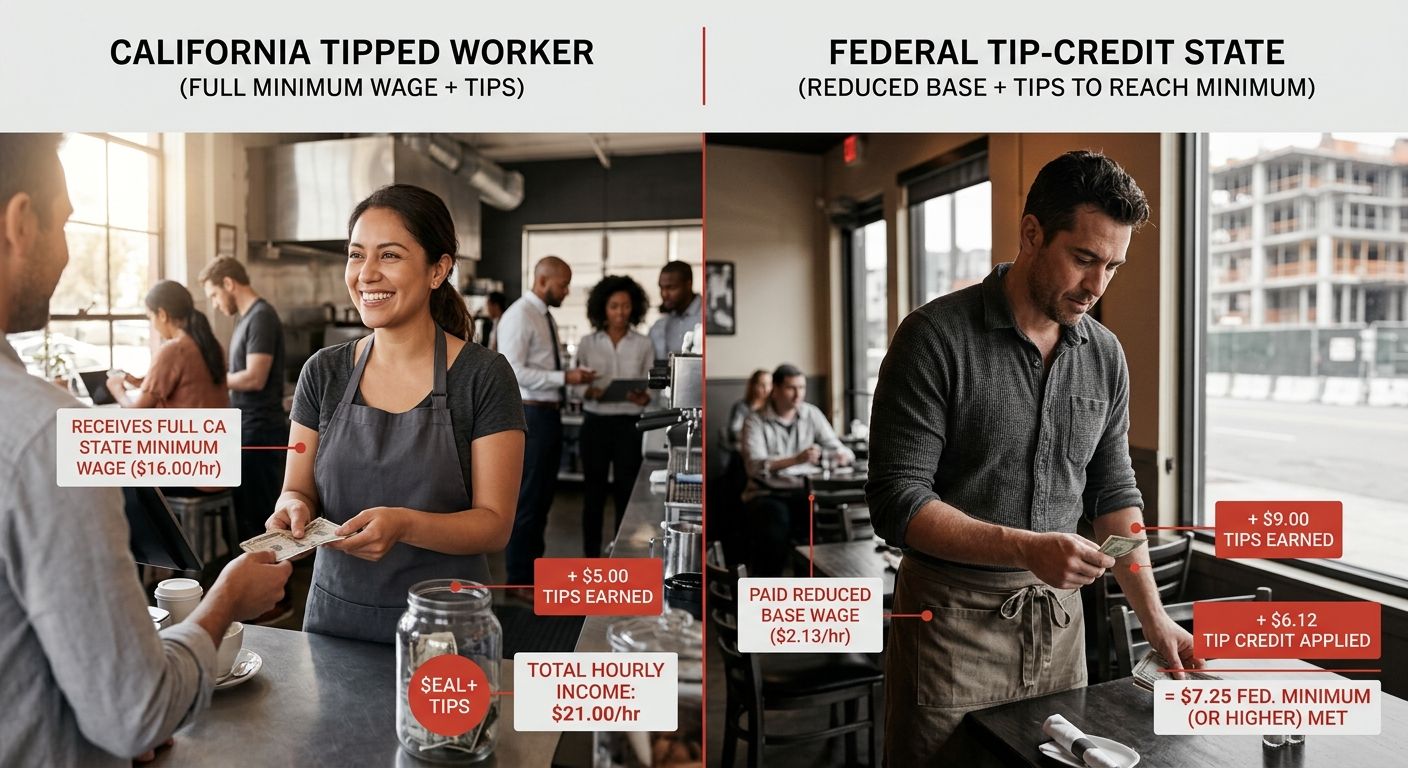
The mechanism also intersects with another California rule that distinguishes it from most states: the complete prohibition on tip credits. Unlike the federal system and the patchwork in states like Florida, California requires tipped employees to receive the full minimum wage before tips. A server at a California restaurant earning $16.90 per hour plus tips takes home every dollar of gratuity on top of that base. Congressional Democrats have pushed to eliminate the restaurant tip credit federally, a model California has maintained for decades.
California also restricts subminimum wages more tightly than most states. The learner rate, set at 85% of the minimum wage, applies only to an employee's first 160 hours of employment with a given employer. And as of January 1, 2025, California officially phased out the subminimum wage provision for workers with disabilities, aligning the state with the position that every worker deserves the full minimum regardless of ability status.
Where the Formula Breaks Down
The CPI-W indexing mechanism, for all its advantages over the old legislative-action model, has structural limits. The 3.5% annual cap means that during periods of high inflation, wages fall behind the cost of living. Between mid-2021 and mid-2023, CPI-W for the West region ran above 5% for multiple months. A 3.5% cap during a 6% inflation year is, in practice, a real-wage cut. The no-decrease guardrail protects the nominal floor during deflation, but deflation hasn't been a meaningful concern in the California economy for decades.
The industry-specific provisions under AB 1228 and SB 525 also have coverage gaps. The fast food definition excludes restaurants that operate within grocery stores or airports under certain conditions, creating gray areas that employers can exploit. SB 525's healthcare worker provisions have generated confusion about which roles within a covered facility are included: does the minimum apply to a contracted security guard working inside a hospital? The DIR has issued guidance on some of these edge cases, but litigation is ongoing.
Local ordinances introduce enforcement fragmentation. The California Labor Commissioner's Office handles statewide and industry-specific wage claims, but local minimum wage ordinances are enforced by a patchwork of city agencies with varying capacity. A worker in a city of 30,000 with a local ordinance may find fewer enforcement resources available than a worker filing a claim under the statewide rate. And for workers already navigating the complexities of organizing their workplaces against employer resistance, wage theft adds another front to fight on.
The exempt salary threshold mechanism, while elegant, creates annual compliance shocks for small employers. Every January 1, the threshold jumps, and any salaried employee who fell just above the prior year's line can suddenly become non-exempt. Employers who fail to reclassify these workers face retroactive overtime liability. The California Division of Labor Standards Enforcement received thousands of these claims in the 2024–2025 cycle.
Common Questions
Does the minimum wage at California apply to part-time and temporary workers?
Yes. California's minimum wage applies to all hours worked by all employees regardless of part-time, full-time, or temporary status. There is no reduced rate for part-time workers. The only partial exception is the 85% learner rate for the first 160 hours of employment.
Are small businesses exempt from California's minimum wage?
No. California eliminated the employer-size distinction that previously allowed businesses with 25 or fewer employees to pay a lower rate. Since 2023, every employer in the state pays the same statewide floor. Small businesses in cities with local ordinances must comply with whichever rate is higher.
How do I know if I'm a covered healthcare worker under SB 525?
SB 525 applies to employees of hospitals, clinics, nursing facilities, home health agencies, dialysis clinics, and certain other healthcare facilities licensed by the state. Coverage depends on the employer's facility type, not the individual employee's job title. A cafeteria worker employed directly by a covered hospital is included; the same worker employed by an outside catering company may not be. Check with the California DIR or your union representative for facility-specific guidance.
Can my employer count tips toward the wage minimum in California?
No. California prohibits tip credits entirely. Your employer must pay the full applicable minimum wage before tips. Every dollar you earn in gratuities is yours on top of that base. This applies statewide and is one of the strongest tip protections of any state.
What happens if my city's minimum wage is lower than the state rate?
The state rate always functions as a floor. If your city has a minimum wage ordinance that sets a rate below the statewide minimum, the statewide rate applies. If your city's rate is higher, you're entitled to the city rate. You always get the highest applicable number among federal, state, local, and industry-specific rates.
The Union Edge Staff
Frequently Asked Questions
- What is California's minimum wage in 2024 and 2026?
- California's statewide minimum wage was $16.00 per hour in 2024, increased to $16.50 in 2025, and will be $16.90 in 2026. These rates are determined by a formula based on the Consumer Price Index, capped at a maximum annual increase of 3.5%.
- How much do fast food workers earn in California?
- Fast food workers in California must be paid at least $20.00 per hour as of April 1, 2024. This applies to employees at chains with 60 or more locations nationally that require payment before eating and provide limited or no table service.
- What is the healthcare worker minimum wage in California?
- Healthcare workers in California have a phased minimum wage schedule starting October 16, 2024, with rates ranging from $18.63 to $24.00 per hour depending on facility type, with a target of $25.00 per hour by 2034. The timeline and starting rate vary based on employer category—large health systems and dialysis clinics must reach $25.00 by 2026, while smaller facilities have until 2033–2034.
- Do small businesses in California have to pay the minimum wage?
- Yes, all employers in California must pay the statewide minimum wage regardless of business size. California eliminated the employer-size distinction in 2023, so businesses with 25 or fewer employees now pay the same rate as larger companies.
- Can employers count tips toward minimum wage in California?
- No, California prohibits tip credits entirely. Employers must pay the full applicable minimum wage before tips, and employees keep 100% of their gratuities on top of the base wage.
- What is the exempt salary threshold in California for 2026?
- For 2026, the exempt salary threshold is $70,304 per year ($5,858.67 per month). Salaried employees must earn at least twice the state minimum wage to be classified as exempt from overtime protections.
- What happens if my city's minimum wage is higher than the state rate?
- California's statewide rate functions as a floor, not a ceiling. If your city has enacted a higher local minimum wage, you are entitled to the city's rate. Employees must always receive the highest applicable rate among federal, state, local, and industry-specific minimums.
- Does California's minimum wage apply to part-time workers?
- Yes, California's minimum wage applies to all employees regardless of whether they work part-time, full-time, or temporarily. The only partial exception is the 85% learner rate that applies during an employee's first 160 hours with an employer.
Related Articles

Minimum Wage California: 2024 Updates & Rates
AB 1228, SB 525, Labor Code Section 1182.12, and at least 38 local ordinances all set binding minimum wages in California, and the highest rate that applies to a given worker is the one the employer must pay.

California Minimum Wage 2025: What's Changed
Three separate legal floors governed what California employers owed their workers during 2025: a $16.50 statewide baseline, a $20.00 fast-food sector rate, and a healthcare scale climbing as high as $23.00 per hour at large hospital systems.
Minimum Wage in California 2026: What to Know
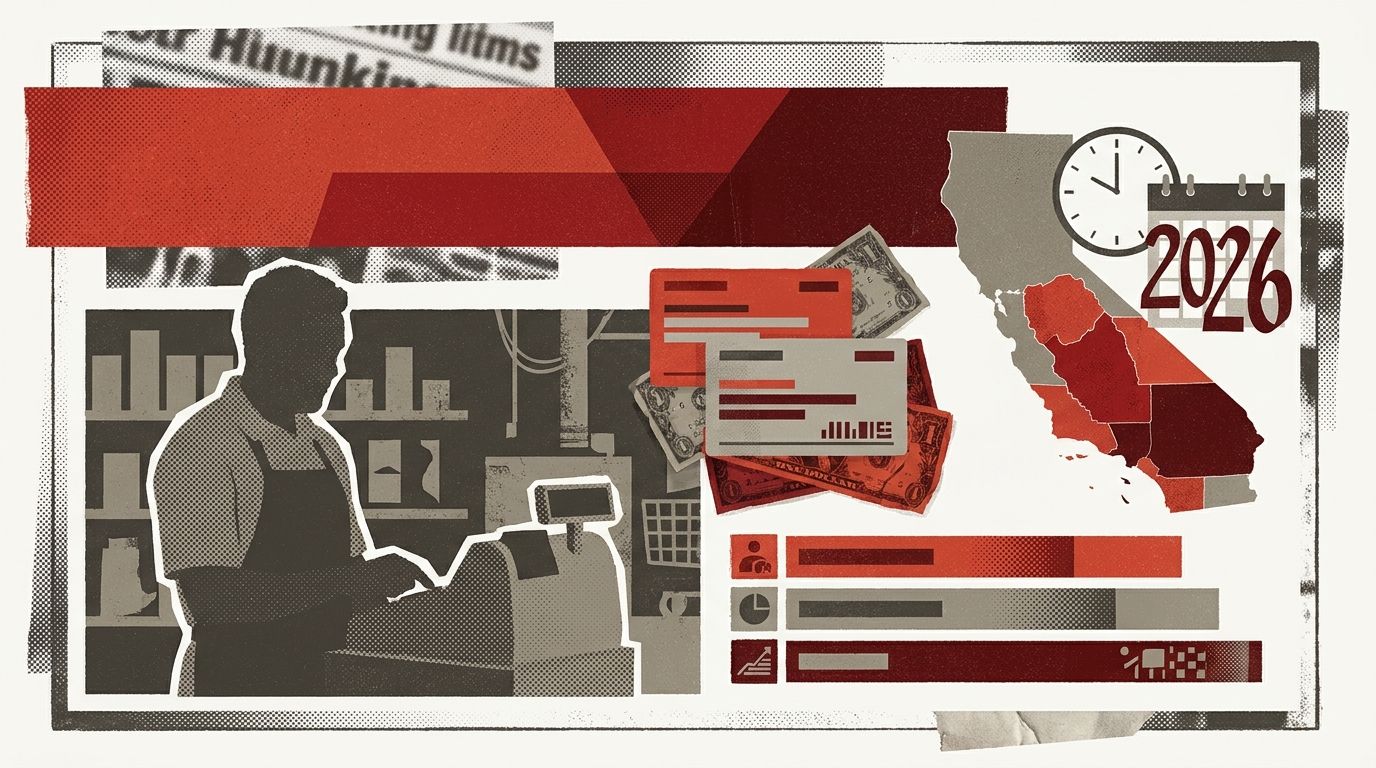
California's minimum wage in 2026 operates as a three-tier system: a CPI-indexed statewide floor of $16.90 per hour, local city and county rates reaching $20.34 in Emeryville, and industry-specific mandates pushing healthcare workers to $25.00 per hour.
Also in the paper