
Minimum Wage California: 2024 Updates & Rates
AB 1228, SB 525, Labor Code Section 1182.12, and at least 38 local ordinances all set binding minimum wages in California, and the highest rate that applies to a given worker is the one the employer must pay.

California Minimum Wage: How Three Legal Systems Set Your Pay Rate
AB 1228, SB 525, Labor Code Section 1182.12, and at least 38 local ordinances all set binding minimum wages in California, and the highest rate that applies to a given worker is the one the employer must pay. The common misunderstanding, that California has a minimum wage, obscures a layered mechanism that produces more than 40 different legal pay floors depending on geography, industry, and facility type.
The Statewide CPI Formula Under Labor Code Section 1182.12
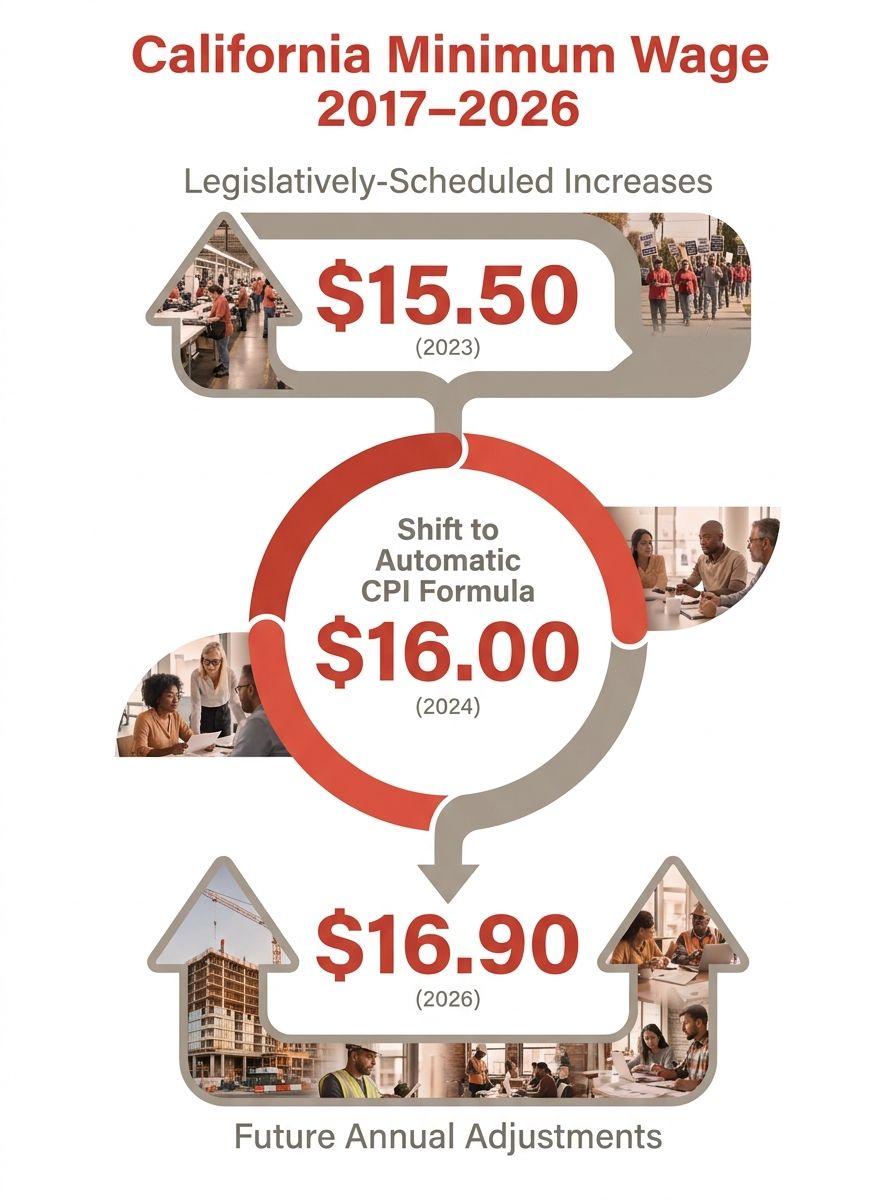
California's statewide minimum wage floor adjusts automatically every January 1 based on the prior year's change in the national Consumer Price Index, with a statutory cap of 3.5% in any single year. This automatic mechanism replaced the old system of legislatively scheduled increases that phased in the $15 rate between 2017 and 2023. According to the California Department of Industrial Relations, the current statewide rate effective January 1, 2026, is $16.90 per hour for all employers.
Here's how the recent progression looks:
Effective Date | Statewide Rate | Increase | Mechanism |
|---|---|---|---|
January 1, 2024 | $16.00/hour | , | First CPI-indexed adjustment |
January 1, 2025 | $16.50/hour | 3.12% | CPI formula |
January 1, 2026 | $16.90/hour | 2.42% | CPI formula |
The elimination of the old two-tier system (which once set different rates for employers with 25 or fewer employees versus larger ones) means every employer in California, regardless of size, pays the same statewide floor. The rate only moves upward under this formula; if the CPI were to decline, the minimum wage would hold at its current level rather than drop. That one-way ratchet is a deliberate design choice written into the statute.
For workers trying to verify what they're owed, the DIR's FAQ page specifies that the $16.90 rate applies to all employers "not otherwise covered by a higher minimum wage specific to an industry or a locality." That qualifier is where the system gets complicated.
Industry-Specific Floors: Fast Food Under AB 1228
The 2024 changes to the wage minimum in California included a dramatic restructuring of pay in the fast food sector. AB 1228, which took effect April 1, 2024, created a $20.00 per hour minimum for all employees at fast food restaurants that are part of national chains operating 60 or more locations. That $20 rate represented a 25% jump from the then-statewide floor of $16.00, implemented in a single day.
The law also established the Fast Food Council, a nine-member body with the authority to raise fast food wages annually by up to 3.5% or the change in the CPI for urban wage earners, whichever is lower. The council includes worker representatives, employer representatives, and state appointees, and it can also recommend standards on working conditions beyond wages.
The economic effects have been studied. Research from Pepperdine University and the National Bureau of Economic Research found that the $20 fast food minimum produced a 13% increase in weekly earnings for covered workers, alongside a roughly 3% reduction in employment in the sector. Those numbers illustrate a real tradeoff, and they track with what labor economists have consistently observed: sectoral wage floors create measurable income gains for workers who keep their positions, while employers adjust staffing levels and hours at the margins.
If you want a fuller breakdown of California's minimum wage rules and requirements, we've covered the compliance details in depth.
Healthcare Floors Under SB 525
SB 525, signed by Governor Gavin Newsom alongside AB 1228 in late 2023 and taking initial effect on October 16, 2024, created a separate wage floor for healthcare facility employees. The law phases in a $25.00 per hour minimum by June 2028, but the implementation timeline varies by facility type. Large hospital systems and dialysis clinics hit higher thresholds sooner. Rural hospitals and smaller clinics operate on a slower schedule, with many seeing their next adjustment on July 1, 2026.
The covered workforce is broad: nurses' aides, medical technicians, housekeepers, food service workers, and other support staff at qualifying healthcare facilities all fall under SB 525. The law defines "healthcare facility" expansively to include hospitals, clinics, skilled nursing facilities, and certain outpatient settings. As CalMatters reported when the law was signed, Governor Newsom positioned both industry-specific laws as responses to pandemic-era recognition that essential workers in these sectors were structurally underpaid.
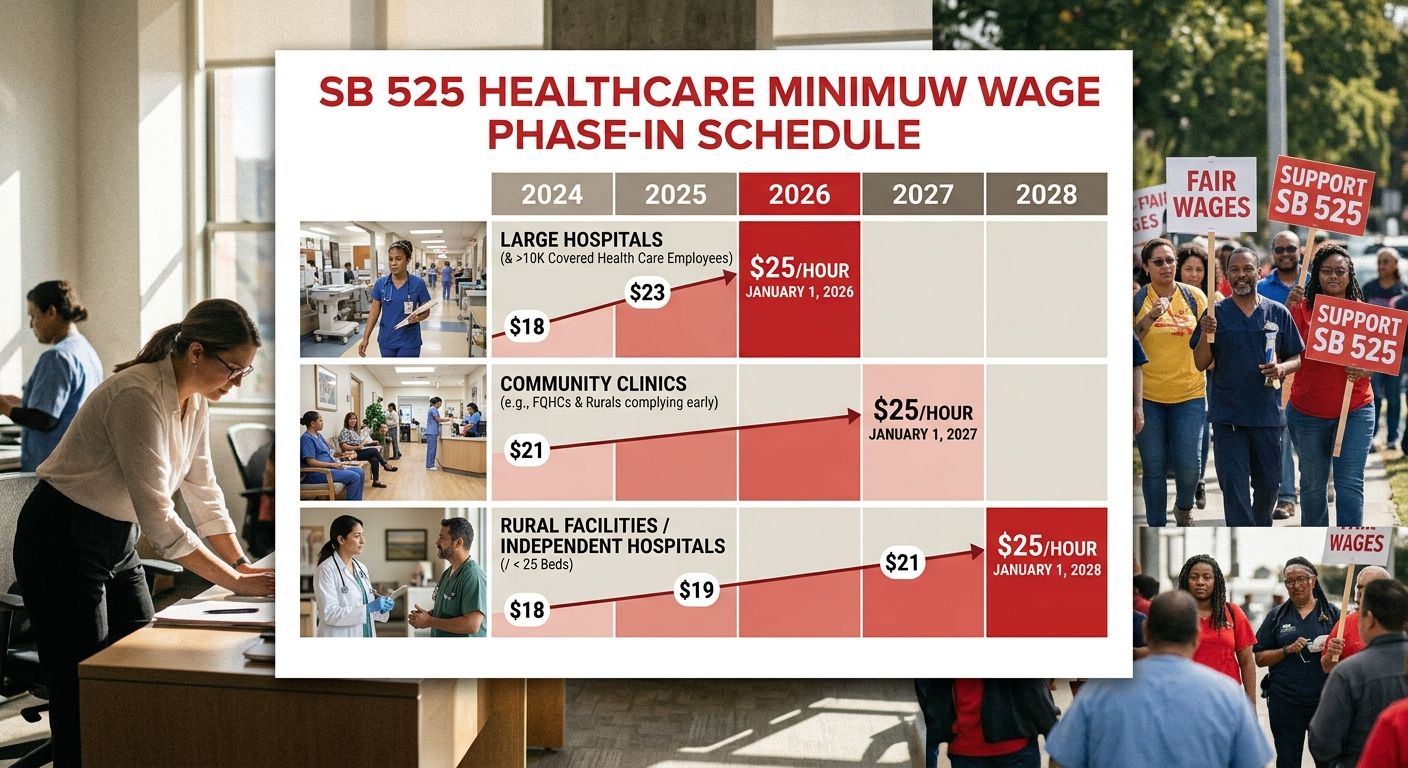
The interaction between SB 525 and local ordinances is worth noting. A healthcare worker in San Francisco, for instance, is covered by the city's own minimum ($19.18), the state floor ($16.90), and the SB 525 healthcare rate. The employer must pay whichever is highest, and as SB 525 ratchets upward, it will increasingly become the binding rate for healthcare workers statewide.
Local Ordinances That Stack on Top
The minimum wage for California workers in dozens of cities exceeds the state rate by a significant margin. The UC Berkeley Labor Center tracks at least 38 cities that enforce their own minimum wage ordinances, each with different effective dates, CPI adjustment formulas, and sometimes different rates based on employer size or whether the business provides health benefits.
Here are some of the highest local rates as of 2026:
City | 2026 Rate | Notes |
|---|---|---|
West Hollywood | $20.25/hour | Highest general rate statewide |
San Francisco | $19.18/hour | CPI-adjusted annually |
Berkeley | $19.18/hour | CPI-adjusted annually |
Emeryville | $19.36/hour | CPI-adjusted annually |
Los Angeles | $17.87/hour | Hotels with 60+ rooms: $22.50 |
The practical effect is that a worker's minimum wage pay in California depends first on their physical work location, then on their industry, and last on the statewide floor. An employer with locations in multiple cities can owe different hourly minimums at each site. Our breakdown of minimum wage rates by county in California covers these local variations in more detail.
One mechanism that catches employers off guard: many local ordinances adjust on July 1 rather than January 1. San Francisco, Berkeley, Emeryville, and several other Bay Area cities use mid-year CPI adjustments, which means an employer compliant on June 30 can be in violation on July 1 without any action by the state legislature. There is no single statewide database that automatically notifies employers of local changes, tracking is the employer's responsibility.
The Exempt Employee Salary Threshold
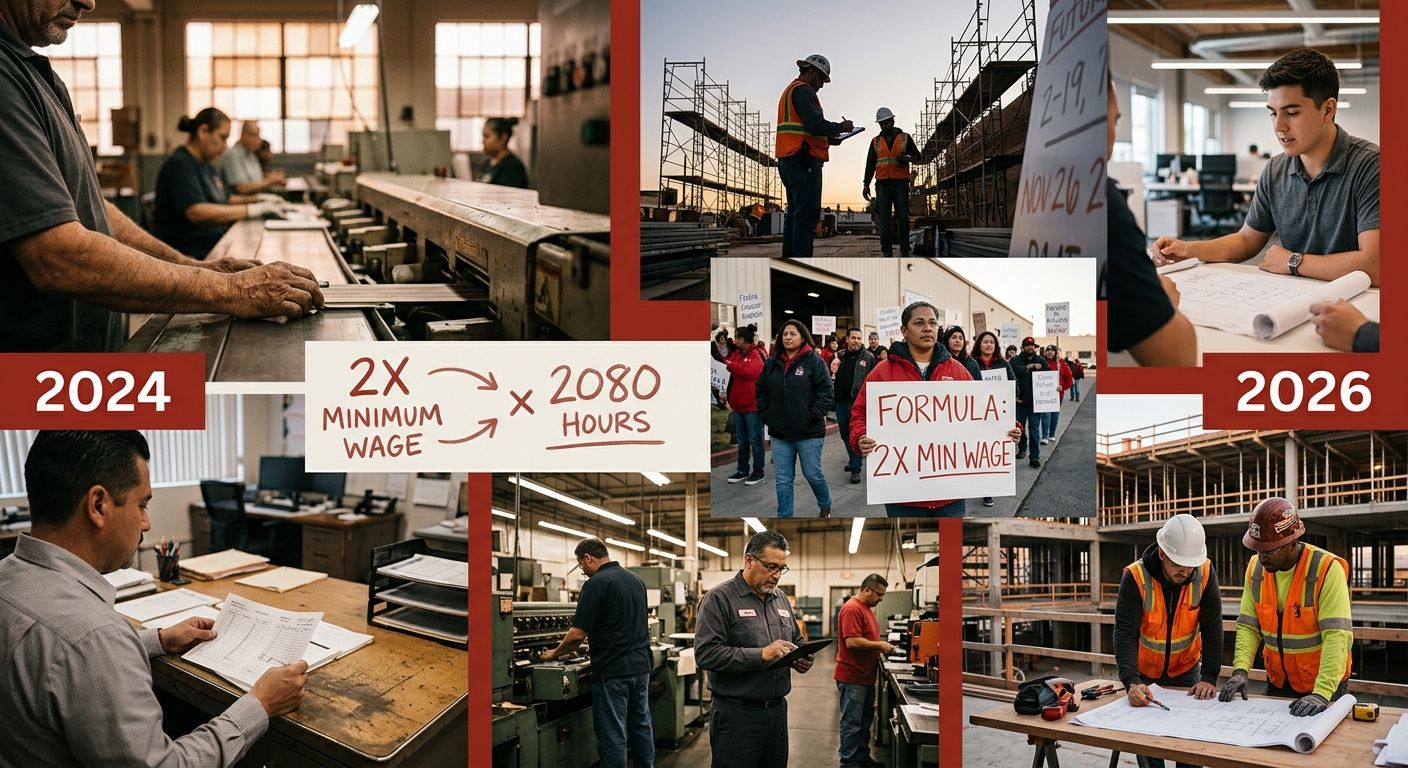
California's minimum wage also determines who qualifies as a salaried exempt employee under state law. To be classified as exempt from overtime protections, a worker must earn at least twice the state minimum wage for full-time employment. As of January 1, 2025, according to the California Labor Commissioner's Office, that threshold was $68,640 per year ($16.50 × 2 × 2,080 hours). With the 2026 rate at $16.90, the exempt salary threshold has risen to $70,304 annually.
This automatic link between the minimum wage and the exemption threshold means every CPI-driven increase to the minimum wage for California workers simultaneously raises the salary floor for exempt classification. An employer who classified a salaried manager at $69,000 in 2025 and failed to adjust in 2026 now has a non-exempt employee entitled to overtime pay, meal and rest break protections, and all the other hourly-worker rights under the Labor Code.
The stakes are high. Misclassification of even a single employee can trigger liability for unpaid overtime, missed meal and rest period premiums, waiting time penalties, and attorneys' fees. For context, other states handle this relationship differently, you can see how New York City structures its wage floors for comparison.
No Tip Credit: A Critical Difference
California prohibits tip credits entirely. Under federal law and the laws of many other states, employers can pay tipped workers a lower cash wage (as low as $2.13/hour federally) and count tips toward the minimum wage obligation. California law forbids this. Every employer must pay the full minimum wage at california, state, local, or industry-specific, whichever is highest, before any tips are factored in.
This means a server at a fast food chain in West Hollywood must receive at least $20.25 per hour (the local rate, which exceeds the $20 fast food floor) in direct wages, with all tips on top of that amount. Congressional efforts to eliminate the federal tip credit entirely would bring the rest of the country closer to California's existing model.
The no-tip-credit rule is one of the strongest wage protections in the country for tipped workers, and it interacts with the layered rate system in ways that make California's effective compensation for restaurant and hospitality workers significantly higher than in states that allow tip credits.
Where the Mechanism Breaks
The three-layer system has real failure points. The first is an information problem: with 38+ local ordinances, two industry-specific statutes, and the statewide CPI formula all operating independently, workers and small employers often don't know which rate applies. The DIR publishes statewide rates, but there is no consolidated, real-time database of every active local minimum wage in the state. The UC Berkeley Labor Center's archive is the closest thing, and it's maintained by a university research center, not a government enforcement body.
The second failure point is enforcement. California's Labor Commissioner processes wage claims after violations occur, but proactive auditing of minimum wage compliance across 40+ jurisdictions is thin. Workers who don't file claims, because they fear retaliation, don't know their rights, or are undocumented, fall through the gaps.
The third is the CPI cap. The 3.5% annual limit on statewide increases means that in years of high inflation, the minimum wage loses purchasing power in real terms. Between mid-2021 and mid-2023, California's CPI rose well above 3.5% annually, and the cap prevented the minimum wage from keeping pace. The mechanism works well in low-to-moderate inflation environments but structurally lags during inflationary spikes.
And the fast food and healthcare carve-outs, while significant for covered workers, leave out entire sectors. Warehouse workers, agricultural laborers, retail employees, and domestic workers all remain on the statewide or local floor. The 2024 reforms chose two politically visible industries for targeted intervention and left broader wage compression unaddressed.
Common Questions
Does California's minimum wage apply to all workers, including part-time and temporary employees?
Yes. California's minimum wage of $16.90 per hour (as of January 2026) applies to all employees regardless of hours worked, whether they're full-time, part-time, seasonal, or temporary. The relevant factor is where the work is performed and in what industry, not the employment arrangement.
Which rate applies if a city's minimum wage is different from the state rate?
The highest applicable rate always governs. If a worker in San Francisco is employed at a fast food chain, the employer compares the state rate ($16.90), the local rate ($19.18), and the fast food rate ($20.00), and must pay $20.00. If that same worker were in a non-fast-food job, the local $19.18 rate would apply because it exceeds the statewide floor.
Do California employers get a tip credit that reduces the minimum wage they owe?
No. California is one of seven states that prohibit tip credits entirely. Employers must pay the full applicable minimum wage in direct hourly compensation, and tips belong entirely to the employee on top of that amount. This applies at every rate tier, statewide, local, and industry-specific.
How does the exempt salary threshold change when the minimum wage goes up?
The exempt salary threshold equals twice the state minimum wage multiplied by 2,080 hours (a standard work year). At $16.90/hour, the 2026 threshold is $70,304. Any salaried worker earning less than this amount cannot legally be classified as exempt from overtime, regardless of job title or duties.
When does the state minimum wage adjust each year, and can it go down?
The statewide rate adjusts every January 1 based on the prior year's national CPI, with a 3.5% annual cap. The rate can only increase or stay flat, the formula does not allow decreases even if the CPI falls. Many local ordinances adjust on different dates, with several Bay Area cities updating on July 1 instead.
The Union Edge Staff
Frequently Asked Questions
- What is the California minimum wage for 2024 and 2025?
- California's statewide minimum wage is $16.00 per hour effective January 1, 2024, and $16.50 per hour effective January 1, 2025. As of January 1, 2026, the rate is $16.90 per hour and applies to all employers not covered by a higher industry-specific or local minimum wage.
- What is the California fast food minimum wage?
- AB 1228 established a $20.00 per hour minimum wage for employees at fast food restaurants that are part of national chains operating 60 or more locations, effective April 1, 2024. The Fast Food Council can adjust this rate annually by up to 3.5% or the CPI change, whichever is lower.
- How much do healthcare workers make under SB 525?
- SB 525 phases in a $25.00 per hour minimum wage for healthcare facility employees by June 2028, with large hospital systems and dialysis clinics reaching higher thresholds sooner and rural hospitals operating on a slower schedule. The law covers nurses' aides, medical technicians, housekeepers, food service workers, and other support staff at qualifying healthcare facilities.
- Do California employers have to pay tips or can they use a tip credit?
- California prohibits tip credits entirely. Employers must pay the full applicable minimum wage in direct compensation before any tips are factored in, and all tips belong entirely to the employee on top of that hourly wage.
- What are the highest local minimum wages in California?
- West Hollywood has the highest local rate at $20.25 per hour, followed by Emeryville at $19.36 per hour, and San Francisco and Berkeley each at $19.18 per hour as of 2026. Los Angeles's general rate is $17.87 per hour, though hotels with 60 or more rooms must pay $22.50.
- What is the exempt salary threshold in California for 2026?
- As of January 1, 2026, the exempt salary threshold is $70,304 annually, which equals twice the state minimum wage ($16.90) multiplied by 2,080 hours. Any salaried worker earning below this amount cannot be classified as exempt from overtime protections.
- When does California's minimum wage adjust and can it decrease?
- The statewide minimum wage adjusts every January 1 based on the prior year's national CPI, with a 3.5% annual cap. The rate can only increase or remain flat—it cannot decrease even if the CPI falls, by design of the statute.
Related Articles

Minimum Wage in California: 2024 Rules & Requirements
California's minimum wage is a formula-driven system that recalculates every January 1 based on changes in the Consumer Price Index, capped at 3.5% annually. The statewide floor rose from $16.00 per hour in 2024 to $16.

California Minimum Wage 2025: What's Changed
Three separate legal floors governed what California employers owed their workers during 2025: a $16.50 statewide baseline, a $20.00 fast-food sector rate, and a healthcare scale climbing as high as $23.00 per hour at large hospital systems.

What Is the Minimum Salary Wage in California
California's minimum wage is $16.90 per hour as of January 1, 2026, and that single number sets off a chain reaction across salary thresholds, industry-specific floors, and local ordinances that together determine what every worker in the state must legally be paid.
Also in the paper