
Minimum Wage in Florida USA: Current Rates 2024
Florida's minimum wage is a constitutionally mandated rate that increases automatically each September 30 without any legislative vote. The current rate is $14.00 per hour, effective since September 30, 2025, and the constitutional escalator driving these raises keeps the floor $6.

Minimum Wage in Florida USA: The Constitutional Mechanism Behind Every Annual Raise
Florida's minimum wage is a constitutionally mandated rate that increases automatically each September 30 without any legislative vote. The current rate is $14.00 per hour, effective since September 30, 2025, and the constitutional escalator driving these raises keeps the floor $6.75 above the frozen federal minimum of $7.25.
The Constitutional Amendment Behind Florida's Wage Floor
Florida's minimum wage exists because voters put it there. Twice. The first time was in 2004, when Amendment 5 established a state minimum wage and tied future increases to inflation. The second time was November 3, 2020, when Amendment 2 rewrote Article X, Section 24 of the Florida Constitution to create a fixed $1.00-per-year escalator toward $15.00.
This distinction carries real weight for working people. A statutory minimum wage can be repealed, amended, or frozen by a hostile legislature in a single session. A constitutional minimum wage requires another constitutional amendment to change, which in Florida demands 60% voter approval at a general election. The legislature cannot touch it. The governor cannot veto it. The rate increases happen automatically, by operation of the constitution itself.
Before 2004, Florida had no state minimum wage at all. Workers fell back on the federal rate, which was $5.15 per hour at the time. The 2004 amendment fixed that gap, and the 2020 amendment accelerated the trajectory dramatically. Florida State University's Office of Human Resources documented the full arc: a trajectory from $8.65 to $15.00 per hour by September 2026, a 73% increase over five years.
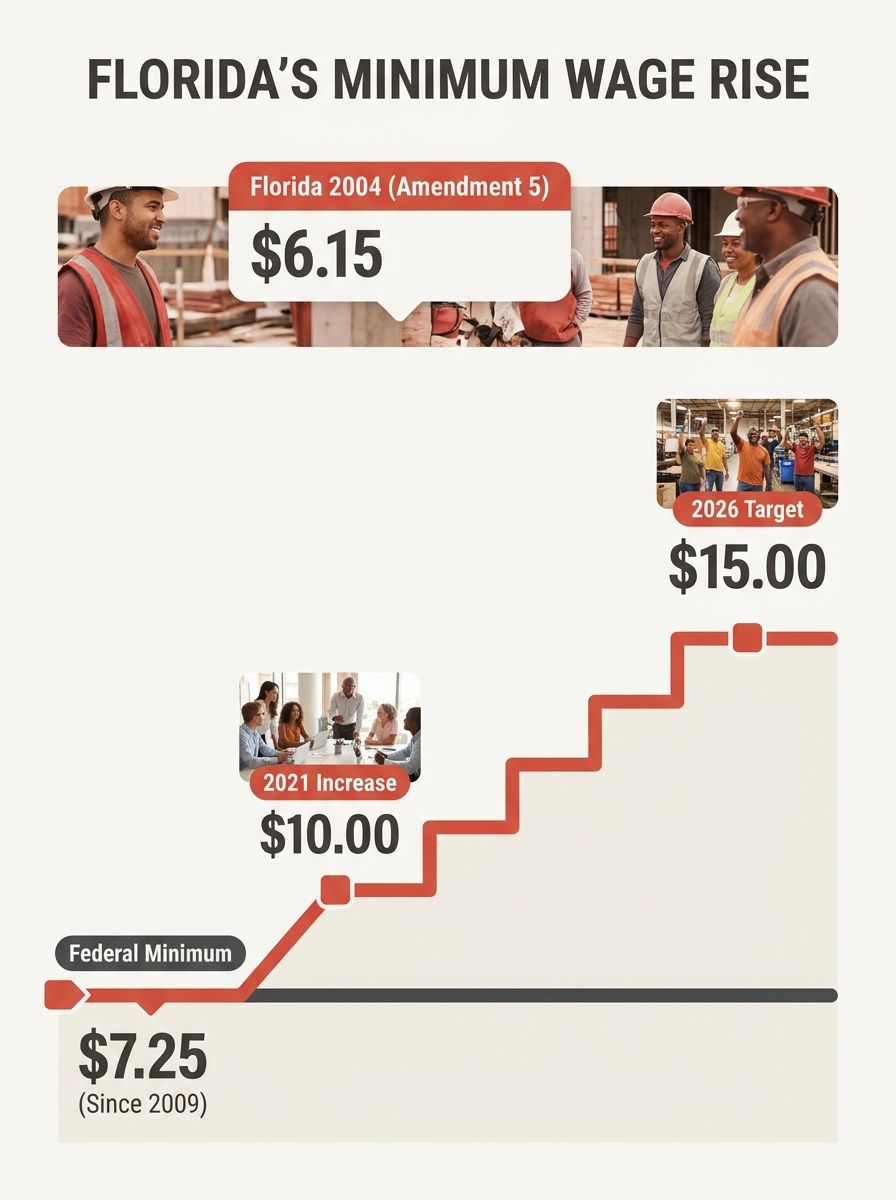
The constitutional route is significant from a civil rights perspective. When elected officials in Tallahassee refused to raise wages for more than a decade, Florida workers used direct democracy to do it themselves. Amendment 2 passed with over 60% support in the same election that saw Florida vote for a presidential candidate who opposed a federal minimum wage increase. The wage floor had bipartisan support among voters even when it didn't among politicians.
The Year-by-Year Rate Schedule
Each increase takes effect on September 30, not January 1. This timing catches some employers off guard because it doesn't align with the federal fiscal year, the calendar year, or most payroll cycles. The Florida Department of Economic Opportunity publishes each new rate annually to give employers advance notice.
Here's the full escalator schedule created by Amendment 2:
Effective Date | Standard Rate | Tipped Cash Wage | Tip Credit |
|---|---|---|---|
September 30, 2021 | $10.00 | $6.98 | $3.02 |
September 30, 2022 | $11.00 | $7.98 | $3.02 |
September 30, 2023 | $12.00 | $8.98 | $3.02 |
September 30, 2024 | $13.00 | $9.98 | $3.02 |
September 30, 2025 | $14.00 | $10.98 | $3.02 |
September 30, 2026 | $15.00 | $11.98 | $3.02 |
The 2024 minimum wage in Florida USA was $13.00 per hour, applying from September 30, 2024, through September 29, 2025. Workers who were paid below that rate during that window have a wage theft claim under state law.
For context, the federal minimum wage has remained at $7.25 per hour since 2009. When September 2026 arrives, Florida's $15.00 floor will be more than double the federal rate. Congressional Democrats have proposed raising the federal floor to $25 per hour, but no federal increase has passed in 17 years.
How the Tipped Wage Calculation Works
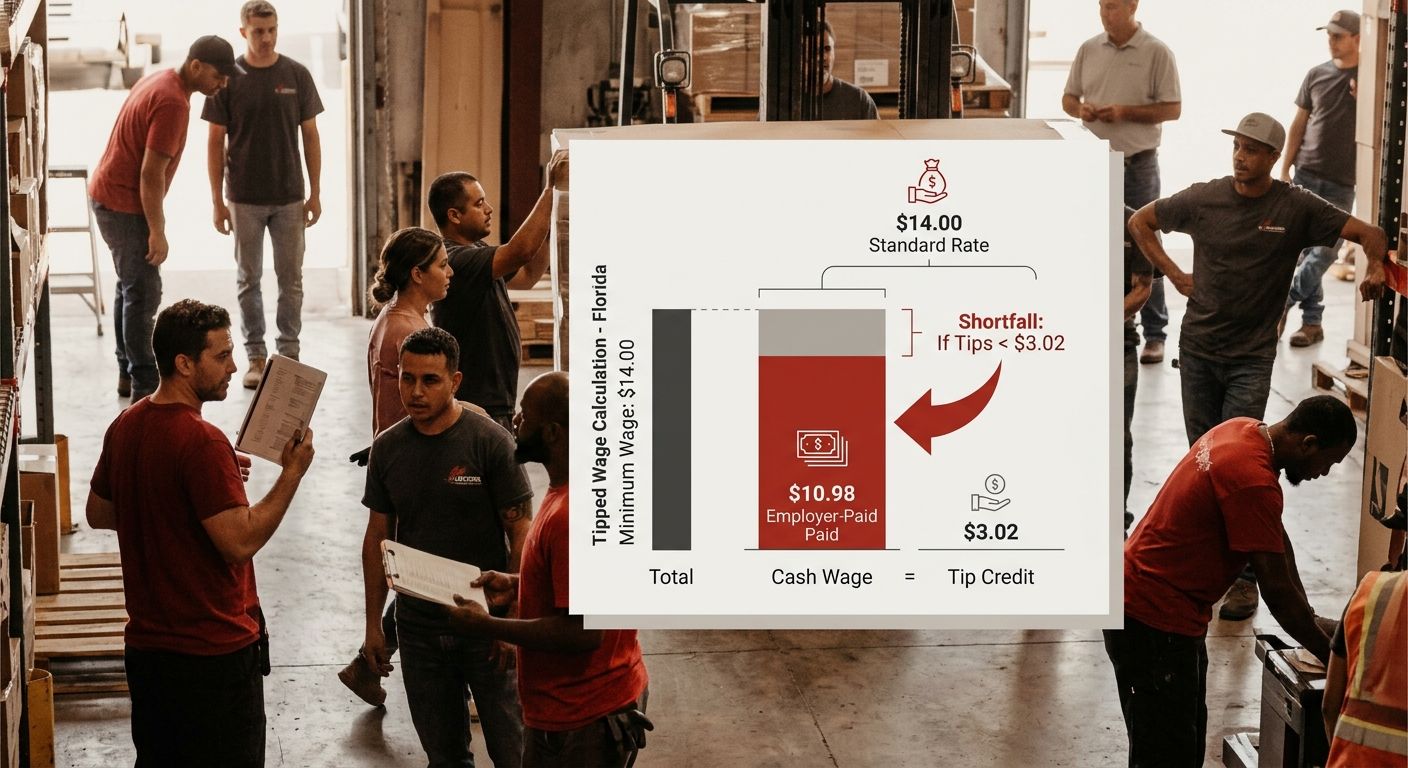
Florida allows employers to pay tipped employees a lower cash wage, but the math has strict rules baked into the constitutional text. The tip credit is fixed at $3.02 per hour under the amendment. That means the tipped cash wage always equals the standard minimum wage minus $3.02.
At the current $14.00 rate, tipped workers must receive at least $10.98 per hour in direct cash wages. Their tips must bring total hourly compensation to at least $14.00. If tips fall short in any given workweek, the employer is legally required to make up the difference. No exceptions.
An employer cannot average tips across a two-week pay period, cannot count tips from a high-earning Saturday to cover a slow Tuesday, and cannot deduct credit card processing fees from tips to a degree that drops total compensation below the minimum. Violations are common in the restaurant and hospitality industries, and workers who experience them can file complaints with the Florida Department of Economic Opportunity or pursue private civil action.
Understanding how the tipped minimum wage works in Florida matters especially as federal debates about eliminating the restaurant tip credit continue to surface.
The CPI Switch Coming in 2027
The $1.00 annual escalator ends after the September 30, 2026, increase to $15.00. Starting in 2027, Florida's minimum wage adjusts annually based on the Consumer Price Index (CPI), the same inflation-indexing mechanism that governed the rate between 2004 and 2020 under the original Amendment 5.
This shift has significant implications for workers. During periods of low inflation, annual increases could shrink to $0.10 or $0.15. During periods of high inflation like 2022-2023, when CPI spiked above 8%, the adjustment could be substantial. The CPI mechanism has a floor of zero, meaning the wage can never decrease even if prices drop. The rate can only go up or stay flat.
Whether CPI-based adjustments after 2026 will keep pace with housing costs, health insurance premiums, and grocery prices in Florida's high-cost metro areas is a genuine structural concern. CPI tracks a national basket of consumer goods, not Florida-specific costs. Florida's housing market has inflated faster than the national CPI in every year since 2020, which means CPI adjustments will trail the actual cost increases that Florida workers face on rent, utilities, and insurance.
Who the Standard Rate Doesn't Cover
The constitutional amendment establishes a floor, but several categories of workers fall into gaps or exemptions under federal law that interact with state protections in complicated ways.
Full-time students employed by their university can be paid 85% of the minimum wage under a Department of Labor certificate. Workers under 20 years old can be paid a federal "youth minimum" of $4.25 per hour for their first 90 consecutive calendar days on a job, though Florida's constitutional language does not explicitly authorize this carve-out, creating ambiguity that state courts have not fully resolved.
Agricultural workers, particularly those paid on a piece-rate basis, present another boundary case. The minimum wage still applies, but calculating compliance requires dividing total piece-rate earnings by total hours worked in a given week. Employers in Florida's citrus, tomato, and sugarcane industries have historically undercounted hours or inflated piece-rate productivity estimates to avoid minimum wage liability. The Coalition of Immokalee Workers has spent decades fighting these practices through farmworker organizing campaigns and negotiating Fair Food Program agreements with major corporate buyers.
Independent contractors are excluded entirely from minimum wage protection. Florida has no state-level test for worker misclassification that differs from the federal standard, and gig economy companies operating in the state classify drivers, delivery workers, and other platform laborers as contractors. A worker classified as a contractor has no minimum wage guarantee under either state or federal law, regardless of how many hours they work or how little they earn.

Where the Constitutional Mechanism Falls Short
Florida's amendment locks in a statewide floor, but it also locks out local variation. State preemption law prevents cities and counties from setting their own minimum wages. Miami-Dade County, where the MIT Living Wage Calculator estimates a single adult needs over $21.00 per hour to cover basic expenses, must abide by the same $14.00 floor as rural counties where costs are lower. This one-size-fits-all structure means the constitutional rate functions as a meaningful raise in parts of the Panhandle while falling well short of a living wage in South Florida.
The $15.00 rate arriving in September 2026 represented a meaningful target when voters approved it in 2020. Adjusted for inflation since that vote, $15.00 in 2026 buys roughly what $12.80 bought in November 2020. The amendment succeeded in raising the floor substantially over five years. It could not, and structurally cannot, keep the floor aligned with the actual cost of living in Florida's most expensive markets over time.
And the amendment contains no enforcement mechanism of its own. Workers whose employers violate the minimum wage must file complaints or lawsuits under existing state and federal frameworks. There is no dedicated enforcement agency, no automatic audit trigger, and no penalty structure written into Article X, Section 24. The right exists in the constitution. Enforcement depends on workers knowing their rights and being willing to assert them, which is where understanding how employers resist organizing becomes essential for workers who want collective power behind their wage claims.
The same structural gap applies to the tipped wage protections in Florida. The amendment created the right. It did not create the infrastructure to make that right reliable for the workers who need it most.
Common Questions
Does the minimum wage in Florida USA apply to all workers?
The $14.00 rate (rising to $15.00 on September 30, 2026) applies to all employees covered under Florida's constitutional amendment. Exemptions exist under federal law for certain student workers, youth employees in their first 90 days, and workers classified as independent contractors. Agricultural piece-rate workers are covered but face distinct compliance challenges around hour calculation.
What happens if my tips don't bring my total pay to the minimum wage?
Your employer must pay the difference. If your cash wage of $10.98 plus tips in a given workweek totals less than $14.00 per hour for all hours worked, the employer is legally obligated to make up the shortfall. Failure to do so constitutes wage theft under Florida law, and you can file a complaint with the Department of Economic Opportunity.
Will Florida's minimum wage keep going up after $15.00?
Yes, but through a different mechanism. Starting in 2027, annual increases will be based on the Consumer Price Index rather than the fixed $1.00 escalator. Increases could be larger or smaller than $1.00 depending on inflation, but the constitutional text guarantees the rate can never decrease.
Can Florida cities set their own higher minimum wages?
No. Florida's state preemption law prohibits cities and counties from establishing local minimum wages above the state floor. Workers in high-cost areas like Miami, Tampa, and Orlando earn the same constitutional minimum as workers in lower-cost rural counties.
How does Florida's rate compare to other states?
At $14.00, Florida sits above the national median for state minimum wages and $6.75 higher than the federal floor of $7.25. States like California ($16.50) and Washington ($16.66) have higher rates, while 20 states still default to the unchanged federal $7.25 rate. The September 2026 increase to $15.00 will push Florida further ahead, putting the state's wage floor at more than double the federal minimum.
The Union Edge Staff
Frequently Asked Questions
- What is the current minimum wage in Florida 2024?
- Florida's minimum wage is $14.00 per hour, effective since September 30, 2025. The rate increases automatically each September 30 under a constitutional amendment, and will reach $15.00 on September 30, 2026.
- When does Florida minimum wage increase each year?
- Florida's minimum wage increases on September 30 each year, not January 1. This timing is set by Amendment 2 to the Florida Constitution, which mandates automatic annual increases without requiring legislative approval.
- What is the tipped minimum wage in Florida?
- Tipped employees in Florida must receive a minimum cash wage of $10.98 per hour at the current $14.00 rate, with a fixed tip credit of $3.02 per hour. If tips don't bring total compensation to $14.00 in a workweek, the employer must make up the difference.
- How much will Florida minimum wage be in 2026?
- Florida's minimum wage will increase to $15.00 per hour on September 30, 2026, which was the final fixed increase under Amendment 2. After that date, adjustments will switch to inflation-based indexing tied to the Consumer Price Index.
- Can Florida cities set their own minimum wage higher than the state rate?
- No, Florida state preemption law prohibits cities and counties from establishing local minimum wages above the state floor. Workers in high-cost areas like Miami must earn the same constitutional minimum as workers in lower-cost rural counties.
- What happens after September 2026 with Florida minimum wage increases?
- After the $15.00 rate takes effect on September 30, 2026, Florida's minimum wage will adjust annually based on the Consumer Price Index (CPI) rather than the fixed $1.00 escalator. Increases could be larger or smaller than $1.00 depending on inflation, but the rate can never decrease.
- How much higher is Florida's minimum wage than the federal minimum?
- At $14.00 per hour, Florida's minimum wage is $6.75 above the federal minimum of $7.25, which has remained unchanged since 2009. When it reaches $15.00 in September 2026, Florida's rate will be more than double the federal floor.
- What can I do if my employer doesn't pay Florida minimum wage?
- Workers who receive below minimum wage can file a wage theft complaint with the Florida Department of Economic Opportunity or pursue private civil action under state law. Employers who fail to display the official minimum wage poster in the workplace also violate state law separately from wage theft claims.
Related Articles

Minimum Wage in Florida: 2024 Rate Changes
Before 2004, Florida had no state minimum wage at all. Voters fixed that twice through constitutional amendments, the second of which created a fixed $1.00-per-year escalator that brought the minimum wage in Florida to $13.00 per hour on September 30, 2024, with a $15.

What Is the Florida Minimum Wage in 2024
Florida's minimum wage for 2024 is $13.00 per hour, a rate that took effect on September 30, 2024, under a constitutional amendment voters passed in 2020 to bypass a state legislature that wouldn't act. The tipped employee cash wage for the same period is $9.98 per hour.

What Is the State of Florida Minimum Wage
Amendment 2, ratified by Florida voters in November 2020, embedded a minimum wage escalator directly into Article X of the state constitution, removing the rate from legislative control entirely. The current floor is $14.00 per hour for non-tipped workers and $10.
Also in the paper