
US Minimum Wage Florida: 2024 Rates & Updates
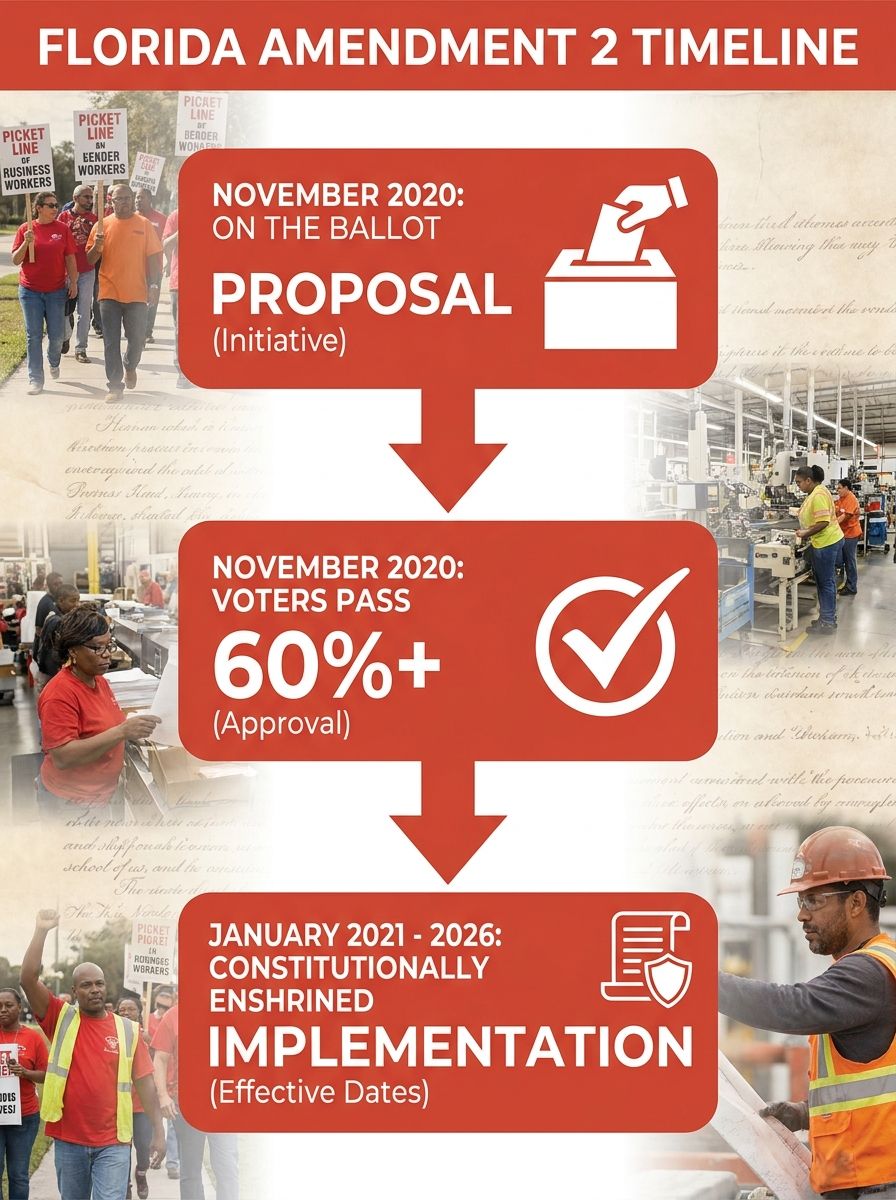
Amendment 2, the constitutional provision Florida voters approved on November 3, 2020, locked the state's minimum wage into a fixed $1-per-year escalator that no governor or legislature can repeal.

How Florida's Minimum Wage Actually Works: Amendment 2, the $1-Per-Year Ladder, and What Comes After $15
Amendment 2, the constitutional provision Florida voters approved on November 3, 2020, locked the state's minimum wage into a fixed $1-per-year escalator that no governor or legislature can repeal. The rate reached $13 per hour on September 30, 2024, the fourth step in a six-year climb toward $15, with a tipped minimum of $9.98 per hour during that same period.
The Constitutional Mechanism Behind Amendment 2
Florida's minimum wage sits inside Article X, Section 24 of the state constitution, placed there by direct ballot initiative. The amendment's own text declares that "all working Floridians are entitled to be paid a minimum wage sufficient to provide a decent and healthy life, that protects their employers from unfair low wage competition, and that does not force them to rely on taxpayer-funded public services," according to legislative analysis of HB 433.
That language matters. By embedding the wage floor in the constitution rather than passing a statute, Florida voters chose the most durable legal structure available in state law. A statute can be amended or repealed by a simple legislative majority. A constitutional provision requires another statewide ballot measure. The us minimum wage florida workers receive is, in this sense, a constitutionally protected right on the same legal footing as property protections and due process guarantees.
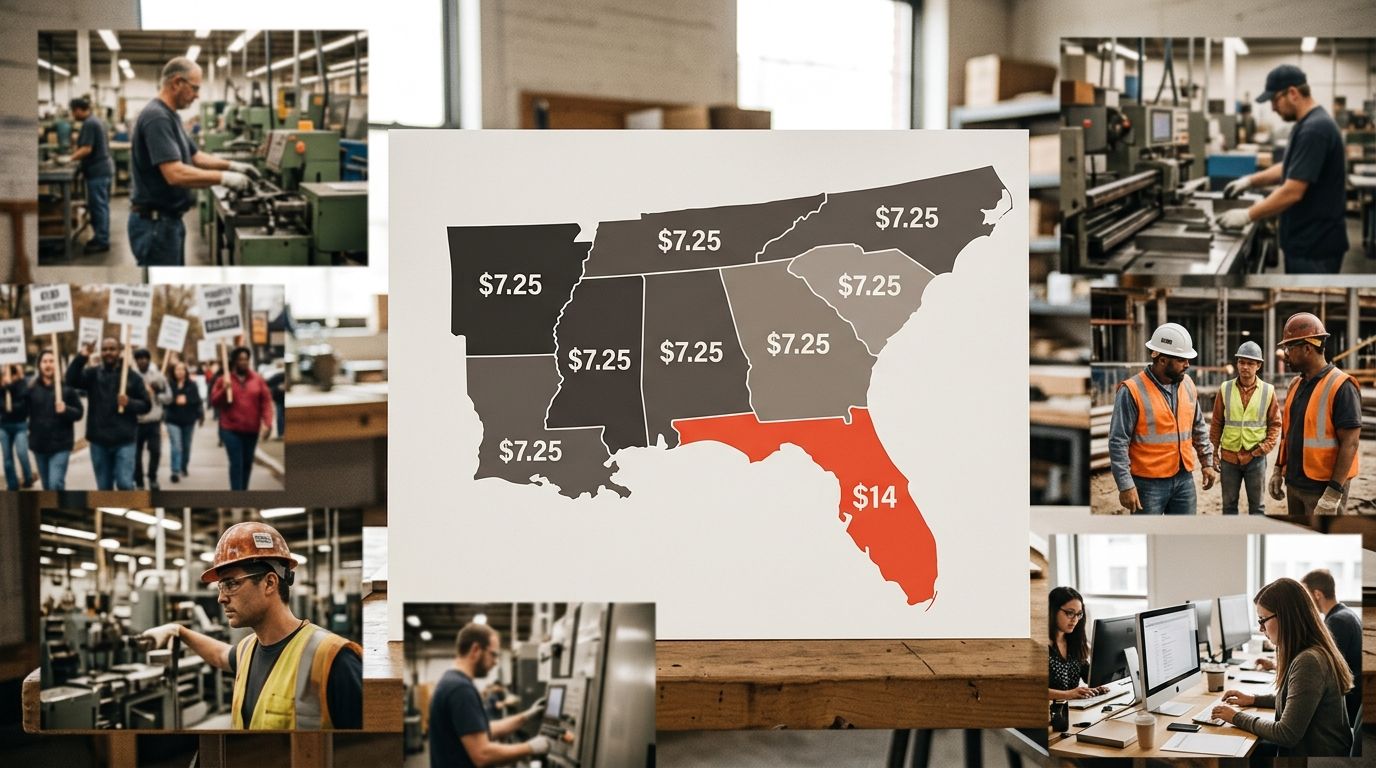
This differs sharply from how most states set their floors. States like Georgia, Kentucky, Tennessee, and South Carolina have no state minimum wage above the federal rate and default to $7.25 per hour. Legislatures in those states would need to pass new laws to raise their rates, a process that stalls easily under political pressure. Florida bypassed that chokepoint entirely.
The Step Schedule: $10 to $15 in Six Annual Jumps
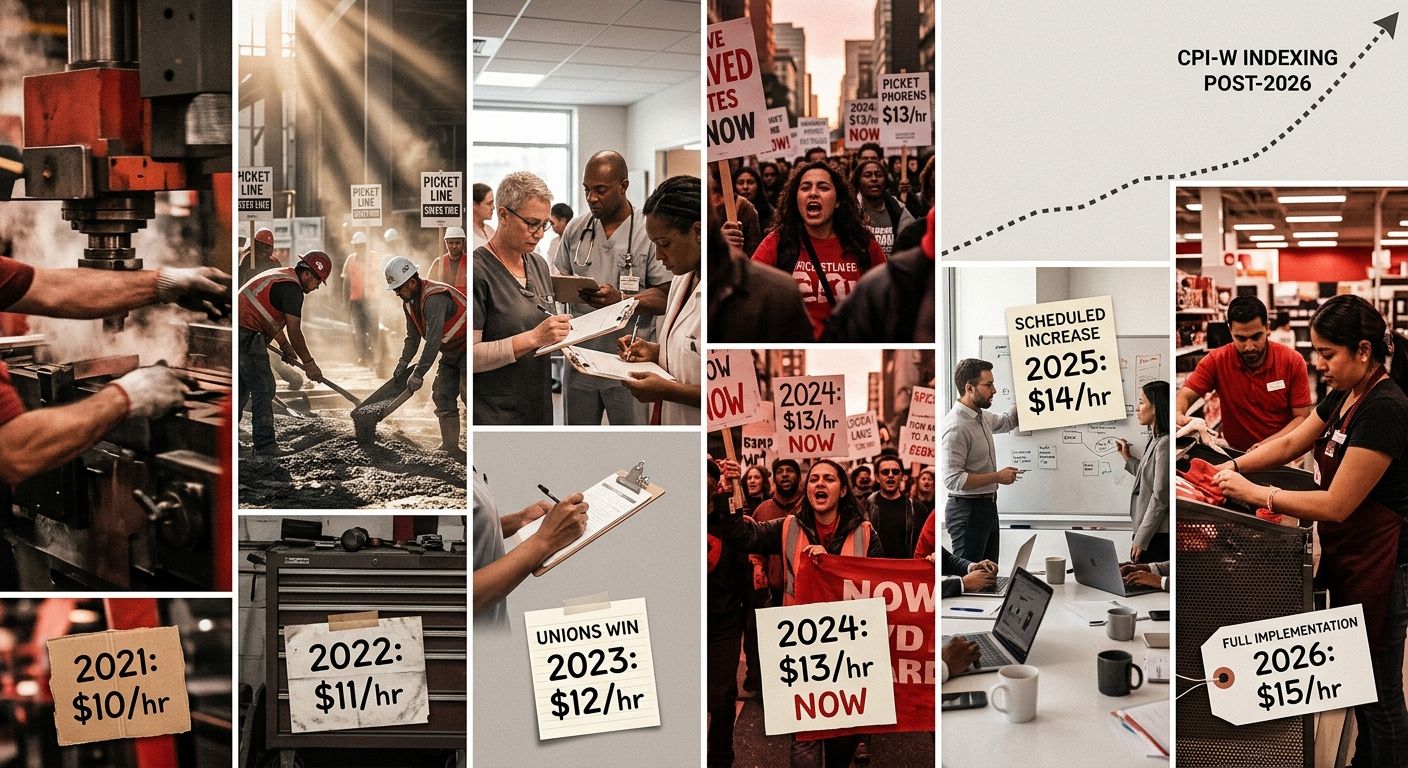
The escalator built into Amendment 2 follows a rigid structure. Each September 30, the rate increases by exactly $1, with the tipped employee rate rising in lockstep. Here's the complete schedule:
Effective Date | Standard Rate | Tipped Rate | Tip Credit |
|---|---|---|---|
September 30, 2021 | $10.00 | $6.98 | $3.02 |
September 30, 2022 | $11.00 | $7.98 | $3.02 |
September 30, 2023 | $12.00 | $8.98 | $3.02 |
September 30, 2024 | $13.00 | $9.98 | $3.02 |
September 30, 2025 | $14.00 | $10.98 | $3.02 |
September 30, 2026 | $15.00 | $11.98 | $3.02 |
The 2024 rate of $13 per hour applied from September 30, 2024 through September 29, 2025. As of September 30, 2025, the rate stands at $14 per hour, which is $6.75 higher than the federal minimum wage of $7.25. When a state rate and the federal rate diverge, employers must pay whichever is higher. For every covered worker in Florida, the federal floor is irrelevant.
The September 30 effective date creates a compliance pinch point. Payroll systems, posted notices, and tipped-wage calculations all need to update on the same day each year. Florida's Department of Commerce issues updated mandatory workplace posters before each increase, and employers who fail to display them face potential enforcement under Florida Statutes 448.110.
How the Tipped Wage Calculation Works
The tipped employee rate uses a fixed tip credit of $3.02 per hour, deducted from the standard minimum wage to produce the direct cash wage an employer owes before tips. At the 2024 rate, that calculation was $13.00 minus $3.02, yielding a tipped minimum of $9.98 per hour. At the current $14 rate, the tipped minimum is $10.98.
The tip credit amount has remained at $3.02 throughout the entire escalator. This is a design choice embedded in the amendment, and it means the gap between tipped and non-tipped workers stays constant in dollar terms even as both rates climb. By contrast, the federal tipped minimum wage has been frozen at $2.13 per hour since 1991, producing a federal tip credit of $5.12. Florida's $3.02 credit is substantially smaller, meaning tipped workers in Florida receive a higher guaranteed cash wage before tips enter the equation.
Three compliance rules bind employers who claim the tip credit:
They must inform tipped employees of the exact direct cash wage, the tip credit amount, and each employee's right to retain all tips outside valid tip-pooling arrangements.
If an employee's tips combined with the direct cash wage fall short of the full minimum wage in any pay period, the employer must cover the shortfall.
Employers must maintain accurate time and payroll records for at least two years (three years for payroll records) to defend against audits or wage claims.
Workers in states with no state-level tipped wage protections, like the comparison between New York City's wage floor and the federal minimum, face substantially wider gaps between tipped and standard rates.
After $15: The CPI-W Indexing Phase
Once the standard rate reaches $15 per hour on September 30, 2026, the $1-per-year escalator stops. Beginning in 2028, annual adjustments will be tied to the Consumer Price Index for Urban Wage Earners and Clerical Workers (CPI-W), the same index the Social Security Administration uses to calculate cost-of-living adjustments.
This shift changes the mechanism fundamentally. During the escalator phase, the rate of increase is predictable and guaranteed: $1 per year regardless of economic conditions. During the indexing phase, the increase depends entirely on measured inflation. If CPI-W rises 3% in a given year, the minimum wage adjusts by 3%. If inflation runs flat, the wage stays flat.
The gap year of 2027 matters. The amendment's structure means $15 will be the rate for the full period from September 30, 2026 through September 29, 2028, a two-year plateau before CPI-W adjustments kick in. Workers should expect no change during calendar year 2027.
The CPI-W index has both strengths and weaknesses as a wage-adjustment tool. It captures price changes experienced by hourly and clerical workers specifically, making it more representative of minimum-wage earners than the broader CPI-U. But it can lag behind housing costs in high-growth metro areas like Miami, Orlando, and Tampa, where rents have risen far faster than the national average.
Regional Context: Where Florida Sits Among the States
Florida's $14 current rate (and upcoming $15) positions it in the upper-middle tier of US state minimum wages. Understanding how the minimum wage usa florida workers earn compares to neighboring states reveals how wide the regional gaps are.
Washington, D.C. leads at $17.50 per hour. Washington state and California both exceed $16. At the opposite end, five southeastern states bordering or near Florida offer no state minimum above the federal $7.25: Georgia, Kentucky, Tennessee, South Carolina, and Alabama. A worker crossing from Jacksonville into southern Georgia takes an immediate $6.75 per hour pay cut if their employer pays only the legal minimum.
These gaps affect worker migration patterns, employer recruitment, and the competitive dynamics of border-region labor markets. They also create stark differences in household survival. A full-time worker earning $7.25 per hour grosses $15,080 annually before taxes. At Florida's $14 rate, that same 2,080-hour year produces $29,120, a $14,040 difference that can determine whether a family qualifies for Medicaid, SNAP, or subsidized housing.
Workers who want to push beyond state-mandated floors often turn to collective bargaining, where negotiated contracts frequently set wages well above the minimum. The constitutional floor provides a baseline; organized workplaces build on it.
Where the Model Breaks
Amendment 2's design has clear limits. The fixed $1-per-year schedule didn't account for the inflation surge of 2021–2023, when cumulative CPI-W growth exceeded 17%. During those years, each $1 increase failed to keep pace with rising costs, meaning the real purchasing power of the minimum wage actually fell even as the nominal rate climbed. A worker earning $12 per hour in September 2023 had less buying power than a worker earning $10 in September 2021 after adjusting for price increases.
The CPI-W indexing phase introduces a different vulnerability. If inflation drops to zero or turns negative (deflation), the amendment does not specify whether the minimum wage can decrease. Most states with indexed minimums include a no-decrease clause, but the specifics of Florida's amendment language will face legal interpretation pressure if that scenario arises.
Coverage gaps are another fracture point. The amendment applies to employers covered under Florida's minimum wage law, but federal exemptions still apply to certain categories of workers: some agricultural employees, seasonal recreation workers, and employees of very small businesses. Workers who believe they're exempt should verify their status, because misclassification is common, and employers sometimes claim exemptions they don't qualify for. Understanding how employers push back against worker protections gives workers a clearer picture of what resistance looks like in practice.
The tipped-wage structure also has a structural weakness. The fixed $3.02 tip credit means tipped workers always earn $3.02 less per hour in guaranteed cash than non-tipped workers, regardless of how high the base rate climbs. Advocacy groups have pushed for "one fair wage" models that eliminate the tip credit entirely, arguing that tips should supplement a full minimum wage rather than subsidize it. Seven states plus the District of Columbia already require full minimum wage for tipped employees, with no tip credit allowed.
And the mechanism offers no retroactive relief. Workers underpaid during previous rate periods must file claims under existing wage-theft statutes, a process that demands documentation, legal resources, and time that many low-wage workers don't have. Workplace organizing, even outside a formal union context, makes these claims stronger. Building the kind of rank-and-file leadership that tracks wage violations collectively produces better outcomes than individual complaints.
Common Questions
Does the Florida minimum wage apply to salaried employees?
Florida's minimum wage applies to most hourly and salaried non-exempt employees. Salaried workers who qualify as exempt under the Fair Labor Standards Act (executive, administrative, professional exemptions) are not covered. The key test is the worker's duties and compensation level, not whether they receive a salary versus hourly pay.
What happens if my employer doesn't update to the new rate on September 30?
The new rate is legally effective on September 30 regardless of whether an employer updates payroll. Any hours worked at the old rate after the effective date constitute a wage violation. Workers can file complaints with the Florida Department of Commerce or pursue claims under Florida Statutes 448.110, which allows recovery of back wages plus damages.
Is the $15 rate in 2026 the final increase?
The $15 rate is the final step of the fixed-dollar escalator. Beginning in 2028, annual adjustments will be calculated based on changes in the CPI-W inflation index. The minimum wage will continue to change each year, but by an amount determined by measured inflation rather than a predetermined dollar figure.
How does Florida's tipped wage compare to the federal tipped wage?
The federal tipped minimum wage is $2.13 per hour, unchanged since 1991. Florida's tipped minimum was $9.98 per hour during the 2024 rate period and is currently $10.98 as of September 2025. Florida tipped workers receive $8.85 per hour more in guaranteed cash wages than the federal floor requires.
Can Florida's legislature override Amendment 2?
No. Because the minimum wage is embedded in the state constitution through a voter-approved amendment, the legislature cannot reduce, freeze, or repeal it through ordinary legislation. Changing the provision would require a new constitutional amendment, which itself would need to pass a statewide ballot with at least 60% voter approval.
The Union Edge Staff
Frequently Asked Questions
- What is Florida's minimum wage in 2024 and 2025?
- Florida's minimum wage was $13 per hour from September 30, 2024 through September 29, 2025, and increased to $14 per hour as of September 30, 2025. The tipped minimum wage is $9.98 per hour (2024) and $10.98 per hour (2025), with a fixed tip credit of $3.02 per hour.
- When will Florida's minimum wage reach $15 per hour?
- Florida's minimum wage will reach $15 per hour on September 30, 2026, completing a six-year escalator that began at $10 in 2021. After 2026, increases will be tied to inflation adjustments based on the Consumer Price Index starting in 2028.
- Can the Florida legislature change or repeal Amendment 2?
- No, the Florida legislature cannot override Amendment 2 because the minimum wage is embedded in the state constitution. Changing or repealing it would require a new constitutional amendment approved by voters with at least 60% support in a statewide election.
- How does Florida's tipped minimum wage compare to the federal rate?
- Florida's tipped minimum wage is $10.98 per hour (2025), which is $8.85 per hour higher than the federal tipped minimum of $2.13 per hour. Florida uses a fixed $3.02 tip credit, whereas the federal tip credit is $5.12.
- What happens if my employer doesn't pay the new minimum wage on the effective date?
- If an employer doesn't update to the new rate by September 30, any hours worked at the old rate after the effective date constitute a wage violation. Workers can file complaints with the Florida Department of Commerce or pursue claims under Florida Statutes 448.110 to recover back wages plus damages.
- How will Florida's minimum wage adjust after it reaches $15 in 2026?
- Starting in 2028, Florida's minimum wage will be adjusted annually based on the Consumer Price Index for Urban Wage Earners and Clerical Workers (CPI-W), rather than fixed dollar increases. The rate will remain at $15 per hour throughout 2027 before inflation-based adjustments begin.
- Do employers have to pay the tip credit if tips don't cover the minimum wage?
- No, employers must cover the difference if an employee's tips combined with the direct cash wage fall below the full minimum wage in any pay period. The tip credit reduces only the employer's direct cash obligation, not the employee's minimum wage entitlement.
Related Articles

Minimum Wage USA Florida: 2024 Guide
The Florida Constitution, not the state legislature, controls the minimum wage for roughly 10 million workers statewide. That constitutional lock is the defining feature of Florida's wage law: the current rate is $14.00 per hour, rising to $15.

What Is the State of Florida Minimum Wage
Amendment 2, ratified by Florida voters in November 2020, embedded a minimum wage escalator directly into Article X of the state constitution, removing the rate from legislative control entirely. The current floor is $14.00 per hour for non-tipped workers and $10.

Minimum Wage in Florida USA: Current Rates 2024
Florida's minimum wage is a constitutionally mandated rate that increases automatically each September 30 without any legislative vote. The current rate is $14.00 per hour, effective since September 30, 2025, and the constitutional escalator driving these raises keeps the floor $6.
Also in the paper