
What Is the Florida Minimum Wage in 2024
Florida's minimum wage for 2024 is $13.00 per hour, a rate that took effect on September 30, 2024, under a constitutional amendment voters passed in 2020 to bypass a state legislature that wouldn't act. The tipped employee cash wage for the same period is $9.98 per hour.

What Is the Florida Minimum Wage in 2024?
Florida's minimum wage for 2024 is $13.00 per hour, a rate that took effect on September 30, 2024, under a constitutional amendment voters passed in 2020 to bypass a state legislature that wouldn't act. The tipped employee cash wage for the same period is $9.98 per hour. Both figures are steps in a six-year escalator schedule that ends at $15.00 in September 2026.
Amendment 2 and How It Rewrote Florida's Constitution
On November 3, 2020, Florida voters approved Amendment 2, amending Article X, Section 24 of the state constitution to mandate a schedule of minimum wage increases. The amendment required 60% approval to pass, and it cleared that bar despite opposition from the state's Republican legislative leadership and major business lobby groups including the Florida Chamber of Commerce.
The amendment established a fixed path: raise the minimum wage from $8.65 to $10.00 on September 30, 2021, then add $1.00 every year on September 30 until the wage hits $15.00 in 2026. After that, annual adjustments will be tied to the Consumer Price Index starting in 2027. The mechanism matters because it's embedded in the constitution, which means the Florida legislature can't repeal or weaken it through ordinary legislation. Any change would require another ballot measure and another supermajority vote.
This structure mirrors how other states have used ballot initiatives to force wage increases that lawmakers refused to pass. Ohio, for instance, embedded its own minimum wage escalator into its state constitution through a similar voter-driven process.
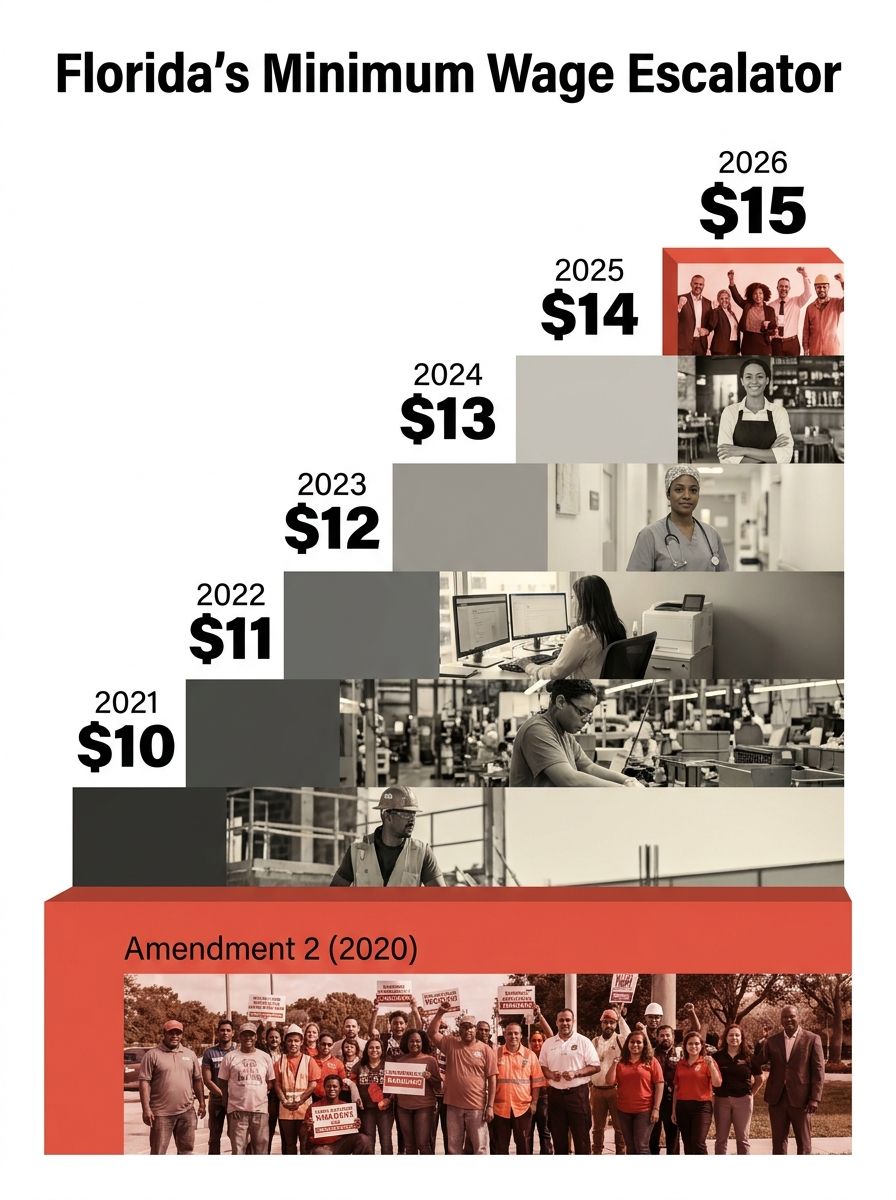
The Year-by-Year Dollar Increases
The $13.00 rate that defines 2024 is straightforward within the escalator's design, but the transition dates trip people up. Florida's minimum wage year doesn't follow the calendar year. Each new rate kicks in on September 30, which means:
From January 1 through September 29, 2024, the operative rate was $12.00 per hour (the 2023 increase).
From September 30, 2024 onward, the rate became $13.00 per hour.
If you worked in Florida during 2024, your minimum wage depends on which part of the year you're looking at. Any employer who paid $12.00 for hours worked after September 30, 2024, underpaid you by $1.00 per hour.
The full schedule under Amendment 2:
Effective Date | Non-Tipped Rate | Tipped Cash Wage |
|---|---|---|
September 30, 2021 | $10.00 | $6.98 |
September 30, 2022 | $11.00 | $7.98 |
September 30, 2023 | $12.00 | $8.98 |
September 30, 2024 | $13.00 | $9.98 |
September 30, 2025 | $14.00 | $10.98 |
September 30, 2026 | $15.00 | $11.98 |
That $13.00 rate sits well above the federal minimum wage of $7.25, which hasn't moved since 2009. Federal law requires employers to pay whichever rate is higher, so the federal floor is functionally irrelevant in Florida. For comparison, Texas still defaults to the $7.25 federal rate because it has no state minimum above it, as we've covered in our breakdown of Texas minimum wage law.
The Tipped Employee Gap
"Why does the minimum wage for tipped employees have a separate number?" is the single most common question Florida workers ask about this system, and the answer goes to the core of how tip credits work under both state and federal law.
Florida law allows employers to pay tipped workers a cash wage that is $3.02 less than the full minimum wage. In 2024, that means $9.98 per hour in direct pay. The remaining $3.02 is supposed to come from tips. If an employee's tips don't bring their total hourly earnings up to $13.00, the employer is legally required to make up the difference.
The problem is enforcement. The $3.02 tip credit creates a gap that many workers never see filled. Restaurant and hospitality workers across the state report that employers claim the credit without tracking whether actual tips cover the difference. The Florida Department of Economic Opportunity publishes the required rates but has limited enforcement capacity for individual wage claims, leaving workers to file complaints or pursue private legal action.

Who the Law Exempts
Florida's minimum wage doesn't cover every worker in the state, and the exemptions disproportionately affect workers with the least bargaining power. Businesses with annual gross revenue under $500,000 that aren't covered by the federal Fair Labor Standards Act are exempt from the state minimum wage entirely. Full-time students employed by their educational institution can be paid as low as 85% of the minimum wage, or $11.05 per hour during the 2024 rate period, if the employer obtains proper certification.
The state's minimum wage law also aligns with federal FLSA coverage rules, which means the same categories of workers who are exempt under federal law are exempt in Florida. That includes certain agricultural workers, seasonal recreation employees, and workers in specific small-scale retail establishments.
And then there's the classification question. Workers who are classified as independent contractors fall outside minimum wage protections entirely, regardless of what they actually do. Florida has no equivalent of the stricter classification tests that states like New Jersey have adopted to prevent misclassification. Gig workers, day laborers, and freelancers in Florida have no state minimum wage floor at all under current law.
Wage Theft Eats the Gains
The $13.00 rate represents a 50.3% increase over the $8.65 floor that was in place before Amendment 2 took effect. That's a real gain for Florida's lowest-paid workers on paper. The gap between what the law says and what workers actually receive, though, remains severe.
According to data compiled from federal enforcement records and academic research, Florida has the highest minimum wage violation rate among the ten most populous U.S. states. Workers subject to minimum wage theft lose an average of 18% of their entitled wages. For a full-time worker earning $13.00 per hour, that 18% translates to roughly $97 per week, or more than $5,000 per year in stolen pay.
Florida is one of the few large states with no state-level department of labor that investigates individual wage claims. Workers who believe their employer is violating the minimum wage must either file a complaint with the U.S. Department of Labor's Wage and Hour Division or hire a private attorney. The state constitution mandates the minimum wage but provides no state-funded enforcement mechanism dedicated to collecting it.
This enforcement vacuum is why labor organizers in Florida have focused on worker-led monitoring and community-based wage recovery programs. Unions and worker centers in Miami-Dade, Broward, and Hillsborough counties have documented systematic underpayment in construction, hospitality, and agriculture, three sectors where minimum wage violations are concentrated and where many workers face immigration-related retaliation threats for reporting violations.
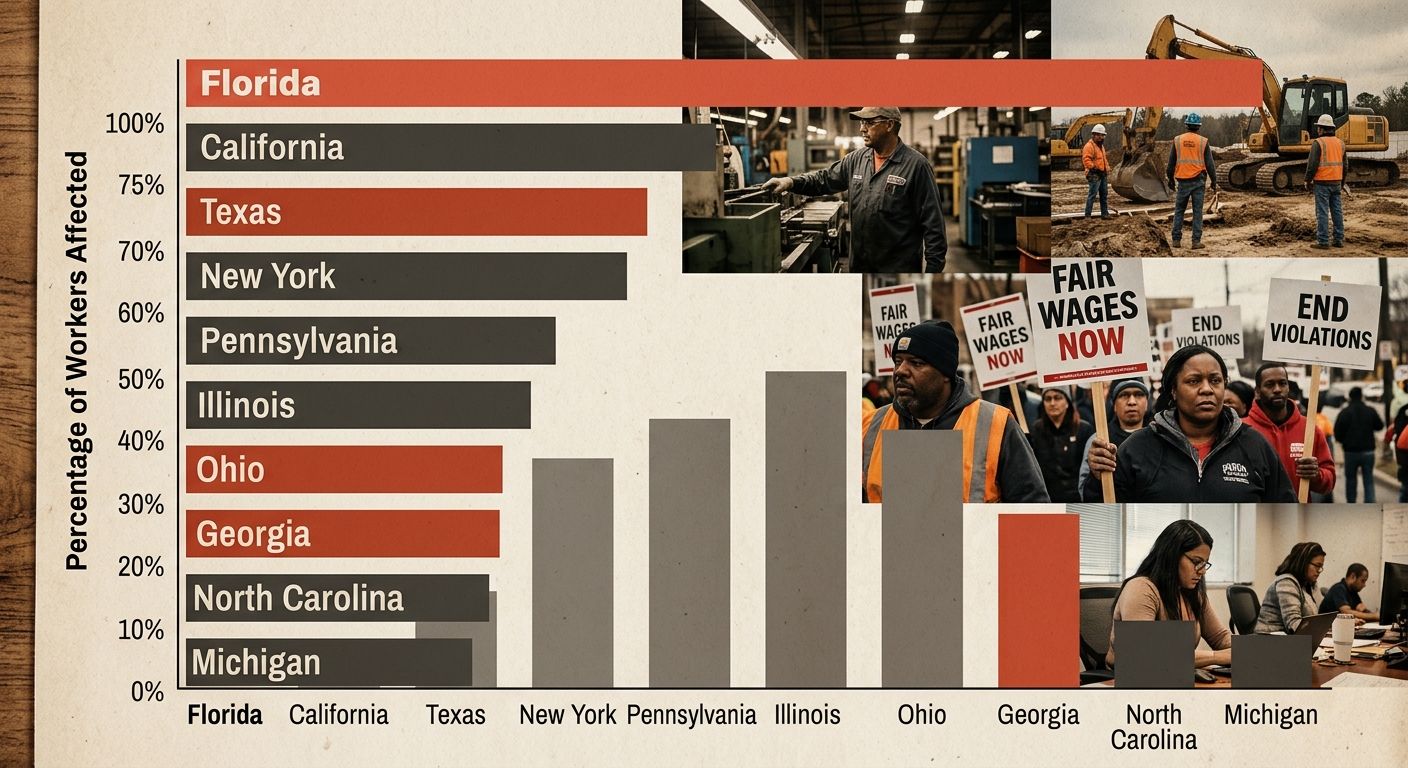
Where the $15 Ceiling Stops Protecting Workers
The Amendment 2 escalator was designed to bring Florida's minimum wage to $15.00 by September 30, 2026. That endpoint is now less than two months away. But $15.00 in 2026 buys significantly less than $15.00 would have in 2020 when voters approved the measure. Consumer prices in the Miami metropolitan area alone rose more than 22% between November 2020 and mid-2026, according to Bureau of Labor Statistics CPI data. A $15.00 wage in September 2026 has roughly the same purchasing power as a $12.30 wage when the amendment passed.
After 2026, the constitutional mechanism switches from fixed-dollar increases to annual CPI adjustments. That protects against further erosion but doesn't recover the ground already lost. And CPI-based adjustments have their own weakness: they track price changes over the prior year, meaning wages always lag behind cost increases rather than keeping pace in real time. States like Oregon and Washington have used similar CPI-indexing systems and found that they slow the pace of decline in purchasing power without reversing it.
The broader structural limitation is that $15.00 per hour, working 40 hours per week for 52 weeks, produces $31,200 in annual gross income. The MIT Living Wage Calculator estimates that a single adult with no children in Miami-Dade County needs approximately $22.68 per hour to cover basic expenses. For a single parent with one child, that figure rises above $42.00. The constitutional minimum wage, even at its peak, falls well short of a living wage in most Florida metro areas.
The mechanism also lacks any provision for regional variation. The cost of living in Jacksonville differs substantially from the cost of living in Key West, but the constitutional rate applies uniformly statewide. Unlike Washington state, which layers city-level minimums on top of the state floor, Florida's Amendment 2 preempts local governments from setting their own higher rates.
Common Questions
Does Florida's $13.00 minimum wage apply to all workers?
No. Businesses with annual gross revenue under $500,000 that aren't covered by the federal FLSA are exempt. Full-time students employed by educational institutions can be paid 85% of the minimum, or $11.05 during the 2024 rate period. Independent contractors have no minimum wage protection under Florida law regardless of their actual working conditions.
What should tipped workers do if their tips don't bring pay up to $13.00?
Your employer is legally required to cover the difference between your $9.98 cash wage plus tips and the full $13.00 rate. Keep personal records of every shift's tip income. If your total hourly compensation falls below $13.00 in any pay period, you can file a complaint with the U.S. Department of Labor Wage and Hour Division or consult a private employment attorney. Florida has no state-level agency dedicated to processing these claims.
When did the $13.00 rate take effect, and what comes next?
The $13.00 rate took effect September 30, 2024. The next increase, to $14.00, arrived on September 30, 2025. The final scheduled increase under Amendment 2 brings the rate to $15.00 on September 30, 2026. After that, annual adjustments will be calculated based on the Consumer Price Index beginning in 2027.
Can Florida cities set minimum wages higher than the state rate?
No. Amendment 2 establishes a statewide floor and Florida law preempts municipalities from enacting local minimum wage ordinances above that floor. Unlike states with city-level minimum wages, every employer in Florida is bound to the same rate regardless of location.
How does Florida's 2024 minimum wage compare to other large states?
Florida's $13.00 rate for 2024 sits above the federal floor of $7.25 and above states like Texas that have no state-level minimum, but below states like California, which held a $16.00 general minimum for most of 2024, and Washington, which set its statewide rate at $16.28. The gap between Florida and higher-wage states narrows as the Amendment 2 schedule advances, but cost-of-living differences mean a direct comparison on rates alone doesn't capture the full picture.
The Union Edge Staff
Frequently Asked Questions
- What is the Florida minimum wage in 2024?
- Florida's minimum wage in 2024 is $13.00 per hour, effective September 30, 2024. The tipped employee cash wage is $9.98 per hour for the same period.
- When did Florida's $13.00 minimum wage take effect?
- The $13.00 minimum wage took effect on September 30, 2024. From January 1 through September 29, 2024, the operative rate was $12.00 per hour.
- What is the tipped minimum wage in Florida for 2024?
- The tipped employee cash wage in Florida for 2024 is $9.98 per hour. Employers are required to cover any gap between tips and the full $13.00 minimum wage rate.
- What will Florida's minimum wage be in 2025 and 2026?
- Florida's minimum wage will increase to $14.00 on September 30, 2025, and then to $15.00 on September 30, 2026, under the six-year escalator schedule established by Amendment 2.
- How did Florida's minimum wage increase to $13.00?
- Amendment 2, a 2020 constitutional ballot measure approved by voters, mandated $1.00 annual raises starting from $10.00 in 2021, reaching $13.00 in 2024 and $15.00 in 2026.
- What workers are exempt from Florida's minimum wage?
- Businesses with annual gross revenue under $500,000 not covered by federal law are exempt. Full-time students can be paid 85% of minimum wage ($11.05 in 2024), and independent contractors have no minimum wage protection under Florida law.
- What should I do if my employer isn't paying Florida minimum wage?
- You can file a complaint with the U.S. Department of Labor's Wage and Hour Division or hire a private employment attorney, as Florida has no state-level agency dedicated to processing individual wage claims.
- Can Florida cities set their own minimum wage higher than the state rate?
- No. Amendment 2 preempts local governments from setting their own minimum wage ordinances above the statewide floor, so every employer in Florida is bound to the same rate regardless of location.
Related Articles

What Is the State of Florida Minimum Wage
Amendment 2, ratified by Florida voters in November 2020, embedded a minimum wage escalator directly into Article X of the state constitution, removing the rate from legislative control entirely. The current floor is $14.00 per hour for non-tipped workers and $10.

Minimum Wage in Florida USA: Current Rates 2024
Florida's minimum wage is a constitutionally mandated rate that increases automatically each September 30 without any legislative vote. The current rate is $14.00 per hour, effective since September 30, 2025, and the constitutional escalator driving these raises keeps the floor $6.

What is the Minimum Wage in Florida
Unlike most state wage floors, which legislatures can freeze or repeal at will, Florida's minimum wage is locked into the state constitution. The current rate is $14.00 per hour, climbing to $15.
Also in the paper