
NYS Minimum Wage 2026: What's Changing
New York's minimum wage operates through a three-layer structure: a regional hourly floor ($17.00 downstate, $16.00 upstate as of January 1, 2026), a set of sub-rates for tipped and salaried workers, and starting in 2027, an automatic inflation-indexing formula.
NYS Minimum Wage 2026: How the Three-Layer Wage Floor Actually Works
New York's minimum wage operates through a three-layer structure: a regional hourly floor ($17.00 downstate, $16.00 upstate as of January 1, 2026), a set of sub-rates for tipped and salaried workers, and starting in 2027, an automatic inflation-indexing formula. Understanding each layer determines whether workers actually receive what they're owed.
The Regional Split and Why Geography Sets Your Rate
New York doesn't have a single minimum wage. It has two geographic tiers that reflect the cost-of-living gap between the New York City metro area and the rest of the state. As of January 1, 2026, workers in New York City, Nassau County, Suffolk County (Long Island), and Westchester County earn a minimum of $17.00 per hour. Workers in every other county earn a minimum of $16.00 per hour.
Both figures represent a $0.50 increase over their 2025 levels of $16.50 and $15.50 respectively. Governor Kathy Hochul's office announced the increase as the final step of a historic agreement to raise the state's wage floor through 2026.
The geographic divide matters enormously for workers who commute across tier boundaries. If you live in Orange County (upstate tier) but work at a restaurant in Westchester County (downstate tier), your employer owes you the $17.00 rate. The rate follows the worksite, not your home address. Workers who split shifts across locations in different tiers should see the appropriate rate applied to each set of hours separately.
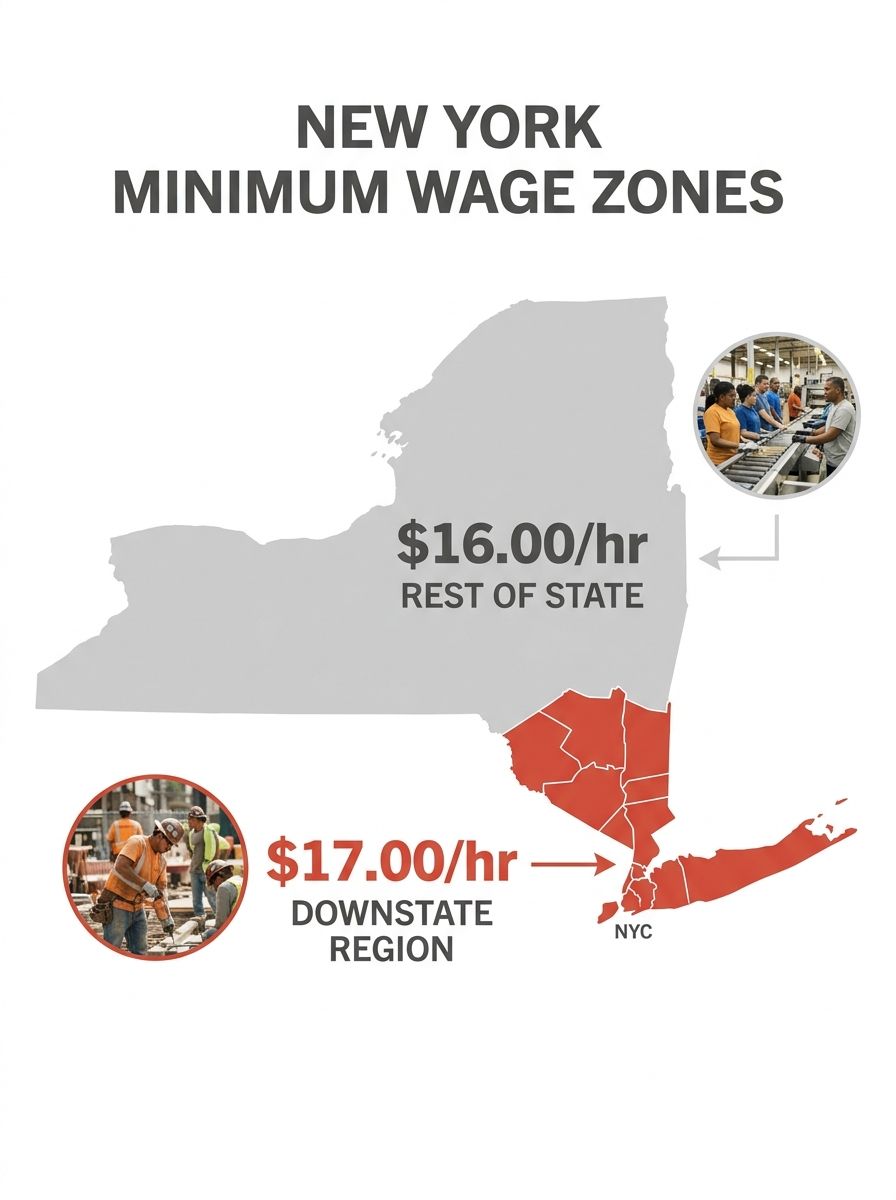
This two-tier approach contrasts sharply with states like Texas, where the wage floor matches the federal minimum of $7.25 statewide with zero regional variation. It also differs from California's approach to its 2026 minimum wage, where the state sets a single floor but allows cities to legislate higher. New York's structure builds geographic differentiation directly into state law, making your county line a paycheck issue.
How Tipped Worker Sub-Rates Function
The headline number of $17.00 or $16.00 doesn't tell the full story for tipped workers across New York. These workers are governed by a different mechanism: the cash wage plus tip credit system.
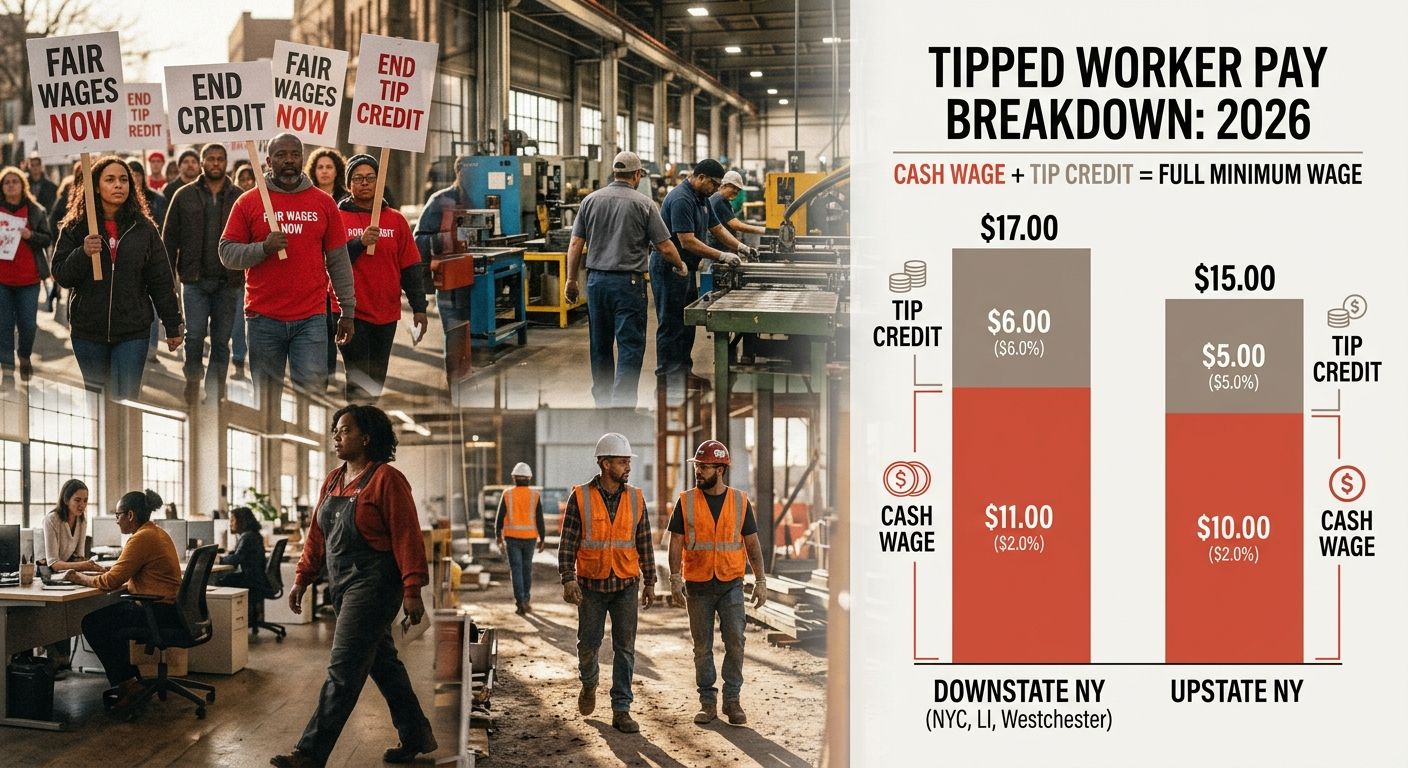
Under this system, employers pay tipped workers a lower cash wage and claim a "tip credit," assuming that tips will make up the difference to the full minimum. For 2026, the cash wage for tipped food service workers is $11.35 per hour in the downstate region and $10.70 per hour upstate, according to analysis from Seyfarth Shaw LLP. The corresponding tip credits are $5.65 and $5.30.
Here's where enforcement becomes a civil rights issue. If a worker's tips plus cash wage don't equal the full $17.00 or $16.00 minimum for any pay period, the employer must make up the difference. Many don't. New York's Department of Labor investigates wage theft complaints, and minimum wage violations are a crime under state penal law. But the burden of tracking hours, calculating tips, and filing complaints falls heavily on workers, who are disproportionately immigrants, women, and people of color in the food service industry.
Component | Downstate (NYC, LI, Westchester) | Upstate (Rest of State) |
|---|---|---|
Minimum wage | $17.00/hr | $16.00/hr |
Tipped cash wage (food service) | $11.35/hr | $10.70/hr |
Tip credit | $5.65/hr | $5.30/hr |
Overtime rate (1.5×) | $25.50/hr | $24.00/hr |
The New York City Council introduced Bill Int. No. 757 on March 10, 2026, which would eliminate tip credits entirely within city limits and establish a separate New York City minimum wage above the state standard. If passed, tipped workers in NYC would receive the full minimum wage before tips. The bill remains in committee as of September 2026, and its progress is worth watching for any worker relying on tips to reach the floor.
Exempt Salary Thresholds and Overtime Rates
The minimum wage increase ripples upward into salary requirements for exempt employees. Under New York law, workers in executive or administrative roles must earn above a specific weekly salary threshold, in addition to meeting duties tests, to be classified as exempt from overtime.
Effective January 1, 2026, the exempt salary threshold rose to $1,275.00 per week ($66,300 annually) in the downstate region and $1,199.10 per week ($62,353.20 annually) for the rest of the state, as detailed by Proskauer Rose LLP in their analysis of the 2026 updates. These thresholds significantly exceed the federal exempt salary floor of $43,888 per year.
For workers, this matters in a concrete way: if your employer calls you a "manager" and pays you a salary of $60,000 in Manhattan, you don't meet the $66,300 threshold. You're entitled to overtime pay at 1.5 times your effective hourly rate for every hour worked beyond 40 in a week. Misclassification, calling hourly workers "exempt" to avoid overtime, remains one of the most common wage violations in the state.
The overtime rate itself also increased. For minimum wage workers, time-and-a-half means $25.50 per hour downstate and $24.00 per hour upstate. Workers in other high-cost northeastern states face their own calculations; compare New York's overtime floor with the rates derived from Massachusetts minimum wage rules or those based on Connecticut's current structure. New York's exempt salary thresholds are among the highest of any state, which makes proper classification a bigger issue here than almost anywhere else.
The 2027 Indexing Formula
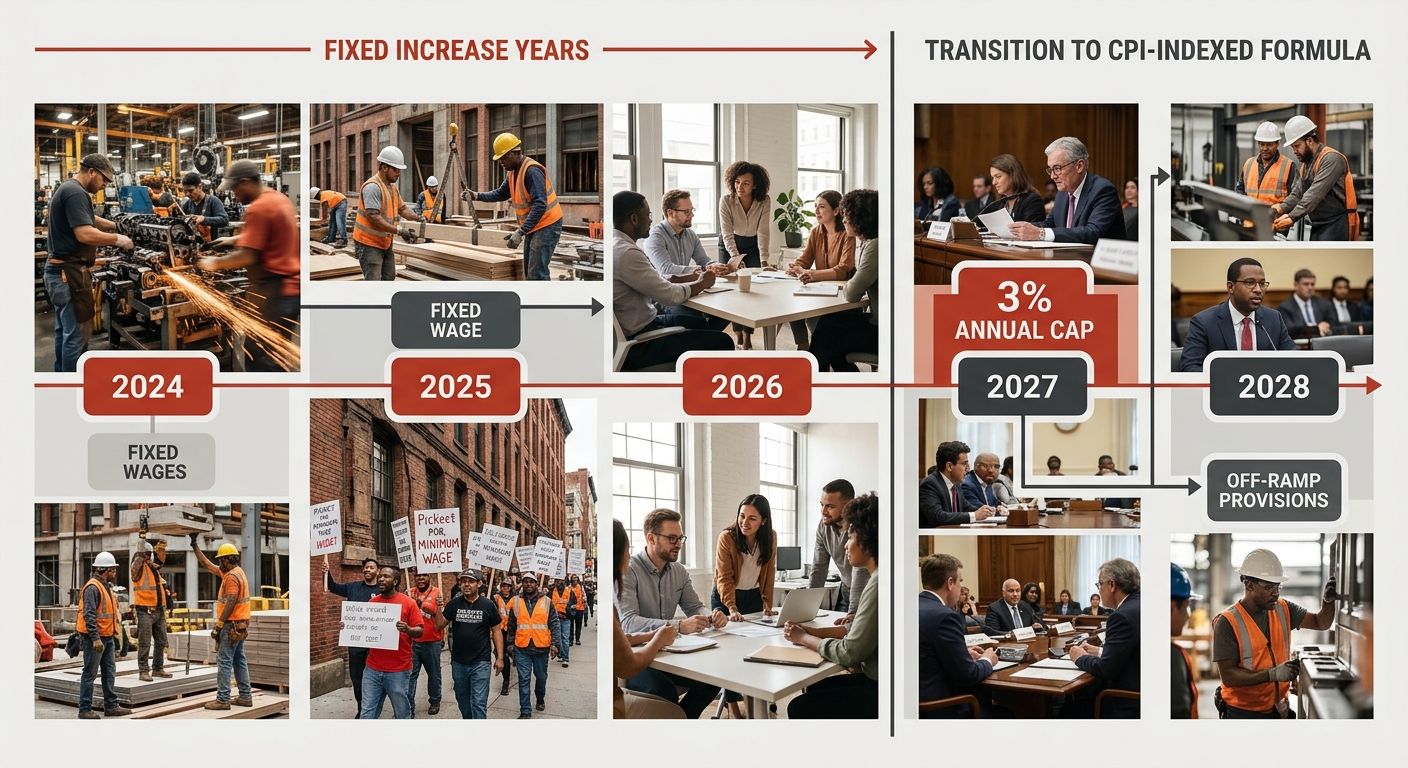
The $17.00 and $16.00 rates are the last fixed increases under the three-year plan that began in 2024. Starting January 1, 2027, New York's minimum wage will be determined by an automatic formula tied to inflation, moving away from the legislative negotiation process that produced the current rates.
The formula uses the three-year average of the Consumer Price Index for Urban Wage Earners and Clerical Workers (CPI-W) for the Northeast Region. Each year's increase is capped at 3%, meaning even in high-inflation periods the wage floor can't jump more than $0.51 in a single year based on the $17.00 downstate rate. The formula also includes economic "off-ramps": if unemployment rises sharply or the CPI turns negative, the scheduled increase can be paused or reduced.
This indexing approach addresses a pattern that hurt workers for years. Under the old system, the minimum wage stayed frozen until legislators agreed on an increase, a process that allowed real purchasing power to erode quietly. Between 2009 and 2013, New York's minimum wage sat at $7.25 while consumer prices climbed roughly 8% across the period.
The 3% cap is the most contested design choice. In a year where Northeast CPI-W rises 4.5%, workers absorb the 1.5% difference as a real pay cut. Supporters argue the cap gives employers predictability for planning purposes. From a worker rights perspective, a 3% ceiling during a 5% inflation year means the people least able to absorb rising costs are guaranteed to fall behind. The formula also maintains the two-tier geographic split, so downstate and upstate rates will continue to diverge in dollar terms.
Where the Model Breaks
New York's tiered minimum wage system has clear boundary conditions where it fails to protect workers or creates outcomes at odds with its stated purpose.
The geographic boundary is the most obvious fault line. A worker in Yonkers (Westchester, $17.00) and a worker five miles north in Putnam County ($16.00) do identical work at identical businesses and earn different rates. The $1.00 gap is a policy approximation of cost-of-living differences, but county borders are blunt instruments. Housing costs in parts of the Hudson Valley rival Westchester prices, yet those workers earn the lower upstate rate.
The tip credit system creates a second failure point. Enforcement depends on workers knowing their rights, tracking their own hours and tips, and filing complaints against employers who control their schedules and future shifts. The power imbalance is structural. Bill Int. No. 757's proposal to eliminate tip credits in NYC acknowledges this problem directly, but the bill covers only one city in a state with tipped workers from Montauk to Niagara Falls.
The 3% indexing cap introduces a third vulnerability. The cap works well during normal inflation (2-3% annual CPI growth). But the Northeast experienced CPI-W increases above 5% in both 2022 and parts of 2023. If similar spikes return, the formula guarantees that minimum-wage workers fall behind. The off-ramp provisions compound this: they allow pauses when unemployment rises, which is precisely when low-wage workers need purchasing power most.
And the exempt salary thresholds, while higher than federal requirements, still leave a gap for workers in the most expensive parts of the state. A salaried "assistant manager" earning $66,300 in Manhattan sits exactly at the exempt threshold in one of the costliest labor markets in the world. The threshold doesn't differentiate within the downstate region itself. A worker crossing the exempt line in the Bronx faces very different economic realities than one crossing it in a Suffolk County suburb, but the law treats both identically.
The NYS minimum wage 2026 structure represents genuine progress over the frozen-rate years and over states that still peg their floors to the federal $7.25. But progress with structural gaps written into the design requires workers who know exactly where those gaps are and how to enforce the protections that do exist.
Common Questions
Does New York City have its own separate minimum wage?
Not yet. As of September 2026, New York City follows the state's downstate rate of $17.00/hour. The City Council introduced Bill Int. No. 757 in March 2026, which would create a higher city-specific minimum wage and eliminate tip credits. The legislation hasn't been enacted and remains in committee. If it passes, NYC's minimum wage would exceed the $17.00 state floor.
How does the NYS minimum wage 2026 compare to the federal minimum wage?
The federal minimum wage remains $7.25 per hour, unchanged since 2009. New York's $17.00 downstate rate is 2.3 times the federal floor; the $16.00 upstate rate is 2.2 times higher. When federal and state rates differ, employers must pay whichever is higher, making the federal rate effectively irrelevant for NYS workers.
What happens to the minimum wage in 2027?
Fixed annual increases end after 2026. Beginning January 1, 2027, New York's minimum wage will be adjusted annually based on the three-year average of the CPI-W for the Northeast Region. Increases are capped at 3% per year, and economic off-ramps allow pauses during periods of rising unemployment or deflation. The two-tier geographic structure remains in place.
Are there different rates for different industries?
Yes. New York sets distinct sub-rates by industry, particularly for food service and service workers. Tipped food service workers in the downstate region earn a cash wage of $11.35/hour with a $5.65 tip credit; upstate the cash wage is $10.70 with a $5.30 tip credit. Meal and lodging allowances also adjusted on January 1, 2026. The full rate schedules are published in the Wage Order Summary on the state Department of Labor's website.
Can my employer average my tips across the week to meet the minimum?
Your employer must ensure that your cash wage plus tips equals or exceeds the applicable minimum wage ($17.00 or $16.00) for each payroll period. If your tips fall short, the employer is legally required to make up the difference. Failure to do so constitutes wage theft under New York law. Workers experiencing shortfalls should document their hours and tips carefully and contact the New York State Department of Labor's Division of Labor Standards.
The Union Edge Staff
Frequently Asked Questions
- What is the New York State minimum wage for 2026?
- As of January 1, 2026, New York's minimum wage is $17.00 per hour in New York City, Long Island, and Westchester County, and $16.00 per hour in the rest of the state. Both figures represent a $0.50 increase over 2025 levels.
- What is the cash wage for tipped workers in New York 2026?
- For tipped food service workers in 2026, the cash wage is $11.35 per hour downstate and $10.70 per hour upstate. Employers claim a tip credit of $5.65 downstate and $5.30 upstate, and must make up the difference if tips plus cash wage don't equal the full minimum.
- How will New York's minimum wage change after 2026?
- Starting January 1, 2027, New York's minimum wage will be adjusted automatically based on the three-year average of the Consumer Price Index, with annual increases capped at 3%. Economic off-ramps allow pauses during periods of rising unemployment or deflation.
- What is the exempt salary threshold for New York State in 2026?
- Effective January 1, 2026, exempt employees must earn at least $1,275.00 per week ($66,300 annually) downstate and $1,199.10 per week ($62,353.20 annually) upstate to qualify for exemption from overtime pay.
- What is the overtime rate in New York for 2026?
- For minimum wage workers, overtime at time-and-a-half means $25.50 per hour downstate and $24.00 per hour upstate as of January 1, 2026.
- Does minimum wage in New York depend on which county you work in?
- Yes, New York has a two-tier regional structure where the rate depends on the worksite location, not your home address. Workers in NYC, Nassau, Suffolk, and Westchester counties earn $17.00/hour, while workers in all other counties earn $16.00/hour.
- What should I do if my employer isn't paying minimum wage in New York?
- Minimum wage theft is a crime under New York State law. Contact the New York State Department of Labor to file a wage theft complaint, and the Department will investigate and can recover underpayments on your behalf.
- How does the New York minimum wage compare to the federal minimum wage?
- The federal minimum wage remains $7.25 per hour unchanged since 2009. New York's $17.00 downstate rate is 2.3 times the federal floor, and employers must pay whichever rate is higher, making the federal rate effectively irrelevant for NYS workers.
Related Articles

New York State Minimum Wage: 2024 Rates & Requirements
The new york state minimum wage is a two-zone geographic system where workers in New York City, Long Island, and Westchester earn one hourly floor, and workers everywhere else in the state earn a lower one. As of January 1, 2024, those floors sat at $16.00 and $15.

New York City Minimum Wage: 2024 Updates & What Changed
New York City's minimum wage is the legal hourly floor every employer in the five boroughs must pay, and on January 1, 2024, it climbed from $15.00 to $16.00 per hour. That dollar increase was the first move in a three-year legislated schedule that reaches $17.

Minimum Wage in New York: Current Rates & Updates
Depending on where you clock in, the minimum wage in New York ranges from $16.00 to $17.00 per hour, set by a two-zone structure that completed its final scheduled $0.50 increase on January 1, 2026, and will hand future adjustments to an inflation formula in 2027.
Also in the paper