
NY City Minimum Wage: 2024 Rates & Requirements
New York City's minimum wage is $17.00 per hour as of January 1, 2026, but that single number obscures a system of at least five different pay floors determined by industry classification, tip status, and whether an employer provides health benefits.

NY City Minimum Wage: Every Rate, Rule, and Rights Protection Workers Need
New York City's minimum wage is $17.00 per hour as of January 1, 2026, but that single number obscures a system of at least five different pay floors determined by industry classification, tip status, and whether an employer provides health benefits. Understanding how these rates interact is a civil rights issue: the workers most affected by tip credits and industry-specific carve-outs are disproportionately immigrants, women, and people of color.
How the NY City Minimum Wage Is Set
The NY city minimum wage is determined by New York State through legislation passed in Albany, not by the City Council. The New York State Department of Labor (NYSDOL) administers and enforces it. NYC itself has no independent authority to raise or lower the hourly floor, which means workers who want to push for higher wages need to direct their advocacy at state legislators, not municipal officials.
The NYSDOL publishes rate schedules, poster requirements, and a Minimum Wage Lookup Tool that accounts for regional and industry variations. Employers are required to display current wage posters where all employees can see them, and failure to do so is itself a violation under state labor law.
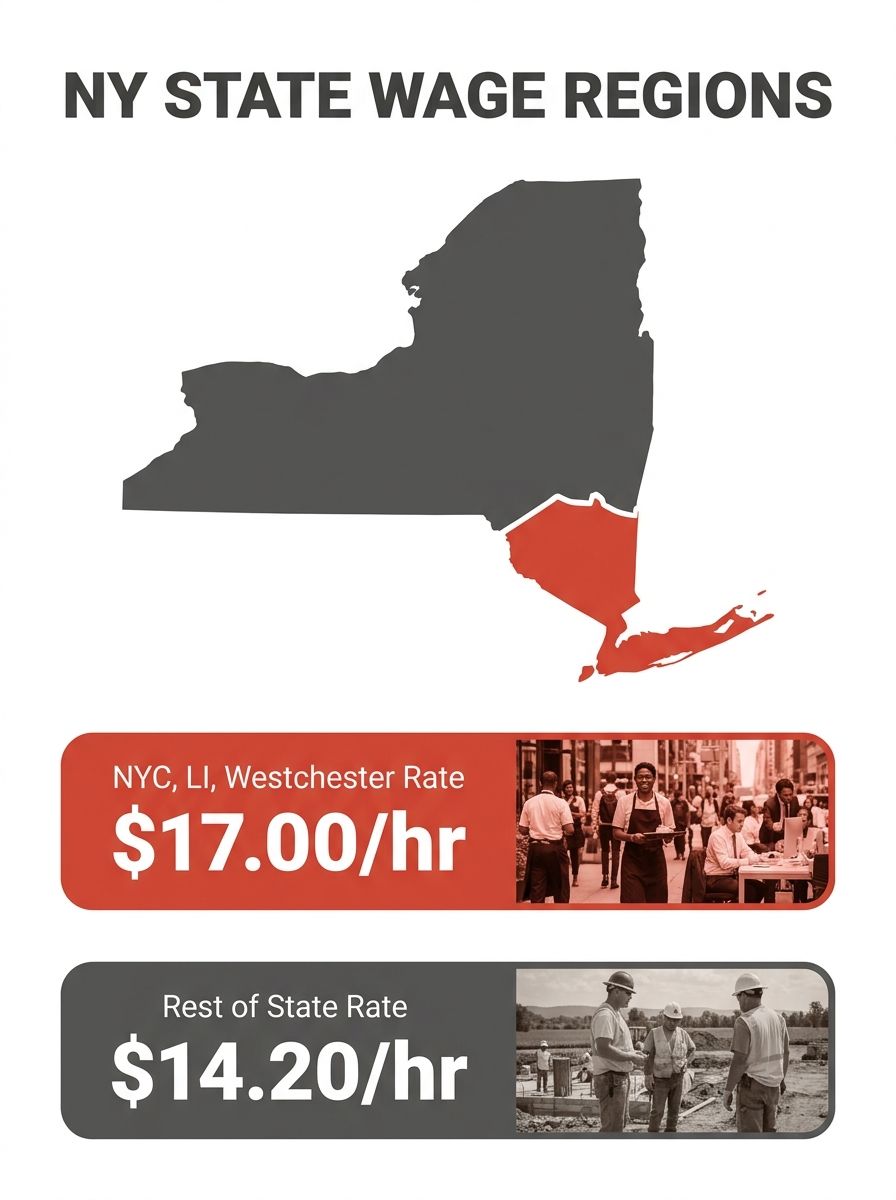
New York State's wage structure carves the state into geographic zones with different rates. NYC, along with Nassau, Suffolk, and Westchester counties, sits in the highest tier. The rest of the state follows a lower schedule. The rate that applies to any individual worker depends on where the work is physically performed, not where the employer's headquarters sits. If an employee works across multiple regions, the highest applicable rate must be paid for all hours, or hours must be pro-rated by region.
The Rate Schedule From 2024 Through 2027
New York City's minimum wage followed a defined escalator from 2024 through 2026, with automatic inflation indexing beginning in 2027. Here's the full progression:
Year | NYC Minimum Wage | Rest of State | Exempt Salary Threshold (NYC) |
|---|---|---|---|
2024 | $16.00/hr | $15.00/hr | $1,200/week ($62,400/yr) |
2025 | $16.50/hr | $15.50/hr | $1,237.50/week ($64,350/yr) |
2026 | $17.00/hr | $16.00/hr | $1,275/week ($66,300/yr) |
2027+ | CPI-indexed (3% cap) | CPI-indexed (3% cap) | TBD |
The $1.00 annual increases from 2024 to 2026 were written directly into state law. They weren't negotiated each year and didn't require new legislation. That predictability helped workers and employers plan, but it also locked the increases in regardless of whether inflation ran higher or lower than expected. As we covered in our breakdown of NYC's minimum wage rates and requirements, the 2024 jump to $16.00 represented a significant shift for small businesses across all five boroughs.
The 2027 indexing mechanism ties future increases to a three-year rolling average of the Consumer Price Index for Urban Wage Earners in the Northeast (CPI-W NE), with a hard cap of 3% in any single year. Governor Hochul's original budget proposal centered on this CPI linkage as a way to prevent the wage floor from eroding through inflation without requiring annual legislative fights. The "Raise Up NY" legislative proposal had pushed for faster increases to $17.25 in 2024 and indexing to inflation plus productivity growth after 2026, but the final law adopted the more conservative CPI-only formula.
Industry-Specific Rates and Tip Credit Mechanics
The $17.00 headline rate applies to most workers, but several industries operate under different rules. The tip credit system is where many wage violations occur, and it's the mechanism most likely to shortchange the city's most vulnerable workers.
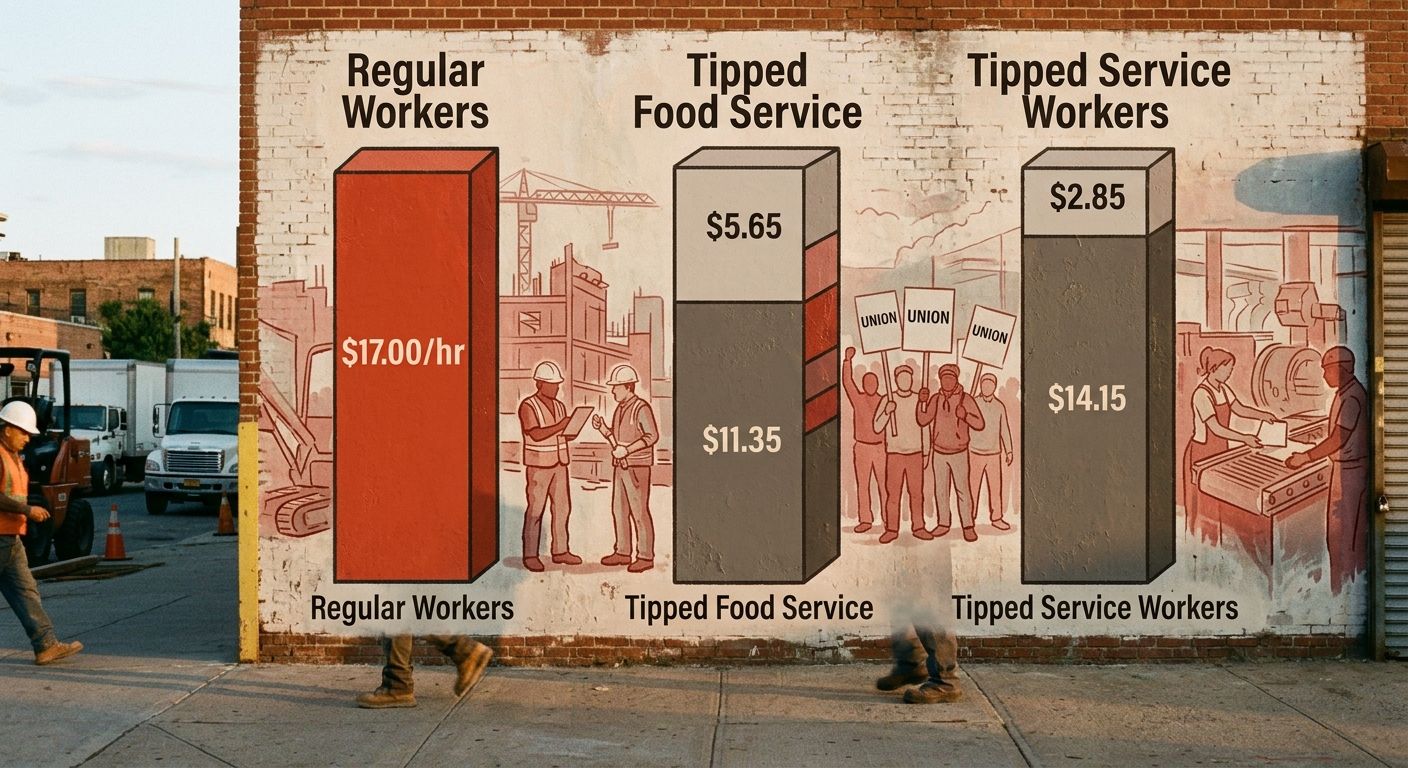
Tipped food service workers (servers, bartenders, bussers in restaurants) receive a cash wage of $11.35 per hour in 2026, with employers claiming a tip credit of $5.65. The employer is legally responsible for ensuring that cash wage plus tips equals or exceeds $17.00 for every hour worked. If tips fall short, the employer must make up the difference. According to HelpNewYork.com's 2026 rate breakdown, this obligation is one of the most frequently violated provisions in NYC wage law.
Tipped service workers in other industries (hotel bellhops, car wash attendants, nail salon workers) receive a higher cash wage of $14.15, with a smaller tip credit of $2.85.
Home care aides earn $19.65 per hour in 2026, reflecting the physically demanding and often dangerous nature of the work. This rate is set separately from the general minimum wage through a distinct regulatory process.
The federal debate over eliminating the tip credit entirely has intensified, with congressional Democrats introducing a $25 minimum wage bill that would abolish the sub-minimum tipped wage nationwide. New York's current structure keeps the tip credit intact but narrows it significantly compared to the federal tipped minimum of $2.13 per hour, which hasn't changed since 1991.
The Exempt Employee Threshold
Salaried workers classified as "executive" or "administrative" employees are exempt from overtime requirements, but only if their salary meets a minimum threshold. In NYC for 2026, that threshold is $1,275 per week, or $66,300 per year.
This number matters because misclassification is rampant. An employer who calls a worker a "manager" and pays them a salary of $50,000 cannot legally deny them overtime. The salary must meet the threshold, and the worker's actual duties must involve genuine executive or administrative functions under the NYSDOL's tests.
The threshold has risen in lockstep with the minimum wage: $1,200/week in 2024, $1,237.50 in 2025, $1,275 in 2026. Workers who suspect they've been misclassified can file a complaint with the NYSDOL or contact the NYC Department of Consumer and Worker Protection, which publishes employer compliance guides specifically addressing misclassification.
The Living Wage Gap
NYC's $17.00 minimum wage now matches the city's Living Wage Rate of $17.00, which applies to certain employees of city-contracted service providers. But matching the Living Wage Rate does not mean the minimum wage covers actual living costs in one of the world's most expensive cities.
MIT's Living Wage Calculator for New York County estimates that a single adult with no children needs to earn well above $17.00 per hour to cover housing, food, transportation, and healthcare in Manhattan, assuming 2,080 hours of work per year. The gap widens dramatically for workers with dependents. A single parent with one child faces a living wage estimate that can exceed double the current minimum, making the $17.00 floor a survival baseline at best.
The Living Wage Law also includes a Health Benefit Supplement of $2.25 per hour for covered workers whose employers don't provide health insurance. This supplement is separate from the minimum wage and applies only to employees of city-contracted businesses, not to all NYC workers. Research on minimum wage impacts suggests that increases may raise the Consumer Price Index by approximately 0.14 percentage points in the first year, with effects concentrated in food services, meaning part of each raise gets absorbed by the very inflation it's trying to outpace.
Florida's approach offers a useful contrast. As we've documented in our coverage of Florida's minimum wage rate changes, that state's constitutionally mandated annual $1.00 increases (reaching $14.00 in 2025) operate through a voter-approved constitutional amendment rather than legislative action. Both states use escalator structures, but the enforcement and political dynamics differ fundamentally.
How to File a Wage Complaint
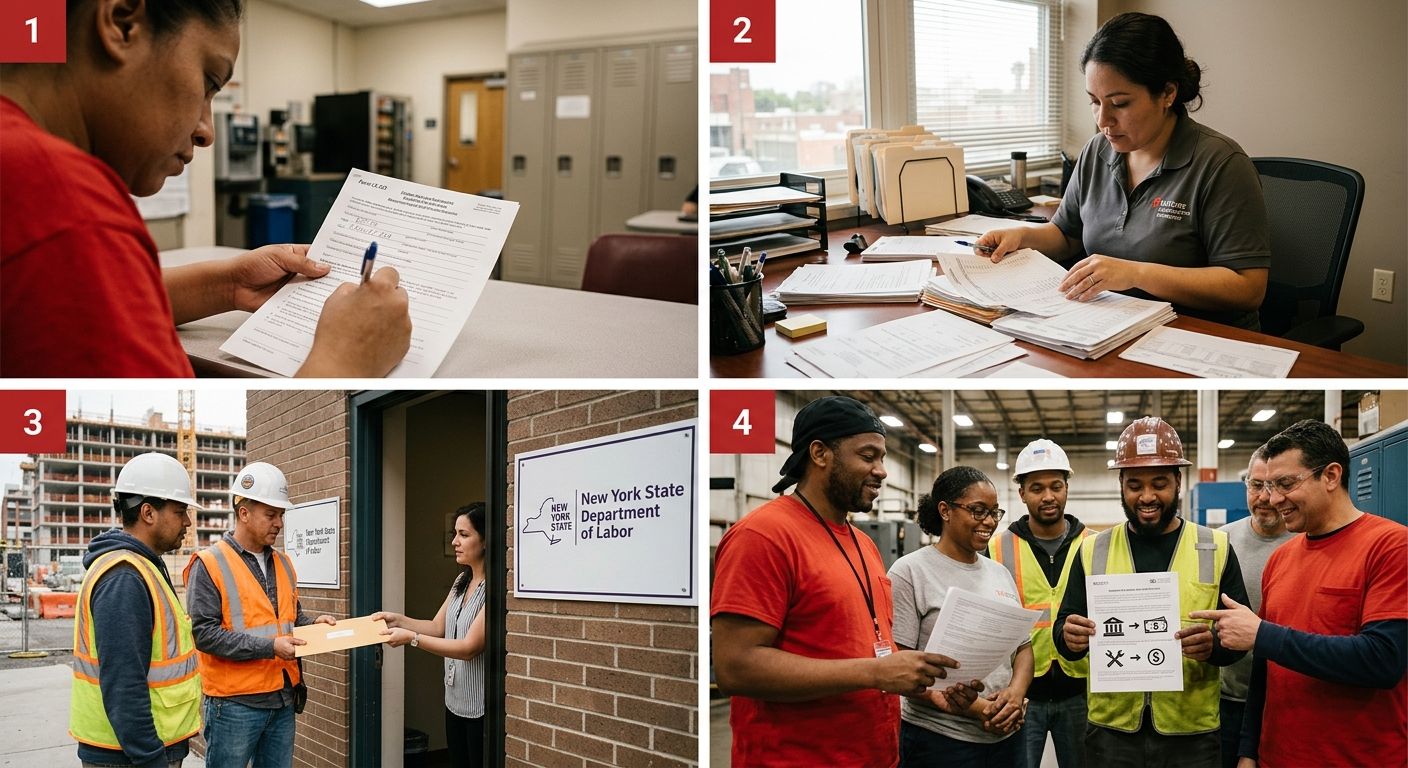
Workers who believe their employer is paying below the minimum wage, misapplying tip credits, or misclassifying them as exempt can file a claim with the NYSDOL using Form LS 223. The complaint covers unpaid wages, unpaid wage supplements, and mandatory overtime violations.
The process works as follows:
Download the LS 223 claim form from the NYSDOL website or call 1-888-4NYSDOL (1-888-469-7365)
Document the violation with pay stubs, schedules, and personal records of hours worked and tips received
Submit the completed form to the Division of Labor Standards at Building 12, Room 266B, State Office Campus in Albany
The NYSDOL investigates and can order back pay, penalties, and interest
Retaliation against workers who file wage complaints is illegal under New York Labor Law Section 215. An employer who fires, demotes, or reduces the hours of a worker for filing a complaint faces additional penalties, including reinstatement and back pay for the retaliation itself.
Where the Model Breaks
NYC's minimum wage structure has three significant weak points that workers and organizers should understand.
Multi-location workers present a compliance puzzle. If a delivery driver picks up an order in Manhattan and delivers it across county lines, the rate that applies depends on where the work is "performed." State guidance says the highest applicable rate should govern, but enforcement is inconsistent, and gig platforms routinely calculate pay using proprietary formulas that may not align with state law. The growth of app-based work has outpaced the regulatory framework built for fixed workplaces.
The 3% CPI cap starting in 2027 protects employers from sudden large increases, but it also means that in years when inflation exceeds 3%, the minimum wage falls further behind the cost of living. A year with 5% inflation and a 3% wage increase produces a real pay cut of 2%. The three-year rolling average further dampens responsiveness, building a lag into the system that ensures the wage floor always trails economic reality rather than keeping pace with it.
Enforcement depends almost entirely on worker complaints. The NYSDOL does not proactively audit every employer in the city. Workers in industries with high turnover, cash payments, and limited English proficiency are least likely to file complaints and most likely to experience violations. Research consistently shows wage theft concentrating among immigrants, undocumented workers, and employees in restaurants, construction, and domestic work. The legal framework provides strong protections on paper, while enforcement relies on the workers who face the greatest barriers to activating it.
Common Questions
Does the NY city minimum wage apply to all workers regardless of immigration status?
Yes. New York's minimum wage applies to every worker performing work in the city, regardless of immigration or documentation status. Undocumented workers have the same legal right to minimum wage, overtime, and protection from retaliation as any other employee. Employers who threaten to report a worker's immigration status for filing a wage complaint commit an additional violation under state law.
Do fast food workers in NYC earn a different minimum wage?
Fast food workers in New York previously had a separate, higher minimum wage that reached $15.00 statewide before the general minimum caught up. As of 2026, fast food workers in NYC are covered by the same $17.00 rate as other employees, though the state retains authority to set industry-specific rates through wage orders.
How does overtime work with the NYC minimum wage?
Non-exempt workers in NYC are entitled to 1.5 times their regular hourly rate for all hours worked beyond 40 in a week. At the 2026 minimum wage, that means overtime pay of $25.50 per hour. Salaried workers earning below the $1,275/week threshold are entitled to overtime if their actual job duties don't qualify as executive or administrative under the NYSDOL's functional tests.
Can my employer pay me less than minimum wage during a training period?
No. New York does not allow a sub-minimum "training wage." From the first hour of work, employers must pay at least the applicable minimum wage rate. The only exceptions involve workers with disabilities employed through state-certified programs, which are subject to separate regulatory requirements.
What happens after 2027 when rates are indexed to inflation?
Starting in 2027, the minimum wage will increase annually based on a three-year rolling average of the CPI-W for the Northeast region, capped at 3% per year. The NYSDOL will publish each year's rate in advance of the January 1 effective date. If the CPI calculation produces a decrease, the minimum wage holds steady at the prior year's rate rather than dropping. For workers tracking New York's evolving wage landscape, our 2024 minimum wage update for New York State provides additional context on how the state arrived at the current escalator structure.
The Union Edge Staff
Frequently Asked Questions
- What is the NYC minimum wage for 2026?
- The NYC minimum wage is $17.00 per hour as of January 1, 2026. However, different rates apply to tipped workers and certain industries: tipped food service workers earn $11.35 plus a $5.65 tip credit, tipped service workers earn $14.15 plus a $2.85 tip credit, and home care aides earn $19.65 per hour.
- How is the New York City minimum wage determined and enforced?
- The NYC minimum wage is set by New York State through legislation passed in Albany, not by the City Council. The New York State Department of Labor (NYSDOL) administers and enforces it, meaning workers seeking higher wages must advocate to state legislators rather than municipal officials.
- What is the tip credit system in NYC and how does it work?
- Tipped workers receive a lower cash wage with employers claiming a tip credit toward the minimum wage. Employers are legally required to ensure that cash wage plus tips equals at least $17.00 per hour in 2026; if tips fall short, the employer must make up the difference. This is one of the most frequently violated provisions in NYC wage law.
- What salary threshold determines if an employee is exempt from overtime in NYC?
- For 2026, the exempt salary threshold in NYC is $1,275 per week ($66,300 per year). Workers earning below this threshold are entitled to overtime pay regardless of their job title, and actual job duties must involve genuine executive or administrative functions—a title alone doesn't determine exemption status.
- How do I file a wage complaint with New York State if my employer underpaid me?
- You can file a complaint using Form LS 223 with the NYSDOL by downloading it from their website or calling 1-888-4NYSDOL. Submit documentation of hours worked and tips received along with the completed form to the Division of Labor Standards in Albany. The NYSDOL can order back pay, penalties, and interest, and retaliation by your employer is illegal.
- Does the NYC minimum wage apply to undocumented workers?
- Yes, New York's minimum wage applies to every worker performing work in the city regardless of immigration or documentation status. Undocumented workers have the same legal rights to minimum wage, overtime, and protection from retaliation, and employers cannot threaten to report a worker's immigration status for filing a wage complaint.
- What will happen to NYC minimum wage rates after 2027?
- Starting in 2027, the minimum wage will be indexed annually to a three-year rolling average of the Consumer Price Index for the Northeast, capped at 3% per year. If inflation exceeds 3%, the minimum wage will fall behind the cost of living, and if the CPI calculation produces a decrease, the wage holds steady rather than dropping.
- Can my employer pay me less than minimum wage during training in NYC?
- No. New York does not allow a sub-minimum training wage; employers must pay at least the applicable minimum wage from the first hour of work. The only exceptions are workers with disabilities employed through state-certified programs, which are subject to separate regulatory requirements.
Related Articles

New York City Minimum Wage: 2024 Updates & What Changed
New York City's minimum wage is the legal hourly floor every employer in the five boroughs must pay, and on January 1, 2024, it climbed from $15.00 to $16.00 per hour. That dollar increase was the first move in a three-year legislated schedule that reaches $17.

Minimum Wage NYC: 2024 Rates & Requirements
NYC's minimum wage operates through a system of geographic zones, industry-specific tip credits, and exempt salary thresholds that together produce at least five different legal pay floors. The base rate is $17.

Minimum Wage in NYC: 2024 Rates & Requirements
Section 652 of New York's Labor Law sets the minimum wage in NYC at $16.00 per hour as of January 1, 2024. That headline number hides a tiered system of tip credits, industry-specific floors, and geographic zones that can reduce a worker's guaranteed cash wage to $10.
Also in the paper