
The Organizer's Listening Framework: Moving Beyond Solutions to Root Causes
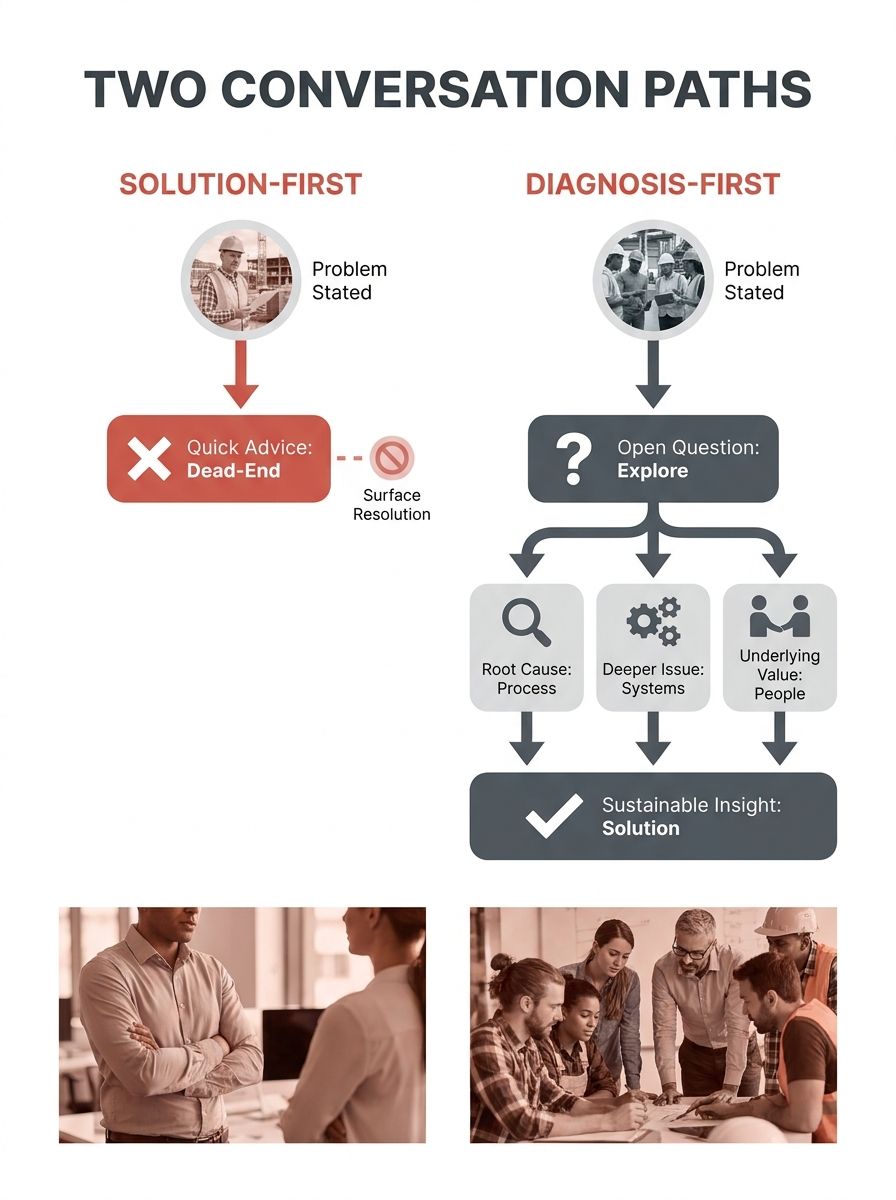
The biggest failure in organizer training is teaching people to solve problems before they understand them.

The Organizer's Listening Framework: Moving Beyond Solutions to Root Causes
The biggest failure in organizer training is teaching people to solve problems before they understand them. Active listening in labor campaigns requires a structured method that surfaces root causes like discrimination and wage theft, instead of letting conversations stall at surface-level complaints about scheduling or individual supervisors.
IATSE Local 122's organizing conversation guide puts it directly: in active listening, "an organizer is genuinely interested in understanding what the other person is thinking and feeling" before responding with their own viewpoint. That definition sounds simple. In practice, most organizers skip straight to the response. They hear a worker describe unfair scheduling, and within 30 seconds they're pitching a grievance process or an authorization card. The worker walks away feeling processed, not heard. And the organizer never learns that the scheduling problem traces back to a supervisor who assigns weekend shifts disproportionately to workers of color.
A 2023 Workforce Institute study found that 86% of employees feel they are not heard fairly or equally at work. That number rises among workers in hourly, manual, and service positions where civil rights violations hide inside mundane operational decisions. The gap between "heard" and "processed" is where campaigns die or flourish.
These seven rules structure a listening practice that reaches root causes. They draw from motivational interviewing, community organizing traditions, and the hard lessons of campaigns that won recognition but lost first contracts because nobody understood the real problems.
Ask what's wrong before you ask what workers want
The natural instinct in an organizing conversation is to steer toward what workers want: better pay, more respect, a voice on the job. But "what do you want?" is a solution-oriented question. It assumes the worker already understands the full scope of the problem. In civil rights terms, that's like asking someone to prescribe a remedy before they've been allowed to describe the injury.
The first question in any organizing conversation should be diagnostic. "What's happening at your job right now?" or "Tell me about your worst day here this month" opens space for description, not prescription. Workers who are asked solution questions tend to give answers they think the organizer wants to hear. Workers asked descriptive questions tell you what's actually happening on the floor, in the break room, during shift changes.
This matters for worker engagement because the stories that emerge from descriptive questions reveal patterns the organizer would never have guessed. A 2023 Salesforce study found that employees who feel genuinely heard are 4.6 times more likely to feel capable of performing their best work. That statistic applies doubly in organizing: a worker who feels heard becomes a worker who trusts the campaign enough to talk to coworkers.
Reflect the emotion before you address the complaint
When a home care aide says "they keep changing my hours and I can't pick up my kid from school," the complaint is about scheduling. The emotion is about powerlessness, about being treated as disposable. If you jump to the scheduling complaint, you miss the deeper current. If you reflect the emotion first ("It sounds like they're making decisions about your life without asking you"), the worker will often go further. They'll tell you about the other ways the agency treats them as interchangeable, about the racial dynamics of who gets stable schedules and who doesn't.
The OARS framework adapted from motivational interviewing gives organizers a practical structure here. OARS stands for Open-ended questions, Affirmations, Reflections, and Summaries. Reflections — restating what you heard in slightly different words, emphasizing the feeling behind the facts — are the single most powerful tool in the set. They slow the conversation down enough for the worker to think about what they're actually saying, sometimes for the first time.
Organizer training programs that skip emotional reflection produce organizers who collect grievances like a suggestion box. They end up with lists of individual complaints instead of a map of systemic problems. And systemic problems are what win elections, build committees, and hold up in unfair labor practice charges under the National Labor Relations Act.
Name the system behind the symptom
A worker complains about favoritism in overtime assignments. Another worker on a different shift says the same thing about promotion decisions. A third mentions that the break room is segregated by unspoken custom. Each of these sounds like a separate problem. A listening organizer who tracks patterns across conversations will recognize them as expressions of a single system: racial or ethnic discrimination embedded in management practice.
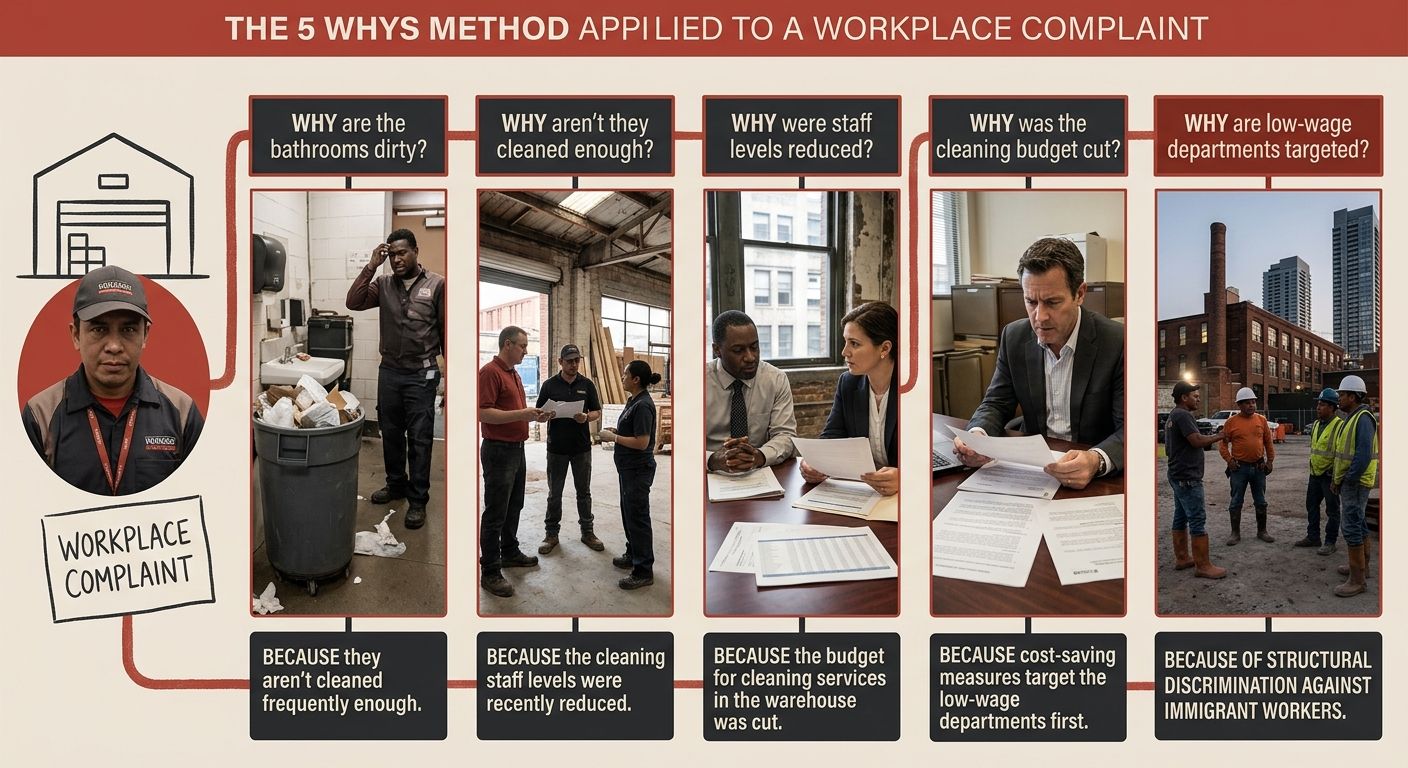
Washington State's Office of Financial Management publishes an employee engagement problem-solving guide that walks through root cause identification using affinity diagrams and the "5 Whys" method. Those tools were designed for management, but they work even better for organizers because organizers have access to something management rarely does: honest testimony from workers who trust them.
The 5 Whys applied to an organizing conversation looks like this. A worker says the bathroom facilities are always filthy. Why? Because maintenance staff only clean the office bathrooms, not the warehouse. Why? Because management doesn't consider warehouse workers' facilities a priority. Why? Because warehouse workers are majority immigrant, majority non-English-speaking, and management doesn't see them as worth the investment. By the fifth "why," you've moved from a bathroom complaint to a civil rights problem with legal implications under Title VII. That root cause becomes a far more powerful campaign foundation than a request for cleaner bathrooms.
Use OARS to structure every organizing conversation
Why does active listening in labor campaigns break down so consistently? Because organizers lack a repeatable protocol. OARS provides one. Open-ended questions prevent yes/no answers that shut down disclosure. "How do things work around here for someone like you?" generates more actionable information than "Is your supervisor fair?" Affirmations validate the worker's courage in speaking honestly: "It takes guts to say that out loud." Reflections demonstrate that you actually processed what was said. Summaries tie the conversation together and give the worker a chance to correct misunderstandings.
A 2023 Gitnux workplace communication report found that 80% of workplace conflicts stem from poor communication. Inside organizing campaigns, poor communication between organizer and worker takes a specific form: the organizer talks more than they listen, pitches union benefits before understanding the worker's situation, and leaves the conversation with assumptions rather than facts. OARS reverses that dynamic by giving the organizer a protocol that prioritizes the worker's voice.
When organizers go directly to workers rather than waiting for people to come to the union office, OARS becomes the conversational backbone that makes those field encounters productive instead of awkward.
Map individual grievances to collective root causes
After ten or twenty conversations using the methods above, an organizer will have a collection of stories. The critical step is synthesis: grouping individual complaints into root-cause categories. This is where organizing strategy separates itself from case management or social work. A caseworker addresses individual problems one at a time. An organizer identifies shared structural problems and builds collective power to change them.
Research from Alvarez & Marsal on employee retention and engagement emphasizes that local leaders "hold the keys to improvements in work conditions, supervisor quality and pay" and need data-driven analysis before they can act. The same principle applies to organizing committees. Workers on your committee need to see the pattern across stories, not individual anecdotes. When a committee member says "this is happening to all of us," that's the moment collective identity forms.
We've seen campaigns succeed at the recognition stage but stumble during bargaining because the organizing committee never developed a root-cause analysis of workplace problems. They had a list of complaints. They didn't have a diagnosis. At the bargaining table, a list of complaints gets picked apart item by item. A diagnosis of systemic failures in safety, equity, or respect gives the committee a unified bargaining position that's harder to divide, and a much stronger basis for unfair labor practice charges if management retaliates.
Let the affected workers define both the problem and the solution
The Forge's definition of community organizing is precise: it starts with "people with a problem who define their community and decide the problems that they wish to address, the solutions they wish to pursue, and the methods they will use to accomplish their goals." That principle transfers directly to workplace organizing. The organizer's role is to help workers see the pattern. The workers' role is to decide what to do about it.
This rule protects campaigns from a specific failure mode: the organizer who arrives with a predetermined analysis and uses listening as a tool to confirm it. Workers can tell the difference between genuine inquiry and guided persuasion. When the organizing model replaces the service model, workers own the analysis, the strategy, and the outcome. The organizer provides structure and institutional knowledge, not predetermined answers.
In civil rights terms, this principle carries legal weight. The NLRA protects workers' right to self-organization under Section 7, which guarantees the right to "engage in concerted activities for the purpose of collective bargaining or other mutual aid or protection." The root causes that workers identify through structured listening become the foundation for protected concerted activity. When a group of workers presents management with a petition about discriminatory scheduling, the legal strength of that petition depends on whether the workers themselves identified and articulated the problem. An organizer-drafted complaint is a piece of paper. A worker-owned analysis backed by dozens of documented conversations is a civil rights case.
When these rules collide with reality
Structured listening takes time, and campaigns face hard deadlines: authorization card thresholds, election dates, legal checkpoints that determine whether the campaign survives. An employer working with the $1.7 billion union-avoidance industry will not pause while your organizers practice their reflective listening skills.
The tension is real, and pretending otherwise insults the difficulty of organizing work. But the rules above aren't alternatives to urgency. They're the methods that make urgency productive. An organizer who spends 45 minutes in genuine OARS-structured conversation with a single worker learns more about campaign vulnerabilities, management pressure points, and committee recruitment targets than an organizer who spends three hours knocking on doors and racing through authorization card pitches.
The rule that breaks first under pressure is usually number six: letting workers define the problem. When the election is two weeks away and the employer is holding captive-audience meetings, the temptation to hand workers a scripted talking-points sheet is overwhelming. Resist that impulse. Workers who have gone through the process of identifying root causes and articulating them in their own language are the same workers who hold firm during captive-audience meetings, who persuade skeptical coworkers in the parking lot, and who show up at the bargaining table with clarity about what they're fighting for.
The framework here isn't an abstraction. It's the difference between campaigns that win elections and campaigns that win contracts, between unions that organize workplaces and movements that change working conditions for entire industries. Root-cause listening, practiced with discipline and taught through deliberate organizer training and worker education, builds the kind of worker engagement that survives management opposition, legal delays, and the long grind between recognition and a signed agreement. The organizers who learn to listen before they prescribe are the ones whose campaigns still have momentum six months after the vote count.
The Union Edge Staff
Related Articles

The Organizing Committee's Hidden Liability: Why Inadequate Worker Education Becomes Your Weakest Link
The AFL-CIO's Organizing Institute trains participants to have one-on-one organizing conversations, chart workplace leaders, and run mini-campaigns around live issues.

Beyond the Union Office: Why Organizers Fail When They Wait for Workers to Come to Them
Campaigns that file for an NLRB election with 60–70% worker support win 78% of the time. Campaigns built primarily on walk-in interest at a union hall rarely come close to that success rate.

From Salting to Sustained Campaigns: How Unions Plant Organizers and Build Lasting Workplace Power
Salting, the practice of trained union organizers taking jobs at non-union workplaces to build support from the inside, drove the first successful Starbucks organizing campaign in decades.
Also in the paper