
Workers Rights Consortium: Labor Standards Guide
The Workers Rights Consortium (WRC) is an independent labor rights monitoring organization that investigates factory conditions across 24 countries, enforcing codes of conduct that universities adopt for goods bearing their logos.
Workers Rights Consortium: How Labor Standards Enforcement Actually Works
The Workers Rights Consortium (WRC) is an independent labor rights monitoring organization that investigates factory conditions across 24 countries, enforcing codes of conduct that universities adopt for goods bearing their logos. Since its founding in 2000, the WRC has secured specific remedies in 711 cases affecting 266,100 workers, through a mechanism that operates nothing like the corporate-funded auditing firms most people assume police global supply chains.
What the Workers Rights Consortium Is
The WRC is an independent monitoring body founded in 2000 by international labor rights experts, university administrators, and student organizations. It exists for one specific purpose: helping universities enforce binding labor standards on factories that produce apparel and other goods carrying university logos. The organization conducts investigations in factories around the globe, operating independently of the brands and manufacturers it monitors.
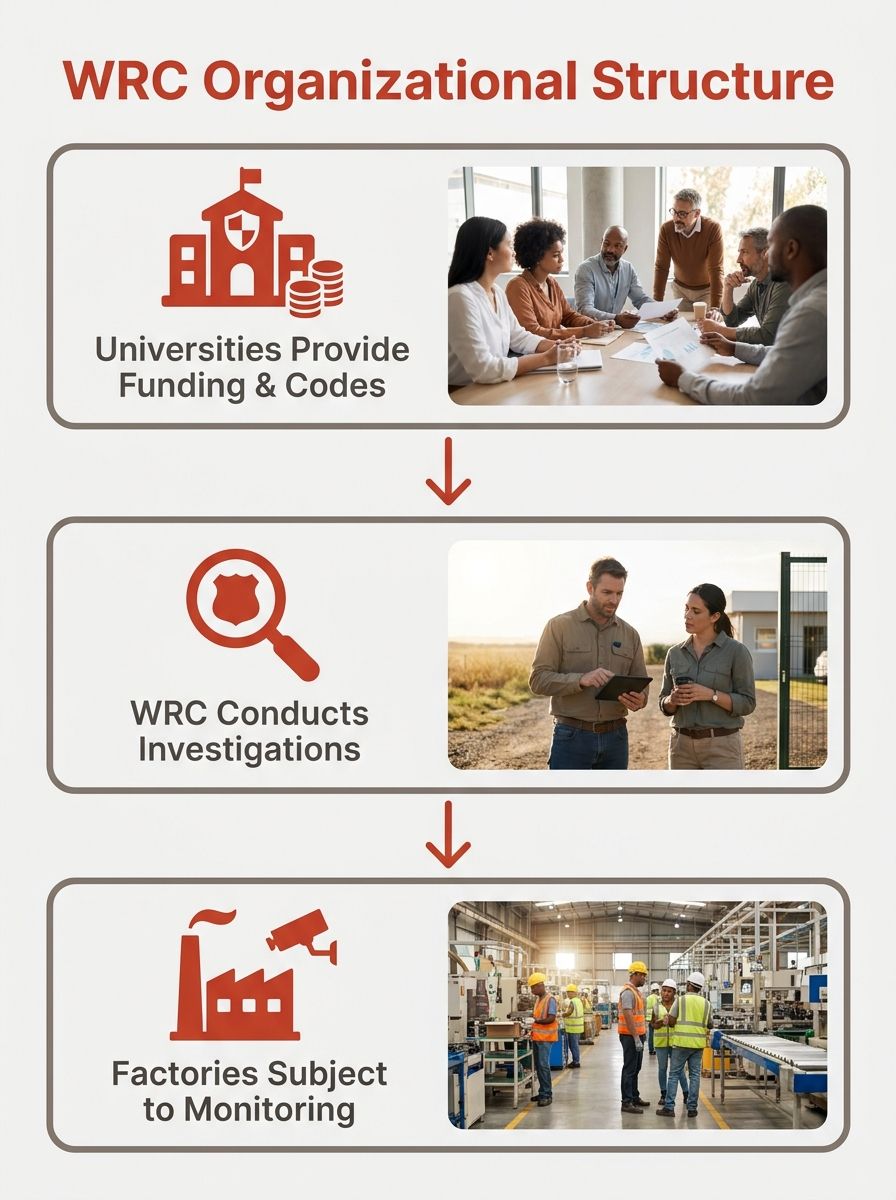
This independence is the structural feature that separates the WRC from dominant industry audit programs. Most factory auditing in the global apparel supply chain is paid for by the brands themselves. The WRC's funding comes from affiliated universities, which pay annual dues based on licensing revenue. That funding structure means the WRC answers to institutions with an educational mission and public accountability obligations, not to the companies whose factories it investigates.
The WRC's jurisdiction is narrow by design. It doesn't cover every factory making clothes. It covers factories making goods that carry the name or logo of an affiliated university. But that narrow scope gives it real teeth, because universities can and do pull licensing agreements when factories refuse to remediate violations.
The University Code of Conduct
Every university that affiliates with the WRC must adopt a code of conduct governing the labor conditions under which its licensed goods are produced. According to the University of Minnesota Human Rights Library's documentation of the WRC model, that code must include provisions covering a living wage, the right to organize and collectively bargain, worker health and safety protections, compliance with local laws, protection of women's rights, and prohibitions on child labor, forced labor, and forced overtime.
These aren't aspirational statements. They're binding contractual terms embedded in licensing agreements between universities and the brands that produce logo merchandise. When a factory violates the code, the university has legal grounds to terminate its licensing relationship with the brand sourcing from that factory.
The code also requires full public disclosure of the site locations of all facilities, including those operated by contractors or subcontractors. This transparency requirement blocks the common industry practice of hiding production in undisclosed subcontractor facilities where conditions are worst. If you've followed how wage theft operates domestically, the subcontracting shell game will look familiar. It's the same dynamic, scaled globally.
The specific standards within these codes align with International Labour Organization (ILO) conventions, which means they carry recognized international benchmarks rather than vague corporate promises. Universities conduct gap analyses and develop policies around minimum wage compliance, non-discrimination, and worker dialogue as part of their affiliation process.
How Factory Investigations Work
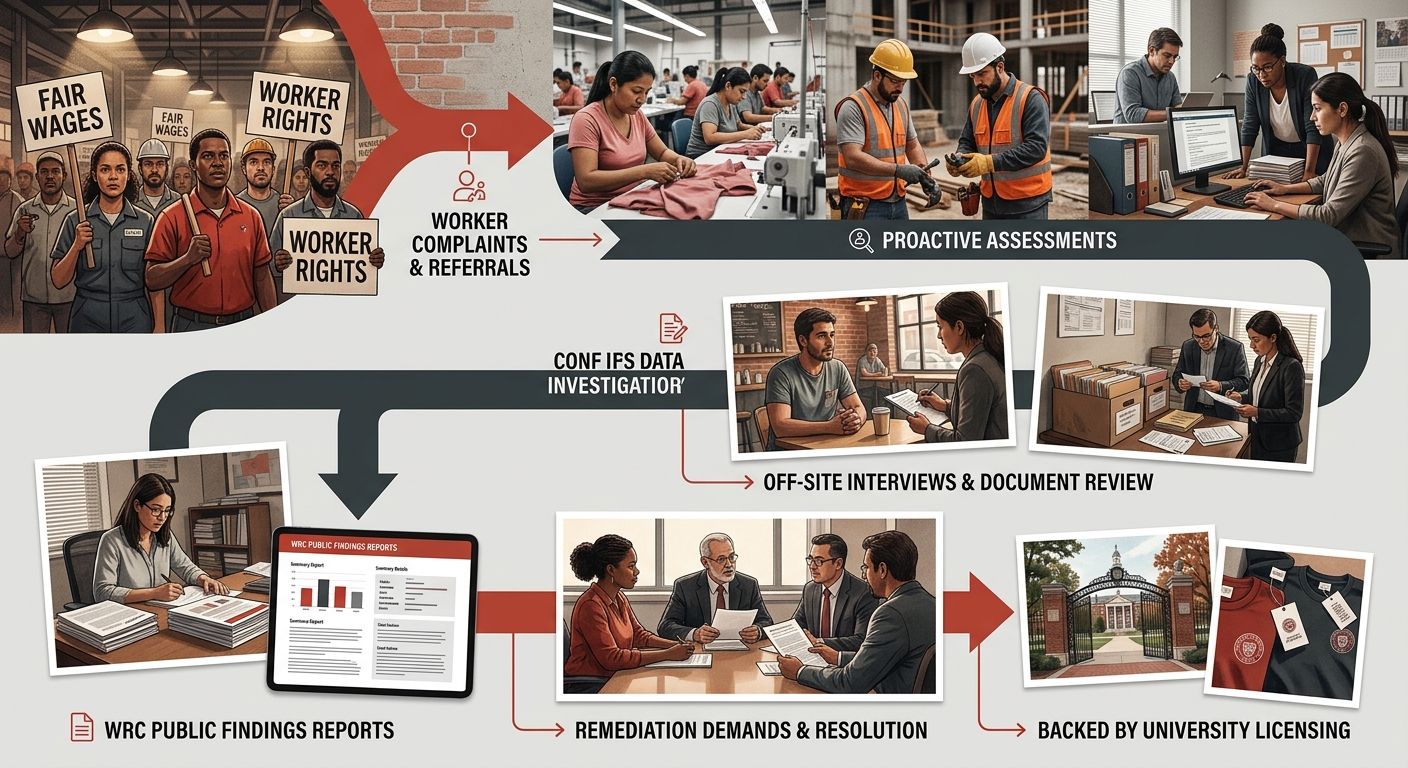
The WRC's investigative process runs on two tracks: proactive assessments of factories in the university supply chain, and reactive investigations triggered by worker complaints. Both tracks follow a methodology built around direct worker engagement, not the clipboard-and-checklist approach that characterizes most commercial audits.
When the WRC investigates a factory, its field staff interview workers off-site, away from management surveillance. They review production documentation, observe manufacturing processes, and interview operators and supervisors separately, following the established audit principle that documented procedures must reflect actual practice and executed activities must be recorded. The gap between written policy and shop-floor reality is where violations live.
In 2024, the WRC documented serious violations of labor rights at KOA Modas, including association violations, statutory benefit violations, and wage and severance theft. Cases like this illustrate a pattern: the violations most commonly found aren't obscure regulatory technicalities. They're fundamental civil rights abuses including retaliation against workers who try to organize, withheld legally mandated benefits, and straight theft of earned wages.
The WRC publishes its investigation findings publicly. This is a radical departure from the commercial audit model, where audit results are typically proprietary and shared only with the brand that commissioned them. Public disclosure means that universities, students, journalists, and workers themselves can see what the WRC found and whether remediation occurred.
The Remediation and Pressure Mechanism
Finding violations is the easier part. Fixing them requires a pressure mechanism with real economic consequences. The WRC's remediation model works through a chain of use that runs from factory floor to university boardroom.
When an investigation documents violations, the WRC issues findings and recommendations to the factory, the brand sourcing from that factory, and the affiliated universities whose codes are being violated. The factory and brand receive a specific timeline to remediate. If they don't, the WRC recommends that universities cut the brand from their licensing programs.
This matters because university logo merchandise represents significant revenue. College apparel is a multi-billion-dollar market in the United States alone. When a major university system threatens to pull its logo from a brand's product line, the brand faces real financial consequences. That threat has proven effective across the WRC's 711 documented remediation cases in 24 countries.
The mechanism works because it creates accountability at every link in the supply chain. The factory can't hide behind the brand. The brand can't hide behind the factory. And the university can't claim ignorance, because the WRC's public reporting ensures that students, faculty, and administrators all know when violations exist and whether they've been fixed.
This chain of accountability echoes the dynamics visible in domestic labor fights. When nurses at Central Maine Medical Center voted to unionize with 91% approval, the underlying mechanism was similar: workers collectively applying pressure through institutional channels that carry economic weight. The WRC model scales that principle internationally by making universities the institutional anchor.
What the Standards Actually Cover
The WRC's labor standards framework addresses seven core areas, each corresponding to fundamental worker rights recognized under international law.
Living wages require that workers earn enough to meet basic needs, which goes beyond the legal minimum wage in countries where statutory minimums fall below subsistence levels. Many of the countries producing university logo apparel have minimum wage structures that don't cover actual living costs, making the living wage provision the most economically consequential standard in the code.
Freedom of association and collective bargaining protect workers' rights to form unions and negotiate collectively without employer retaliation. Among the WRC's 266,100 impacted workers, union leader reinstatements have been a frequent remedy, reflecting how commonly factories target organizers for dismissal.
Health and safety protections mandate conditions that meet or exceed local occupational safety standards. These provisions cover everything from chemical exposure and fire safety to ergonomic conditions and working hours.
Prohibitions on child labor, forced labor, and forced overtime establish absolute floors. No volume of production pressure or seasonal demand justifies these practices, and the WRC treats them as non-negotiable violations requiring immediate remediation.
Women's rights protections address the specific vulnerabilities of the predominantly female workforce in global garment manufacturing, including prohibitions on pregnancy-based discrimination, sexual harassment, and gender-based wage disparities.
Compliance with local laws functions as a baseline requirement. The WRC's standards apply on top of local legal requirements, meaning the code defaults to whichever standard is higher: local law or the university code.
Where the Model Breaks
The WRC model has real structural limitations that its advocates shouldn't paper over.
First, scope. The WRC covers factories producing university-licensed goods. Factories producing identical garments for non-university brands, sometimes in the same building, fall outside the WRC's jurisdiction. A factory might remediate conditions for the production lines making university logo shirts while maintaining abusive conditions on adjacent lines producing for brands with weaker oversight. The same workers sometimes rotate between these lines.
Second, enforcement depth. The WRC can recommend that universities cut licensing ties, but it can't compel them to do so. University administrators face competing pressures from alumni donors, brand relationships, and institutional inertia. Some universities have been slow to act on WRC recommendations, weakening the use chain that makes the model work.
Third, the model depends on worker willingness to report. In countries with weak rule-of-law protections or active anti-union violence, workers may face physical danger for engaging with WRC investigators. The WRC's off-site interview methodology reduces but doesn't eliminate this risk.
Fourth, the living wage standard is difficult to enforce consistently across dozens of countries with different cost-of-living structures, currency fluctuations, and inflation rates. Calculating a living wage for Dhaka is a different exercise than calculating one for Ho Chi Minh City, and the benchmarks require constant updating.
And fifth, the WRC's public disclosure model creates transparency but can also create perverse incentives. Some brands, when faced with public findings, simply shift production to undisclosed factories rather than remediate. The pattern of companies fighting worker organizing through avoidance rather than engagement plays out internationally too.
These limitations don't invalidate the WRC model. They define the boundaries within which it operates and the conditions under which it's most and least effective. The model works best when universities are willing to enforce, workers feel safe reporting, and brands have strong enough ties to university licensing that the threat of losing those contracts carries weight.
Common Questions
Does the Workers Rights Consortium inspect all clothing factories?
No. The WRC's jurisdiction is limited to factories producing goods that carry affiliated university names or logos. Factories making identical products for non-university brands fall outside WRC monitoring unless those brands have separate agreements with the organization.
How is the WRC different from Fair Trade certification?
Fair Trade certification requires producers to meet social, environmental, and economic standards across a broad range of product categories, with certification fees paid by producers. The WRC focuses specifically on labor rights in factories producing university-licensed goods, funded by university dues rather than factory payments. The WRC also publishes investigation findings publicly, while most certification bodies treat audit results as confidential.
Can workers file complaints directly with the WRC?
Yes. Workers, labor rights organizations, and unions can submit complaints directly to the WRC, which triggers a reactive investigation. The WRC conducts interviews off-site and away from management to protect complainants from retaliation, though risks to workers vary by country and legal environment.
What happens if a factory refuses to fix violations?
The WRC recommends that affiliated universities terminate licensing agreements with brands sourcing from non-compliant factories. Universities can pull their logos from a brand's products, costing the brand revenue from the college apparel market. This economic pressure has driven remediation in 711 cases across 24 countries.
Do WRC standards override local labor laws?
WRC standards operate alongside local laws, defaulting to whichever protection is stronger. If local law requires a higher minimum wage than the WRC's living wage calculation, local law governs. If the WRC's code provides stronger protections on freedom of association than local statutes, the WRC standard applies. The two systems are layered, with workers receiving the higher level of protection from either source.
The Union Edge Staff
Frequently Asked Questions
- What is the Workers Rights Consortium and how does it work?
- The Workers Rights Consortium (WRC) is an independent labor rights monitoring organization founded in 2000 that investigates factory conditions in 24 countries and enforces labor codes of conduct that universities adopt for goods bearing their logos. It has secured specific remedies in 711 cases affecting 266,100 workers through a three-part mechanism consisting of university-adopted codes, on-the-ground investigations, and remediation pressure.
- How is the WRC funded and how does that differ from commercial auditors?
- The WRC is funded by affiliated universities through annual dues based on licensing revenue, meaning it answers to institutions with educational missions and public accountability obligations rather than to the companies whose factories it investigates. Most factory auditing in the global apparel industry is paid for by the brands themselves, creating a structural conflict of interest that the WRC avoids.
- What labor standards must universities enforce under the WRC code of conduct?
- University codes must include living wages, the right to organize and collectively bargain, worker health and safety protections, compliance with local laws, protection of women's rights, and prohibitions on child labor, forced labor, and forced overtime. These are binding contractual terms embedded in licensing agreements, not aspirational statements.
- How does the WRC investigate factories and what violations does it typically find?
- The WRC conducts proactive assessments and reactive investigations triggered by worker complaints, with field staff interviewing workers off-site away from management surveillance. The violations most commonly found are fundamental civil rights abuses including retaliation against organizing workers, withheld legally mandated benefits, and wage and severance theft.
- What pressure mechanism does the WRC use to force factories to fix violations?
- When violations are documented, the WRC recommends that affiliated universities cut the brand from their licensing programs if the factory and brand don't remediate within a specified timeline. Since university logo merchandise represents significant multi-billion-dollar revenue, the threat of losing licensing agreements creates real financial consequences for brands.
- Can workers file complaints directly with the WRC?
- Yes, workers, labor rights organizations, and unions can submit complaints directly to the WRC, which triggers a reactive investigation. The WRC conducts interviews off-site and away from management to protect complainants from retaliation.
- What are the main limitations of the WRC model?
- The WRC's scope is limited to university-licensed goods only, meaning identical garments produced in the same factory for non-university brands fall outside its jurisdiction. Additional limitations include that it can only recommend universities cut ties but cannot compel them to do so, worker safety concerns in countries with weak rule-of-law protections, difficulty calculating living wages consistently across countries, and the risk that brands simply shift production to undisclosed factories rather than remediate.
- How do WRC standards interact with local labor laws?
- WRC standards operate alongside local laws with workers receiving whichever protection is stronger. If local law requires a higher minimum wage than the WRC's living wage calculation, local law governs; if the WRC code provides stronger protections on freedom of association than local statutes, the WRC standard applies.
Related Articles
NLRB Wagner Act: What You Need to Know
The National Labor Relations Act of 1935, commonly called the Wagner Act, is the federal statute that guarantees private-sector employees the right to organize unions, bargain collectively, and strike.

NLRB: What Employers and Employees Need to Know
The National Labor Relations Board is the independent federal agency that decides whether your employer broke the law when it fired you for talking about wages, interrogated you about a union meeting, or refused to bargain after workers voted to organize.

Examples of Collective Bargaining Success
At nearly 3am on November 25, 2024, graduate workers at the University of Minnesota and university administrators finalized a tentative first collective bargaining agreement after more than 30 hours of continuous mediation over two days, according to UE News.
Also in the paper