
Minimum Wage in California 2026: What to Know
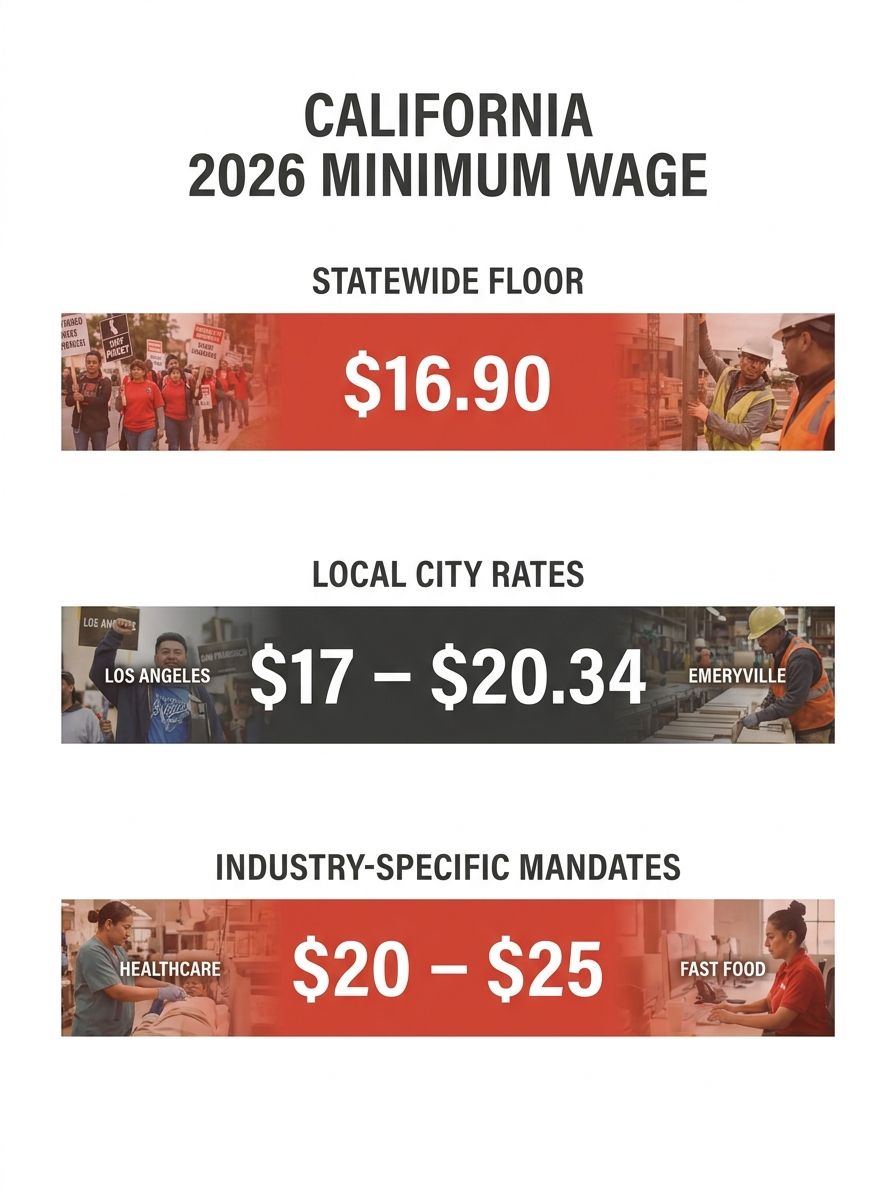
California's minimum wage in 2026 operates as a three-tier system: a CPI-indexed statewide floor of $16.90 per hour, local city and county rates reaching $20.34 in Emeryville, and industry-specific mandates pushing healthcare workers to $25.00 per hour.
Minimum Wage in California 2026: How the Three-Tier System Actually Works
California's minimum wage in 2026 operates as a three-tier system: a CPI-indexed statewide floor of $16.90 per hour, local city and county rates reaching $20.34 in Emeryville, and industry-specific mandates pushing healthcare workers to $25.00 per hour. Knowing only the state number means looking at the wrong rate for millions of workers.
How CPI Indexing Sets the Statewide Floor
The California Department of Industrial Relations pegs the statewide minimum wage to the national Consumer Price Index, automatically adjusting each January without requiring new legislation. On January 1, 2026, this mechanism raised the rate from $16.50 to $16.90 per hour, a 2.49% increase tied directly to CPI movement. The adjustment applies to all employers statewide regardless of size, eliminating the small-business carve-outs that states like Illinois and Texas still maintain.
Before 2024, California's minimum wage increases required either legislative action or ballot initiatives. The shift to automatic CPI indexing was a structural change: it took the annual wage fight out of Sacramento's political calendar and tied it to measured inflation instead. Workers won a predictable annual adjustment. They also lost a political pressure point, because the automatic formula removes the public negotiation that once forced legislators to justify their positions on the floor.
The formula has a ceiling, though. If inflation spikes dramatically in a single year, the adjustment doesn't fully track the increase. And if prices fall, the wage stays flat rather than declining. This asymmetry protects workers from cuts but also means the CPI mechanism can lag behind real cost-of-living surges in expensive metros like Los Angeles and San Francisco. Compared to how Illinois structures its wage floor, California's indexing removes the stepwise legislative schedule, but the tradeoff is less democratic input into the number.
What $16.90 Actually Buys a California Worker
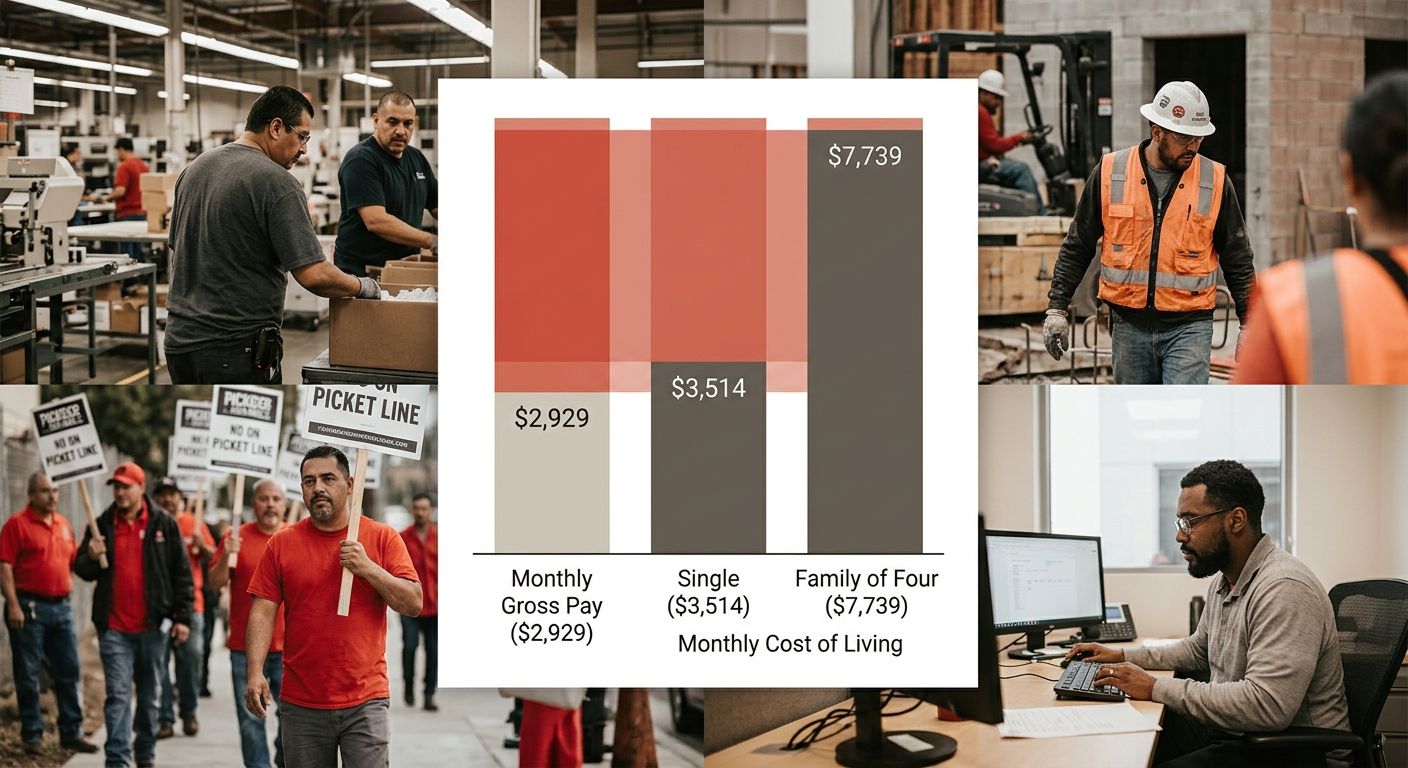
A full-time worker earning the statewide minimum of $16.90 per hour grosses $35,152 per year before taxes, based on a standard 2,080-hour work year. That comes out to roughly $2,929 per month in gross pay. After federal and California state income taxes, the take-home for a single filer lands in the range of $2,200 to $2,400 per month.
According to Salary.com's 2026 cost-of-living data, California's monthly cost of living runs $3,514 for a single person and $7,739 for a family of four. A minimum-wage worker earning the statewide rate faces a gap of roughly $1,100 to $1,300 per month between take-home pay and basic living costs. And the Bureau of Labor Statistics reported that compensation costs in the Los Angeles metro rose 3.3% in the year ending June 2026, while Phoenix, San Jose, San Francisco, and Oakland saw increases between 3.6% and 4.2%. The statewide minimum wage increase of 2.49% fell short of compensation growth in every major California metro area measured.
This is the core tension in the CPI-indexing mechanism. The formula references national inflation data, but California's cost of living significantly exceeds the national average. A 2.49% adjustment calibrated to nationwide price changes doesn't reflect what a Sacramento barista or Fresno warehouse worker actually pays for rent. The worker share of income has been falling nationally for decades. As documented in reporting on the gap between worker income and productivity, wage gains at the bottom consistently trail both inflation in high-cost states and executive compensation growth.
Local Ordinances Running Ahead of the State
The statewide $16.90 rate is a floor, and dozens of California cities and counties have built above it. As CDF Labor Law LLP documented, many local minimum wage ordinances require employers to pay rates well above the state number, with a significant round of increases taking effect on July 1, 2026.
The local rates as of July 1, 2026, sorted by region:
Bay Area:
Emeryville: $20.34/hour
Berkeley: $19.61/hour
San Francisco: $19.61/hour
Southern California:
Pasadena: $18.57/hour
Los Angeles County (unincorporated): $18.47/hour
Los Angeles City: $18.42/hour
San Diego region:
San Diego hospitality hotels: $19.00/hour
San Diego event centers: $21.06/hour
The legal rule is straightforward: employers must pay whichever rate is higher, state or local. But compliance gets complicated for businesses operating across multiple jurisdictions. A cleaning company with contracts in both Emeryville and Fresno pays $20.34 in one city and $16.90 in the other. Remote and hybrid workers add another layer. Employers must track the physical location where work is performed on a given day and apply the corresponding local rate.
For workers who've followed how Maryland handles its statewide rate, the contrast is instructive. Maryland applies a single $15.00/hour rate statewide with no local variation. California's patchwork creates higher peaks but also more confusion, more wage theft opportunities, and more enforcement gaps.
Sector-Specific Mandates for Healthcare, Fast Food, and Hospitality
The third tier of California's wage system consists of industry-specific minimum wages, each created by separate legislation with its own escalation schedule.
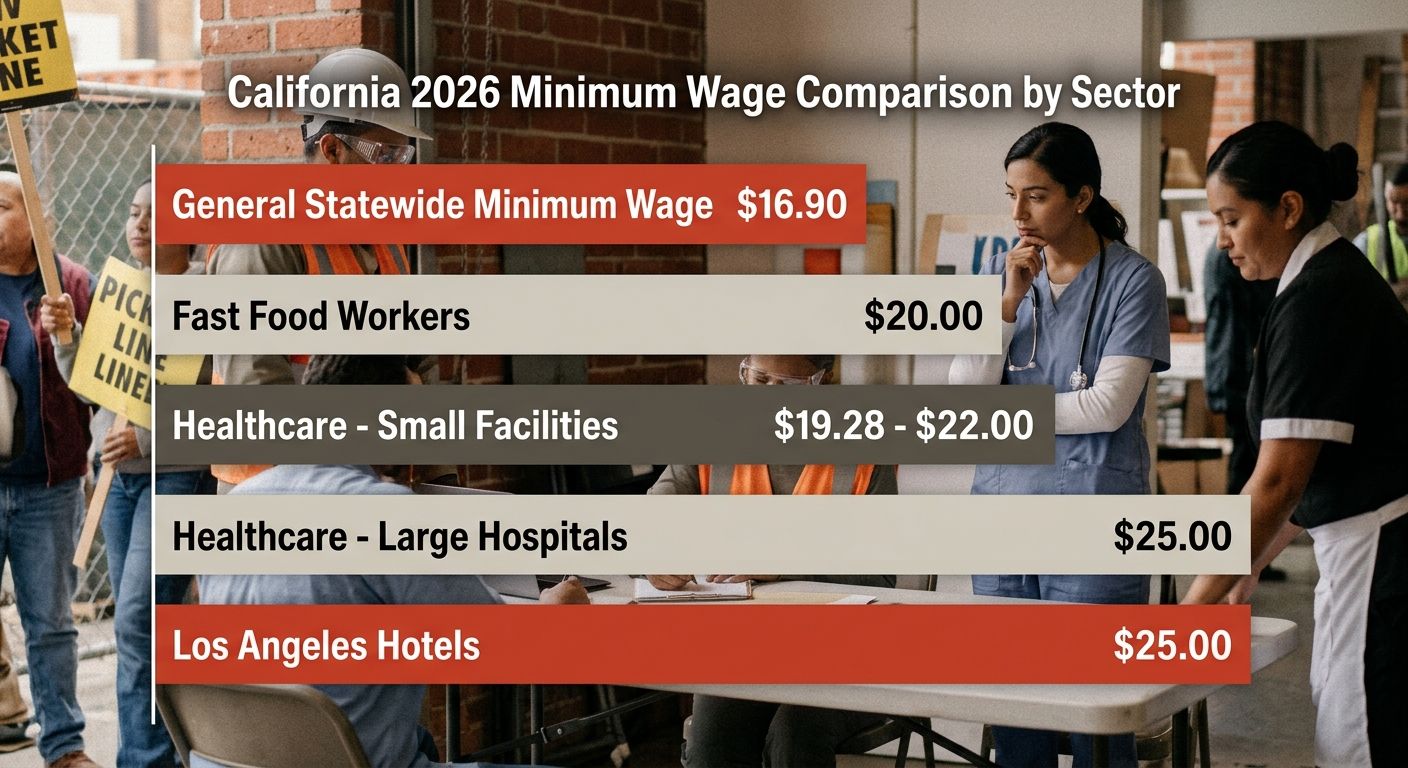
Healthcare, SB 525: Large hospital systems and dialysis clinics moved to $25.00 per hour on July 1, 2026. Smaller facilities and rural clinics operate on tiered schedules, with some reaching $22.00/hour and others at $19.28/hour depending on their classification. SB 525 was one of the most significant healthcare labor wins in recent California history, and union nurses have continued pushing on related working-condition demands throughout 2026.
Fast Food, AB 1228: National fast-food chains with 60 or more locations pay a minimum of $20.00 per hour. This rate has held flat since it took effect, with no CPI indexing attached. The Fast Food Council created by AB 1228 has authority to recommend future increases up to 3.5% annually, but the rate hasn't moved yet.
Hospitality: Los Angeles hotel workers reached $25.00 per hour, the same as large healthcare systems. San Diego introduced new hospitality rules with rates starting at $19.00 for hotels and $21.06 for event centers.
These sector mandates exist because industry-specific organizing pushed them into law. The healthcare minimum didn't materialize from Sacramento generosity. SEIU and the California Nurses Association spent years building the campaign that produced SB 525, framing it as a workforce retention issue during post-pandemic staffing shortages. The fast-food rate came after SEIU's Fight for $15 evolved into a legislative strategy targeting the specific franchise model that keeps fast-food wages low. Every one of these numbers has a union campaign behind it.
Exempt Salary Thresholds and Misclassification Pressure
The minimum wage increase triggers a corresponding rise in the salary threshold for exempt employees. As of January 1, 2026, executive, administrative, and professional workers must earn at least $70,304 per year ($1,352 per week) to qualify as exempt from overtime protections. The minimum hourly rate for the Computer Software Professional exemption rose to $56.97 per hour.
Spencer Fane's 2026 employment law guide advised employers to "review their offer letters, contracts, and job descriptions with a view of implementing minimum wage and salary threshold related changes." California employers were also required to provide a standalone written notice about certain workers' rights to every current employee by February 1, 2026. These notice requirements, established by new 2026 employment laws, broadened leave protections, expanded personnel file and pay reporting requirements, and altered independent contractor classification rules.
SB 642 also clarified California's pay scale disclosure law: a "pay scale" now explicitly means a "good faith estimate of the salary or hourly wage range that the employer reasonably expects to pay for the position upon hire," as Holland & Knight's analysis detailed. The law also updated California's Equal Pay Act to bar employers from paying employees of different demographics unequal wages for substantially similar work. For workers, SB 642 means you can now demand to see the pay scale for any posted position and hold employers to a documented range rather than a vague promise.
Misclassification is where this tier intersects with the others. An employer who classifies a $55,000/year assistant manager as exempt saves thousands in overtime. But under the 2026 threshold, that worker is non-exempt and entitled to overtime at 1.5× for hours beyond 8 in a day or 40 in a week. Workers who suspect misclassification can file a wage claim with the Labor Commissioner's Office. The NLRB's broader enforcement role doesn't directly cover wage claims, but misclassification often overlaps with efforts to deny workers collective bargaining rights by labeling them as independent contractors or exempt professionals.
Where the Three-Tier Model Breaks Down
The CPI-indexed floor, local ordinances, and sector mandates form a system that's more protective than the federal $7.25/hour minimum or the unchanged floors in states like Texas. But the model has real failure points that affect workers every pay period.
Enforcement gaps at the local level. Most local minimum wage ordinances rely on the same state Labor Commissioner's Office for enforcement. Cities pass higher rates but rarely fund dedicated enforcement staff. Workers in jurisdictions with $18+ minimums still get paid $16.90 or less because small employers either don't know the local rate or bank on workers not knowing it either.
The CPI formula lags behind housing costs. California's housing inflation outpaces the national CPI that drives the statewide adjustment. Between 2024 and 2026, rent increases in Los Angeles, San Diego, and the Bay Area exceeded the national CPI by 1 to 3 percentage points annually. The wage floor rises, but the gap between wages and rent grows wider each cycle.
Sector mandates don't cover adjacent workers. A hospital janitor employed directly by a large health system earns the SB 525 rate of $25.00/hour. A janitor employed by a subcontracted cleaning company working in the same hospital hallway earns the statewide $16.90 or whatever local rate applies. The sector mandate follows the employer's classification, not the worksite. Subcontracting is the escape hatch.
Tipped workers and piece-rate employees. California doesn't allow a tip credit against the minimum wage, which is a significant protection. But piece-rate workers in agriculture and garment manufacturing sometimes find their effective hourly rate falls below the floor because employers miscalculate or manipulate piece-rate formulas. The Labor Commissioner has pursued enforcement actions, but the complaint-driven system puts the burden on workers who are often the most vulnerable to retaliation.
The three-tier model works best for workers who know their rights, know which tier applies to them, and have either union representation or access to legal aid when violations occur. For the millions of California workers without those resources, the gap between the law's promise and the paycheck's reality persists, even as the headline numbers keep climbing.
Common Questions
Does the $16.90 rate apply to all California employers regardless of size?
Yes. Unlike some states that set lower rates for small businesses, California's $16.90/hour statewide minimum applies to every employer as of January 1, 2026. There is no small-business exception, no training wage for adults, and no tip credit that allows employers to pay less.
Which rate applies if my city has a higher minimum wage than the state?
Your employer must pay the higher rate. If you work in San Francisco, where the local minimum is $19.61/hour, that's the rate that applies during any hours you work within city limits. The state's $16.90 is the absolute floor, and local ordinances build on top of it.
Does the fast-food minimum of $20.00 per hour apply to all restaurant workers?
No. AB 1228 covers employees of national fast-food chains with 60 or more locations nationally. A worker at an independent burger restaurant isn't covered by the fast-food mandate and instead earns the statewide or local rate, whichever is higher. Bakeries that produce and sell bread as a standalone product are also excluded.
How do I file a complaint if I'm being paid below the applicable minimum?
File a wage claim with the California Labor Commissioner's Office, which investigates minimum wage violations at the state and local level. You can file online, by mail, or in person at any Division of Labor Standards Enforcement office. Retaliation for filing a wage claim is illegal under California Labor Code Section 98.6, and the penalties employers face for retaliation include reinstatement, back pay, and a $10,000 civil penalty per violation.
Will the statewide minimum wage increase again in January 2027?
The CPI-indexing mechanism will trigger another adjustment on January 1, 2027, based on inflation data available in the fall of 2026. The rate can go up or stay flat. It cannot decrease. The exact number depends on the CPI movement during the measurement period, which the Department of Finance calculates and announces in the fall.
The Union Edge Staff
Frequently Asked Questions
- What is California's minimum wage in 2026?
- California's minimum wage in 2026 operates as a three-tier system: a statewide floor of $16.90 per hour (as of January 1, 2026), local rates reaching up to $20.34 in Emeryville, and industry-specific mandates like $25.00 per hour for healthcare workers. The rate that applies depends on where and what industry a worker is employed in.
- How does California's minimum wage increase each year?
- California's statewide minimum wage is automatically adjusted each January based on the national Consumer Price Index (CPI) without requiring new legislation. On January 1, 2026, this mechanism raised the rate from $16.50 to $16.90 per hour, a 2.49% increase tied directly to CPI movement.
- What is the fast food minimum wage in California 2026?
- National fast-food chains with 60 or more locations must pay a minimum of $20.00 per hour under AB 1228. This rate has held flat since it took effect with no CPI indexing, and workers at independent restaurants are not covered by this mandate.
- Which cities in California have local minimum wage ordinances above the state rate?
- As of July 1, 2026, Emeryville leads at $20.34/hour, followed by Berkeley and San Francisco at $19.61/hour, and other cities like Pasadena at $18.57/hour and Los Angeles City at $18.42/hour. Employers must pay whichever rate is higher—state or local.
- What is the healthcare worker minimum wage in California 2026?
- Under SB 525, large hospital systems and dialysis clinics moved to $25.00 per hour on July 1, 2026, while smaller facilities and rural clinics operate on tiered schedules reaching as low as $19.28/hour depending on their classification.
- How much can a full-time minimum wage worker earn in California annually?
- A full-time worker earning the statewide minimum of $16.90 per hour grosses $35,152 per year before taxes, which comes out to roughly $2,929 per month gross. After federal and California state income taxes, take-home pay ranges from $2,200 to $2,400 per month.
- What is the exempt employee salary threshold in California 2026?
- As of January 1, 2026, executive, administrative, and professional workers must earn at least $70,304 per year ($1,352 per week) to qualify as exempt from overtime protections. The Computer Software Professional exemption requires a minimum hourly rate of $56.97 per hour.
- How do I file a complaint if I'm being paid below minimum wage in California?
- File a wage claim with the California Labor Commissioner's Office, which can be done online, by mail, or in person at any Division of Labor Standards Enforcement office. Retaliation for filing a wage claim is illegal, and employers face penalties including reinstatement, back pay, and a $10,000 civil penalty per violation.
Related Articles

California Minimum Wage 2025: What's Changed
Three separate legal floors governed what California employers owed their workers during 2025: a $16.50 statewide baseline, a $20.00 fast-food sector rate, and a healthcare scale climbing as high as $23.00 per hour at large hospital systems.

Minimum Wage California: 2024 Updates & Rates
AB 1228, SB 525, Labor Code Section 1182.12, and at least 38 local ordinances all set binding minimum wages in California, and the highest rate that applies to a given worker is the one the employer must pay.

Minimum Wage in California: 2024 Rules & Requirements
California's minimum wage is a formula-driven system that recalculates every January 1 based on changes in the Consumer Price Index, capped at 3.5% annually. The statewide floor rose from $16.00 per hour in 2024 to $16.
Also in the paper